If you ask anyone to name the artist renowned for painting ballerinas, the response will undoubtedly be Edgar Degas (1834-1917). His paintings of romantic ballerinas are legendary. Degas sought a synthesis between Impressionism and Realism. His ballerinas were often ethereal, but his paintings also rendered a realistic depiction of the hard-working ballet dancers at the Paris Opera. At approximately the same time that Degas painted his iconic ballerinas, the Dutch artists George Hendrik Breitner (1857-1923) and Willem de Zwart (1862-1931) ventured into the world of ballet. De Zwart explored various themes, such as landscapes, urban scenes, and portraits. Ballet rarely appeared in his artwork. He did, however, paint an impression of Anna Pavlova in her dressing room in 1926. Breitner sometimes depicted the ballerina, although social dance appeared more frequently in his works.

Ballerina Taking a Rest – oil on canvas – 30cm x 41 cm – c. 1884-87 – Artnet
Breitner, a painter and photographer, was an ardent realist. In his photography and paintings he captured ordinary people going about their routine activities. It is possible that Breitner took a snapshot of the above ballerina while she was resting backstage, although no such photograph exists. The listless ballerina gazes directly at the observer. Perhaps she looked up when the photographer Breitner caught her attention. She is definitely not a delightful, romantic ballerina. The dancer is fatigued and has taken a seat on a stool, resting her arm on what seems to be the back of a stage set. Her blank expression and her tired disposition, along with the gloomy, uninviting background, contrast sharply with Degas’s captivating images.
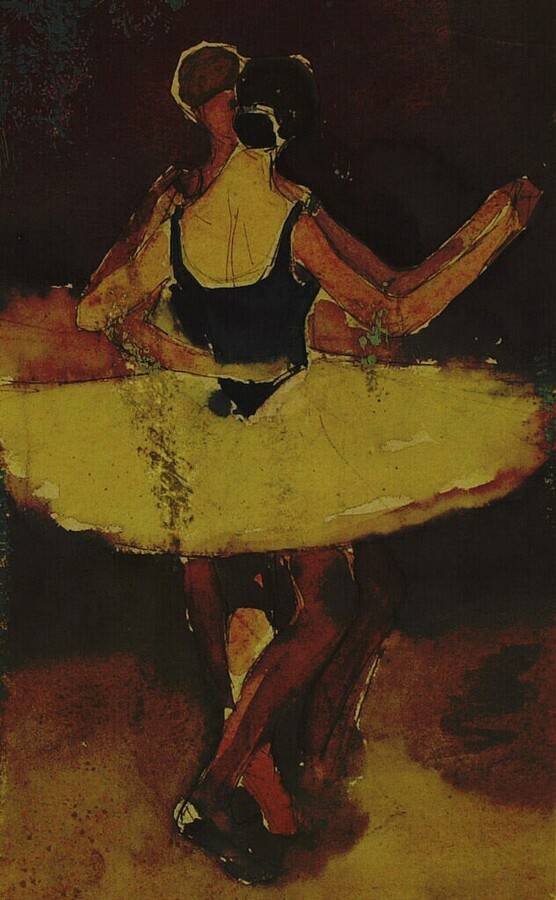
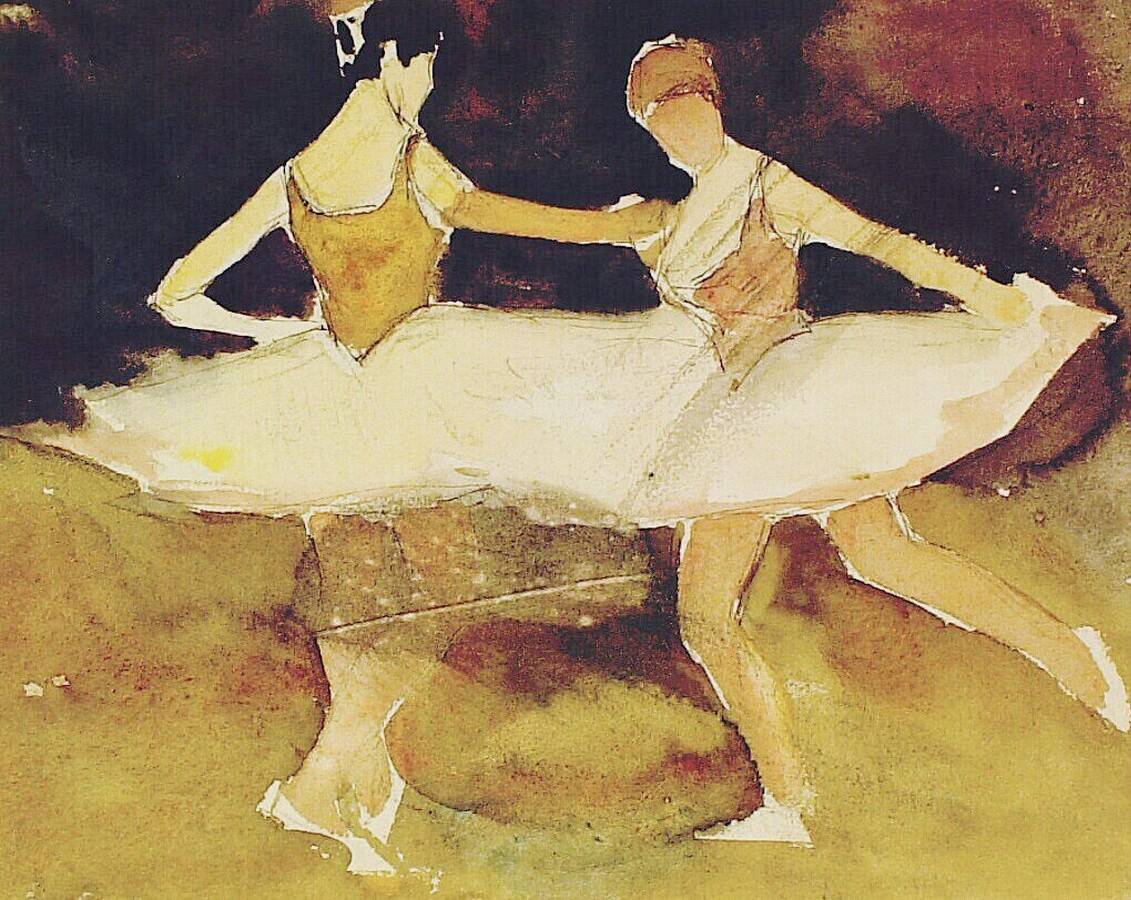
Willem de Zwart – Kröller-Müller Museum, Otterlo Left – Two Dancers – chalk & paint (oil and watercolours) on paper – 24.3 cm x 15 cm – 1885 & Right – Two Dancers – Chalk and watercolours on paper – 19.2cm x 24 cm – circa 1885
1885 is not the year one would expect ballerinas to be depicted as Willem de Zwart has in the two artworks presented above. Degas’ delightful ballerinas and Jean-Louis Forain’s captivating dancers, highly praised during their era, starkly contrast with these anonymous dancers moving in an indistinct environment. They, like typical ballet dancers, wear short tutus, wear fitted bodices, and display bare legs, yet have entirely abandoned any hint of romanticism. In truth, the dancers are tightly confined within the paper structure, depriving them of buoyancy. Together with the pronounced choice of colour, the boldly painted backdrop, and the distinct pencil outlines, Zwart’s portrayal of ballet dancers can be regarded as highly unorthodox.
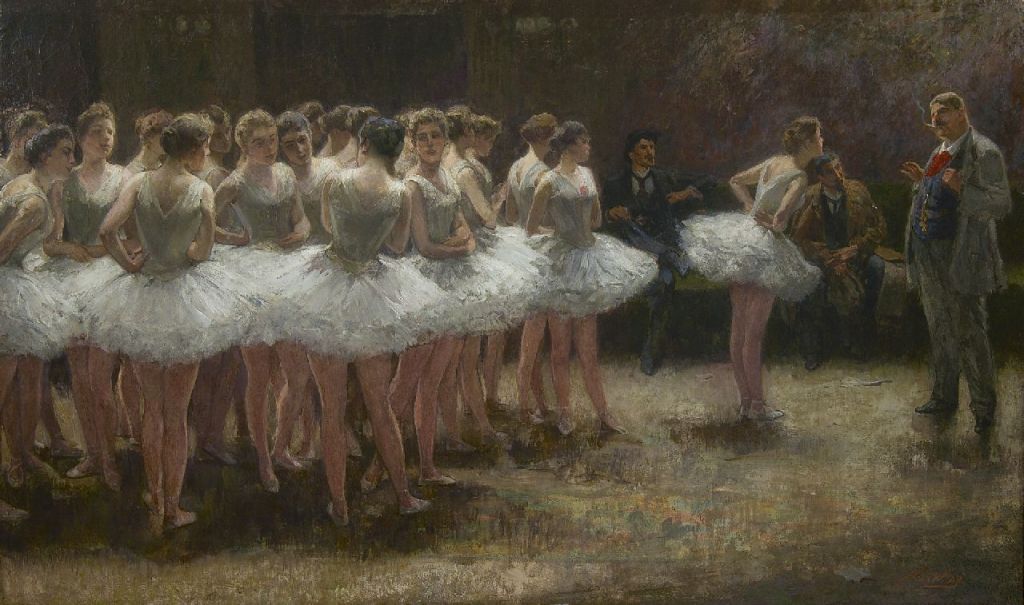
Strike of the Ballerinas – oil on canvas – 60cm x 100 cm – date unknown – Christie’s
Following in the footsteps of Degas, Nicolaas van der Waay (1855-1936) in his artwork Strike of the Ballerinas, fuses an impressionistic approach with realism. Every ballerina evokes the lovely dancers in Degas’ paintings. The sight of the portly smoking man prompts the Degas enthusiast to think of the gentleman lingering in the Foyer de la Danse. Van de Waay’s fluid brush strokes and delicate hues do not obscure the core of the narrative; the ballerinas are in protest. The dancer’s body language evidently reveals their discontent and their uneasiness. This is even truer for the boldest ballerina. Her stance is assertive — leaning forward, hands on her hips, upturned wrists, and head thrust forward — as she confronts the theatre’s director or manager. His body language — an arrogant attitude and a domineering style — is completely persuasive. The identity of this manager, the timing of the protest, and the date when Strike of the Ballerinas was created remain unclear. Nonetheless, irrespective of the setting, moment, or circumstances, the impressionist and realistic painter Nicolaas van der Waay effectively emphasises the working conditions and social challenges faced by the dancers.
Ben Viegers (1886-1947) created a vast array of village scenes, picturesque harbours, boundless tulip fields, charming rural landscapes, and, to my knowledge, just one depiction of a ballerina. The watercolour pastel, Seated Ballerina, depicts a ballerina gazing off into the distance. The composed gaze, the finger gently resting on her chin, the sense of contemplation and the diaphanous tutu all contribute to a personal atmosphere. Moreover, the sky-blue background projects the ballerina to the foreground of the artwork. A certain degree of intimacy has developed between the ballerina and her audience.
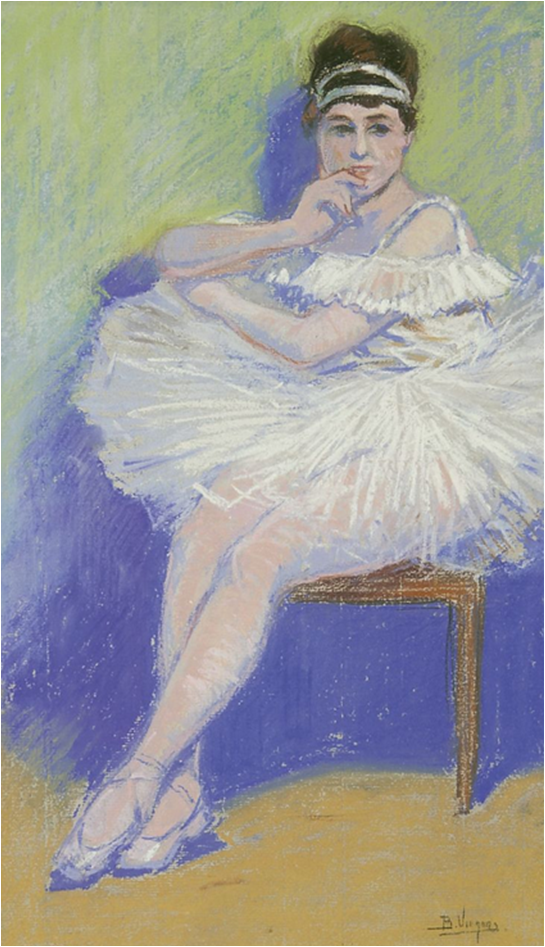
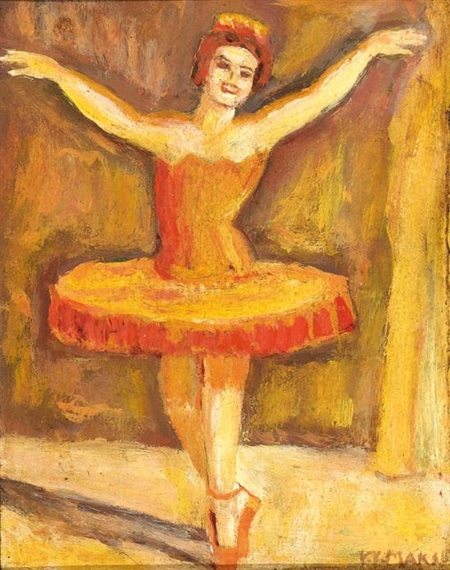
Left: Ben Viegers – Seated Ballerina – pastel on paper – 50 cm x 30.5 cm – Kunsthandel Simonis en Buunk & Right: Kees Maks – Ballerina – oil on cardboard – 14.5 cm x 11 .5 cm – ArtNet
It is hard to envision a more striking contrast to Viegers’ serene ballerina than the exuberant dancer depicted by Kees Maks (1876-1967). She possesses a vivacious personality, greeting her audience with a broad smile. The background and the outgoing dancer share identical warm hues. Maks, known for his bold application of vibrant colours, blends various shades of red, yellow, orange, and brown. Another significant style characteristic, particularly apparent in the floor space and the stage curtain, is his coarse, textured brushwork. Maks loved entertainment. He painted nightlife, circuses, dance halls, revues, cafés, and dance performers.
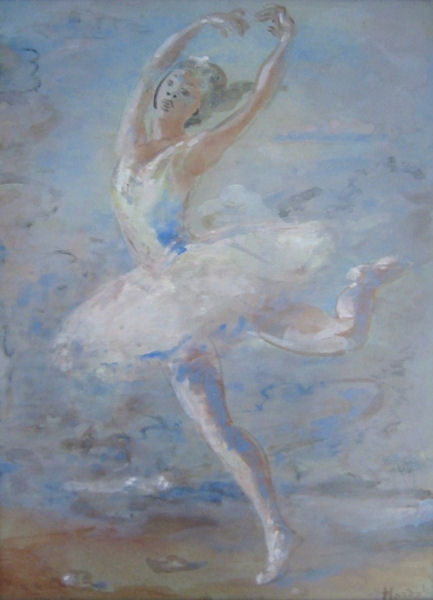
Right: Gerard Hordijk – Ballerina – Galerie Dick van Straten – The Hague
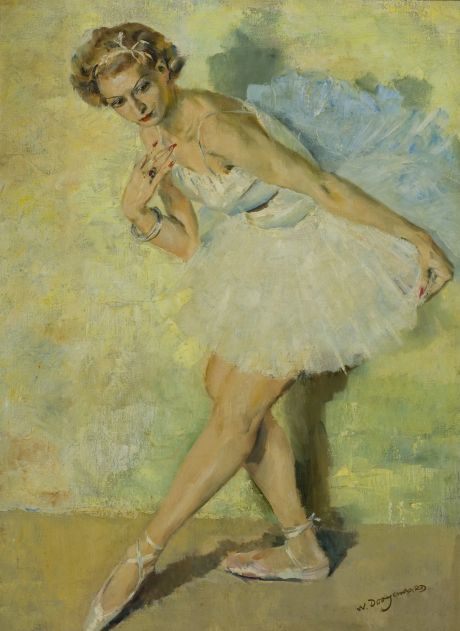
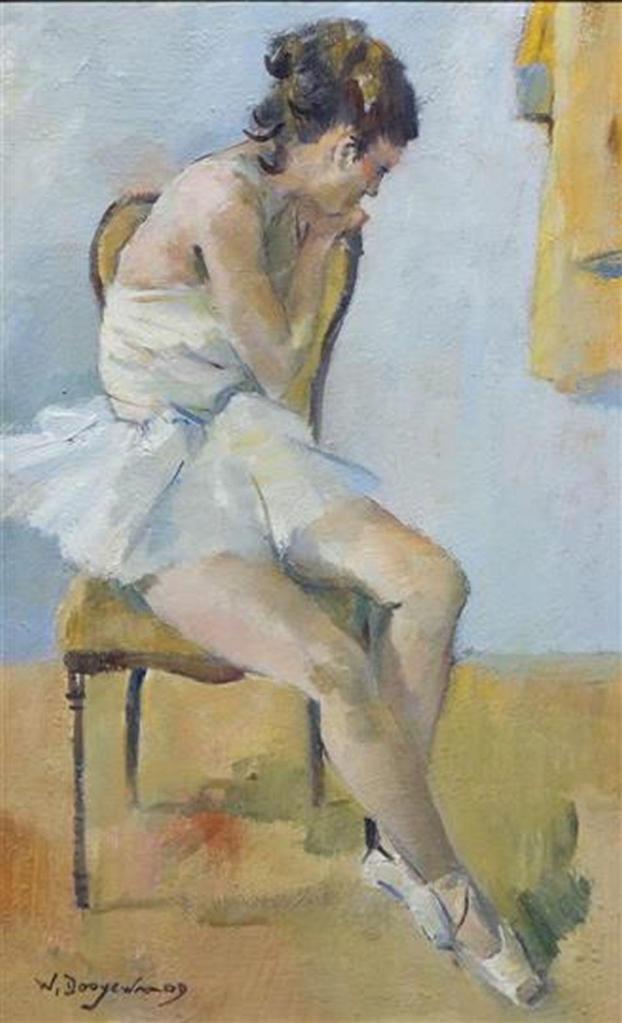
The artists Gerard Hordijk (1889-1958) and Willem Dooijewaard (1892-1980) were avid ballet and dance enthusiasts. Dooijewaard was a passionate traveller, seizing every opportunity to paint dancers and regional cultures throughout his journeys in Asia and beyond. He was fascinated by dance, documenting Balinese dancers, Japanese dancers, and Can-Can dancers, along with an extensive collection of ballet dancers. Hordijk, a contemporary of Willem Dooijewaard, travelled to Paris in 1927. He admired the work of the celebrated French artists Henri Matisse and Raoul Dufy. Hordijk painted and sketched performers, created posters and designed stage costumes. He enjoyed sketching and painting scenes of beach life, amusement parks, theatres, and circuses, and he was captivated by dancers. The majority of his dance images showcase professional dancers performing on stage.
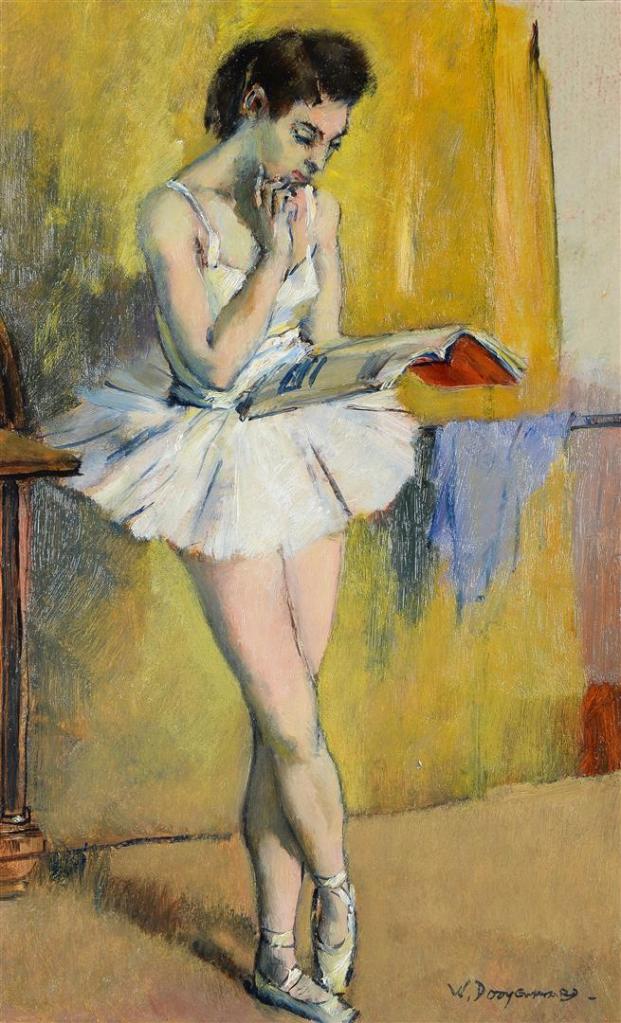
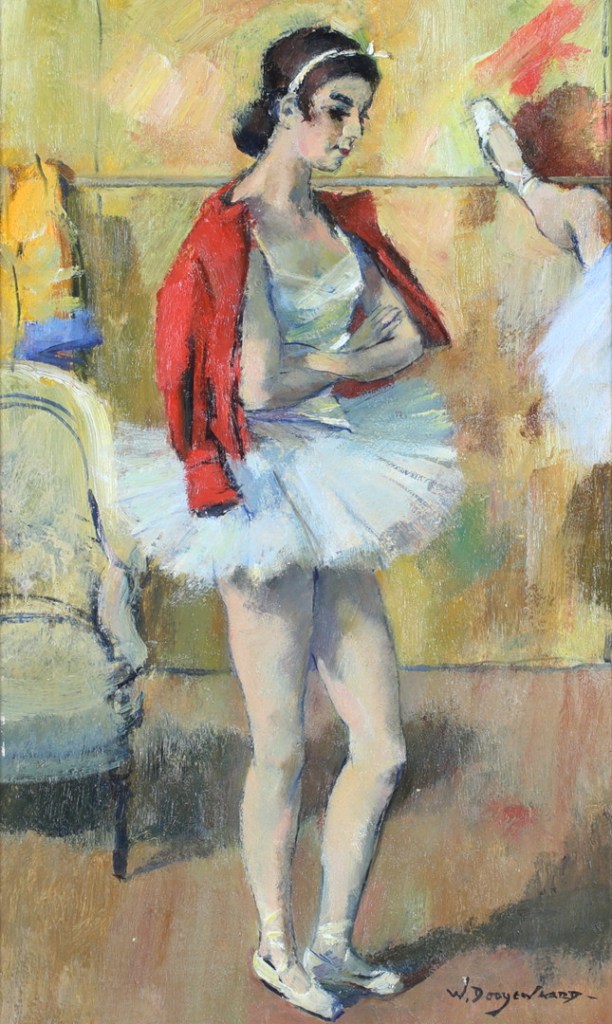
Left : Ballerina – 40 cm x 25 cm – Zeeuws Veilinghuis, Middelburg
Centre: Ballerina – oil on board – Auctionnet
Right: Seated Ballerina – oil on masonite – 40 cm x 24.8 – Artnet
Dooijewaard travelled to Nice in the late 1930s. He promptly became a regular guest at the Ecole de Ballet and at the Theatre of Nice, sketching ballerinas during their daily training and rehearsals. He depicted ballerinas leaning against the barre, reading a book, adjusting their attire, lacing their pointe shoes and sitting on a stool. The dancers, frequently portrayed as full-length portraits, are serene, either standing or sitting motionlessly, absorbed in thought. The figures, with some exceptions, are reserved and not actually dancing. It is effective how the artist juxtaposes the ballerina, always dressed in a white tutu, against a varicoloured backdrop. The ballerina, spanning over the full height of the canvas, is physically and emotionally drawn to the foreground. Dooijewaard, thus, evokes both a sense of distance and intimacy.
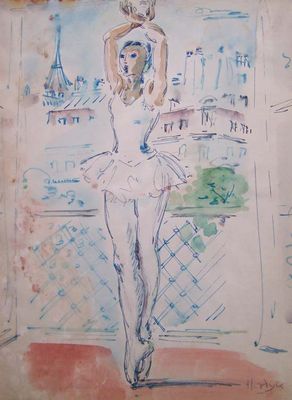
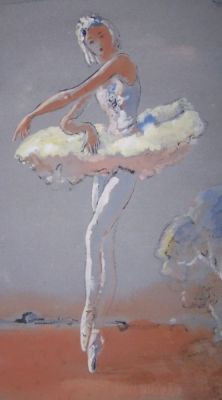
Left: Ballerina in Paris – 1930 – source unknown
Centre: Ballerina – watercolour – circa 1930 – Etsy
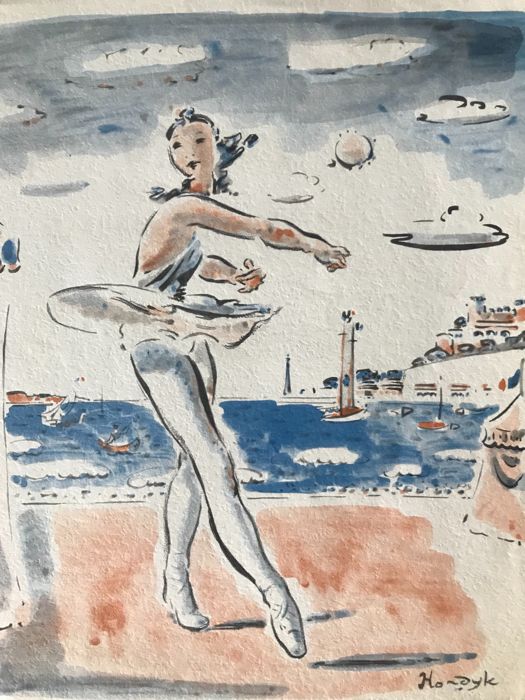
Right: Ballerina in the Park – watercolour – circa 1942 – 43 cm x 29 cm – private collection
Gerard Hordijk valued the joyful, the carefree, and the festive aspects of life. His favourite themes included women, the circus, horse racing, and ballet. Ballet remained a constant source of inspiration throughout his entire career. He was personally acquainted with dancers, including the foremost dancer and choreographer Leonid Massine. Hordijk was a gifted graphic artist, illustrator, designer, and painter. He thrived working with vivid, flowing watercolours. The graceful ballerinas, though often little more than a handful of delicate pencil lines, are evocative. His swift, seemingly effortless pencil strokes suggest a wealth of movement. Whether making an impromptu sketch of a dancer practising a ballet exercise or illustrating a dancer performing on stage, Hordijk’s dancers consistently glide, soar, swirl and sparkle with vitality.
Hordijk’s colourful, vivacious artworks were highly sought after. In fact, during his Parisian years, he achieved greater commercial success than his neighbour, the austere Piet Mondrian. Upon returning to The Netherlands, the talented Hordijk continued his work as an artist, stage designer and editor/illustrator of a prominent Dutch art magazine. In 1939, he received two commissions from the city of Amsterdam: a mural for Het Concertgebouw, and another for Stadsschouwburg/International Theater Amsterdam. Hordijk adopted a theme from ancient Greek mythology for the Concert Hall. The Stadsschouwburg was adorned with paintings of Harlequin and Columbine, characters from the Commedia dell’arte. The mural is divided into two sections and has a height of four metres with a width of three metres. One part displays Harlequin, while the other features Columbine posing elegantly in a graceful arabesque. Behind her stands a statue of Venus and a group of musical Punchinellos.
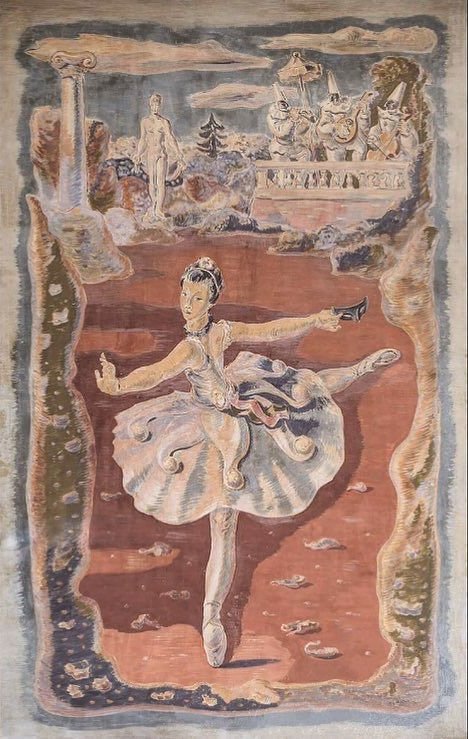
I have visited the Stadsschouwburg countless times. The murals featuring Harlequin and Columbine have always captivated me. It is through writing this post that I have realized these stunning works, which I have always admired, are created by Gerard Hordijk. This discovery certainly adds an additional benefit to writing posts.
* To learn more about Gerard Hordijk, I suggest the impressive monograph Gerard Hordijk (1899-1958) een kleurrijk schilder by art expert Marcel Gieling. ISBN 978 90 76940 52 6 published. 2009 Uitgeverij Optima, Vianen
It looks like a boy’s book, says Marcel Gieling. In 2006, the Utrecht art dealer found the almost complete legacy of painter Gerard Hordijk (1899 – 1958) in an attic in an American village. It was hidden behind a shot in a vacant and dilapidated villa. Hundreds of works of art and an extensive correspondence with Piet Mondriaan (1872 – 1944). Hordijk was once a much sought-after visual artist and one of Mondrian’s best friends in both the Netherlands and New York. – Source Gerard Hordijk website


 DANCE IMAGES IN THE ART OF THE NETHERLANDS
