In Dancers, a painting I discussed in detail in my previous post, artist Theo van Doesburg, utilising his ‘step-by-step towards abstraction-method’ (1), transformed a figurative image into an abstract composition. In three other dance images, Van Doesburg, the driving force behind the art movement De Stijl, once again began with a figurative sketch and progressively reduced the dancing figures into geometrical shapes. While Dancers is well on the path to abstraction, the initial dance image is still discernible. However, in the later paintings – Composition XII (Tarantella), Rhythm of a Russian Dance, and Composition in Gray (Rag-time) – only the rhythmical, dynamic, or spatial qualities of the finished work recall the earlier dancing figures.
The whereabouts of the earliest painting, Tarantella, is unknown. Fortunately, the original drawing and two preliminary sketches have managed to survive over time. Van Doesburg must have considered the painting, presently merely known from black-and-white photographs, as a significant work. The vintage photograph below shows how prominently Tarantella, as Rhythm of a Russian Dance, featured in the Weimar exhibition, Retrospektiv Theo van Doesburg (1923-24). It is worth noting that Tarantella is only slightly smaller than the celebrated work, Rhythm of a Russian Dance.

Van Doesburg’s Tarantella has, to my mind, an incongruous origin. The popular Southern Italian folk dance, the tarantella, is swift and vivacious. Couples tease and flirt with each other as they jump, leap, twist, and turn at an astonishing tempo. The woman frequently accompanies herself on the tambourine. The bare-breasted, scantily clad dancer in Van Doesburg’s preliminary sketch certainly displays a flirtatious demeanour but lacks the exhilarating characteristics typically associated with the traditional Italian dance. Van Doesburg’s dancer is not a passionate mover; she does, however, step forward, and the swing of her skirt reveals some sense of movement. Notwithstanding, this unsophisticated, lacklustre sketch underwent a step-by-step stylisation to be reclaimed in an abstract form of abounding locomotion.
In the first of the two preliminary drawings, the figure is confined within a rectangular boundary. The figure, now elongated, is organised into curves and straight lines. The contours of the dancer are still vaguely distinguishable, with vertical and horizontal lines of varying thickness outlining the physical form. It is unclear at which stage of the creative process the second study was produced, as Van Doesburg was known to create numerous studies. This particular study is drawn on graph paper. Van Doesburg has personally numbered ten separate and identically shaped levels and designated dissimilar planes by means of an alphabetical character. The profile of the dancer is still discernible. This study, though not dissimilar to the earlier study, has undergone further stylisation. The planes are now precisely delineated, and each of the clearly defined geometrical planes is shaded or blank. All planes, except for the central s-curve, are rectangular.


- Dancer (study for Tarantella) – ink on transparent paper – 14 x 9 cm – probably 1918, Centraal Museum, Utrecht
- Study for Tarantella – pencil and ink on lined paper – 10.5 x 4 cm – probably 1918, Centraal Museum, Utrecht
- Study for Tarantella -pencil and Indian ink on graph paper – 11 x 5 cm – probably 1918, Centraal Museum, Utrecht
- Tarantella – oil paint on canvas – 1918 – measurements unknown, whereabouts unknown
The end result is Tarantella, a totally abstract painting consisting solely of vertical and horizontal lines. These lines are all the same width, differ in length, and are placed in a meticulously designed sequence. The curves that were present in the studies have completely vanished. The majority of the lines form open rectangular shapes, with right angles being used consistently. Additionally, all the lines, regardless of their length, end in open space. This allows the viewer to imagine a longer trajectory. It is intriguing to compare the latter study with the final painting; the once shaded planes and the subtle curves have been transformed into open rectangular planes.
Visually, the painting can be approached in a number of ways. The first is to view it directly from the front. The spectator is confronted with a detached vertical line that runs from top to bottom. A variety of horizontal lines intersperse, criss-cross, and overlap the unattached central axis. The swift changes in direction, the upward and downward movements, and the varying lengths of the distinctive lines clearly refer to the scintillating musical rhythm and rapid movements associated with the spirited tarantella. Another approach is to focus on the three horizontal lines moving to the right. This creates a sense of forward momentum, mimicking the dynamic pulse and lively cadence of the southern Italian dance.
I previously mentioned that Van Doesburg was known to prepare many preliminary studies. As many as thirteen sketches of Rhythm of a Russian Dance were exhibited in The Hague/Eindhoven in 1968. Six of these have unfortunately been lost. The remaining seven studies, presented in the following sideshow, have been preserved in the MoMa, New York, offering a unique chance to learn more about Van Doesburg’s creative process.
The first and second sketches are unmistakably those of a dancer. Dressed in what appear to be folk costumes, these figures balance on one leg and lean strongly to one side. The first, the most realistic, has retained a few rough curved lines for the torso and hips. The second figure, who balances in a strong diagonal pose, is exclusively formed by rectangular planes. The remainder of the figures are totally perpendicular and, despite being highly stylised, remain marginally recognizable. Each subsequent figure is composed of multiple rectangular planes. The final sketch is drawn on graph paper. There, the figurative element has practically vanished, but a dancer can still be discerned within the straight lines, right angles, and rectangles.
The loose-fitting costume and dynamic movements of the figure suggest a Cossack dancer or some other energetic Russian folk dance. And to resolve any doubt, Van Doesburg wrote Dans Russes (a combination of Dutch and French), at the bottom of the sketch adding the date 1907. However, art historians suggest that this date, as noted by the artist, may be incorrect.


- Study for Rhythm of a Russian Dance – pencil and ink on paper – presumably 1917-18 – MoMa, New York
- (1) 8.5 x 6.5 cm, (2) 7,5 x 5.5 cm, (3) 8.5 x 4.5 cm, (4) 8 x 6.5 cm, (5) 13.5 x 10.5 cm, (6) 20 x 13 cm, (7) pencil, coloured pencil and ink on graph paper, 16 x 10.5 cm
Where had Van Doesburg seen the Russian (folk) dancers that inspired this pioneering work? Russian and Ukrainian dancers visited Paris a number of times around the turn of the century. It is conceivable that Van Doesburg, like Degas, saw the Russian folk dancers there. It has also been suggested that Van Doesburg was inspired by Le Sacre du Printemps (2), a revolutionary ballet based on Russian folklore, presented, in Paris, by Les Ballets Russes (1913). If that were the case, Van Doesburg could not have produced his first sketch in 1907. Alternatively, Van Doesburg (3) was immensely interested in the events surrounding and impact of the Russian Revolution (1917). Around that time, he informed his friend Antony Kok that he was working on the painting Dans Russe. Notwithstanding that the question of inspiration may remain undecided, Rhythm of a Russian Dance, one of Van Doesburg’s largest works, is without doubt a harmonious configuration of precisely organized vertical and horizontal strips embracing the spirit, dynamics, and pulse of indigenous Russian dance.
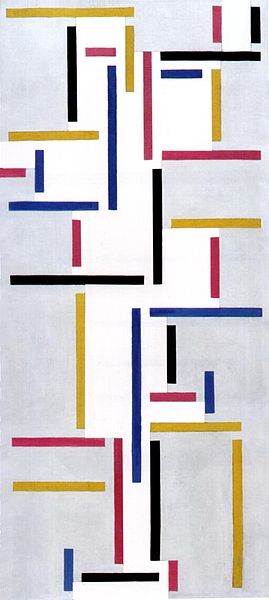
Approaching Rhythm of a Russian Dance without any prior knowledge of its origins, the viewer may not immediately recognize the dance or the dancer. The title, if anything, makes the painting even more puzzling. The work has also been named Composition XVI, but most often the title — Dans Russe, Danse Russes, Rythme plastique d’une danse — has a specific relation to dance. What relationship, the viewer may ask, has an ordered structure of colourful lines bordering a white frame within a light grey extended margin with the rhythm of a Russian dance? But perusing through the seven remaining sketches, illustrated above, Van Doesburg’s ‘step-by-step towards abstraction method‘ is uncovered, leaving a finished painting where an ethereal dancer is forever present.
Rhythm of a Russian Dance is the result of extensive exploration, moving from figurative to abstraction. It goes beyond a mere framework of rhythmically structured coloured lines. Van Doesburg, in typical De Stijl ideology, utilizes primary colours and the non-colour black. Many of these lines border on the light gray margin that extends to the outer edges of the canvas. With the exception of two yellow lines, all the lines either juxtapose or (partially) overlap a vertical, irregular, white geometric shape. This visible, yet elusive, white shape evokes the contours of a Russian dancer, moving to restless, rapid, and highly energetic rhythms.
Rag-time, a syncopated music style popular in the early decades of the 20th century, serves as the subtitle of the last painting that Van Doesburg based on a drawing of dancing figures. Unfortunately, only the artist’s original preparatory drawing of a dancing couple still exists. The music style Ragtime evokes images of vivacious couples dancing to entertaining melodies. Dancers swivel and turn, kick their legs upwards, mimic animal movements, and enthusiastically venture across the dance floor. Van Doesburg’s original line drawing captures a fervently dancing couple, with the man taking long strides as his partner effortlessly kicks her leg to the back. Although the preliminary drawings are no longer available, it is safe to assume that Van Doesburg stylised successive studies until he reached a monochromatic abstract painting that mimics the off-beat and syncopated rhythm of the exuberant ragtime.

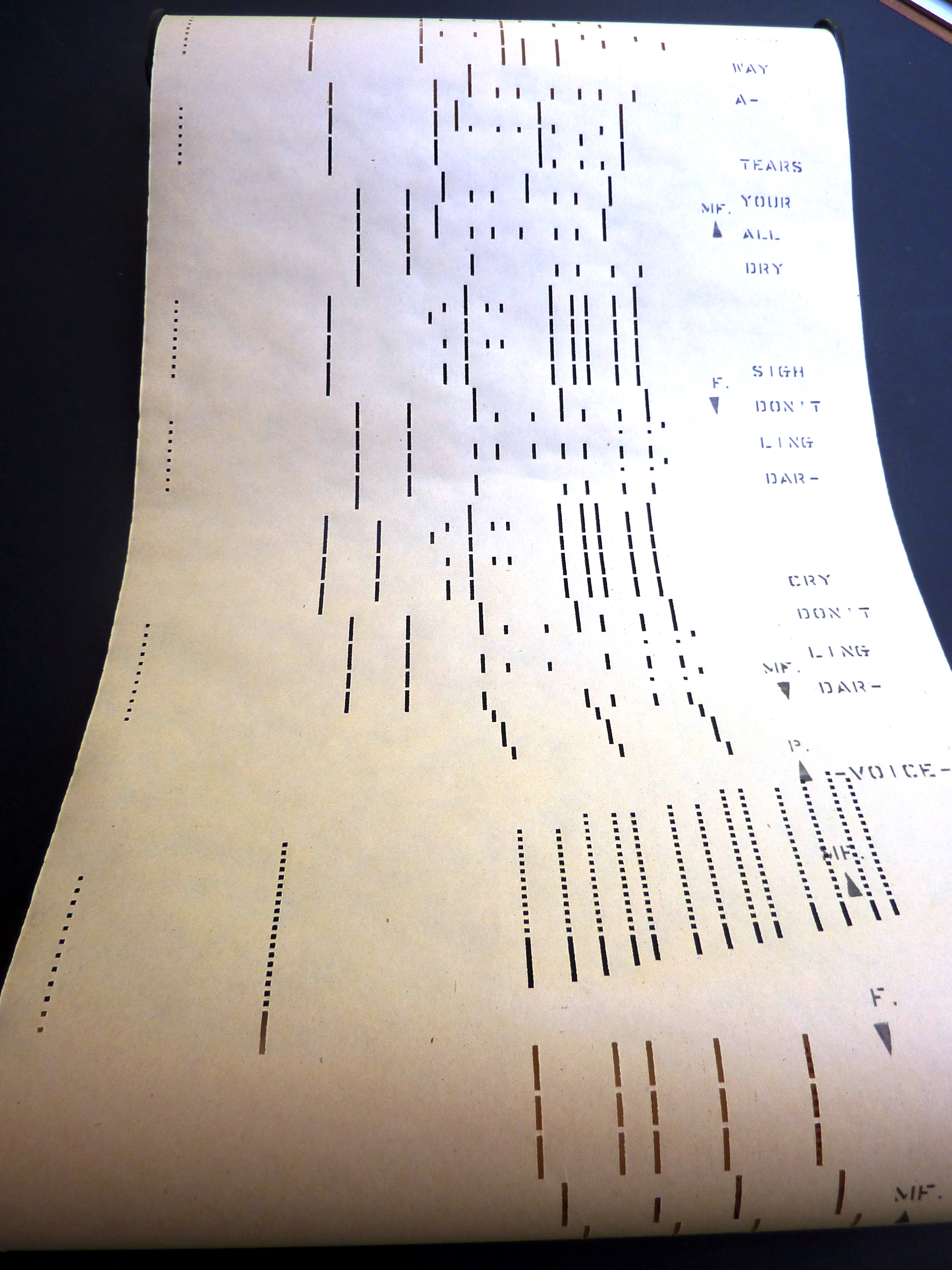
I find Composition in Gray (Rag-time) to be a bold network of diverse and irregular rectangles, methodically arranged by Van Doesburg, but unpredictable from the viewer’s perspective. The dominant colour gray varies from light to dark. Some rectangles are brushed with opaque circular shapes that contrast against a deep gray background. Towards the outer corners, a number of lines and shapes recede as if covered by a foggy gray substance. I particularly appreciate Van Doesburg’s allusion to ‘ragged’ time, as seen in the centre vertical block on the right-hand side that appears to be ‘torn’ from the surface. From a musical point of view, the meticulously constructed shapes could suggest musical notes like breves, minims, crochets, and quavers. Their varied structure, with some longer, shorter, lighter, and darker, could even be transposed into music or dance. I would like to extend this idea a little further, but I must inform you that there is absolutely no documentation to substantiate my impression. I am fascinated by the structural similarity between the piano roll, used in a pianola, and Rag-time; both designs present an analytical array of rhythmically disparate lines and zones. It is intriguing to consider if this idea ever entered Van Doesburg’s mind.
Having the opportunity to compare the original drawing and the painting, which incidentally are approximately the same size, a certain relationship becomes perceptible. Upon closer inspection, one can discover the dancing couple supporting each other at shoulder height. The woman’s lifted foot is also distinguishable, reduced to two parallel vertical lines. Likewise, the man, who dances so attentively in the original drawing, is streamlined into rectangular planes that slope down the canvas. Without the original drawing, it would be unlikely for the viewer to discover these parallels.


Composition in Gray (Rag-time) – Theo van Doesburg – oil on canvas – 96.5 x 59.1 cm- 1919 – Peggy Guggenheim Collection, Venice
Theo van Doesburg applies his “step-by-step towards abstraction-method” to uncover the absolute essence of art. However, painting was not his only interest. Rather, he envisioned art as a universal concept that could harmonize and embrace society. His ideas extended far beyond the traditional medium of canvas painting, as he also explored photography, architecture, performance art, and the written word. As he stated, “Art is not about ‘being’ but ‘becoming’.”
1 – For the term ‘step-by-step towards abstraction-method’ I wish to thank the Centraal Museum, Utrecht and Kröller Müller Museum, Otterloo. The term is used and explained in their information leaflet prepared for their joint exhibition on Theo van Doesburg. (2000)
2 – For further reading on Rhythm of a Russian Dance and Le Sacre du Printemps – Modernism on Stage; The Ballets Russes and the Parisian Avant Garde – Juliet Bellow – pages 6 – 7 ISBN 978-1-4094-0911-3 – published 2013
3 – For more information see Utopian Reality: Reconstructing Culture in Revolutionary Russia and Beyond – Chapter 4 – Theo van Doesburg and Russia : Utopia Thwarted by Nicolas Bueno de Mesquita – pages 59-66 – ISBN 9789004263222, 9004263225 – published 2013


 DANCE IMAGES IN THE ART OF THE NETHERLANDS