Writing posts is an exhilarating pastime, especially when one stumbles upon an artist hitherto unknown to the writer. Whilst researching material on Dutch artists inspired by Spanish folk dance, I discovered an intriguing etching of flamenco dancers by Dick Stolwijk. The image, entitled Cuado Flamenco, highlights a female flamenco dancer. In this predominantly dark image, she stands out as if under a spotlight. The poorly lit background displays another two dancers, both clapping actively, accompanying the dynamic rhythm of the solo woman’s dance. A guitarist sits in the unlit area behind her not far from a fourth person; his face and clapping hands are marginally visible. What I found most intriguing, was not the dancer’s intricate footwork, nor her ruffling skirt, but her downcast eyes and her relative calmness. I have come to expect passion and magnetism in flamenco dancing, but Stolwijk’s image conveys neither. Rather the dancer is placid, her expression seems indifferent; the two seated dancers, whose facial features echo the leading dancer, appear far more spirited.
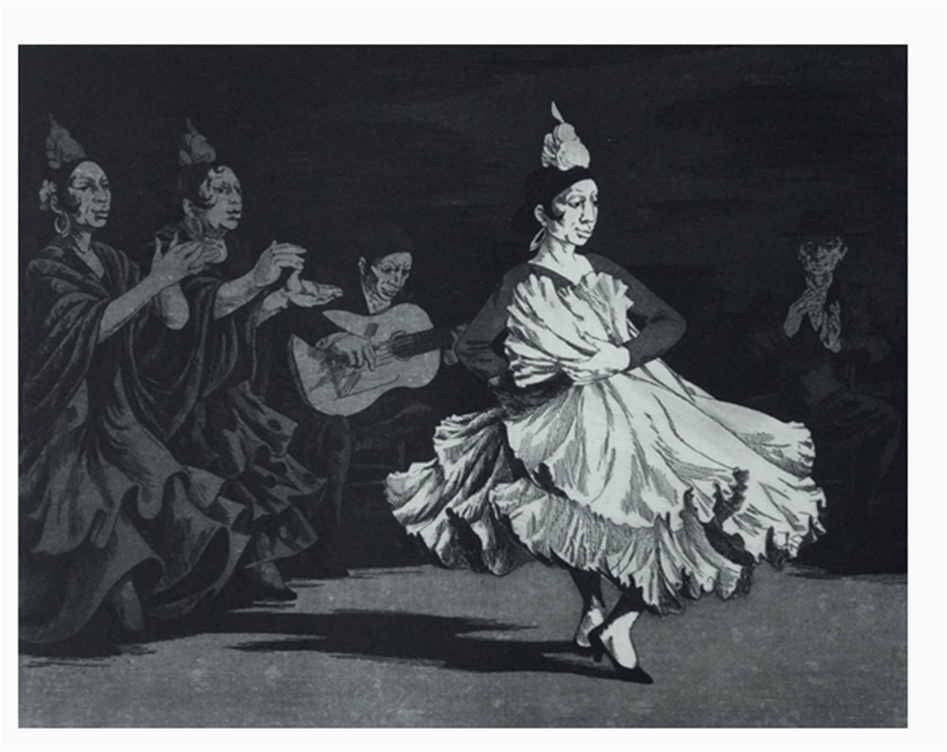
Dick Stolwijk, I have now learned, was a versatile artist known for his photography, book illustrations, paintings, drawings, and etchings. Portraits, insects, animals, mythology, landscapes, and dance were among his diverse interests. He was born in Indonesia, worked in the Netherlands and travelled whenever he could to faraway places, visiting Spain, South America, The Caribbean, and revisiting Indonesia. In The Netherlands, apart from his many etchings of wasps, insects, birds, and haring, Stolwijk frequently visited the theatre drawing actors, singers, and dancers. Stolwijk’s fascination for dance was awakened early in life. As a youth, living in Indonesia, he regularly saw dancers and musicians performing in the streets. Enchanted by their performance, the young Stolwijk followed them down the streets, and, as he grew a little older, started to sketch them.
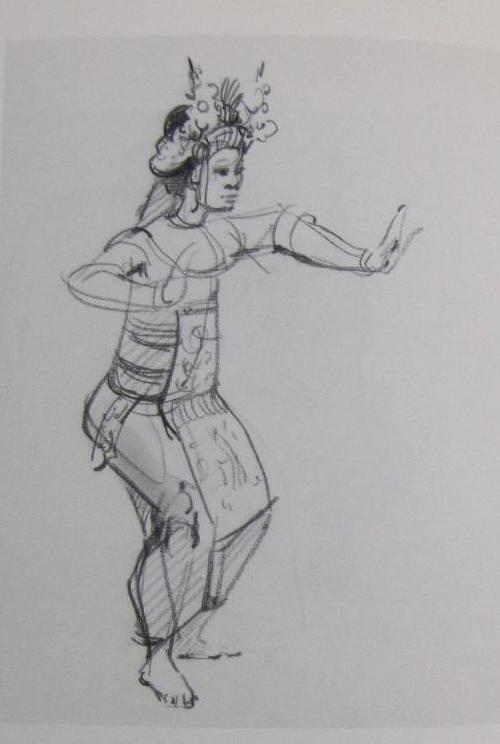
Stolwijk, a fervent dance lover, was practically a ‘resident’ in the Theatre Carré, one of the most popular theatres in Amsterdam. For many years Carré, as the theatre is fondly named, was home to the dance. There, Stolwijk sketched ballet dancers, the Chinese opera, flamenco dancers, the Kabuki, Martha Graham, and a range of other performers. The greatest challenge when drawing dancers, Stolwijk discloses, is to capture the intrinsic nature of movement on paper. To this end he positioned himself in the wings, rapidly sketching the performers with one or two pivotal lines. On average, he produced twenty drawings per evening, all on separate sheets of paper. After the performance he reviewed his work, immediately casting away a number of the sketches, saving only the best few. A commemorative book, Dick Stolwijk en Carré, published in 2007, celebrates the artist’s work at the famous theatre between 1958 and 1974. The three examples presented below appear in this souvenir edition.*
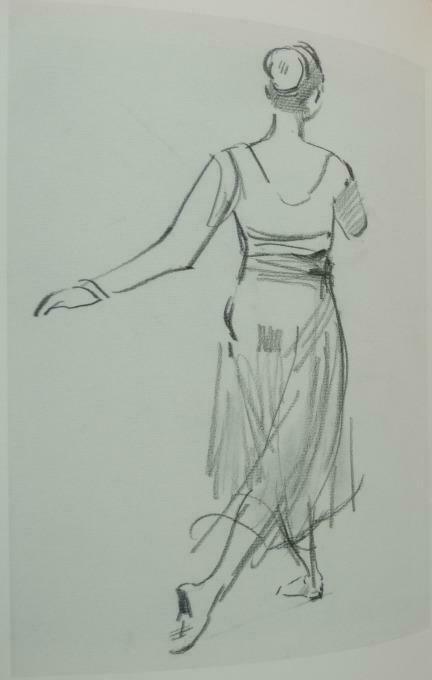
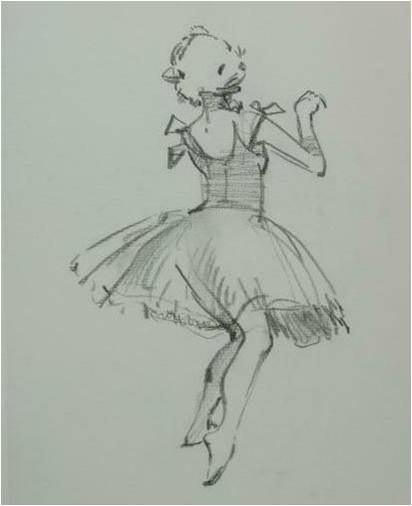
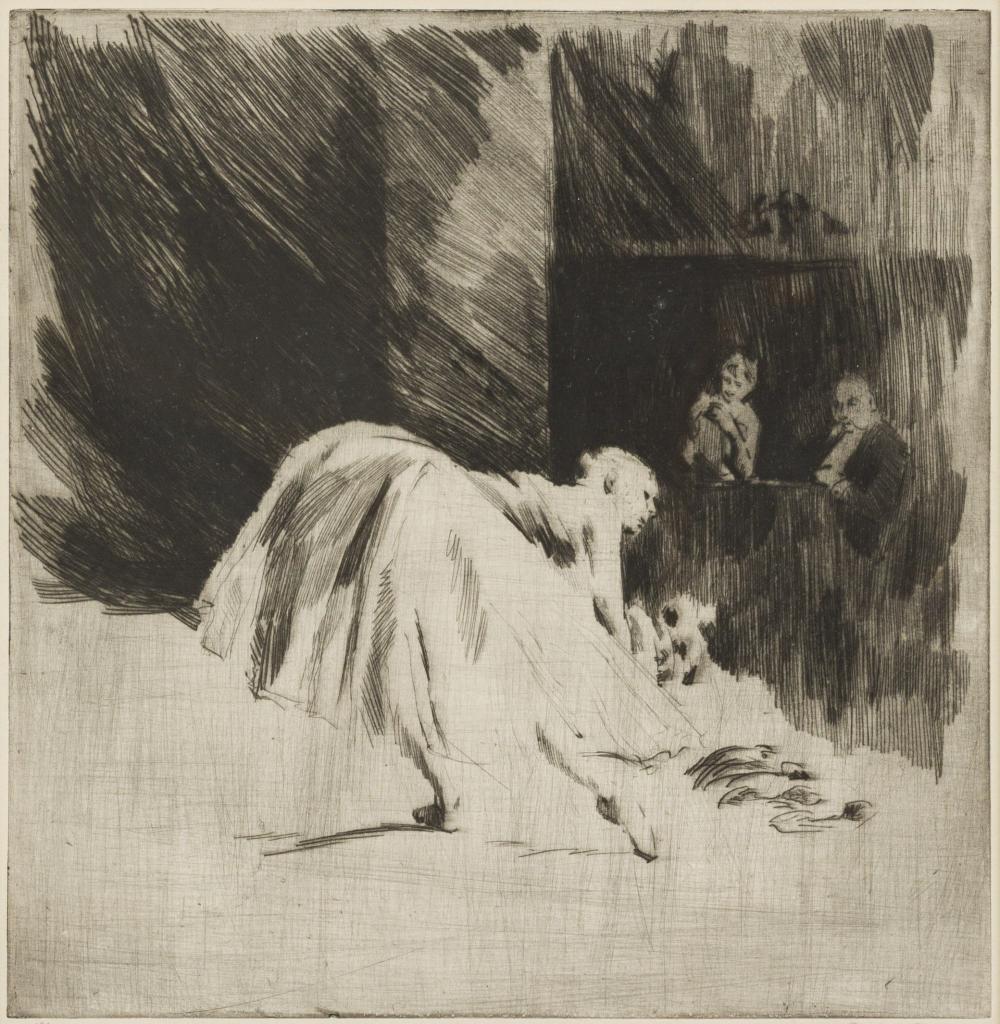
The ballerina, shown below, is depicted from an unusual angle. The pose itself is common in ballet technique, but mostly visual artists chose a frontal perspective to ensure that the head and torso are presented to the greatest advantage. Stolwijk approaches the ballerina diagonally from the side, placing the primary emphasis on her hips and long romantic tutu, downplaying her upper body. It is evident that Stolwijk has captured the ballerina from the wings, depicting not only the ballerina, but also one of the boxes in the auditorium. Two balletomanes are clearly enjoying the performance. The man, who gently nudges forward over the balustrade, is, to me, slightly reminiscent of similar, questionable figures in the Degas’ remarkable paintings.
During his many travels Stolwijk never failed to sketch folk dances, religious dance, rituals, social dances, and exotic performances. In Peru, Stolwijk captured the fascinating Peruvian dancer in mid-movement. His shoulders, his focus, the uplifted leg, and the swirling skirt all indicate a dynamic forward thrust. Even the empty eye sockets of a skull, placed directly on top of the dancer’s head, project forward. The physical dancer is but half of the image; the top half is occupied by a gigantic headdress rendered in astonishing detail.

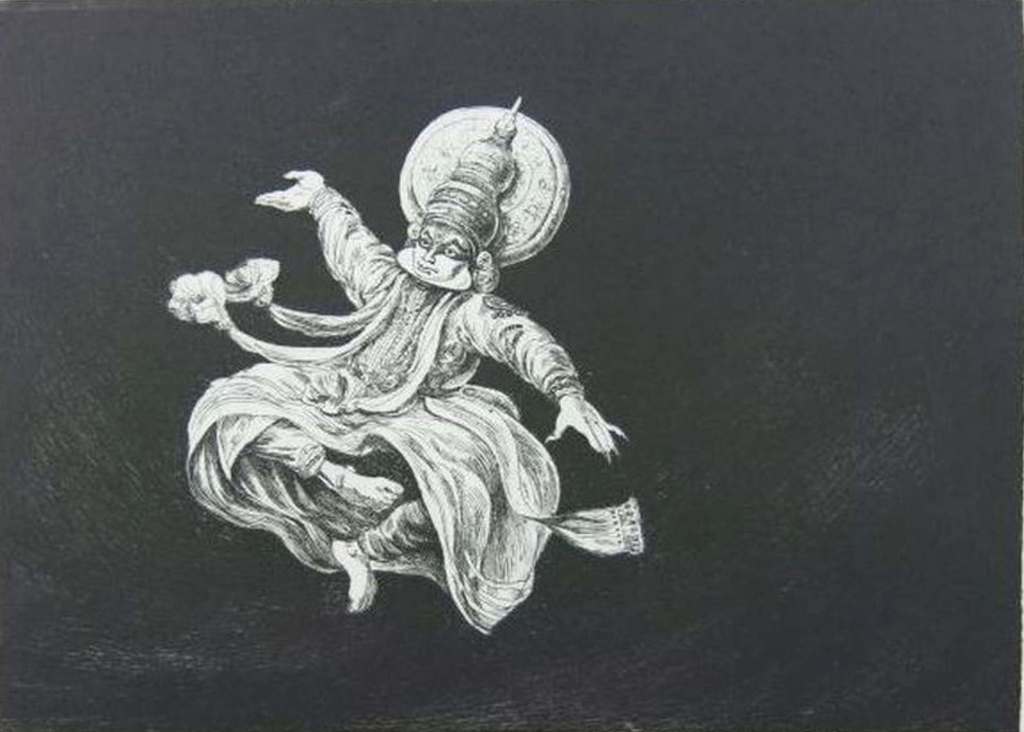
Kathakali, notable for the distinctive costumes, elaborate makeup and magnificent face masks, is a major Indian dance form originating in the southwestern region of Kerala. Stolwijk’s image, a black and white etching, place the dancer against a completely dark framework, positioning him off-centre, leaving practically half of the background without any illustrative content. Having no point of reference, neither floor, stage, nor sky, the dancer appears to hover in mid-air. This is further accented by the soaring clothing and long upwards floating shawls. As with the image of the Peruvian dancer, the details here are extraordinary. Stolwijk depicted the clothing, the headdress, the placement of the feet and even the extended finger nails fastidiously.
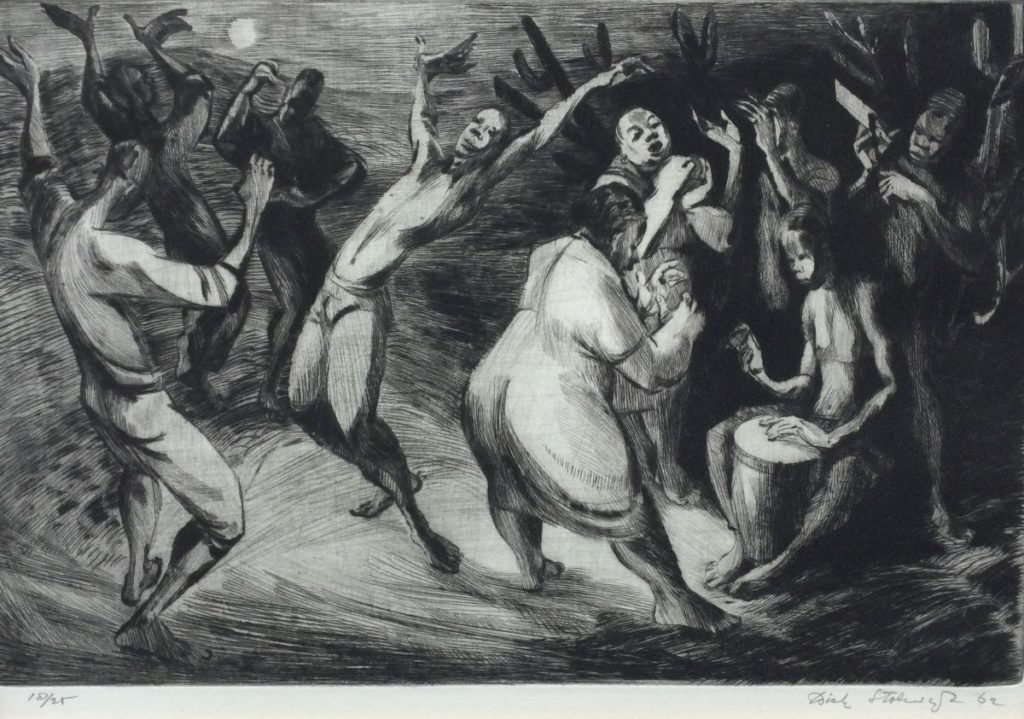
Different, but no less stunning, is Drummers and Dancers illustrating an ecstatic ritual dance. The country where the ceremony takes place is not disclosed by the title, but the Caribbean would be a reasonable guess. The etching falls into two sections divided by a diagonal space; four dancing men on the left and moving to the right, drummers and worshipping women. This latter group is relatively composed; one woman is absorbed in quiet exaltation. These figures are compact, low and withdrawn. In contrast, the dancing men, each striking a unique persuasive pose, are dynamic. All come across as being possessed. The powerful centre man, his chest elevated and arms extended upwards, appears in trance. His hands, just as the hands of the other dancing figures, are large, exaggerated, and near distorted. The strapping man in the left corner casts his gaze downwards as he too raises his arms to the skies. Towards the rear, there are two men dancing in the shadows, one leaning backward and one rocking his hips to and fro as his lilting arms rhythmically accompany his every sway. Where in the etchings of the Peruvian Dancer and the Kathakali Dancer Stolwijk underlines detail and levity, in this etching he accentuates line, length and gravity; these drummers and dancers are earthbound.
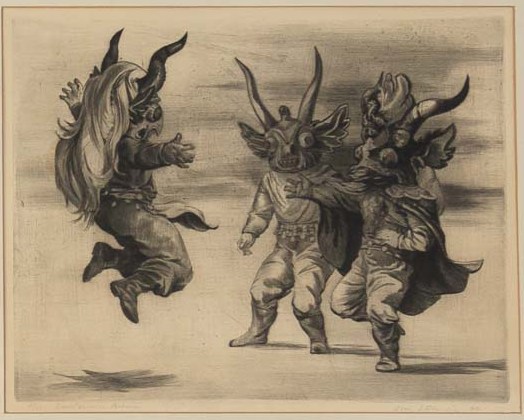
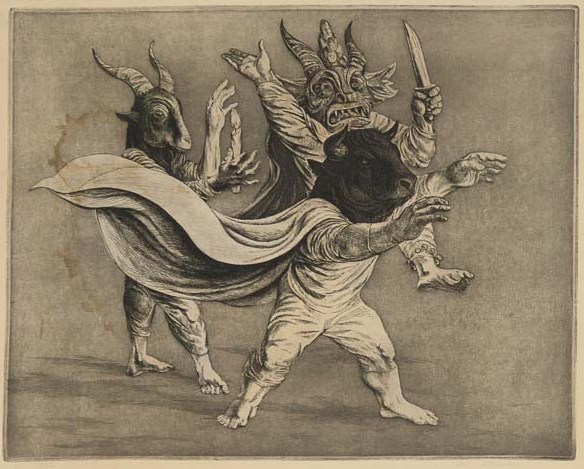
Dick Stolwijk was interested in history and anthropology, most specifically cultural anthropology. Whenever possible he explored exotic cultures and customs; Bolivia provided him with ample opportunity. The three masked dancers in the etching Devil Dancers are diabolical. Especially fiendish is the left fellow whose explosive jump makes him appear incredibly beastly. Just as awful is the masked demon in Minotaur, goat and demon, who as his colleague in Devil Dancer bounds into the air. As we have come to expect from Stolwijk, the figures are rendered in significant detail. A close look reveals ghastly jagged teeth, enclosed in a gruesome mouth, ferocious eyes, and on the more reassuring side, a smart anklet of small bells. The masks of his companions, the goat and the Minotaur, are relatively realistic, though all the more outrageous when you examine the crude human feet and bulky calves that support these daunting figures.
I encountered the work of Dick Stolwijk, the world traveller, dance lover, by chance. His love for dance and theatrical movement never waned. Interviewed late in life, he affirmed that he had always regarded dance as his primary source of inspiration. He gathered his subjects and ideas from the dancers, striving to ingrain their fleeting moments, in his own words, onto his retina. He added, and I paraphrase, that he was still besotted by dance and dancers.
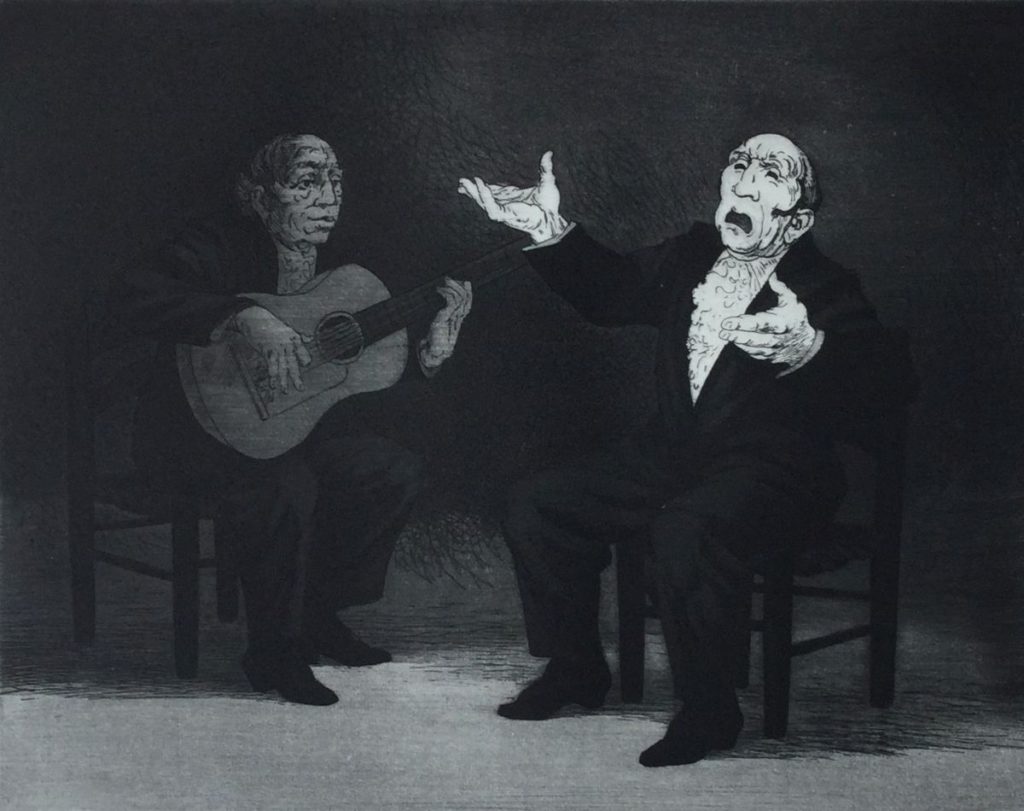
This chance encounter offered me an opportunity to learn more about the remarkable 20th century artist, Dick Stolwijk, and subsequently to share some of his work with you. I would like to share just one more etching, not of dancers, but of Flamenco musicians. Though the dancers may be ‘physically’ absent, this etching Cante Jonda is all about dance. These musicians are the heart and soul of the Flamenco. They accompany the passionate dancer. They form the bridge to the following post, where I will discuss the work of Dutch artists who fell under the spell of the gripping Spanish dancers and their breathtaking musicians.
- Dick Stolwjk EN CARRÉ – Pascal Sloet tot Everlo & Jan van der Eng – 2007 Nationale Stichting tot Exploitatie van Casinospelen


 DANCE IMAGES IN THE ART OF THE NETHERLANDS