Dancing is a social activity. Vivacious figures moving in space, dancing to different melodies and rhythms, offer a constant source of inspiration to artists. In a previous post, Dancing Cheek to Cheek, I looked at images where groups of people dance together in a ballroom or in a café. This post will, once again, focus on social dancing. This time specifically looking at Dutch painters, either working in The Netherlands or abroad, and how they depicted the 20th century dancing couple.
Below are two comparable, yet so different, paintings of dancing couples by Isaac Israels, a regular guest at the Moulin de la Galette. The left image presents a young woman dancing with a military man. The right image illustrates, I presume, a somewhat older couple, though this is not easy to see since both faces are concealed. The younger couple is situated in the absolute centre of the canvas, portrayed from head to foot; looking at the woman’s swinging skirt and her swift footwork, they are most probably dancing a lively fashionable dance. The military man supports his partner just tight enough to facilitate lively dance movements. This is a fun-loving pair, enjoying themselves. The right couple appears to be the only couple on the dance floor. The gentleman embraces his partner gently; his arm placed generously over her back. They are deeply involved with each other. Israels provides no indication as to how they dance. He has cropped their feet entirely. In both these paintings, Israels, pays particular attention to body language and the couple’s physical interaction. He sympathetically illustrates human emotions of everyday people in common situations.
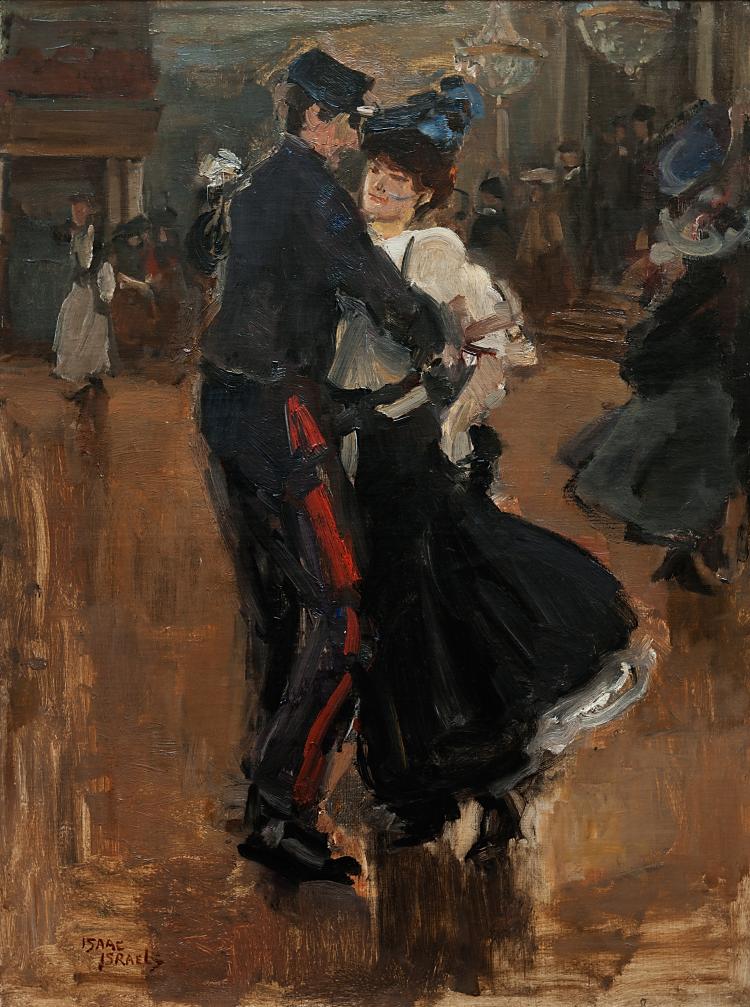
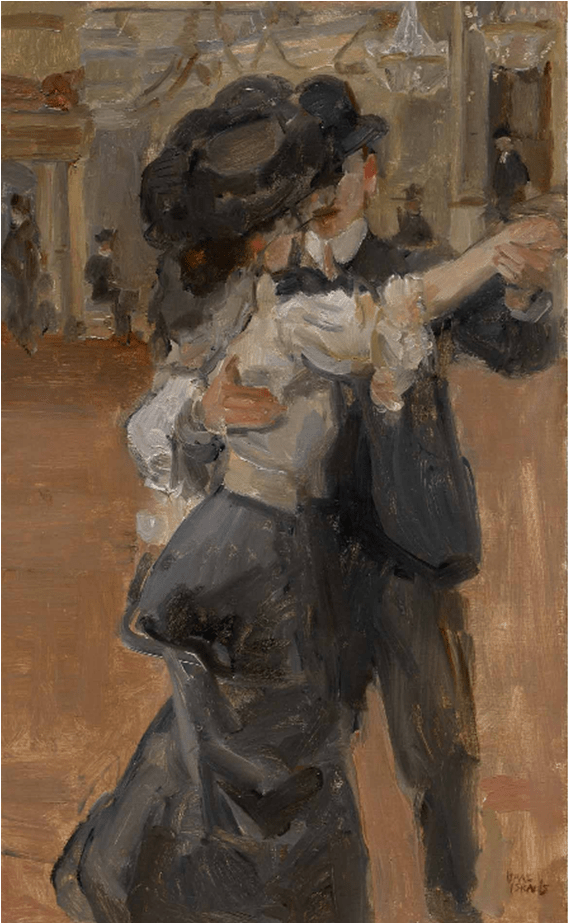
Isaac Israels – Dancing couple at the Moulin de la Galette – c. 1907 – 54 x 33 cm – Kunsthandel Ivo Bouwman
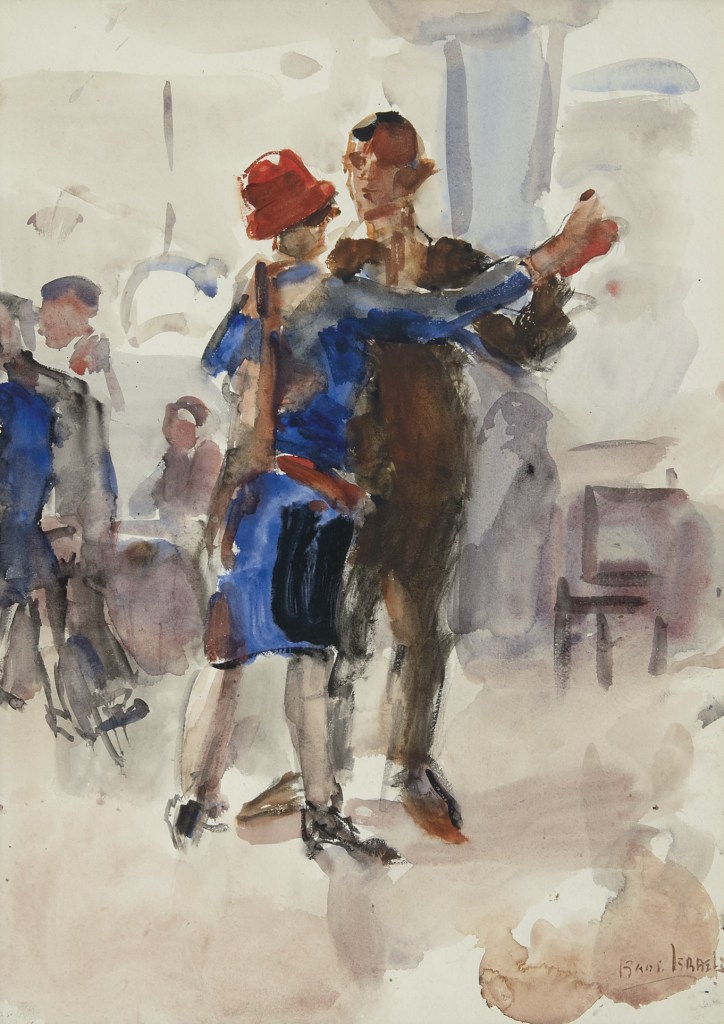
The body language of the two images shown below tells a different story. The left image, a watercolour by Isaac Israels, the same artist as the above two works, is not dated. Judging by the dress, I think the late 1920s or early 30s would be a fair estimate. With little more than a few seemingly nonchalant outlines, daubed loosely in watercolours, Israels set the scene. Most likely, the artist was present at a social event or, looking at the decorum of the dancers, perhaps a ballroom dancing lesson. The lady is dressed immaculately; her hat and belt are a matching colour. This couple stands upright and hold each other courteously, retaining an appropriate distance; so unlike the more frivolous couple at the Moulin de la Galette. And how are they dancing? Their formal body language together with the non-movement of the skirt suggests that the couple is neither whirling nor turning; this is a reserved dance, focussing on footwork and traditional ballroom etiquette.
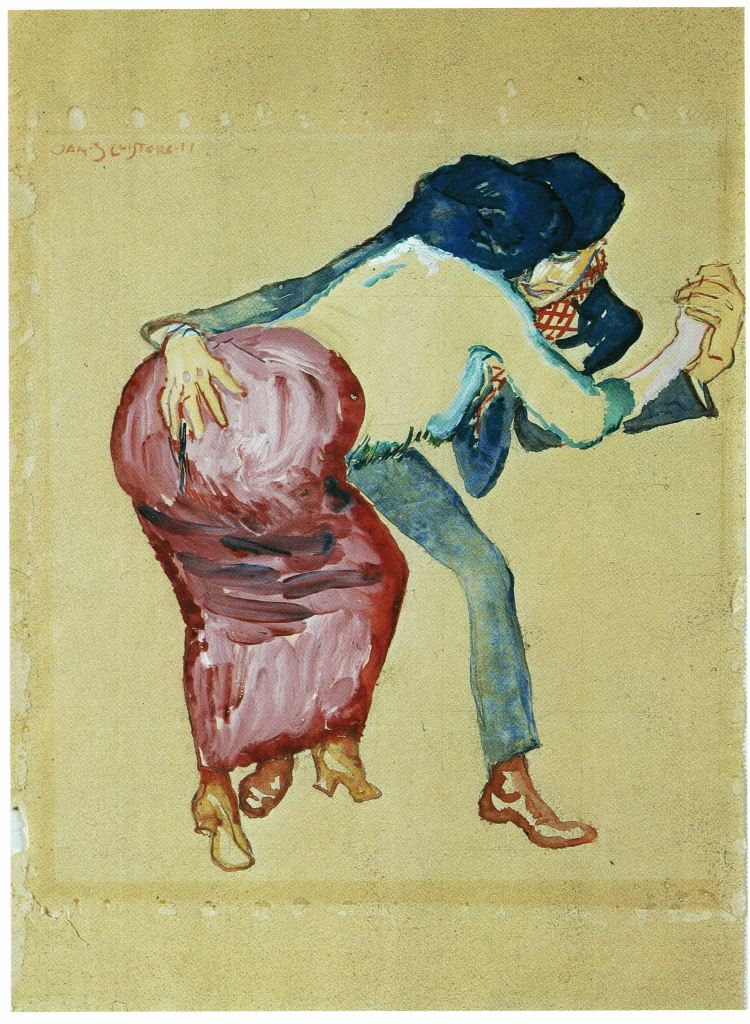
There is nothing formal about Jan Sluijter’s Apache Dance. He captures the very essence of the highly popular, rigorous Apache Dance (also called Valse Chaloupée) which imitates a physical struggle between a ruffian and street girl. Sluijters’ dancers are rugged. Their confrontation is aggressive. The woman bends well forward, forcing herself towards the shoulder of her challenging partner. Even though Sluijters only illuminates a small section of the ruffian’s face, he emphatically delineates the man’s rebellious features. This dynamic image is drawn on a scrap of paper; you can not only see the perforated holes at the top and the bottom of the page, but also the tattered edges. One wonders if Sluijters simply sketched this image at some unexpected moment. Sluijters, you may recall, painted a significant number of fabulous dance images, some of which I have discussed in previous posts.
In Groningen, a province and city in the north of The Netherlands, a group of young artists, writers, and architects formed an artistic collective. De Ploeg (The Plough as the group came to be known) was founded in 1918, the artist Jan Wiegers (1893-1959) being one of the founding members. In 1920, Wiegers travelled to a sanatorium in Davos and there met Ernst Ludwig Kirchner foreman of the artistic group Die Brücke. The two men became friends, and Kirchner’s expressionistic style and ideas strongly influenced Wiegers and subsequently the work of De Ploeg. Strong colour contrasts, exuberant hues, sharp angular lines and impulsive brushwork are characteristic to De Ploeg. Kirchner composed a considerable number of dance images, including paintings and sketches of Mary Wigman and Gret Palucca. His love of dance enthused Wiegers, who in 1922 painted Dancing Room; unfortunately, only a black and white photograph of this painting exists. Another stunning dance image, Bal Nègre, created by Wiegers in 1930, fortunately, does exist and can be enjoyed at the Groninger Museum.
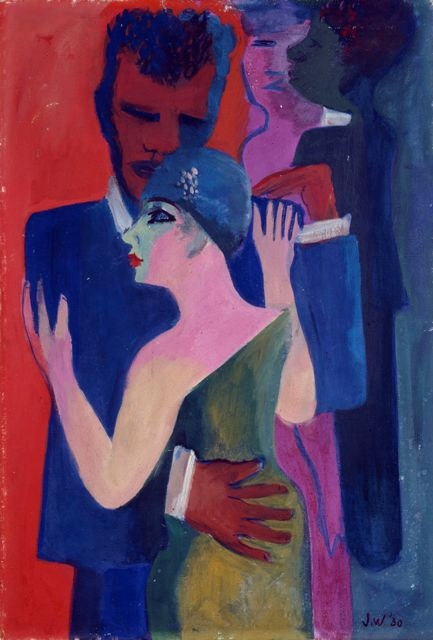
The colour scheme is absolutely dazzling; light skin tones resting against a large patch of deep blue, and all this deposited in front of a red surface. Every aspect of this painting is unnatural yet totally recognizable. The woman is attractively dressed in a modern tight-fitting gown that accentuates her slim waistline, her buttocks, and her provocative neckline. She tenderly embraces a tall, broad man whose dark, strongly outlined head, hovers just above her very modish hat. The couple dance intimately, her body pressed firmly against her partner, who reciprocates by spreading his exceptionally large hand on her derrière. Yet there is more than meets the eye. Behind them, rendered in a sketchy fashion, is another couple; both couples are of a mixed race. This, considering that this work was painted in 1930, was not a widespread occurrence. The title of the painting, Bal Nègre, offers the explanation. In the twenties and thirties of the last century, Le Bal Nègre, a nightspot in Montparnasse, was the place to be. There, where tout Paris came to listen to the outstanding jazz musicians and to enjoy the latest dance crazes, men and women, regardless of nationality or race, danced together. Performers and clientele included Josephine Baker, Maurice Chevalier, Mistinguette, May Ray, Albert Camus, Jean-Paul Sartre and the Dutch artist Kees van Dongen.* Jan Wiegers and his friend Hendrik Werkman, also a member of De Ploeg, had visited Paris and like so many before them, found their way to this voguish establishment.
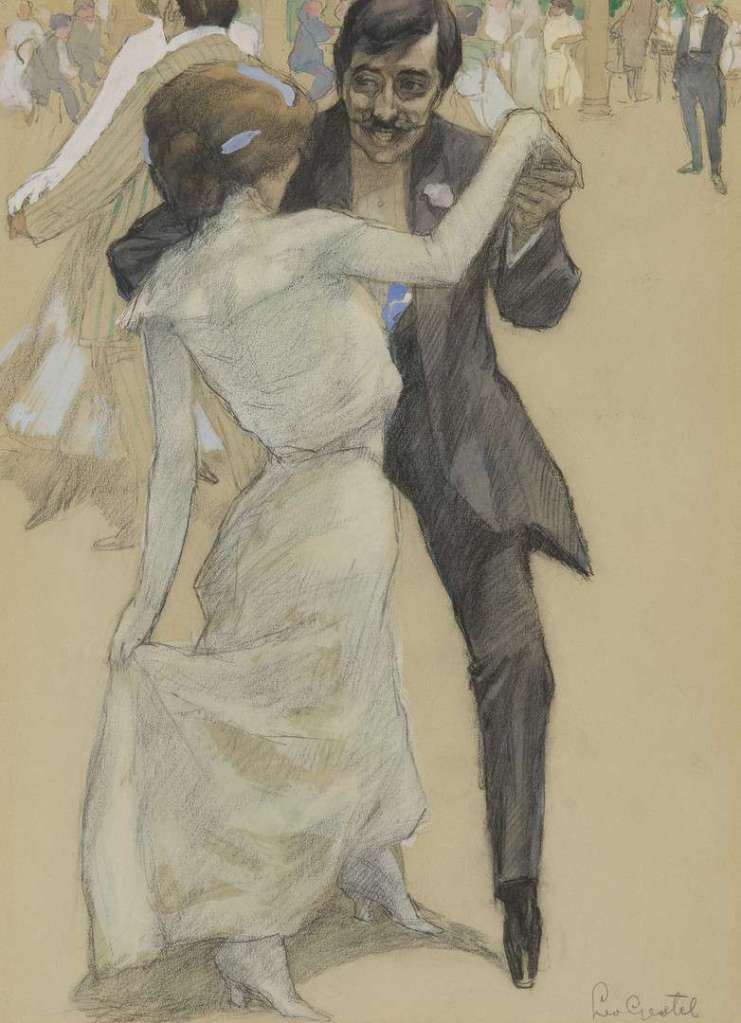
Leo Gestel (1881-1941) was a unique artist. He, as one of the leading figures in Dutch Modern Art, investigated and evolved innovative styles including cubism, expressionism, luminism, and futurism. He created a variety of dance images, ranging from figurative to abstract.
Leo Gestel – Dancing Couple – 31.3 x 23.8 cm – Mark Smit Kunsthandel
The setting; Gestel focuses directly on the gracious lady and her partner dancing in a grand ballroom. A vaguely drawn dancing couple can be distinguished directly behind them. And in the far distance more people sit, talk, or simply stand waiting. The eye-catching couple occupies the entire page, barely fitting from head to toe. In fact, even though the man bends his knees, he is actually too long and needs to be slightly cropped. Similar to Sluijters’ Apache Dance, Gestel disregards the woman’s face altogether, giving prominence to the man, and most specifically to his incredible expression. Nowhere in the artwork is Gestel’s pen stoke more detailed. The man feasts his eyes on his partner; his dubious smile is unsettling. This, Gestel further underscores by the light, fragile, colouring of the woman juxtaposed against the striking dark features of the man’s face and attire. Elegant though the couple may seem, I am bewildered by the man’s body language. Which dance requires the man to bend so ungainly through his knees? And how awkwardly the couple holds hands; not to mention that the woman appears to have no qualms about actively thrusting her pelvis forward. You could argue that Gestel chose to draw a random couple and captured them in a given moment of time. But, I for one, looking at the detail of the man’s face, the moustache, the gleaming eyes, the puffed up cheeks, and that consuming grin, feel that Gestel suggests a more decadent situation.
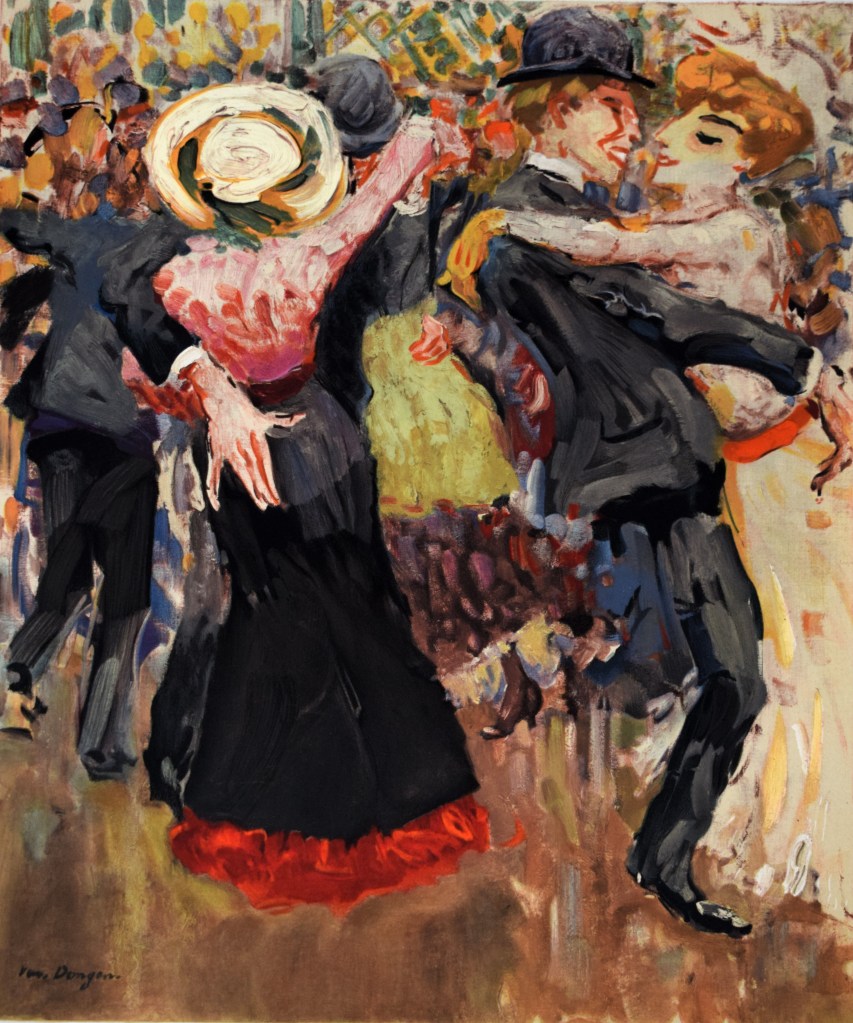
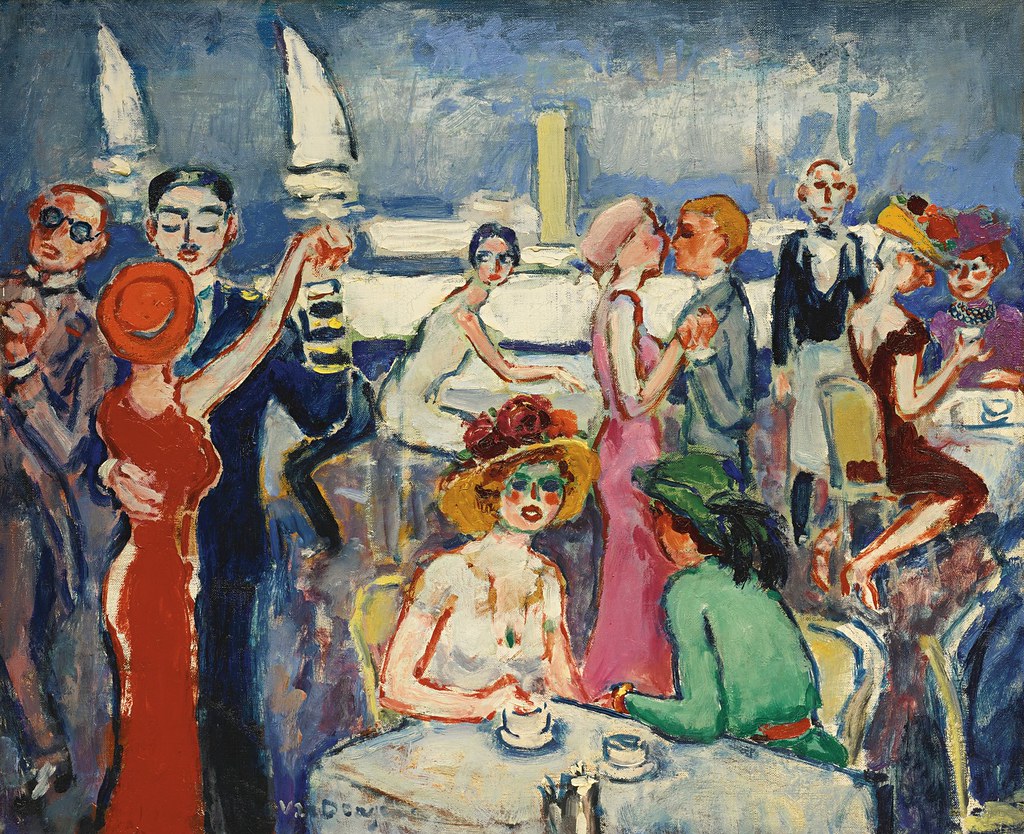
To finish on a more festive note; Kees van Dongen, born in Rotterdam, travelled to Paris and there painted many exciting works to become one of the most innovating Fauvist artists. As the years progressed, this imposing artist turned his interest to portraying society, featuring the very well-to-do. The lively painting, shown below, depicts socialites, enjoying a splendid time at Deauville, the fashionable beach resort. Members of the beau monde are amusing themselves, drinking, conversing and dancing. All are obviously wealthy, expensively dressed and all, including the waiter, are long and slender. The slim lady on the left in her tight-fitting red dress with matching chapeau dances handsomely with a stately gentleman. He appears to be a nautical man. Just as the other dancing couple, a little farther back, they dance face to face. We know they are dancing because they have assumed a dancing position, but how they are dancing is not indicated. Except for the woman in white who looks as if she is about to pounce, and that odd fellow on the left wearing sunglasses, there is very little actual movement in this work. The static, sophisticated dancing couples, in no way recall the voluptuous, spirited dancers of van Dongen’s earlier works. Van Dongen appears to concentrate primarily on exhibiting the jet set; dance is but one of the niceties of their daily existence.
As the 20th century progressed art explored adventurous new styles and ventured into alternative avenues. Artists gradually grew disinterested in the traditional, figurative depiction of social dancing. Artists in the second half of the 20th century and today’s contemporary artists shifted their focus to a less figurative rendition of the dance. As far as the painting of dancing couples is concerned, the time-honoured Dutch tradition, which evolved even before Bruegel’s stunning dancers, has turned over a new leaf.
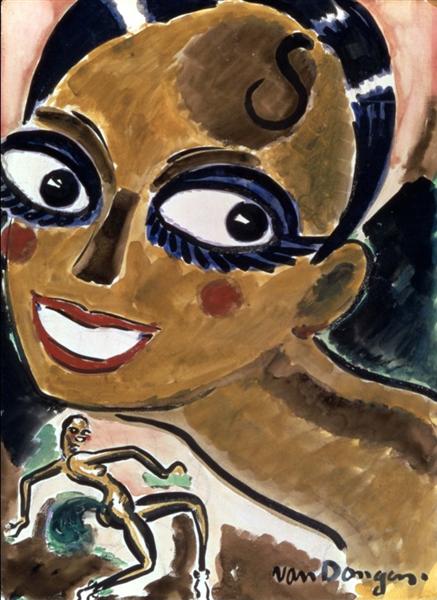 *The poster that Van Dongen designed of Josephine Baker is still used today as the signboard of Le Bal Bromet, as Le Bal Nègre is presently called.
Many thanks to researcher and historian Esther Schreuder; her blog about Le Bal Nègre and Jan Wiegers is interesting & informative.


 DANCE IMAGES IN THE ART OF THE NETHERLANDS

