The tango, a dance of passion, drama and emotion, has many faces. In a region of mass immigration, the Rio de la Plata, the natural border between Argentina and Uruguay, African, Europeans and South American, cultures blended; a fusion that paved the way to the emergence of the tango. A dance originating in the lower working classes, the early tango was a popular dance in the slums, brothels and other less desirable areas. The sensually stirring tango, understandably, was not considered respectable by the leading social classes in Buenos Aires. Nevertheless, the younger generation embraced it, and young travelling Argentinians brought the tango to Europe. Paris was captivated by the innovative movements, intoxicating rhythm, and the open sensuality. Before long, the tango was rid of its ‘offensive’ features and became a fashionable ballroom dance, performed by all layers of society. By 1912 the tango had taken Paris by storm and soon the passionate tango conquered the modern world. The tango was a rage, swaying fashion, music, architecture, social life and inspiring choreographers, artists and filmmakers; Rudolf Valentino danced a most passionate version in Four Horsemen of the Apocalypse. (1921)
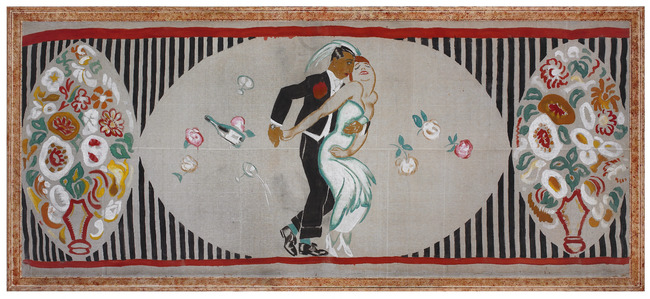
Jan Sluijters, about whom I have written in previous posts, designed a set of six monumental works, each displaying a specific dance. Tango, a work from around 1910, encloses an affectionate couple dancing within a circular shape. Floating around them are various roses, a bottle of champagne and two glasses; champagne, you will have noticed, is spilling from the lower glass. The elegantly dressed couple is presented in a daring pose; their bodies in intimate physical contact and more sexually explicitly illustrated than any other dance of the time. A close look reveals that although the woman is sparing no effort to physically impress her partner, the man appears more than a little dumbfounded.
No less passionate is Piet van der Hem’s Dancing the Tango generally accepted to have been painted in the 1910s, when van der Hem, besides Jan Sluijters and Kees Maks frequented Paris. Van der Hem, a versatile painter, was known for his portrayal of mundane life, cabaret scenes and his sizzling flamenco dancers. He also painted various portraits of his friend, Mata Hari.
Each tango has a unique face. Van der Hem’s tango is a performance dance. His impassioned dancers perform on a heightened stage; below them musicians play in an orchestra pit only lit by a few light bulbs, rapidly sketched by the artist. The two dancers are inseparable; the irresistible man placing the flat of his hand firmly on the back of his partner. Not merely are they cheek to cheek and shoulder to shoulder, but, their entire bodies are pressed together blending into one distinct form. They dance in perfect unison, synchronizing their every move. Both partners sink low, their legs touching to allow the long elegant gliding steps so characteristic of the tango.
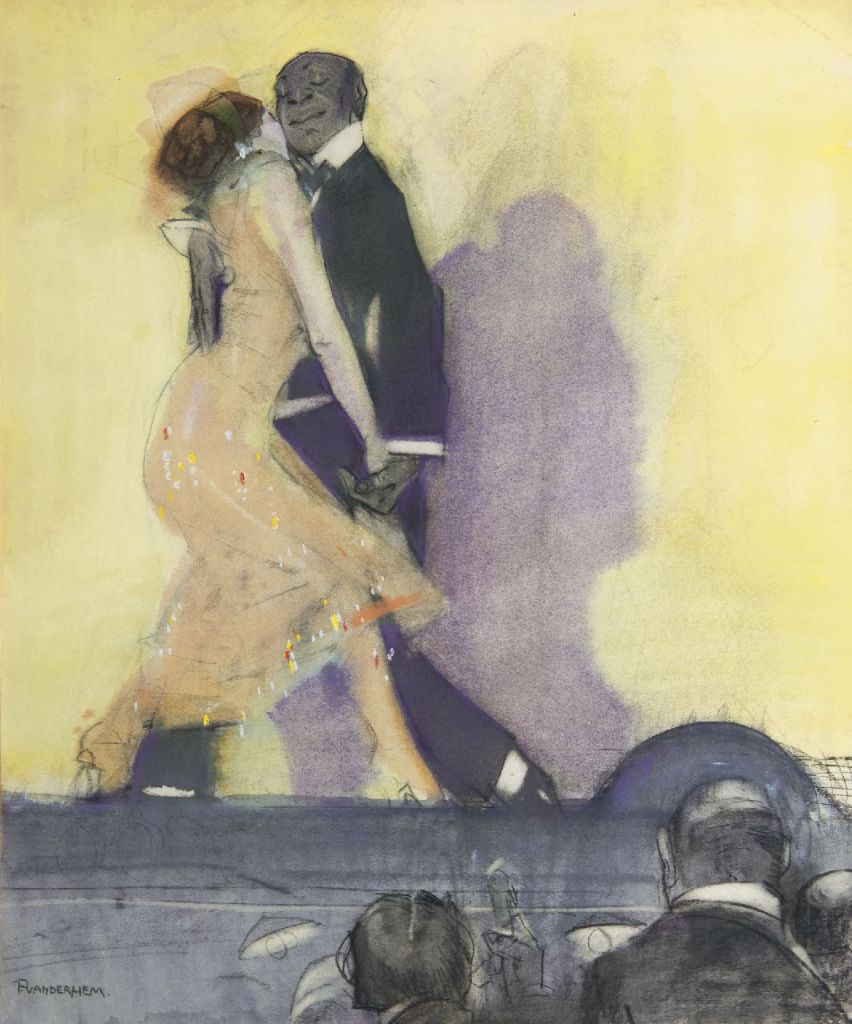
As if the dancer’s intense alignment is not provocative enough, van der Hem not only gives the female a near transparent dress adorned with colourful glitters, but he also pencils the contours of her enticing legs. Her dress, her shoes and even her legs harmonize gently into the background. The woman’s face is adverted, but the man’s face, just as his enormous hands is accentuated. His features and his immaculate black dress-suit contrast vividly against the yellow surroundings. And behind them a mauve silhouette, not of an elegant pair, but a vague shape of an unsophisticated couple.
Kees Maks (1876-1967), fondly named the ‘artist of mundane life‘, worked intermittently in Paris and in Amsterdam. Besides painting fashionable nightlife, dance halls and revues, circus and café scenes, he often painted dancers. Two of his wonderful dance paintings are devoted to the ballroom tango, another one of the tango’s many faces. This tango was simplified, adapted for the conventional ballroom and most piquant features were tamed.
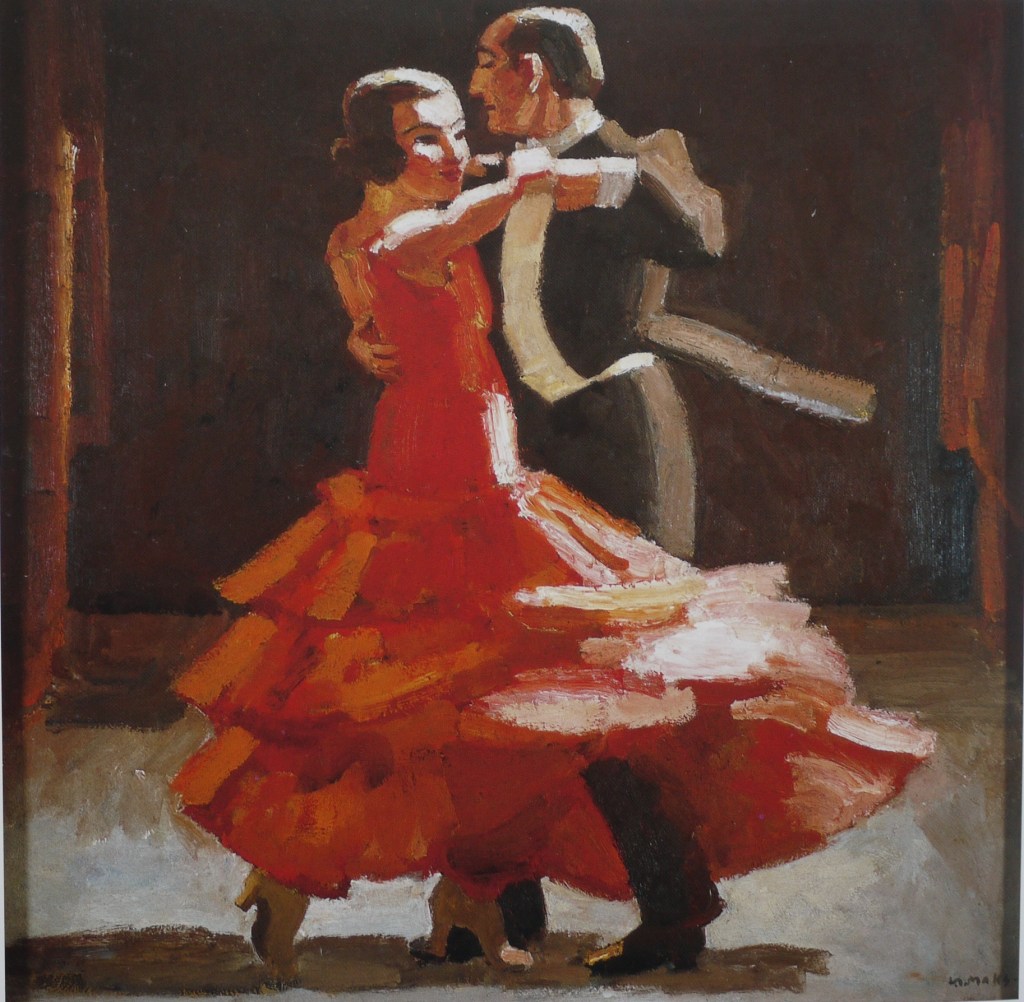
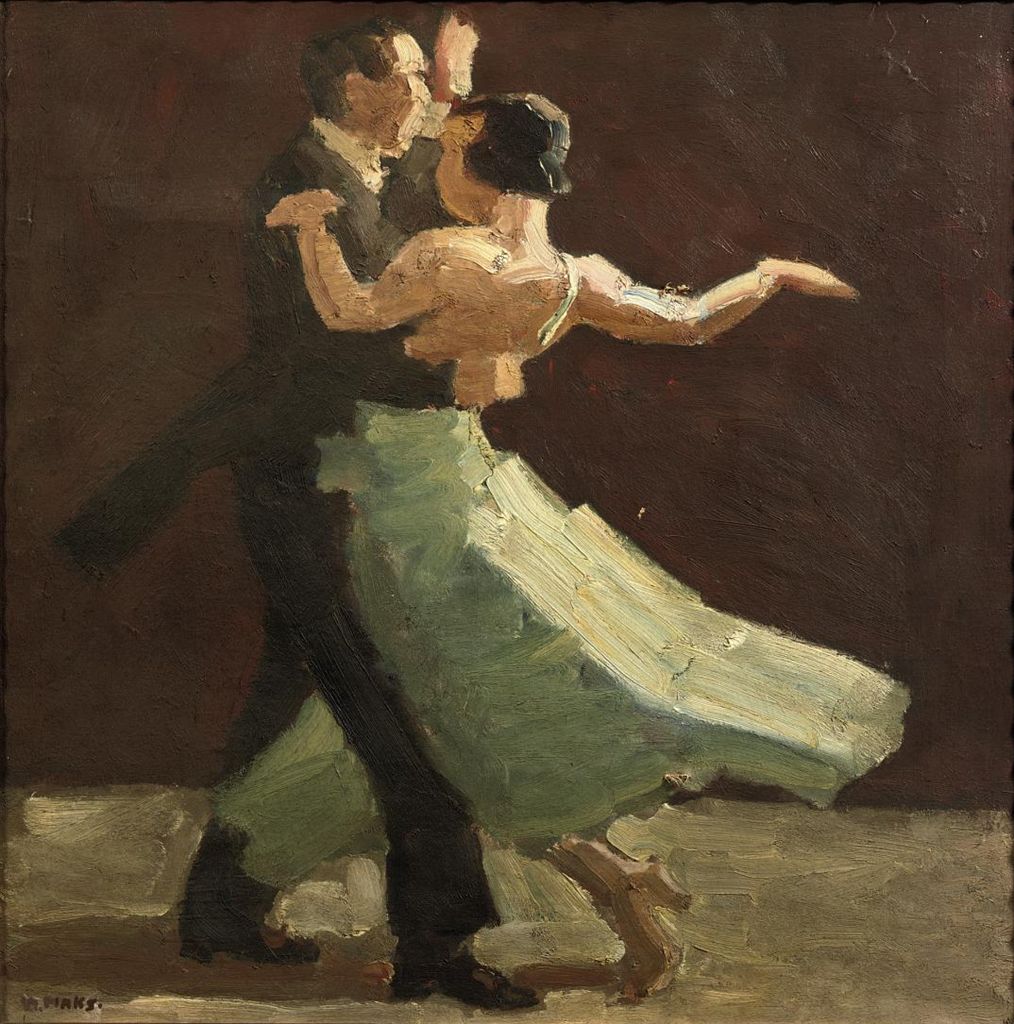
Right: Kees Maks – Vanuit de coulissen – A Dancing Couple – 62.6 x 62.5 – Simonis & Buunk
In my previous post, about the can-can, I described Maks’ astounding ability to visualize movement. The above two paintings, of professional dancers, definitely conjure up an image of exuberance. Both couples face each other, and even though there is a slight distance between, they dance inseparably. The long flowing gowns respectively red and green, wrap around the man’s leg, interlacing the couple. The dancers demonstrate elegance and grace, swirling over the floor with remarkable ease and decorum. Tango for two performed by nightclub performers André and Denise, illustrates technically polished dancers with an accomplished sense of deportment. A Dancing Couple, my favourite, showcases Maks’ mastery at depicting movement. The placement of the dancer’s hips, the slight but definite arch of the woman’s back, the subtle rotation of the upper back, the forward motion of the legs supplemented by the free swing of the skirt all initiate a genuine sense of actually dancing.
Hollywood has embraced the tango; it has been danced, among many others, by Fred Astaire and Cyd Charisse, Charlie Chaplin, Lucille Ball, Gomez and Morticia in Addams Family Values (1993), and not to forget the fabulous, though anachronistic tango in Baz Luhrmann’s 2001 movie, Moulin Rouge. Whether in the ballroom, on the movie screen, or in the visual arts the tango, despite the occasional less popular periods, remains in vogue. You only need to google tango to discover hundreds of images. The woman is often portrayed in ravishing red tints, the man in a sensuous man in a dark outfit and more often than not, pictured in an iconic pose with the women diving forward in a dynamic lounge or in a deep backbend whilst kicking her leg high in the air. Contemporary Dutch artists Nella Monfoort, Anton Martineau, Pieter Zandvliet and Jan Sierhuis have all been inspired, each in their distinct way, by the tango. But where these artists paint the occasional tango image Pim Stallmann (1947) paints tango dancers exclusively, frequently in atypical, trendy, and altogether unexpected locations.
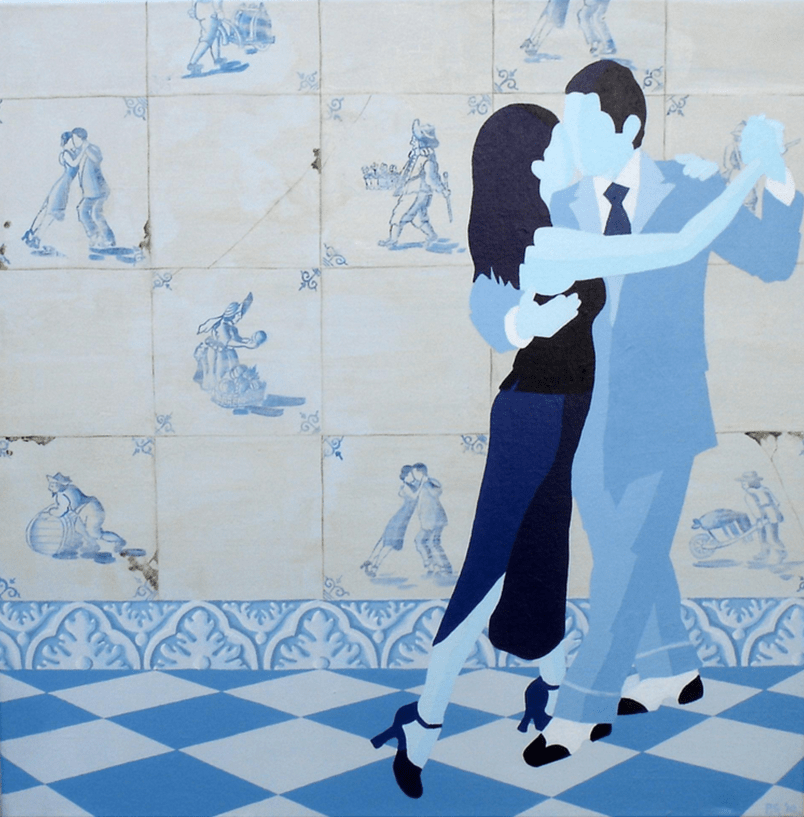
For Pim Stallmann the tango is an unspoken dialogue where two people express themselves emotionally through body language. His fascination for the tango blossomed when he, together with his wife, started taking tango lessons in 2001. The dance so captured his imagination that it became his personal trademark. His artworks have a consistent yet unique pattern. Each artwork is composed of a male and female dancer; seldom is a musician present. The dancing couple represents the epitome of elegance. The woman is mostly attired in a tight-fitting gown, and the man, in a suit or in a sensual tank top. The figures are simplified, without any excess details, coloured bold flat planes of varying hues. Time and again, the man and woman are both shown in the same or in remarkably similar colours. All the figures are anonymous; the pose, the intertwining of the dancers themselves, the body language, is sufficient to define the ardent emotions. Each tango couple is placed in a novel background. There are various themes including a series placed in a stylized art deco setting, another together with traditional Chinese art and the series named Tango in the City is self-explanatory. From the numerous artworks I have selected two which I find especially eye-catching.
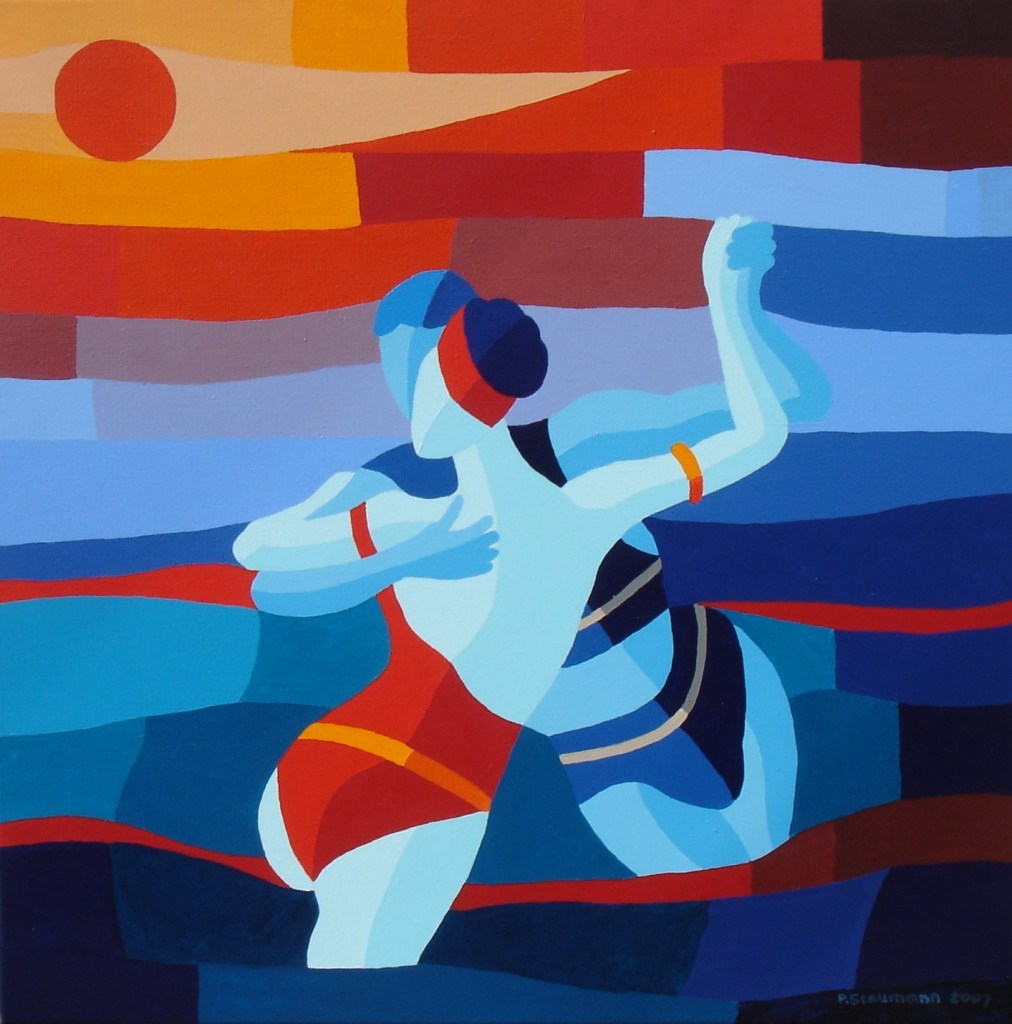
Left: Tango aan zee 4 – 60 x 60 cm – 2008 – Tango & Kunst Pim Stallmann
Right: Delft Tango 5 – 60 x 60 cm – 2010 – Tango & Kunst Pim Stallmann
Who would expect a tango to be danced between waves? And who would envisage a seascape contrived with such distinctive shapes and colours? This painting, taken from the series Tango at Sea, displays, contrary to most of Stallmann’s works, only the top half of the dancers. Though the couple’s legs are hidden, the positioning of the arms, shoulders, and heads, leaves no doubt as to the tango’s intensity. Personally, I love the combination of warm and cool colours of the horizontal shapes in the background as juxtaposed against the sinuous lines of the passionate couple. Delft Tango 5 displays a couple dancing in a traditional tango pose, in a typical Dutch environment, known to tourists worldwide as belonging to the Delft blue earthenware. Take a moment to cast your eye on the blue Delft tiles. Apart from faithfully copying historical tiles, Stallmann drolly adds three apparently ‘authentic’ tiles of 20th century tango dancers; all in perfect Delft blue colouring.
Tango in the art of the Netherlands would not be complete without applauding Five Tango’s, a breathtaking ballet choreographed by the world renowned Dutch choreographer Hans van Manen. Variations of the tango had, at times, appeared in ballets either as a duet or a group dance, but no choreographer has, as van Manen accomplished, transferred the Argentine tango from the dance floor to the modern ballet stage. His tango is not a replica of ballroom dancing, nor is it an imitation of Spanish dance. Rather van Manen, inspired by the stimulating compositions by Astor Piazzolla, has fused the classical ballet technique, including traditional pointe-work with the very essence of the Argentine tango. The electrifying sphere, the dynamic movements, the agility and precision, and the decisive physical attraction, all essential to the tango, are translated by the master choreographer Hans van Manen into, using his own words, ballet entertainment.
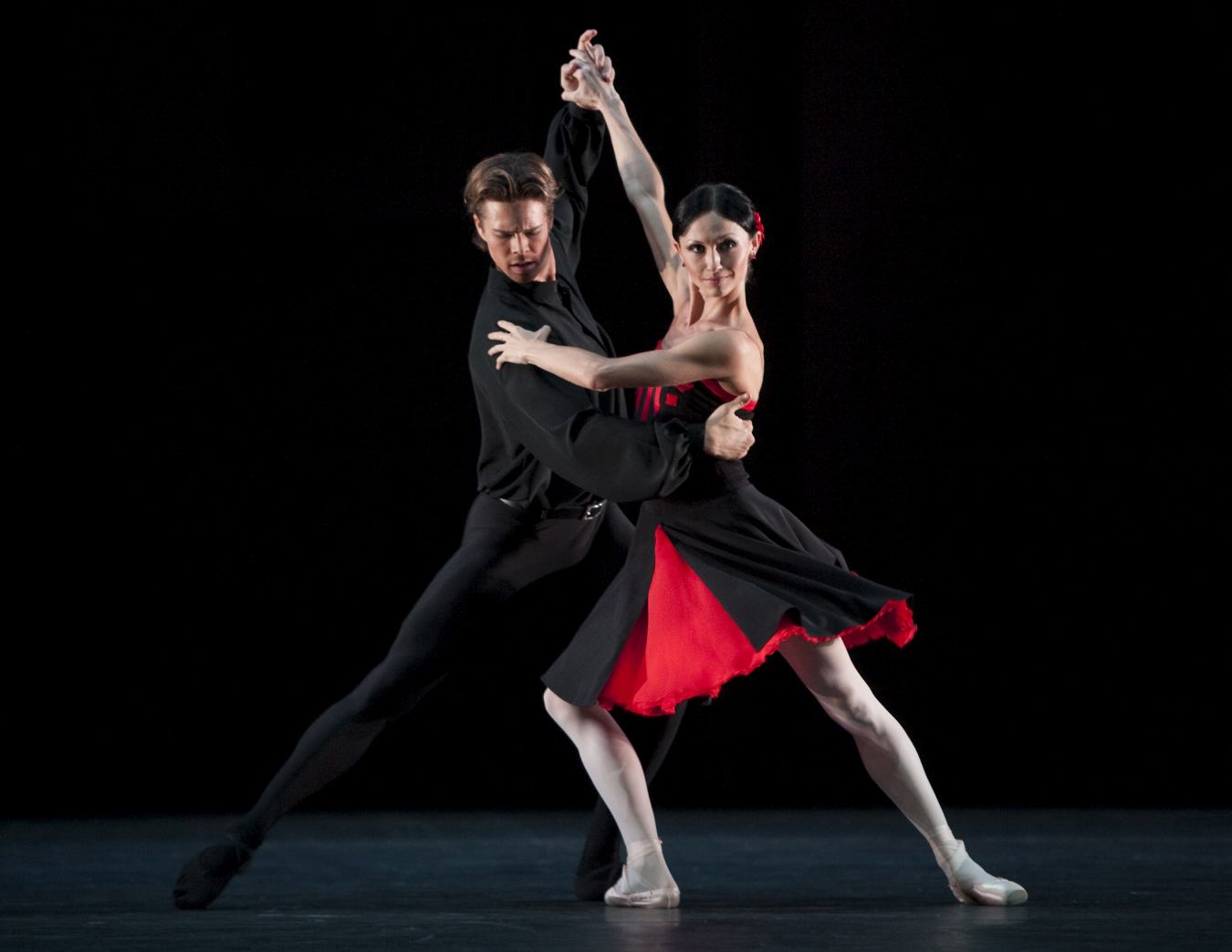
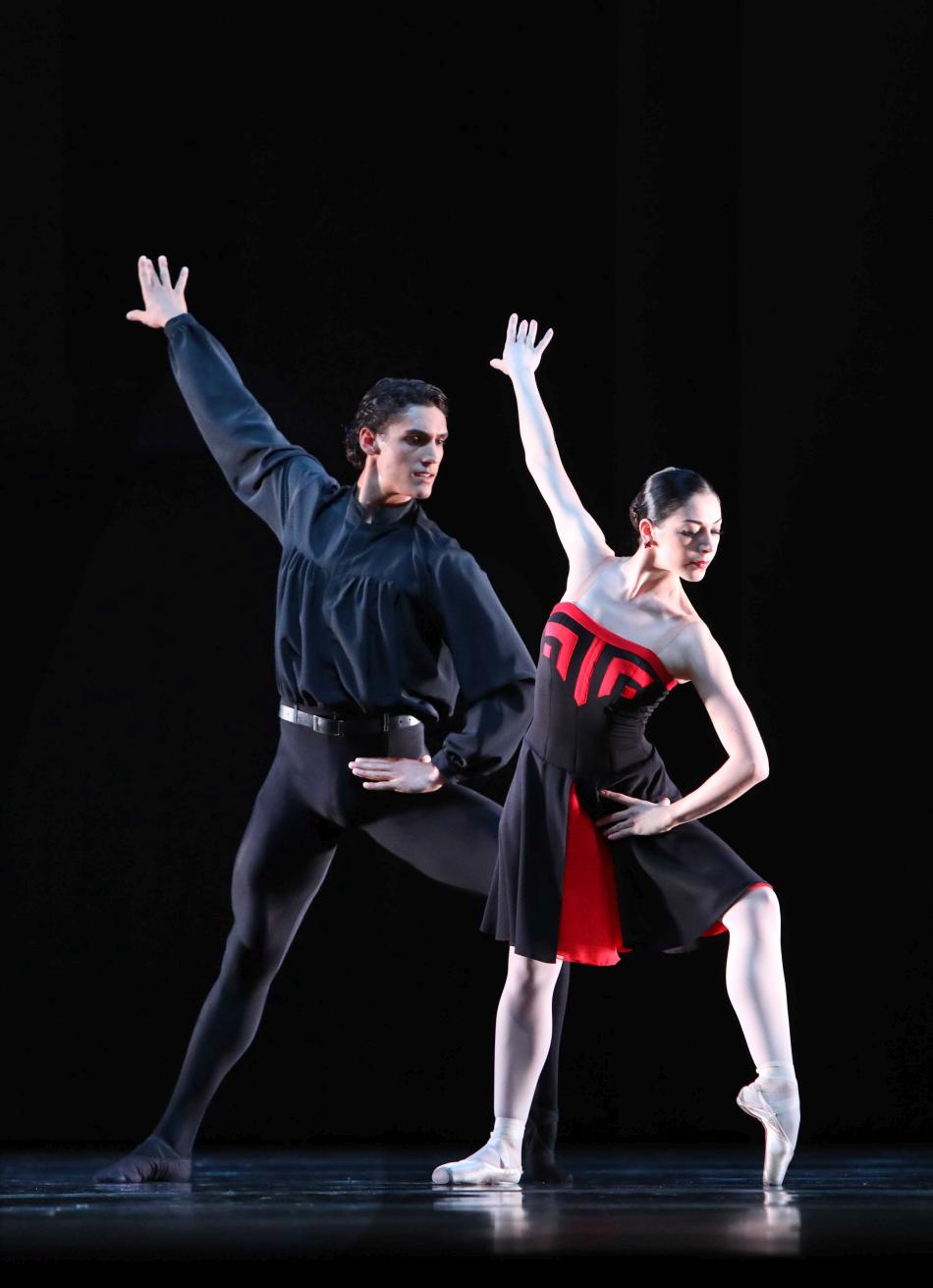
Five Tango’s – Hans van Manen – Dutch National Ballet Left : Anna Tsygankova & Matthew Golding – photo: Angela Sterling Right: Maia Makhateli & Daniel Camargo – 2017 – photo: Hans Gerritsen
The tango has many faces. In each generation, in each community, the tango has evolved. The tango is in constant flow. Dancers, musicians, choreographers, and artists, both in the Netherlands, and for that matter, worldwide are drawn to the overpowering magnetism of the tango.


 DANCE IMAGES IN THE ART OF THE NETHERLANDS