The can-can is Parisian cultural heritage. The long-legged dancers of the Moulin Rouge are legendary; Henri Toulouse-Lautrec’s posters and paintings are world renowned. The combination of Dutch artists and the can-can, however, is not exactly the first thing that springs to mind; a number of Dutch artists, nonetheless, could not resist the temptation of the alluring music-hall merriment.
Early in his career Marius Bauer, the notable Dutch orientalist, visited Paris. Apart from drawing many of the city’s tourist sites, he also visited the Moulin Rouge. No doubt he enjoyed the dancing, filling ten pages of his thirty-five page sketchbook with images of can-can dancers. The can-can is an energetic dance, full of acrobatic capers; the splits, cartwheels, hopping in a circle whilst supporting the leg high in the air and more enthralling, even slightly mischievous movements. Bauer concentrated on the high kicks; with just one or two exceptions, all his sketches show the dancers executing a very high leg kick.


Paris, early 20th century, was the centre of the art world. Painters, from all nationalities, flocked to the light city in search of artistic innovation. Dutch artists including George Breitner, Piet Mondrian, Isaac Sluijters, Leo Gestel, Kees van Dongen, Jan Sluijters, and Kees Maks, visited or resided in Paris for various lengths of time. All these artists painted dance in one form or another; the last three mentioned were most specifically drawn to Parisian nightlife, painting images of the Moulin Rouge, Le Moulin de la Galette and, of course, the can-can.
Kees van Dongen, a Fauvist, stunned Paris with The Red Dancer. The work, so unlike the ‘usual’ image of a can-can dancer, is a close up of the dancer’s upper torso and her flamboyant skirt. The twirling of her multi-layered skirt together with the position of her leg reveal the can-can choreography. Van Dongen experimented with bold colours, was fascinated by the possibilities of electric light, and was interested in the character hidden behind the dance steps.

Jan Sluijters’ fascination with electric lighting culminated in Bal Tabarin, a feast of light and dance. Sluijters choreographed a galaxy of electric light; ribbons, garlands, circles, and spheres of white and coloured light seizing more than the upper half of the painting. The vibrant light towered above untold revellers; on the right, not far from two amorous couples, professional dancing girls are kicking their legs into the air and whirling their frilly dresses.

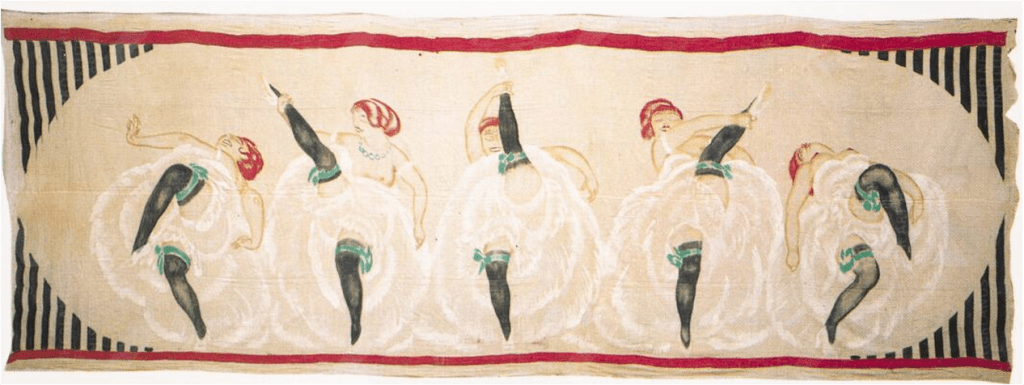
A few years later Jan Sluijters created a set of six frieze-like wall decorations on cheesecloth and flag-cloth, depicting different dance forms. On one, the longest and largest of the set with a length of 568 cm, five blatant dance-figures perform a vigorous can-can. The figures all appear remarkably similar; it is possible that Sluijters painted five moments in time of the same dancer. Alternatively, he has painted five titillating dancers performing simultaneously. There is nothing bashful about this work. The legs are flung to shoulder height, as you would expect from the can-can, offering an unrestricted view of the thighs, ruffled underwear, green suspenders and black stockings. The especially brazen centre dancer is flanked, by two bare breasted high-kickers, who in turn are flanked by topless dancers in a dynamic movement thrusting their torso zealously backwards. Energetic, shameless, bold, dynamic, are merely some of the adjectives befitting this enormous work. Its whereabouts is unknown to me, but what an impact these greater than life-size figures would reap on any wall.
Kees Maks (1876-1967), fondly named the ‘artist of mundane life‘, worked intermittently in Paris and in Amsterdam. He adored light theatrical entertainment and was partial to painting artists performing under the spotlights. The fashionable nightlife, the circus, the dance halls, revues, cafés, and dancers all feature in his figurative art. Characteristic of his work is a striking use of vivid colours together with and a stark light/dark contrast and a rough brush stroke.

What exuberance! Imagine sitting in the Moulin Rouge, or thereabouts, watching these vibrantly alluring dancers; the front dancer lifting her frilly skirt, makes eyes at her onlooker. The others, all painted with Maks’ characteristic robust brushwork, whirl, turn, and otherwise thrill their audience. Take a moment to compare the stationary musicians, placed at the back of the stage, to the perpetually moving dancers at the front. Maks is a master at illustrating movement; the dancer in yellow and pink gives the impression that she can turn endlessly. The effervescence of the performance is highlighted by Maks’ specific use of colour; various hues of pink, yellow, and red are splashed over the canvas. For good measure, Maks embellishes the background, the stage-wings, with forceful strokes of complementary and analogous colours. Maks, like his friend the Fauvist Kees van Dongen, never withheld using bold and pronounced pigments.
The artists, Gerard Hordijk (1889-1958) and Willem Dooijewaard (1892-1980), were avid ballet and dance enthusiasts. Hordijk painted and sketched dance and dance celebrities, designed posters and costumes as well as creating a series of murals for the foyer of the Stadschouwburg, the municipal theatre, in Amsterdam. Dooijewaard painted an extensive series of ballerinas, practising, dancing on stage, resting, reading, as well as many exotic dancers (Japanese, Balinese), that he met on his worldwide travels. Both Hordijk and Dooijewaard depicted the can-can. Hordijk’s work is based on Gaîté Parisienne, a high-spirited choreography by Leonid Massine, for the Ballets Russes de Monte Carlo (1938).
Dooijewaard’s Cancan dancer, encircled by her enormous skirt, strikes a sumptuous pose. She looks sweetly to the side, so not to confront her viewer. But her timid expression does not deter her from displaying her legs, suspenders, bloomers, long black stockings and her appealing legs without any reservation. Notice how she clings to her voluminous skirt, wheeling it into a horizontal line; Dooijewaard thus accentuates her sensuality, drawing the lady’s voluptuousness to the foreground. Not surprisingly, the dancer’s head and torso recede delicately into the blue surroundings.

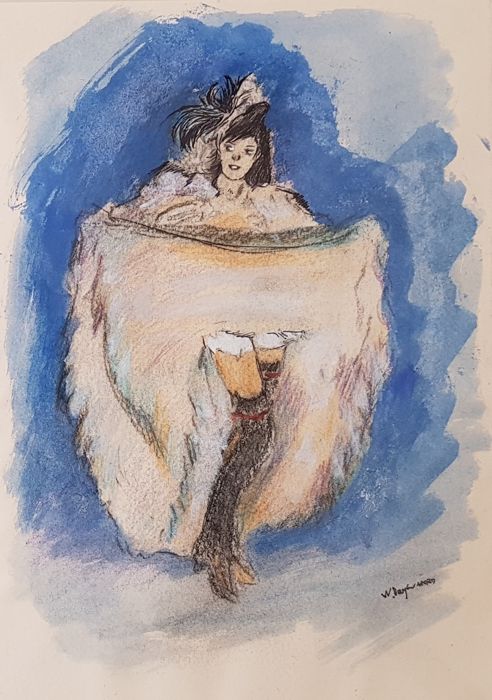
- Gerard Hordijk – French Cancan from Gaîté Parisienne. – watercolour and gouache on paper, 26 x 34 cm – Dolf D. van Omme, Amsterdam
- Willem Dooijewaard – Cancan dancer – c.1920-30 – watercolour with crayon
Fast forward to 1984. Anton Heyboer, an artist living in a rural village just north of Amsterdam, renounces the art establishment and the art market in general. After a successful international career, Heyboer, who has decided that the public should experience art as part of their daily life, churns out large numbers of inexpensive artworks readily available to the masses. He works rapidly; an artwork is accomplished within a few minutes. Heyboer, who lived in a commune with his sometimes four, sometimes five brides, painted an extensive series of chickens, women, dancers and most especially can-can dancers. Below just a few examples; there are many more on the internet.

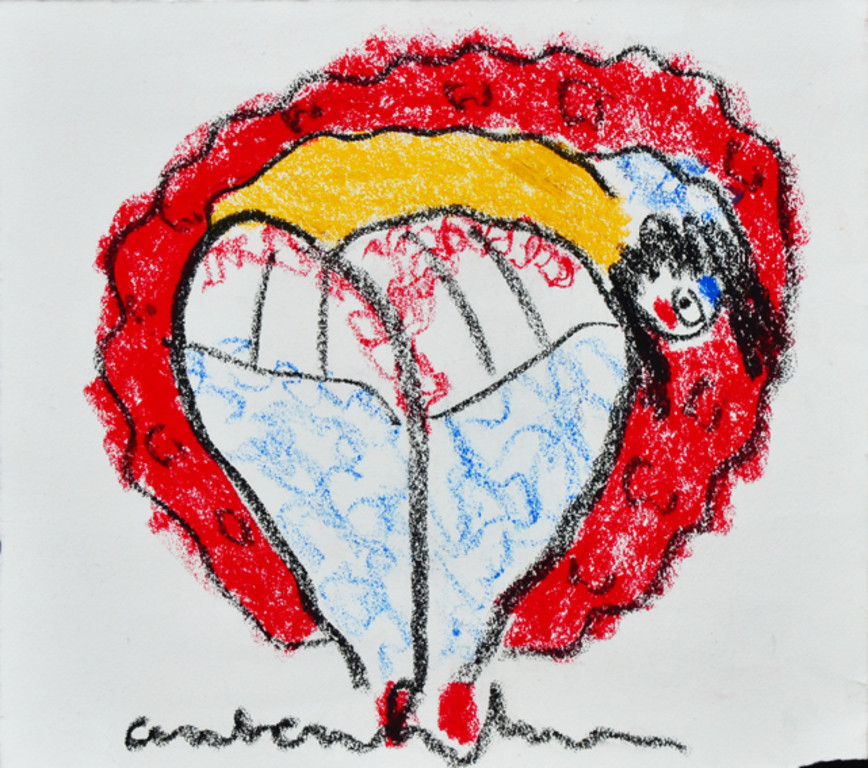


Anton Heyboer was certainly familiar with the can-can. These endearing figures perform high kicks, dance in a chorus line and even turn their backs to the viewer, lifting their skirts to display their derrières. Whether he worked in pastel, oils, crayons, or watercolours, Heyboer always composed a sexy dancer with rounded legs and well-proportioned breasts complete with red nipples. Contrary to Anton Heyboer’s original intentions, these artworks today, not surprisingly, are no longer inexpensive.
During a visit to the Museum Prinsenhof, Delft, I happened to come across a very unexpected use of the cancan. A tile-tableau by Leon Senf (1860-1940) , well-known designer and ceramic artist, shows a cook, a maid and perhaps a salesman dancing a can-can like choreography, with a bottle of Delft oil ‘as the dance master’. This delightful advertisement for a French/Dutch salad oil company reminded me of Toulouse-Lautrec’s poster for the Troupe de Mlle Eglantine. Senf’s work is far more reserved and the dancers are far from sexy ladies, but the frivolous can-can unmistakably reaches prospective customers.

The can-can is and remains Parisian cultural heritage. The high kicks, the cartwheels, the splits, the jumping round with the foot high in the air, the ruffling of the skirts, and the mischievous suggestiveness has captivated the creativity of so many artists, national and international. The inexhaustible can-can has branched out worldwide, inspiriting all art forms; the can-can has inspired artists, composers, choreographers, filmmakers, and has enraptured many a Dutch artist.


 DANCE IMAGES IN THE ART OF THE NETHERLANDS

_1895-6.jpg)