Paris, the City of Light, was the place to be; the Parisian art world, at the turn of the 20th century, was adventurous and innovative. Artists explored new avenues, exploited new themes and were inspired by the invention of electric light. Various Dutch artists, Kees van Dongen, Leo Gestel, Jan Sluijters, and Kees Maks, were drawn to Paris; at that time, the most modern city imaginable. They, as their artistic predecessors, Manet, Degas, Toulouse-Lautrec, painted subjects of everyday life, the boulevards, the cafés, circuses, theatres, cabarets, and dance halls. The infamous dance hall Le Moulin de la Galette was immortalized by Renoir and inspired many artists including Toulouse-Lautrec, Picasso, Isaac Israëls, and Kees van Dongen.
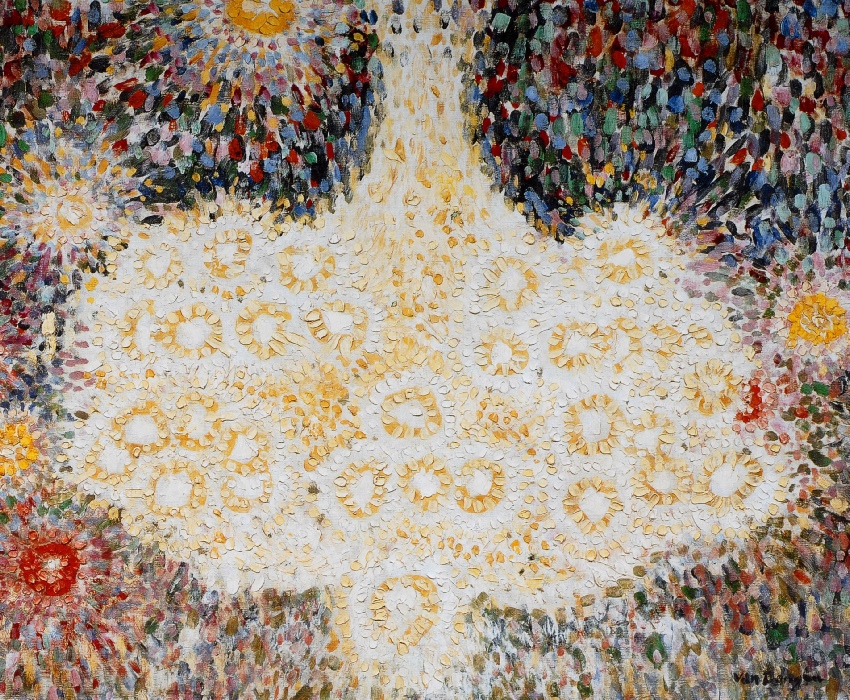
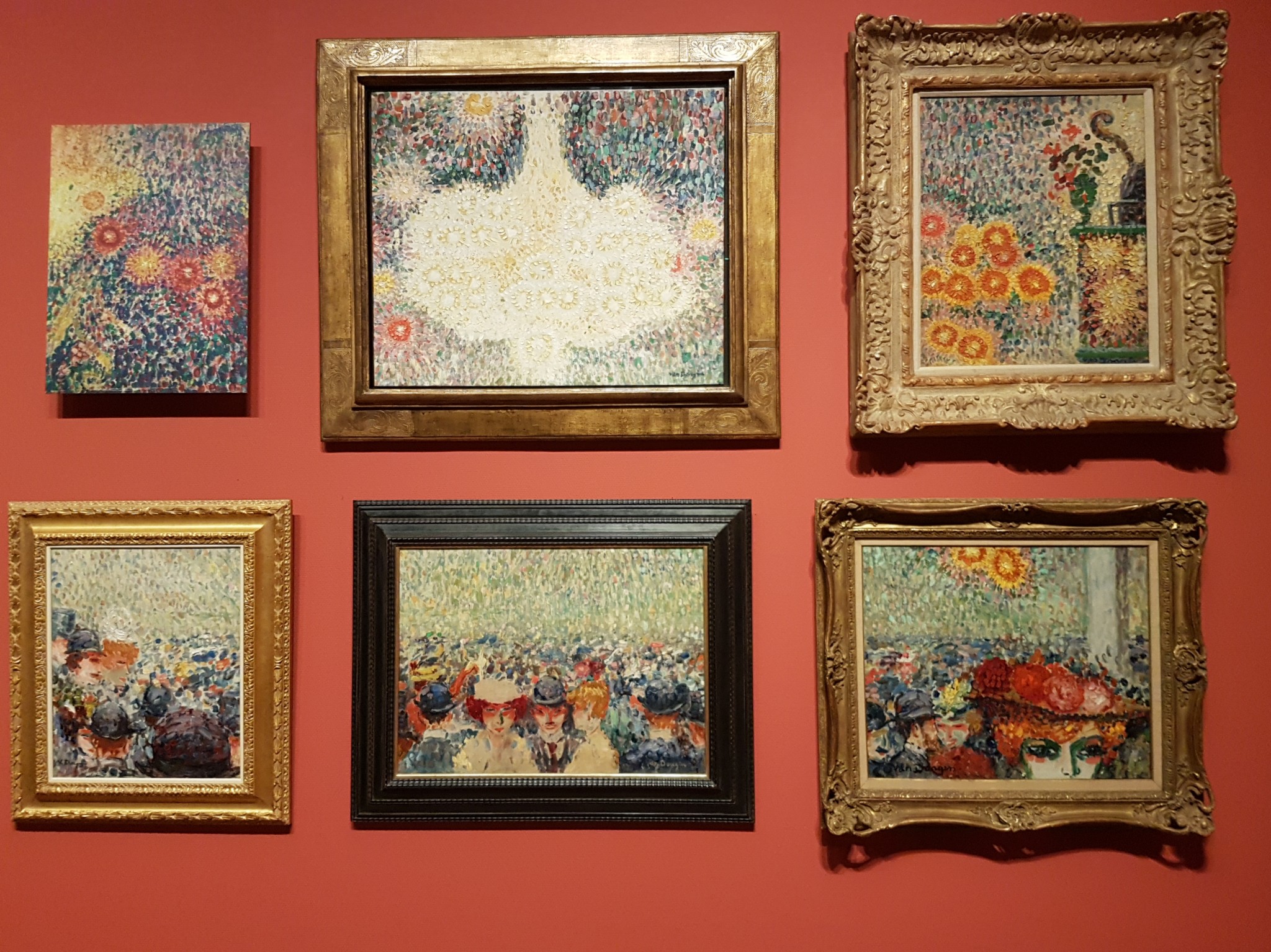
Kees van Dongen arrived in Paris just before the turn of the century. The exuberant Parisian nightlife, the exhilarating dance halls, inexhaustible dancers, and scintillating electric light became the ingredients for his monumental work, Le Moulin de la Galette. This painting, an essay in pointillism, was both praised and admired but also heavily criticized. The image shown below, a feast of flickering electric light, formed by short dots, dashes and stripes, was the pinnacle of modernity. This image, Le Lustre, of a chandelier is but one segment of the larger work which, in the 1950s, was divided into six segments. The second image in the slide show gives an impression of the original work which Van Dongen entered at the Salon des Indépendants in 1906.
Jan Sluijters, winner of the Prix de Rome, re-visited Paris in 1906. The young Sluijters, ambitious and fervent, eagerly acquainted himself with Parisian nightlife, visiting Le Moulin de la Galette and Bal Tabarin. Despite, his obligations in regard to the prestigious Prix de Rome, Sluijters embraced the avant-garde art world. Fortunately, he was in Paris at the very moment that a group of avant-garde artists, later known as Fauvism artists, exhibited their trailblazing work. Sluijters, more than likely, spotted Van Dongen’s original rendering of Parisian nightlife at the Salon des Indépendants exhibition. It did not take long before Sluijters, forgoing his academic training, chose the path of the French avant-garde.
Parisians flocked to the immensely popular dance hall, the Bal Tabarin. There, under an abundance of dazzling electric lamps, merrymakers danced, enjoying the cabaret and the sensational cancan dancers. Sluijters was mesmerized by the overpowering electric light, which was so much brighter, more vivid than the old world gaslight. His innovative spirit was aroused; Sluijters explored the possibilities of creating the illusion of electric light in various paintings and studies, including Café de Nuit, Café de Nuit (Bal Tabarin) as well as in a preliminary study for Bal Tabarin.
In 1907, he presented his stupendous work Bal Tabarin. Sluijters choreographed a galaxy of electric light; ribbons, garlands, circles, and spheres of white and coloured light seizing more than the upper half of the painting. The vibrant light towered above untold revellers; some couples dance, others drink and dine, and all relish under a celebration of illumination.
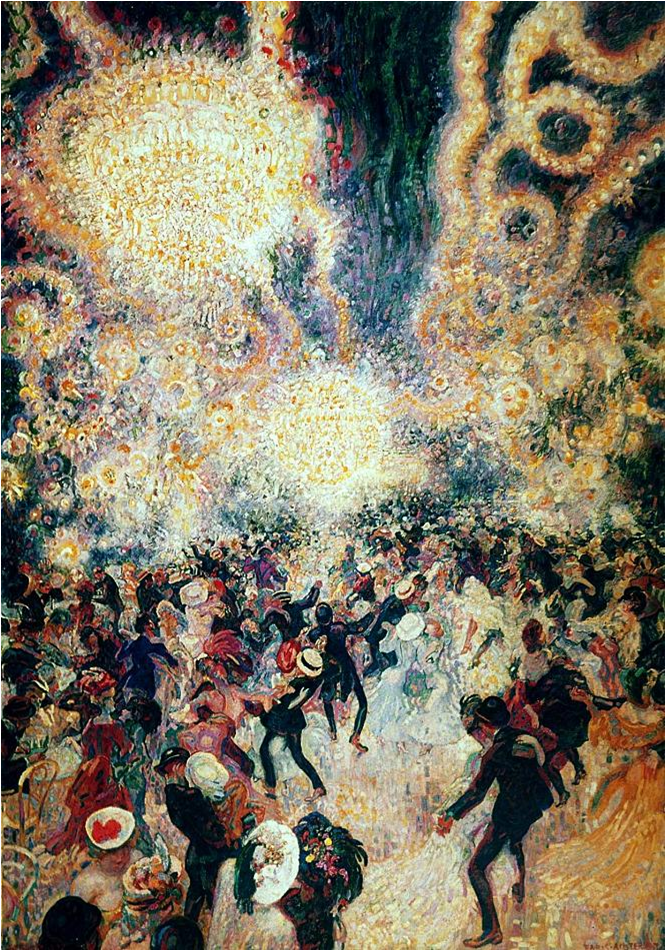
What a feast! People are dancing all around. The ambience is spontaneous; all present are fun-loving, enjoying themselves after a long day’s work. The ladies are draped in their best wardrobe; elaborate dresses and the fanciful hats that, more often than not, resemble plumage appear everywhere. The dancers are frisky, dancing to the rhythm of a very sprightly melody. The orchestra is probably playing an energetic cancan; on the right, not far from the two amorous couples, professional dancing girls are kicking their legs into the air.
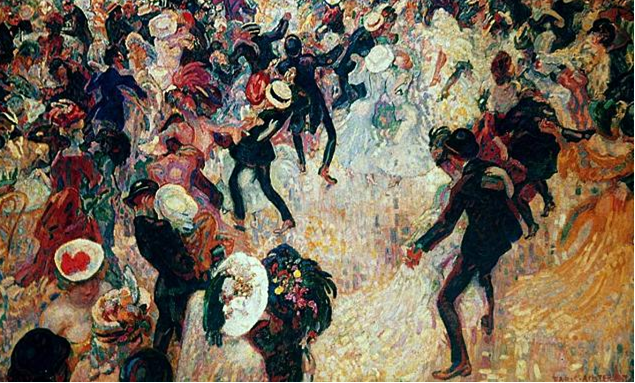
Sluijters has placed the party goers in the lower section of the painting. The front figures are distinguishable, but, as you progress into the light, all that remains is an indecipherable group of dots and dashes where, from time to time, a straw hat, an embracing arm position or a flurry of feathers can be discerned. Yet within this myriad of dancing figures, many of the front couples are unique. Each couple, dances, dresses, and interacts in their own explicit way. Through a passage of light, Sluijters paves the way towards two very endearing women, their faces nearly touching. Probably, if their widely extended skirts are any indication, they are whirling around. Just behind them, there is a couple performing a passionate dance; the man leaning decisively forward over his partner. In the front right corner, a man and woman swirl in the picture, her flowing orange-red dress catching the light. And just in front of them are two couples dancing, where you can only guess what the rear man is doing. I have no intention of describing every dance couple, but I must mention one specific couple; the tall lady in the glamorous red dress and striking hat dancing next to a woman who appears to shrink under her overpowering glance. Sluijters used these characters in various drawings and paintings, most especially in Femmes qui s’embrassent, a painting that nearly cost him the Prix de Rome scholarship.

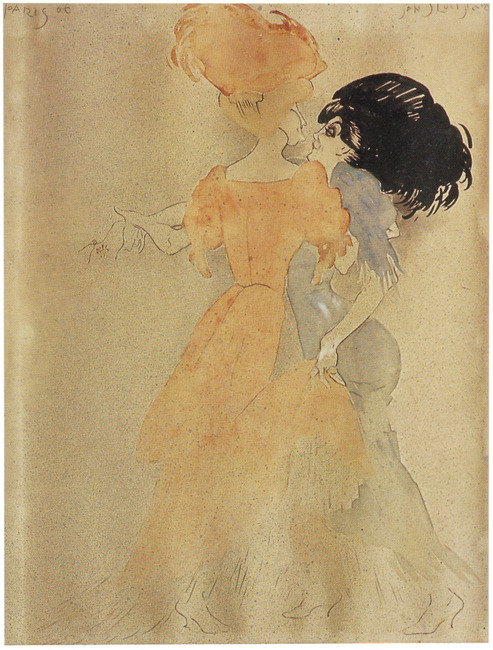
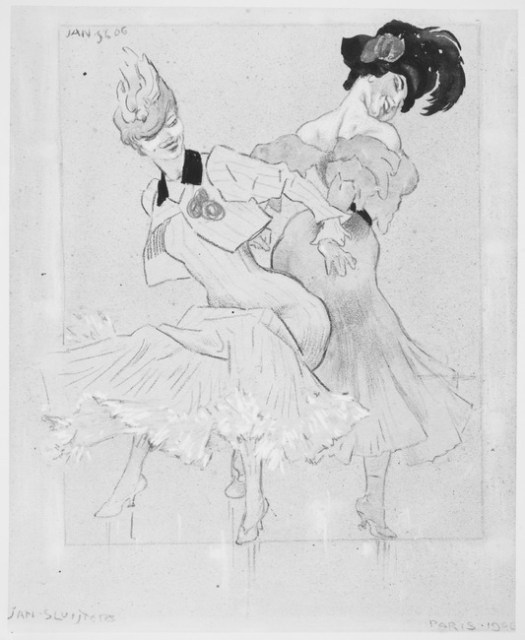
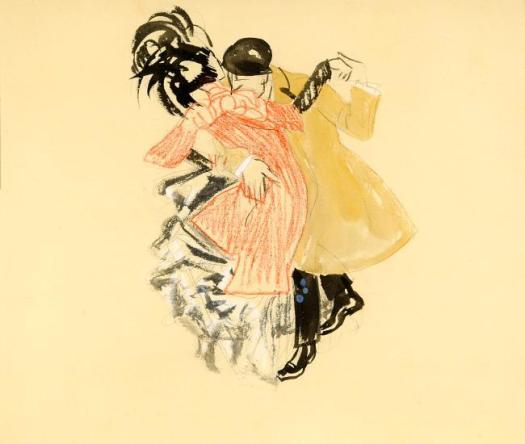
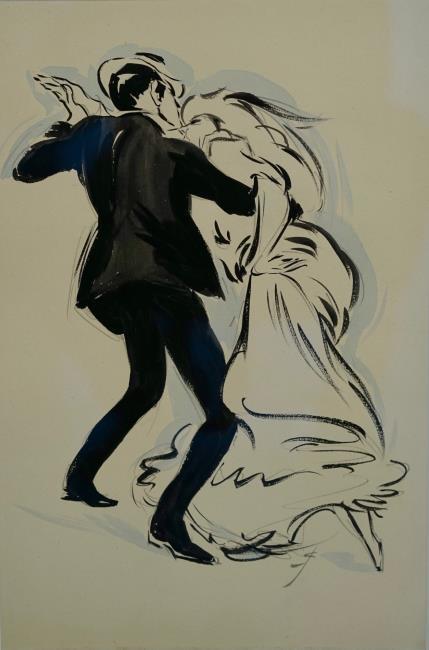
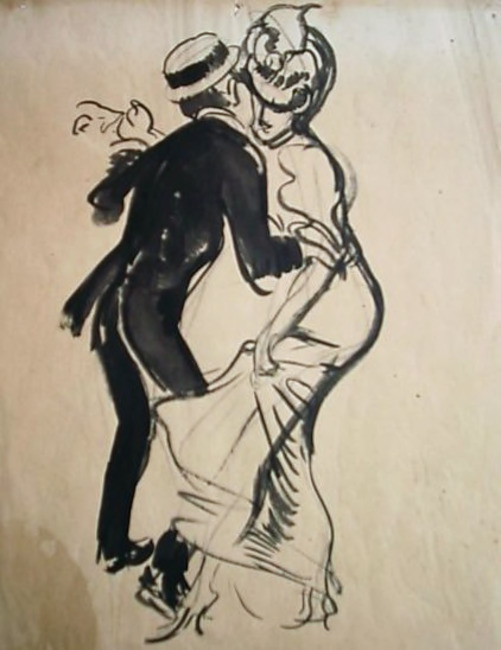
Sluijters, as I discussed in my previous post, was a meticulous artist. Bal Tabarin may appear to be a spontaneous work of art, but in reality Sluijters developed it over a period of time. He prepared multiple sketches and drawings of dancing figures, often in a large series, and many of these eventually appeared in Bal Tabarin. The above images are but six of the many sketches and drawings Sluijters designed in preparation for his dance hall paintings. All the images are dated 1906. Some are near identical examples of the dancers in Bal Tabarin. Others closely resemble, both in character and style, the dancing figures of the final painting. Sluijters must have patiently observed the dancers for hours on hours. It is easy to imagine him, sitting at a wooden table in some corner of the Bal Tabarin, swiftly sketching various poses, characters, gestures, facial expressions, and different styles of movement; the loving and tender, the dashing, the passionate, the brazen, the daring, the intimate, and the immodest all flowing freely from his hand.
Bal Tabarin, now housed in the Stedelijk Museum in Amsterdam, was brutally criticized by the Prix de Rome committee. Not only had Sluijters, according to the committee, renounced sound academic art principles, but had chosen for the French avant-garde, accepting wild new colour schemes combined with raw passion.*The scholarship was revoked.
Sluijters interest in dance gradually dwindled. It was not until around 1918, when the German expressionist dancer, Gertrud Leistikov, toured the Netherlands that his interest in dance and dancers was rekindled, resulting in an extraordinary series of dance compositions, but this is a subject for a future post.
* A section of the committee report freely translated by me.


 DANCE IMAGES IN THE ART OF THE NETHERLANDS

