David Teniers the Younger (1610-1690) was a leading 17th-century Flemish artist, celebrated for his depictions of rural life. Dance and dancers occupied a pivotal role in his images of wedding celebrations, village life, and tavern scenes. In fact, he painted more peasant dance scenes than any other artist of his time. Apart from his many single-theme genre paintings, Teniers the Younger, following in the footsteps of his predecessors, also combined peasant scenes with sweeping landscapes.
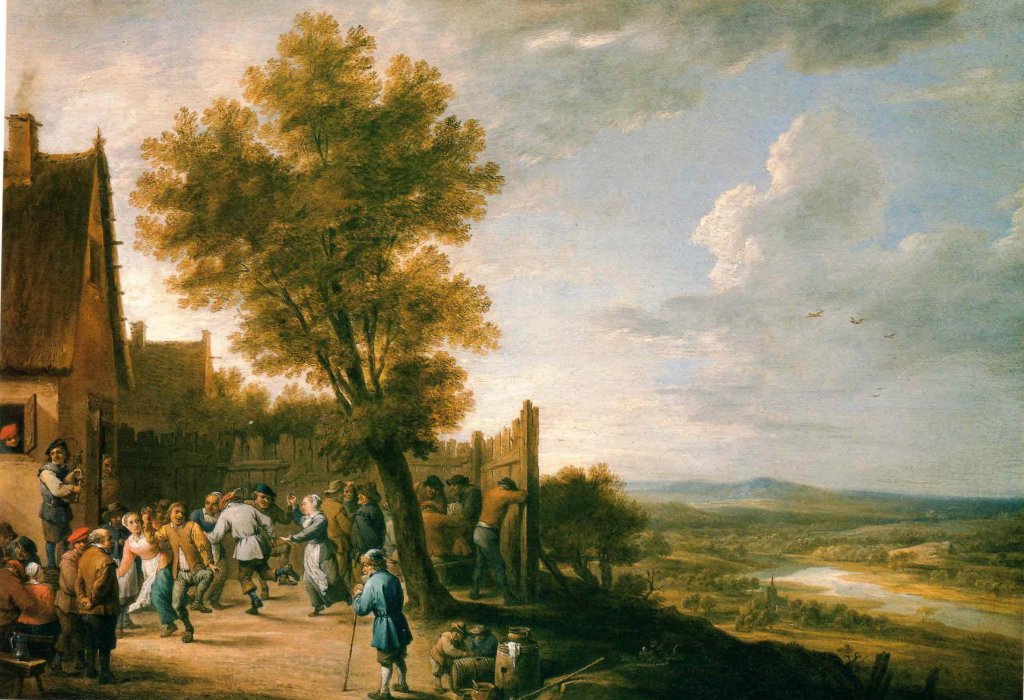
Village Dance overlooking a River – oil on canvas – 58.4 x 83.8 cm – 1648-49 – private collection, Wikipedia
The composition of Village Dance overlooking a River is divided into two sections. The villagers are located on an elevated hilltop, and a tall fence forms a natural division to a lower level, guiding the viewer to an overwhelming panorama. The two sections are independent, yet unified by the grand oak. Its roots are firmly planted in the peasant scene, while the foliage extends into the sky. The landscape, as typical of early Flemish art, is painted with remarkable precision. Teniers’ attention to detail manifests itself in a broad landscape featuring a village church, rows of trees, wide riverbanks, and a river that meanders into the distance.
Tenier’s painting is undoubtedly inspired by the work of his father-in-law, Jan Brueghel the Elder. Brueghel’s work, Dance on a Village Street, is constructed in two separate, yet intermingled sections. In the elevated area peasants dance and make merry. Moving further back along the street, you can see a church, a congregation, and tavern guests. The architecture and the trees are all delicately rendered. As in Tenier’s work, the large oak forms a natural transition from village to landscape. Likewise, in both works, the village scene is painted in earthy hues, while the landscape is primarily a bluish-green tint. The translucent clouds, masterly painted by artists of the Low Countries, embellish both works.
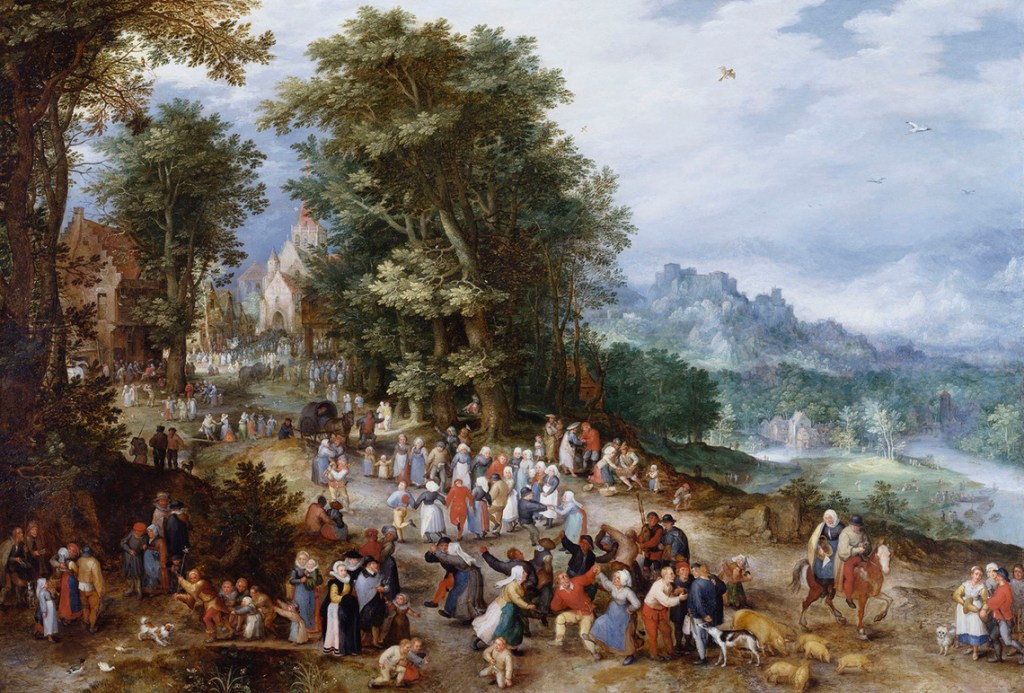
Dance on a Village Street – oil on copper – 47.5 x 68.6 cm – 1600 – Royal Collection Trust, London
The similarities between Brueghel and Teniers are obvious, though the latter has subtly reimagined his predecessor’s composition. Brueghel’s work, Dance on a Village Street, is populated with a myriad of small figures, urging the viewer to explore every detail of the artwork. Each figure or group of figures tells their own narrative. There are children playing, people on horseback, a line dance, and couples cavorting, but none of the figures have visual contact with the viewer. That is logical, of course. We, the viewers, are standing on a high vantage point, gazing down at a street full of bustling activity. In contrast, Teniers positions the viewer at a significantly lower level. There are fewer figures, and each comes to the foreground. The peasants feel nearly real and identifiable as distinct people. And, you will have noticed, the peasant wearing a red cap, a well-known figure in Tenier’s art, gazes directly at the audience.
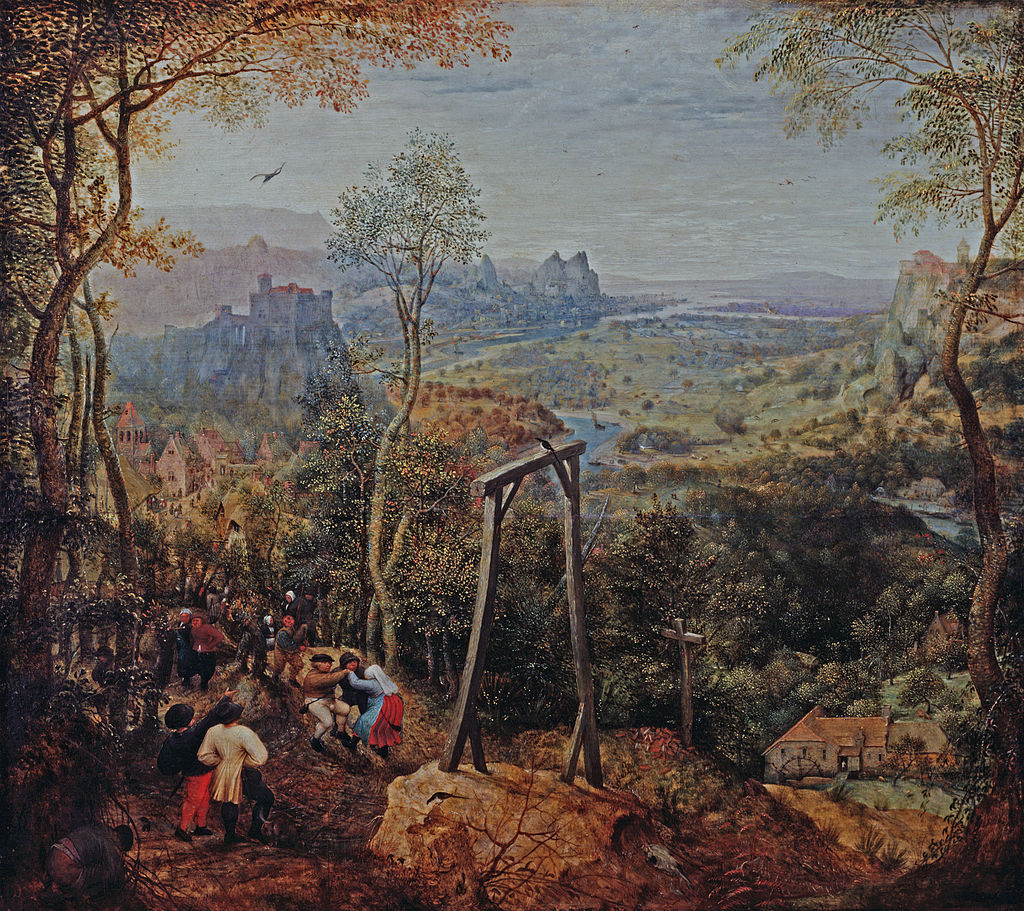
The Magpie on the Gallows – oil on wood panel – 45.9 x 50.8 cm – 1568 – Hessisches Landesmuseum, Darmstadt
One of the earliest paintings that synthesises dance and landscape is by Jan Brueghel’s father, Pieter Bruegel the Elder. The unique artwork, The Magpie on the Gallows (1568), was painted at a time of political, social, and religious instability. If, for a moment, we disregard the gallows and the provincials, we find ourselves in an enchantingly serene landscape.
The Magpie on the Gallows was one of Bruegel’s last, if not his last, works. In both The Wedding Dance and The Peasant Dance, Bruegel revolutionised art by depicting large dancing figures, not from a bird’s eye perspective but practically from a frontal view. In The Magpie on the Gallows, Bruegel has chosen a high vantage point, encouraging the viewer to contemplate the serenity of a timeless landscape and, in the same instance, confront them, metaphorically, with the perils that the people of The Low Countries were subjected to.
Fast-forward to the early 17th century. The Flemish landscape artist Lucas van Uden (1595-1672) worked alongside prominent artists including Jan Brueghel the Younger and David Teniers the Younger; Van Uden staged the landscape, and his associate painted the staffage. Traditionally, these minute peasants and animals were not the main focus; rather, the figures decorated and added interest to the scene. The paintings below are a collaboration between Van Uden and Teniers the Younger. In both works, an idyllic panorama roams on endlessly. The blue sky and the green valleys occupy at least half of the painting. A gentle diagonal line forms the divide between a plateau and the lower, more distant fields and sky. The higher section, which is closest to the viewer, is illustrated using earthy hues. Teniers painted the peasants at work and play.
It is fascinating to compare the following, quite similar, paintings that display Teniers’ innovative approach to the representation of figures within landscape painting. Unfortunately, neither piece is dated, rendering it impossible to accurately position these works within the artistic evolution of Teniers the Younger.
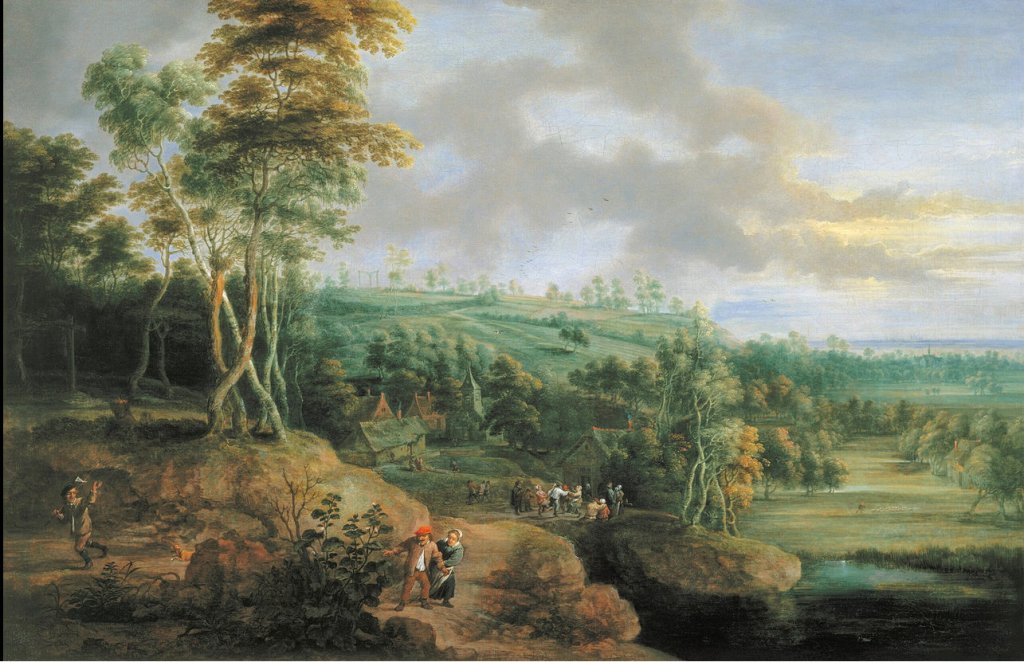
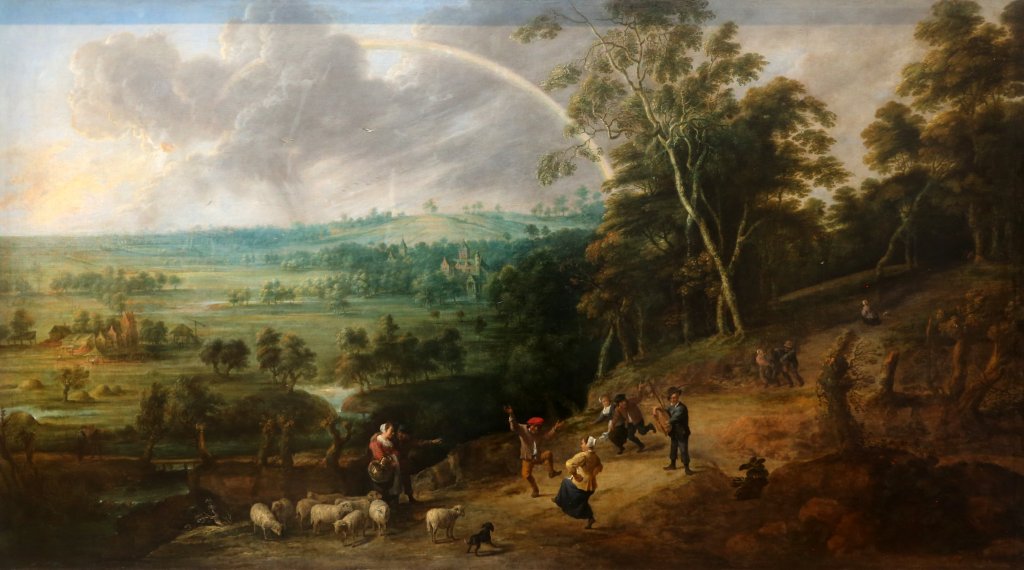
Above: Landscape with a village feast in the background – 82.5 x 127 cm – Hoogsteder & Hoogsteder, The Hague
Below: Peasants Merrymaking – oil on canvas – 122.2 x 218 cm – date not given – National Gallery of Ireland
You may have observed that in Landscape with a village feast in the background, the peasant figures are active on two levels. On the lower level a group of peasants are performing a circle dance. These tiny dancers, together with the musicians and village folk, merely enhance the setting. That cannot be said of the couple in the foreground. They are placed in the spotlight. These figures definitely contribute to the narrative. Questions spring to mind. Is the man drunk? Is the woman ushering him home? Is the man with the dog waving at them? Whatever the case may be, these characters do not qualify as staffage.
In Peasants Merrymaking, Teniers places considerable emphasis on the animals and figures. The sheep are distinctive, as are the white collars and caps of the women. Midway up the hilly slope, a man and a woman support an intoxicated figure who is unable to stay upright on his own. However, for all the activity, it is the dancers that are most apparent. A lively couple runs downhill, greeting the bagpiper as they pass by. The main figures, a rustic couple, are positioned in the foreground. The boorish fellow wearing a red cap throws his arms roughly into the air. He and his vivacious partner hop and bounce, thrusting their legs robustly into the air. These figures are definitely a fundamental aspect of the narrative.
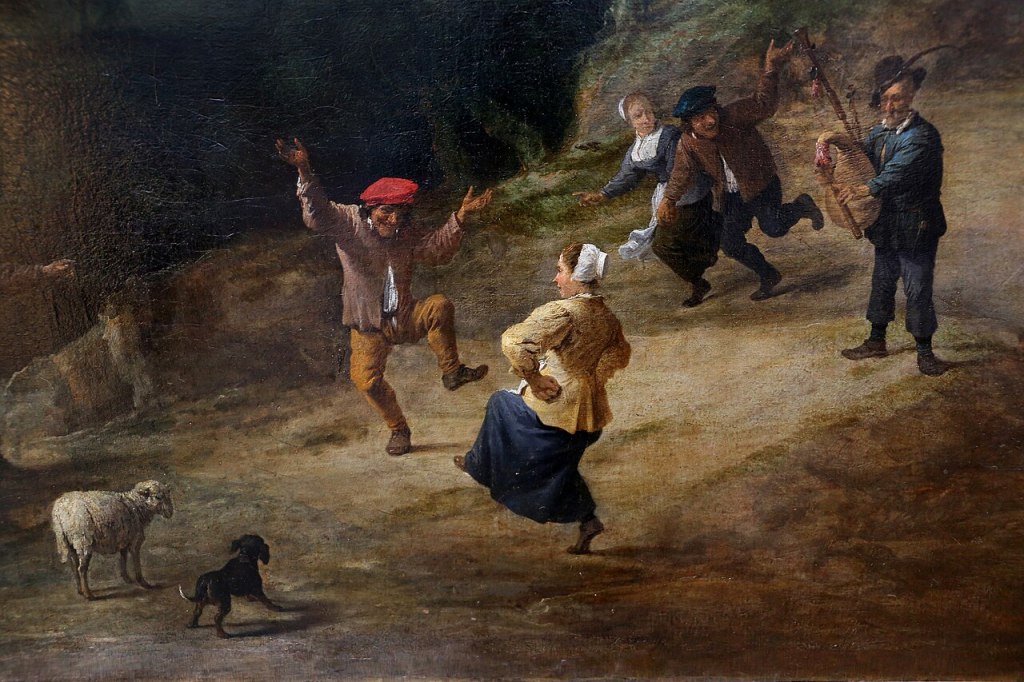
detail of Peasants Merrymaking – oil on canvas – 122.2 x 218 cm – date not given – National Gallery of Ireland
In the following work, Peasants dancing outside an inn at Perck…, Teniers places the dancers at the centre of attention. The typical Teniers dancer, wearing a red cap, has a friendly smile for the viewer. His lovely companion only has eyes for him. Her fleeting white apron not only catches the light but also indicates the sprightliness of the couple’s dancing steps. The familiar bagpiper stands on a beer barrel, surrounded by Teniers’ well-known characters. You will recognise the peasants enjoying a meal, the fellow with a red cap peeping out of the tavern window, and the old woman escorting her intoxicated husband home.
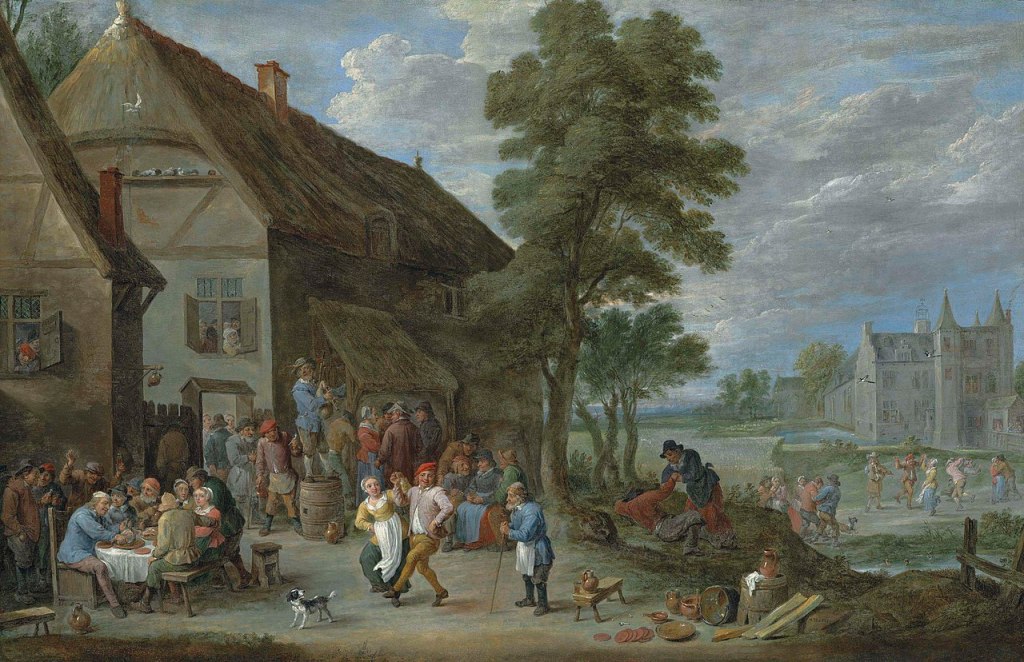
Peasants dancing outside an inn at Perck, with the Kasteel de Drij Toren beyond – oil on canvas – 63.5 x 98.4 cm – circa 1680 – Private Collection, Christie’s
The festivities occur at an elevated level, in the foreground. The viewer is near enough to discern the facial expressions of the various characters. The villagers are mainly rendered in blue and red, which contrast with the earthy tones for the tavern and land. Approximately halfway across the painting, a shallow ridge and a tall tree divide the village area and a broad landscape. In front of the Kasteel de Drij Toren, once Teniers’ estate, more peasants are dancing. A close view reveals that the accompanying musician is dressed like a gentleman and appears to play a sophisticated instrument, perhaps a violin or a vielle. As the gaze shifts beyond the castle, Teniers reveals a vast sky above a tranquil panorama.
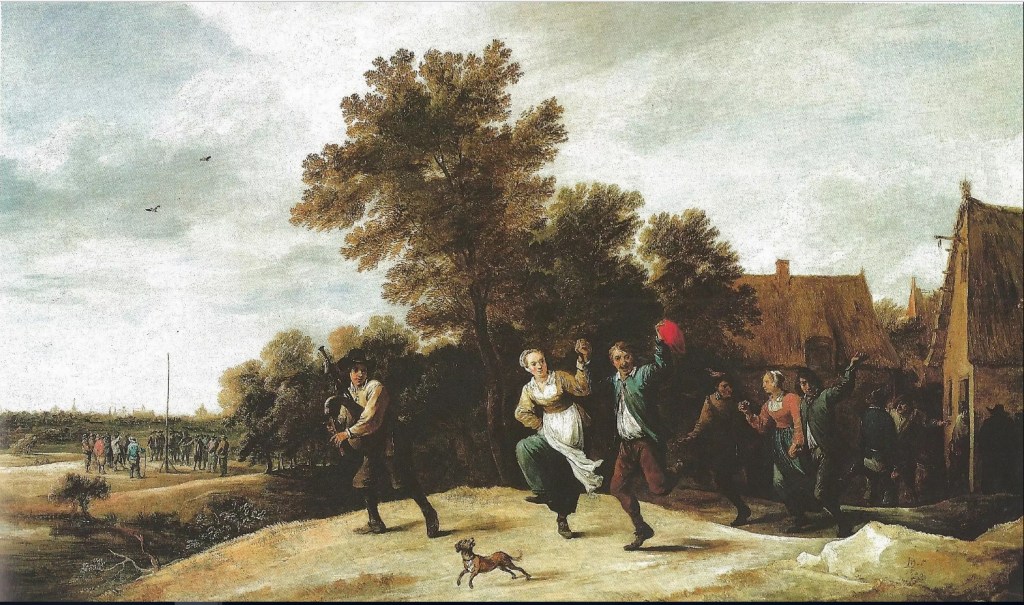
Bagpiper with Dancers – oil on canvas – 113 x 187 cm – 1649 – David Koetser Gallery, Zürich
The dynamic of Bagpiper with Dancers is compelling. Teniers directs the viewer’s attention to the couple dancing downhill while simultaneously guiding their gaze toward the landscape. Equally striking is the contrast between the small group of energetic dancers in the foreground and the large group of archers standing quite motionless in the distance. The front figures are depicted realistically. The archers, on the contrary, are small, anonymous figures. They are participating in a traditional Flemish game and serve as staffage. Teniers employs light in a specific and purposeful fashion. The houses and trees, just as the people standing near the door opening, lack illumination. The greater part of the front level is shaded. Only the dancing couple, the bagpiper, and the dog enjoy the sunshine. Teniers reserves the light for the distant landscape. The low horizon offers a magnificent aerial perspective. Bagpiper with Dancers, painted in 1649, confirms Teniers’ prowess as a landscape and figurative artist.
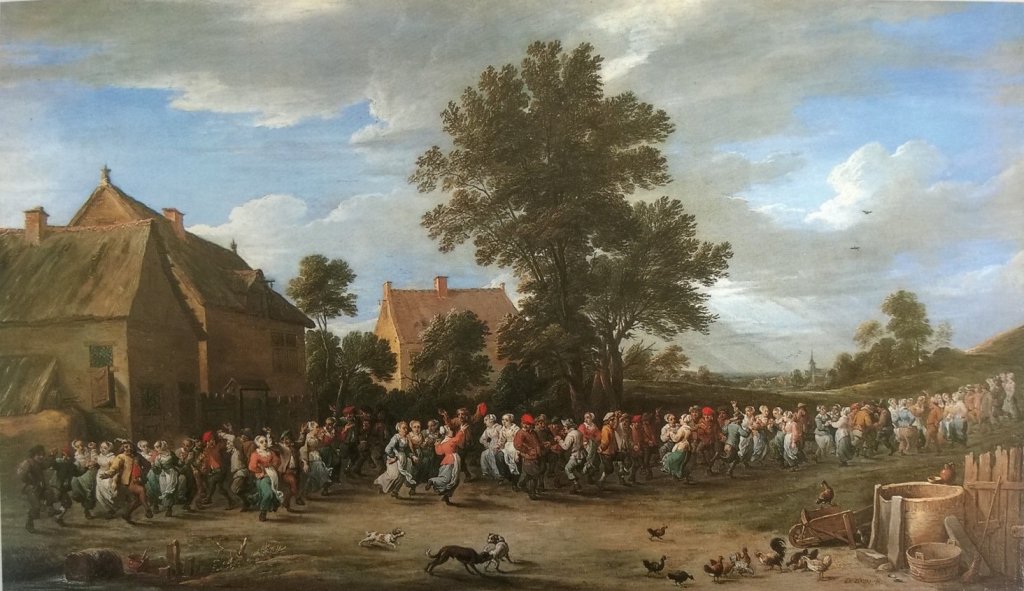
The Village Holiday – oil on canvas – 54 x 93 cm – 1660 – Virginia Museum of Fine Arts
Teniers painted The Village Holiday while serving as court painter for Leopold Wilhelm, the Austrian Archduke. It is a unique work within the artist’s oeuvre. This artwork features seventy or more peasants, and all these figures are dancing. There are no innkeepers, no peasants enjoying a meal, no old men, nor any other characters typical in Teniers’ pieces. The procession of exuberant villagers, skilfully arranged, consists of joyous rural dancers. Elements frequently found in Teniers’ artwork — a drunken man or a patron relieving himself against a wall — have been removed. Presumably, even comical representations of these ‘human traits’ were deemed inappropriate as decoration on the walls of the archduke’s castle. Teniers, however, cannot resist a subtle suggestion of sexuality; observe the two dogs in the foreground.
The procession of dancers forms a long chain across the entire canvas. Instead of relying on the familiar dance positions, Teniers has devised an entire vocabulary of original movements, including groups of women dancing together and peasants hopping and bouncing unaccompanied. Common to all dancers is an earthbound quality. Only occasionally do the hands and arms rise above waist level. The long row of dancers occupies the lower third of the canvas, leaving the viewer ample space to enjoy the vast landscape embellished with a church spire and a meticulously rendered village. The birds soaring just over the village and the larger birds frolicking near the clouds attract the observer to the vast skyscape.
Teniers rendered the peasant folk as humble and impoverished, but nonetheless delightful. This is exactly how the aristocracy wanted to perceive the country people. Teniers’ light-hearted dance paintings, bearing a touch of impropriety, were extremely fashionable. David Teniers the Younger, court painter in Vienna, was, as no other artist, the master of diverting genre art.


 DANCE IMAGES IN THE ART OF THE NETHERLANDS

