The tale of Saint George slaying the dragon is woven into Christian tradition. In numerous regions across the globe, the twenty-third of April is celebrated as the Feast of St. George. In the Middle Ages and Renaissance, the inhabitants of the Low Countries, while faithfully honouring this Christian festival, also saw an opportunity for boisterous festivities. The picturesque villages were filled with peasants drinking, flirting, dancing, and amusing themselves with all things unholy. The Feast of St. George became a popular art theme. Flemish artists from Pieter Bruegel the Elder to the followers of David Teniers the Younger depicted wondrous scenes of villagers partaking in these annual celebrations.
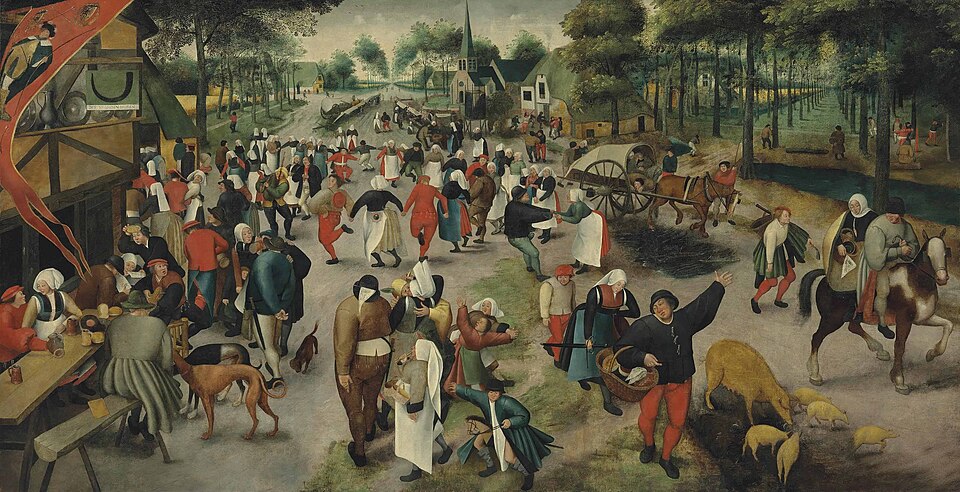
Saint George’s Day – oil on canvas – 131.1 cm x 270.5 cm – date unknown – Christie’s / private collection
Imagine standing on a hilltop and looking down onto a village square where people are celebrating the holiday of St. George. The sphere is bustling. In one corner of the square people are watching a play. Other people are going to church, and yet others are busy at the market stalls. There are also peasants fighting, men on horseback, children playing, animals scampering, and rustics partying, drinking, and dancing. 16th-century Flemish artists such as Pieter Bruegel the Elder, Hans Bol, Martin van Cleve, Peeter Baltens, Gillis Mostaert, and Jacob Grimmer all depicted the Flemish festival from a bird’s-eye perspective. Dance features in all the artworks.
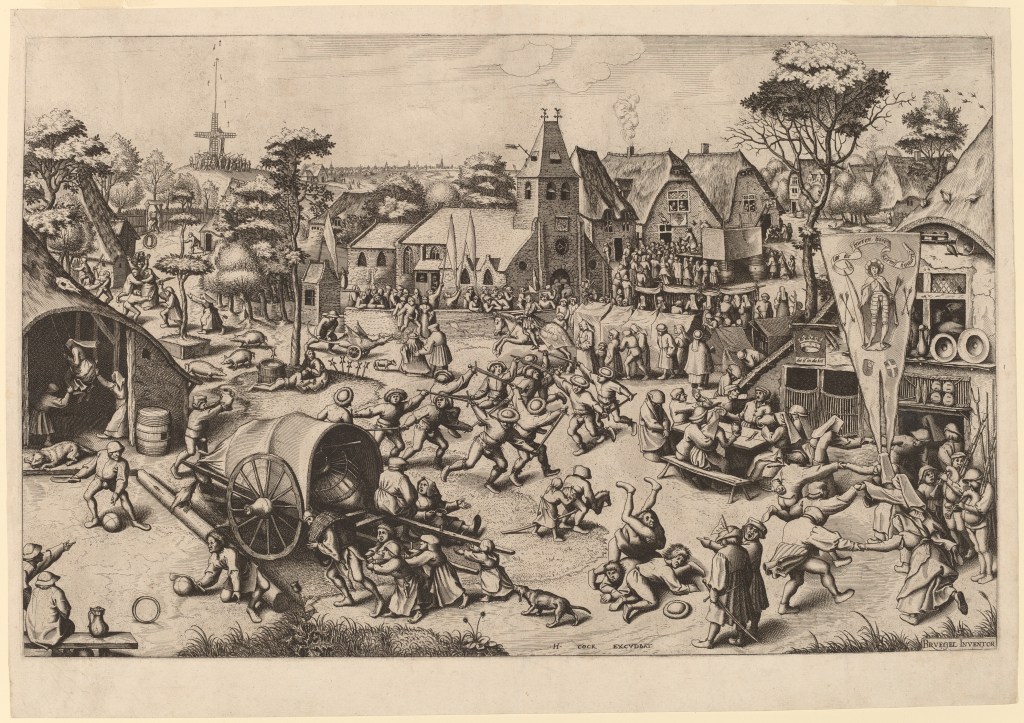
The Festival of Saint George – etching & engraving – 32.9 cm x 52.3 cm (plate) – c.1561 – National Gallery of Art, Washington
Turning to Bruegel’s work, the pennant featuring an illustration of a knight designates the feast of St. George. Besides the church procession, open-air theatre, children playing on a stick-horse, and the usual fighting, drinking, dancing, and playful misbehaviour, the townspeople re-enact the heroic tale of St. George and the Dragon. A knight on horseback is depicted in the centre of the etching, engaged in a mock battle with a “ferocious” dragon. Bruegel has incorporated two different dances in this vibrant village scene: a couple dance and a sword dance. In the lower right-hand corner, four couples dance side by side. Their animated hops and skips lead them to the local tavern. Two country bagpipers are located near the tavern door. Particularly noteworthy is the well-dressed man at the front. He seems misplaced. He gazes directly at the viewer, seemingly to comment on the exuberant goings-on.
Bruegel’s work embodies one of the earliest known images of a sword dance. The exact origin of this technically challenging dance is uncertain, but it is often linked to the St. George celebrations. Dancers, wielding swords, manoeuvre themselves into intricate snake patterns or form star and rose configurations. In this print, the dancers arrange themselves in two opposing groups to construct a tunnel-like design. There is no musician. Instead the dancers wear bells around their ankles and calves. Their clinging provides the necessary cadence. Additionally, the men’s rhythmic stamping serves to regulate the tempo.
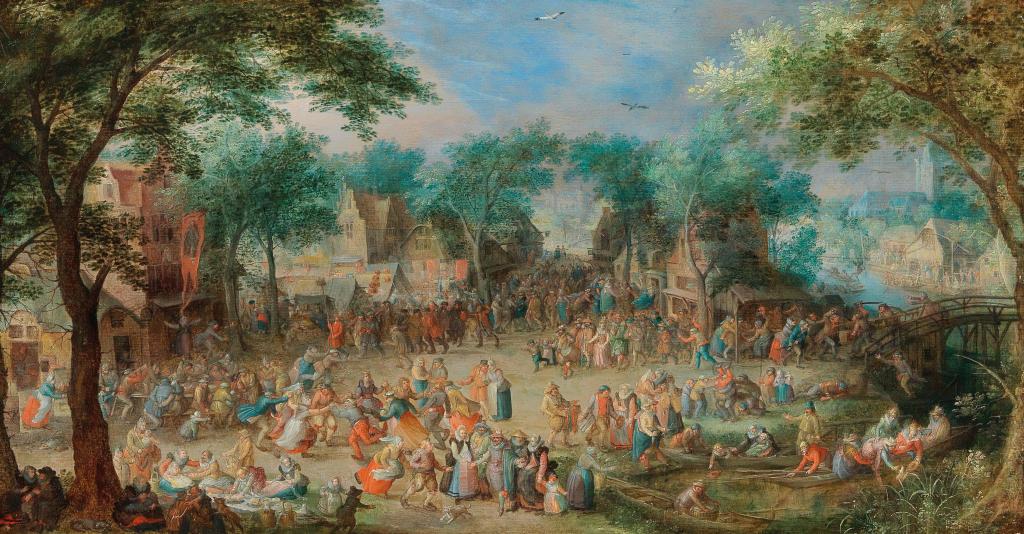
St. George’s Kermesse – oil on oak panel – 41.5 cm x 77 cm – before 1604 – Dorotheum/private collection.
The view is spectacular. David Vinckboons (1576-1632) presents a panoramic scene of a festive village and the surrounding landscape. The artist uses a unique colour scheme. The orange, green, beige and brown tones, assigned to the majority of figures, blend subtly into the blue/green background. The red pennant displayed on the tavern’s flagpole signifies the celebration of St. George. The viewer, as so often seen in 16th- and 17th-century festive scenes, occupies a high vantage point to look down on a myriad of events.
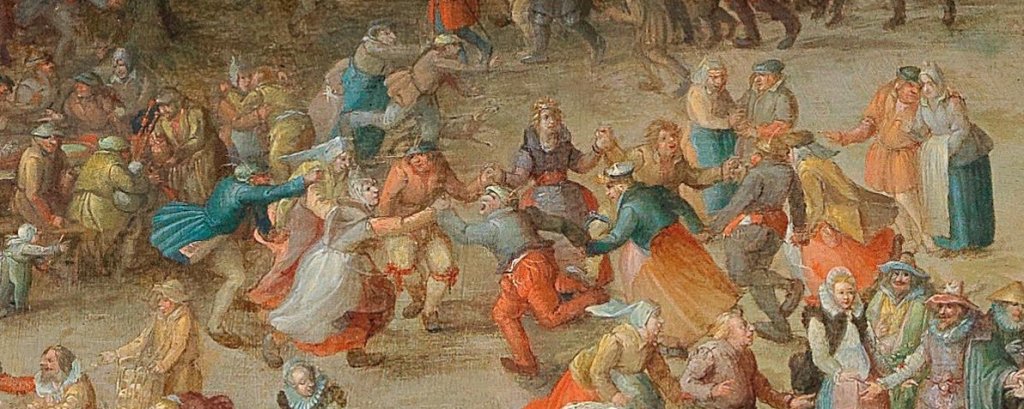
St. George’s Kermesse (detail of circle dance) – before 1604 – Dorotheum, private collection
The dancers are merely one element in Vinckboons’ crowded painting. They blend into the overall view. I have therefore included a close-up that highlights the briskness and rowdiness of the circle dance. Observe the women’s orange skirts swinging swiftly too and fro. Note too how the man in orange legwear energetically kicks his leg backward. The forward thrust of his body and his exaggerated facial expression demonstrate his absolute conviction. The ruffian beside the bagpiper is equally convincing. He fervently grips his partner’s hands, apparently to control the momentum of the circular motion.
The Kermesse of St. George by Pieter Brueghel the Younger (1564-1638) features all the typical motifs associated with a festival scene. A congregation is assembling by the church entrance. It is, after all, a sacred day. While the devout villagers enter the church, other villagers embrace, dance, fight, and drink. Brueghel the Younger even includes scatology, vomiting, and urinating for good measure.
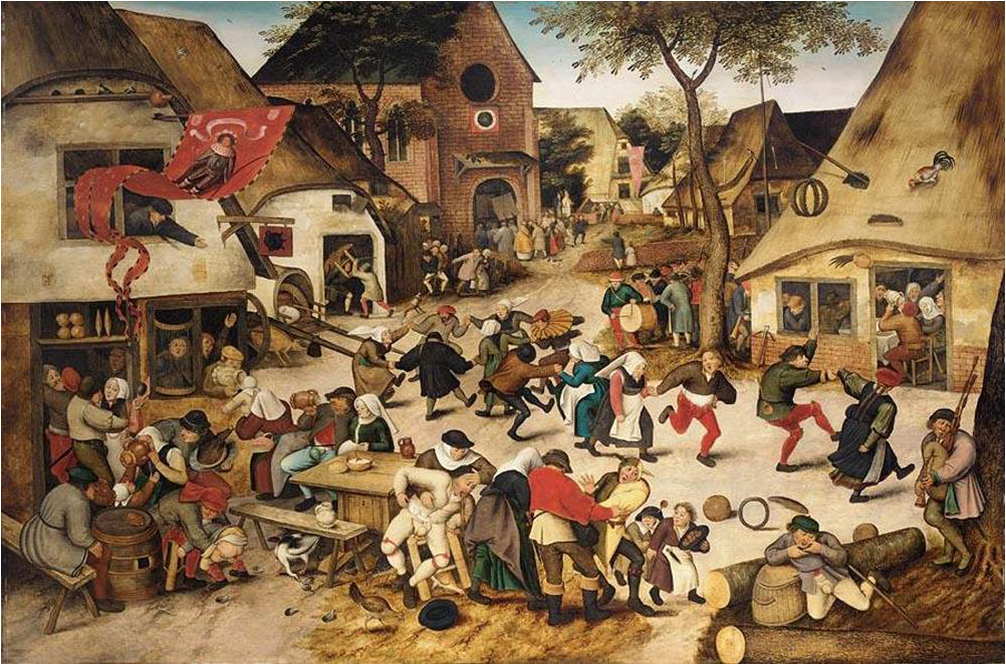
The Kermesse of St. George – oil on oak panel – 117 cm x 176 cm – 1628 – Private Collection/Web Gallery of Art
So much for the similarities. Brueghel the Younger, while maintaining a spacious perspective, has lowered the viewpoint. Additionally, there are fewer figures, and the villagers in the foreground are significantly larger. The facial expression of every figure is clearly visible, and each possesses a unique identity. Moreover, the painting is as rich in detail as it is in colour.
Two groups of dancers occupy the entire central plane: three couples dancing hand in hand and a group of capering rustics enjoying a round dance. This jolly group of rural dancers moves heavily, droops forward, and awkwardly raises their legs. To their right, the uncouth dancing pairs are just as inelegant. Their dance style and body language closely resemble the work of Pieter Bruegel the Elder. As is traditional in the depiction of festive works, a bagpiper accompanies the dancers. This particular bagpiper displays none of the enthusiasm demonstrated by the dancers.
Throughout his extensive career, David Teniers the Younger (1610-1690) created numerous paintings depicting peasant weddings, harvest celebrations, kermesses, and tavern scenes. In many of these artworks, dancers are highlighted. The demand for rural themes was limitless. Teniers followed the tradition of Bruegel the Elder and his descendants, revising this specific genre to suit the art market.
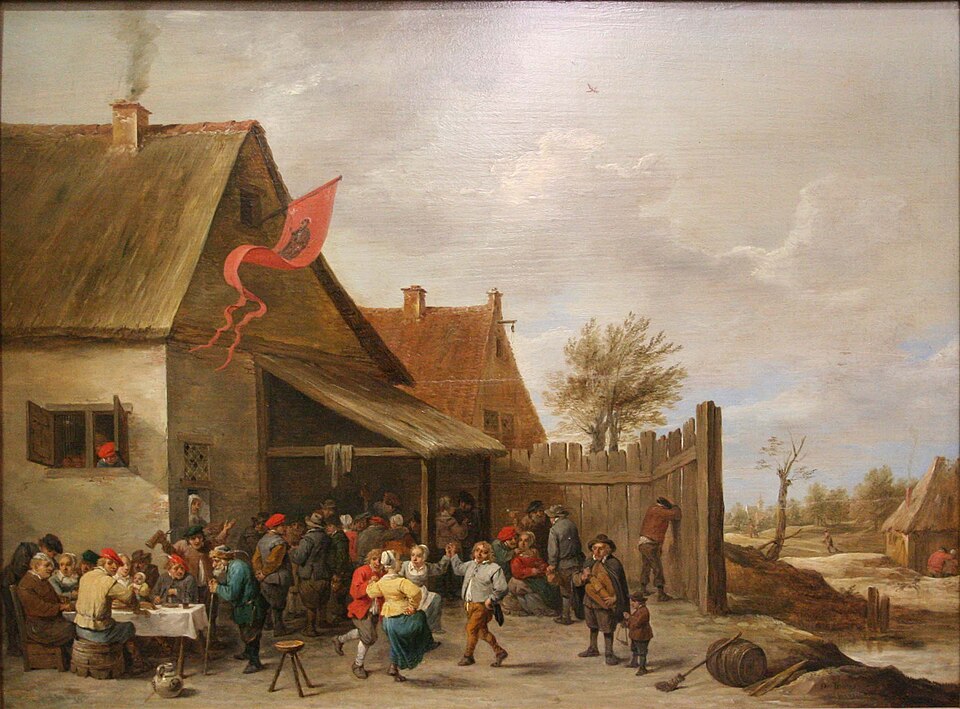
Kermis on St. George’s Day – oil paint on wood – 43.5 cm x 58.5 cm – c. 1644-1645 – Musée Fabre, Montpellier
This early work, Kermis on St. George’s Day, depicts the annual festivities being celebrated in front of the local tavern. Besides changing the setting from a large Brueghelian village square to an intimate tavern yard, Teniers has exchanged the customary elevated viewpoint for a lower perspective. The viewer can follow the characters at eye level; in fact, a figure sitting at the table looks straight out of the picture. All the traditional activities — people eating, embracing, urinating, and drinking — are present. Most of the characters, apart from those seated at the long table and the dancers, merge with the monotone, earthy colour scheme. The dancers, however, take centre stage to enjoy the vivid light.
Teniers exclusively paints frolicking dancers. Their features and dance style are comparable in all his works. The men and women are approximately the same height and have a robust build. It is not unusual to see very similar personages in different paintings. The women generally wear ankle-length skirts, enabling the viewer to see their footwork. Men and women wear sturdy flat shoes. In Kermis on St. George’s Day, the two couples improvise a variation of hops and crossover steps. The dance movements are heavy, except for the woman in the green skirt. She hops lightly and keeps her body upright. In Teniers’ work, the male dancer often wears or waves a red cap. Curiously, in this particular artwork, the dancer has a dark cap in hand, but the merrymakers in the background compensate for that. The red cap is a common attribute in Tenier’s work.
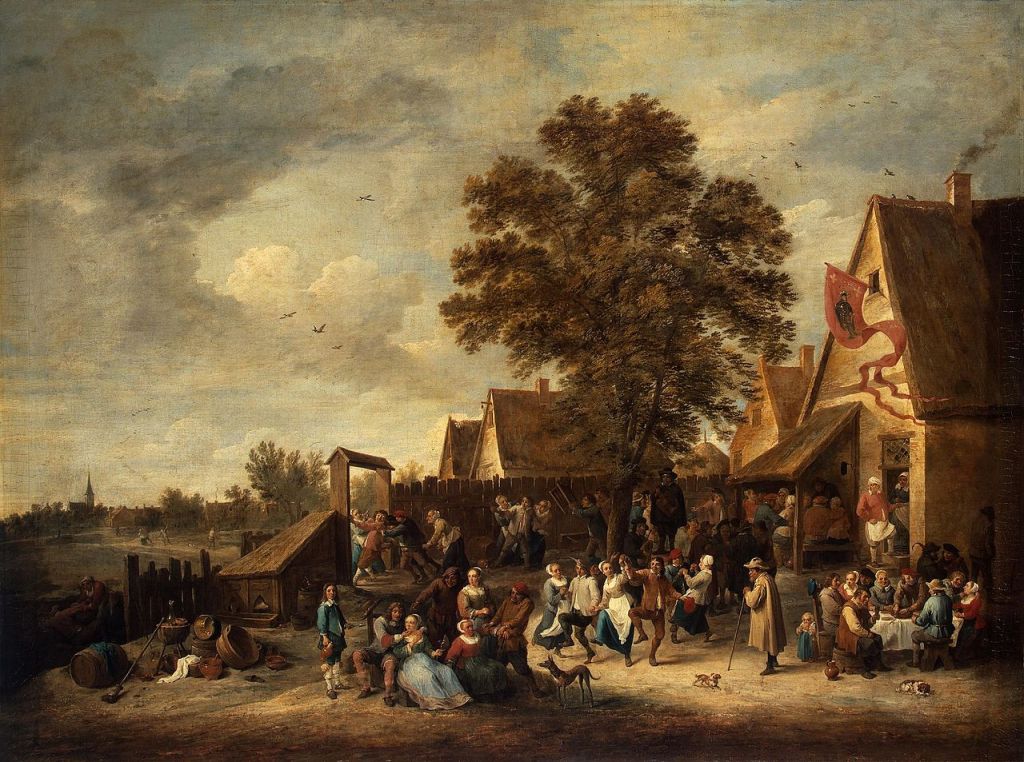
Rural Feast/ Village Feast – oil on canvas – 97.2 cm x 130.5 cm – c.1646 – Hermitage Museum, Leningrad
A mighty tree and a spacious skyscape preside over half of the canvas. The church steeple, shown in the background, acts as a continual reminder of righteousness. There is something familiar about this painting. The people seated around the tables and the folk under the canopy are frequent guests in Teniers’ work. Another recurring character is an older woman bullying her drunken husband home. In this particular painting, the familiar scene is set near the pigsty, calling to mind the old Dutch proverb, “Someone who behaves like a pig belongs in a pigsty.” (1) Less common is the well-dressed page who looks beyond the canvas. His master is seated next to one of the peasant women. The presence of a greyhound and the man’s elegant apparel signify his affluence.
Three couples are dancing beneath the towering tree. They bask in the sunlight alongside the innkeeper and the elderly man who has paused to watch them dance. The bright white hue of the women’s aprons and collars draws the entire dance group to the foreground. The two darkly clad musicians, on the contrary, are nearly obscured in the shadows. The painting is rich in disparities. It is compelling to note that Teniers juxtaposes dancers and fun-loving people with drinking, brawling, and ribaldry. Teniers, while not a moralist, still offers nuanced commentary on social behaviour.
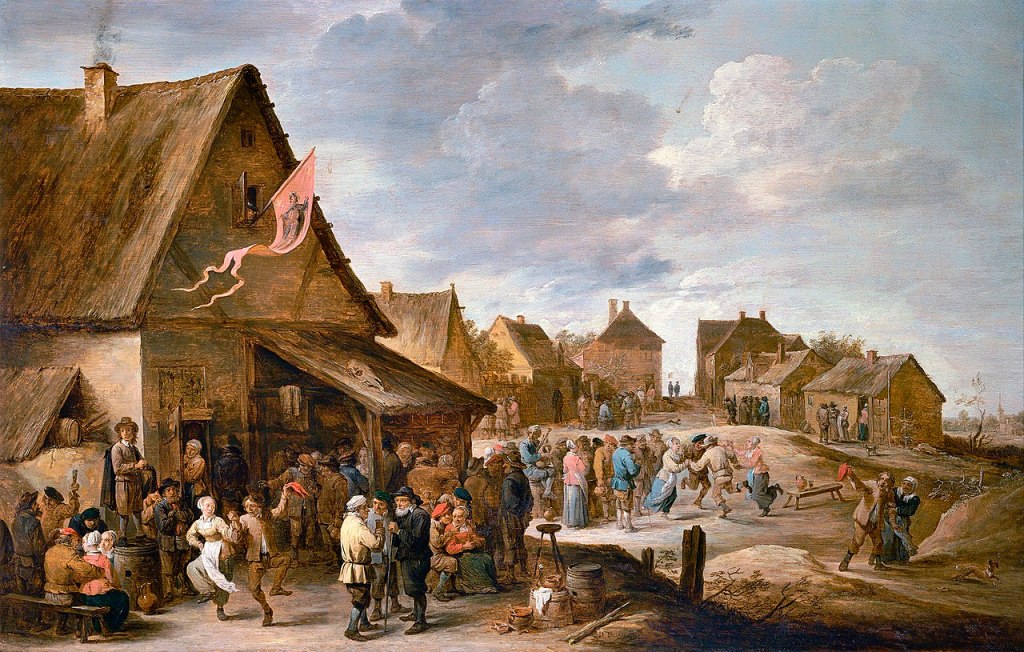
Dorps Feest/Village Feast – oil on canvas – 52 cm x 82 cm – c. 1650 – Snijders & Rockoxhuis, Antwerp Belgium
This village scene is divided diagonally into two sections: a tavern with peasants drinking, flirting, and dancing on the left side, and a sunlit village plain filled with houses and locals on the opposite side. ‘Walking out of the frame’ are the recurring figures of the woman ushering her intoxicated husband home. In the background, there is a group of men seated around a table. They are probably playing cards. The vista reveals the church steeple rising high above the houses. This, of course, is a moral reminder, as is typical of 16th- and 17th-century art. Even more graphic is the horse’s skull lying on top of the canopy. A skull is a symbol of transience. A skull with the lower jaw missing indicates revelry, foolishness, and stupidity. (2)
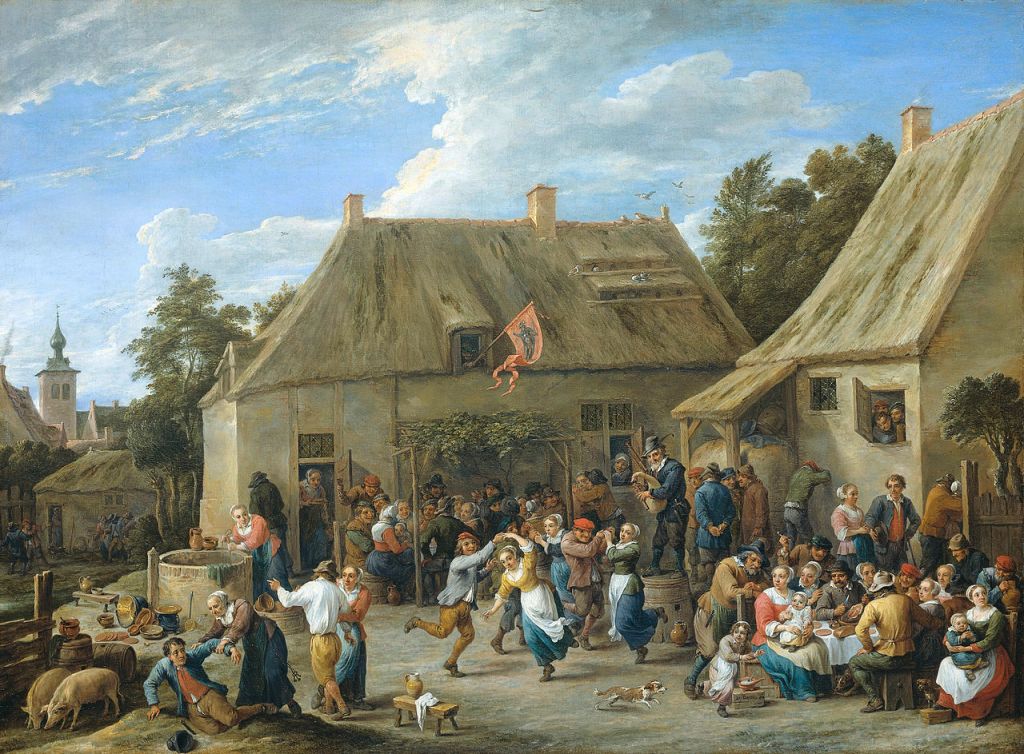
St George’s Day Kermis – oil on canvas – 78 cm x 106.3 cm – c.1665 – Rijksmuseum, Amsterdam.
The warm colours, the friendly atmosphere, and the true-to-life figures welcome the viewer to join in with the festivities. The dancers occupy the central field. Each of the three couples performs a unique dance formation. The movements of the back couple are difficult to define: they are somewhat obscured by the other dancers. The rustic man wearing the red cap, however, is fully visible. He dances with as much energy as he can muster. His raised shoulders reveal the effort. He and his delightful partner are slightly rotated to the front. They, like the other dancers, jump swiftly from one leg to the other. Teniers has painted a pose that no dancer can maintain for any length of time; to perform these steps, the bagpiper needs to play a lively melody at a rapid tempo.
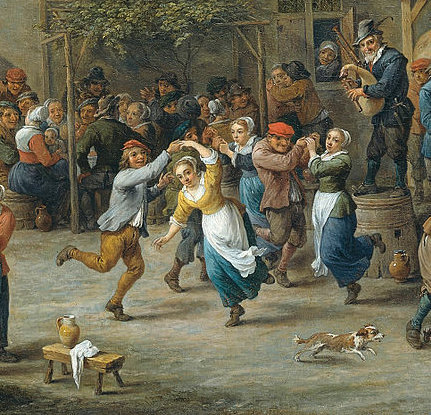
The principals of the painting are the two centre dancers. Both look straight at the viewer. Teniers depicts a specific dance movement where the female dancer rotates under the lifted arm of her partner. With a little imagination, the viewer can visualise the dancer actually turning. This image is unique in Teniers’ work. Perhaps the turning movement appears familiar: you may recognise the dancers in Wedding Dance by Pieter Bruegel the Elder. This iconic movement was later replicated by his son Pieter Brueghel the Younger and many contemporary artists.
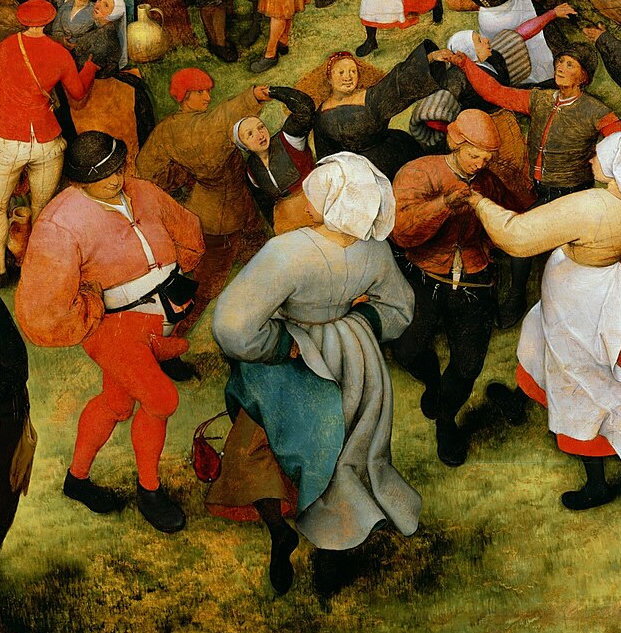
The Wedding Dance – detail of dancers – 1566 – Detroit Institute of Arts, Detroit
Right: David Teniers the Younger
St George’s Day Kermis – detail of turning movement – c.1665 – Rijksmuseum, Amsterdam
David Teniers the Younger, you may recollect, was married to Anne Brueghel, the daughter of Jan Brueghel the Elder, who was the son of Pieter Bruegel the Elder and sibling of Pieter Brueghel the Younger. Teniers enriched the 16th-century genre tradition to become the most celebrated genre artist of the 17th century.
(1) My thanks for this valuable information found on the website of The State Hermitage Museum, Leningrad
(2) I found this interesting information on the Snijders & Rockoxhuis website. Many thanks to Snijders&Rockoxhuis, Antwerp, Belgium


 DANCE IMAGES IN THE ART OF THE NETHERLANDS


