Halloween conjures up visions of witches and the hideously bizarre creatures that inhabit her reign. Artists in the Low Countries have depicted the witch and her entourage, from macabre rodents and roaches to centipedes, since the era of the illuminated manuscript. This post explores fantastical dancing beings and capering creatures who would feel comfortable at any Halloween celebration.
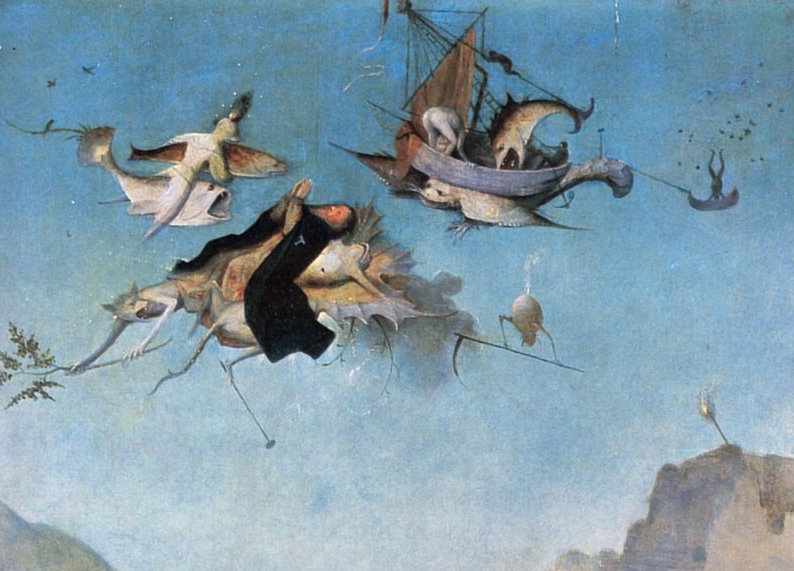
Curious flying figures occupied the phantasmic paintings of Hieronymus Bosch (c. 1450 – 1516) long before the witch mounted her broomstick.
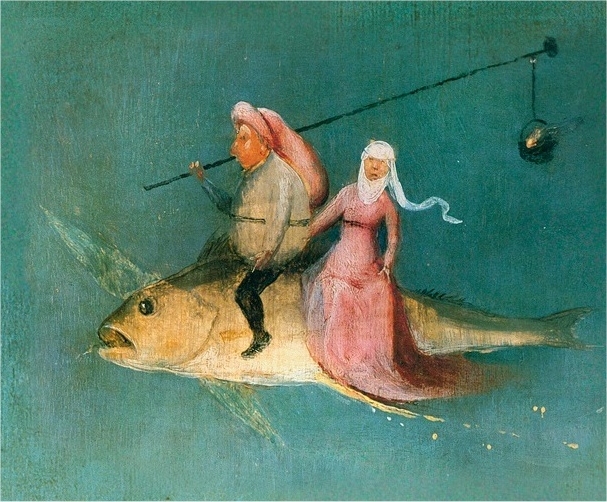
left: Flying fish with two people
right: flying demons
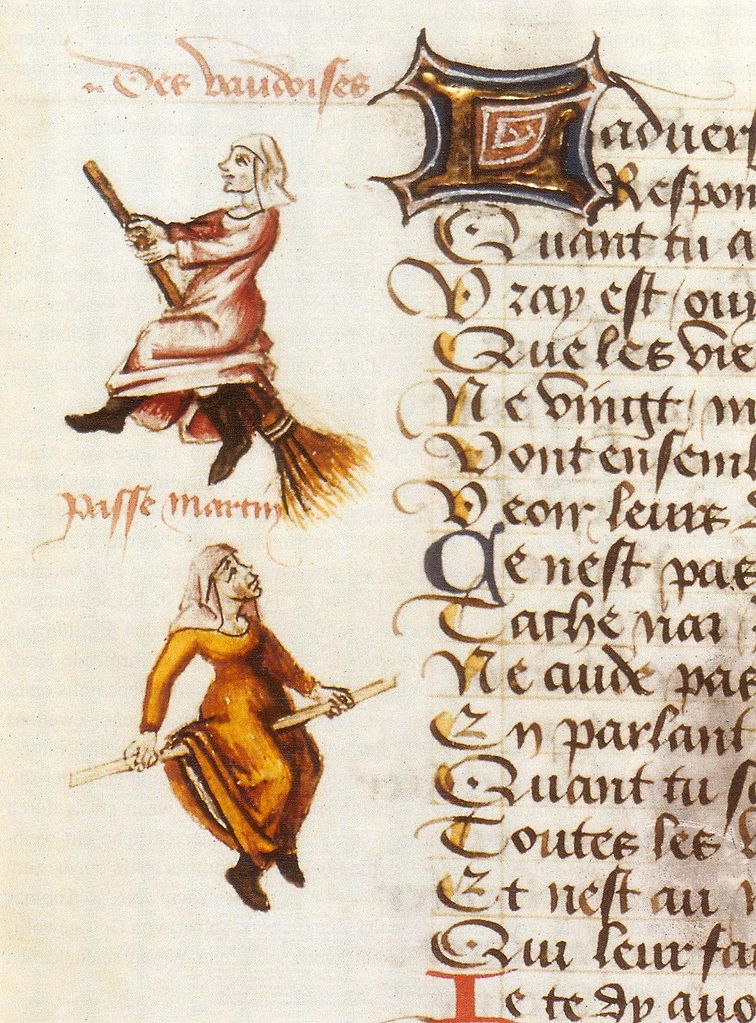
These two flying women may look familiar, but they are not witches. These illustrations embellish the margin of Le Champion des Dames (1451), a 15th-century manuscript written by the poet Martin le Franc. The inscription above their heads identifies them as vaudoises, or Waldensians.
Witches and her worthy ancestors have been around for ages. But when did the witch become the figure flying on a broomstick? Recent studies suggest that Flemish masters, in particular Pieter Bruegel the Elder, established our conception of the archetypal witch.
Bruegel introduced the chimney as the exit point for night flights and placed the cauldron witches used to brew their wicked ointments and magical concoctions on the domestic hearth. Even the black cat was part of his witch image… Bruegel chose to continue the tradition of depicting witches flying on brooms through the night skies to their diabolical assemblies, while earlier artists had deemed many other objects suitable. After Bruegel, the broom became the only mode of transportation.
Bruegel’s Witches. Witchcraft Images in the Low Countries between 1450 and 1700 – Renilde Vervoort & Dries Vanysacker
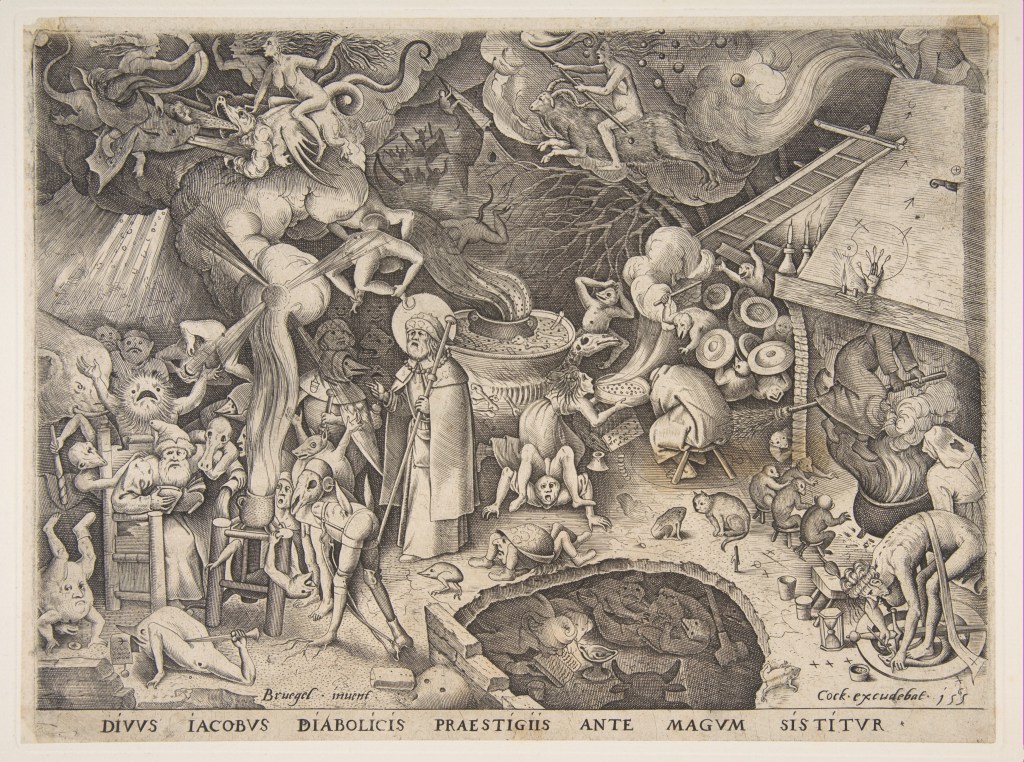
Artist – Pieter van der Heyden , Publisher – Hieronymus Cock – Metropolitan Museum of Arts, New York
The print St. James and the Magician Hermogenes is amazing. I have provided a link to the Metropolitan Museum of Art where you can enlarge the image and admire all the outlandish, obnoxious, eccentric, witty, and chimeric details that Bruegel has concocted.
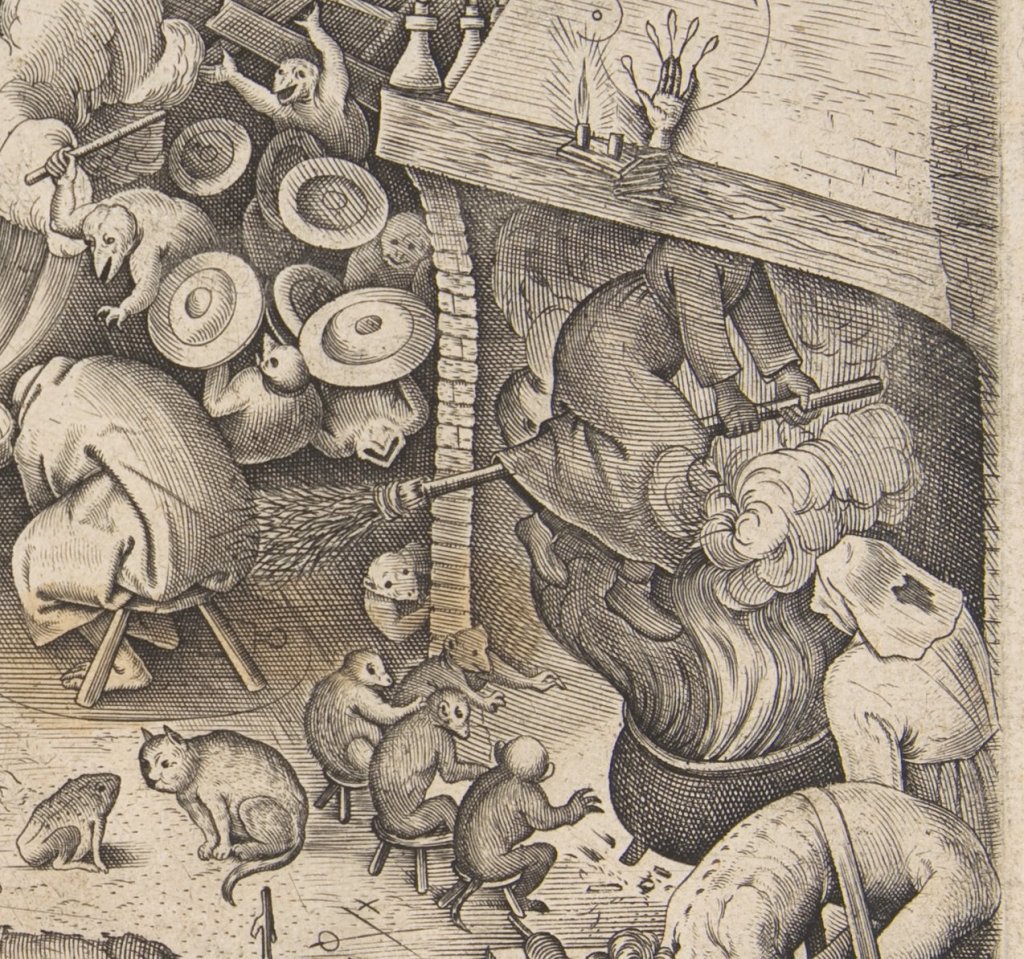
The image on the left is a detail of the larger print. A witch is seen flying up the chimney on her broom. She narrowly escapes the flickering cauldron. The cat and frog are challenging each other’s patience, while the mice, seated on comfortable stools, are enjoying the spectacle.
On a more serious note, the 15th-century Flemish manuscript, Treatise on evil spirits and witchcraft, contains an extraordinary scene showing a man initiated by witches paying tribute to the devil represented as a goat.
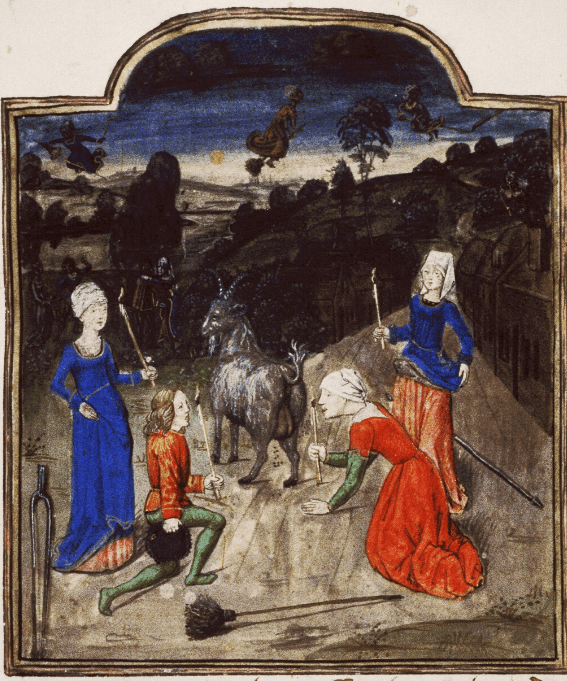
In addition to three witches soaring on broomsticks, there are two couples dancing in the shadows. The left couple dances side by side. The other couple dance in ‘ballroom’ fashion. And, although hard to detect, there is another witch-like figure perched near a chimney.
Treatise on evil spirits and witchcraft – Flemish – late 15th century – Oxford, Bodleian Library MS. Rawl. D. 410
The Witch Cove, about which I wrote extensively in the post Circle dances – bizarre, eerie, and endearing, is a curious, Boschian artwork. The canvas is filled with weird human figures, hybrids, flying fish, witches, and partially recognisable animals.
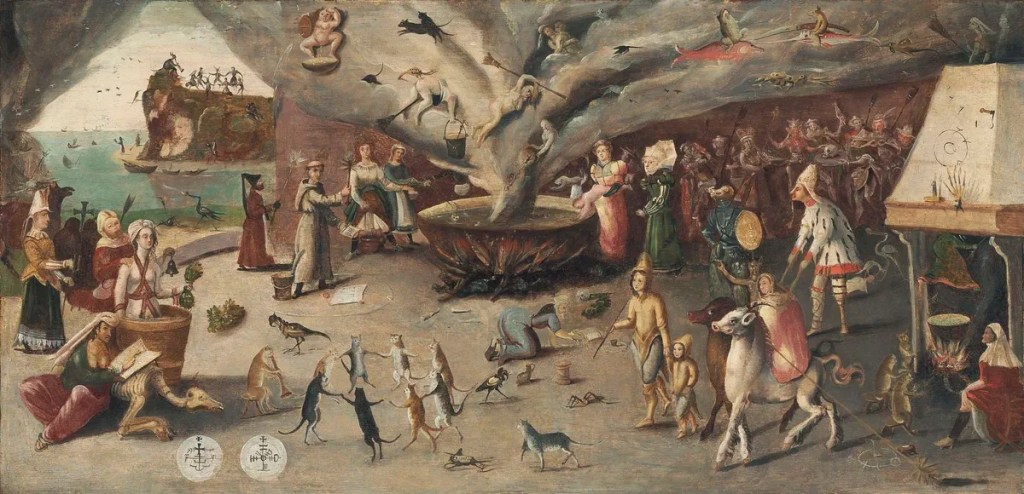
The Witches’ Cove – 16th c. – Morbid Anatomy Museum Collection – collection of Jennifer Butkevich
below; a detail of the cat dance
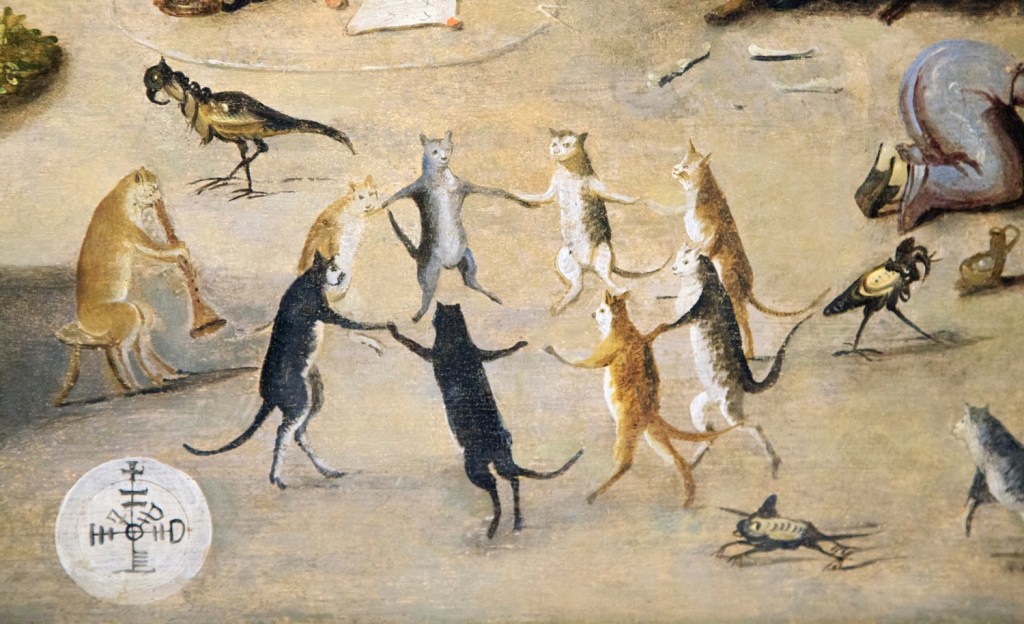
Among the witches, creatures, and monstrosities, there is a group of eight ‘charming’ cats dancing in a perfect circle. Their accompaniment? A 16th-century ginger cat.
While on the subject of circle dances, I should mention a gruesome, nightmarish circle dance created by David Ryckaert III. The Dance of the Leprechauns features five partially morphed figures — witches? humans? devils? — revolving in a ghastly ring dance. This horrendous ritual ensues in a semi-lit cave. There are at least two onlookers: an ogling figure, resting between the rocks, and a second figure, a mysterious mortal, sitting on the lofty ridge. The accompanist, a foul creature reposing on the ground, plays some type of flute.
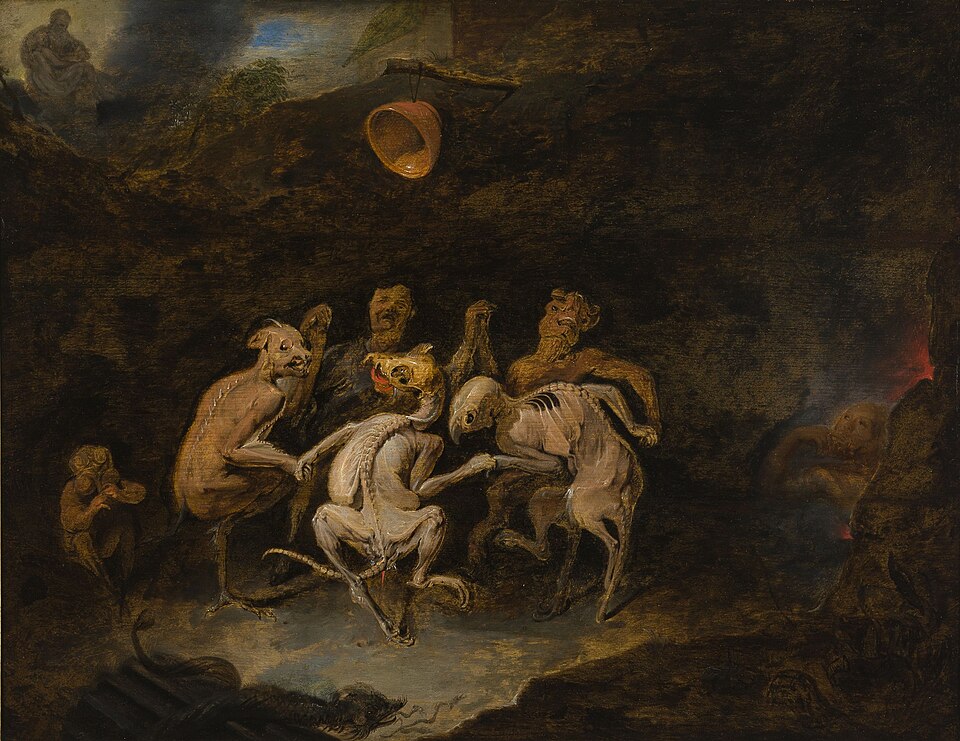
Dance of the Leprechauns – 1651 – oil on canvas – 48.2 x 62.7 cm – Musée d’Art Roger-Quillot, Clermont-Ferrand
The witches’ Sabbath emerged as a popular subject in the art of the Low Countries. Numerous artworks, such as those by Cornelis Saftleven, Frans Francken the Younger, and David Teniers the Younger, depict the witch and her entourage in different contexts. Dance seldom features in these paintings. There are two minor dance scenes, however, in Witches’ Sabbath, an artwork by Claes Jacobsz van der Heck. The remainder of the painting abounds with fantastical beings, demons, vermin, and surrealistic creatures that populate an imaginary landscape inspired by equally fanciful Roman architecture.
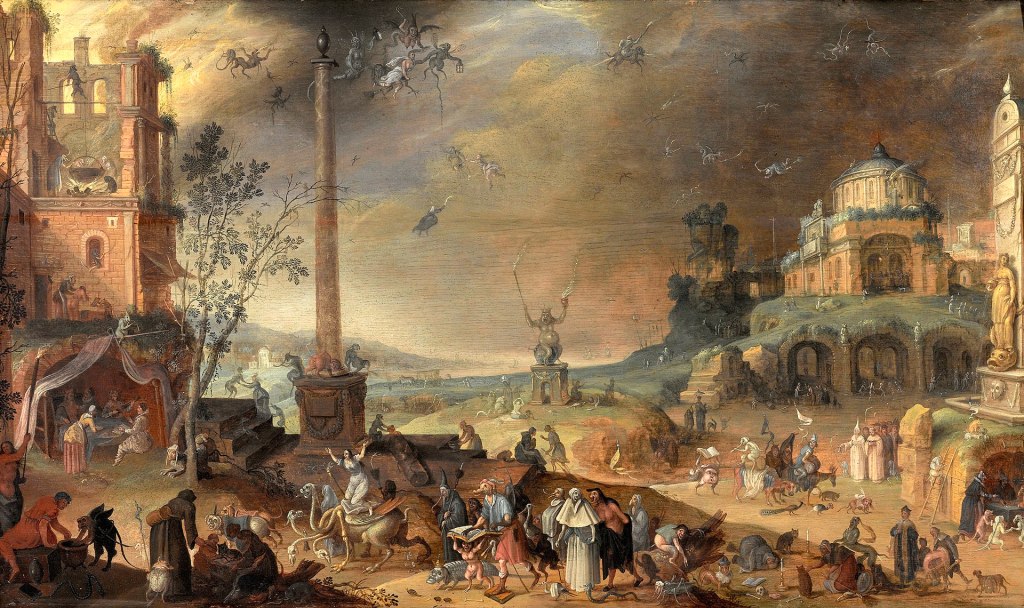
Witches’ Sabbath – oil on panel – height 56.8 cm x width 97.9 cm – 1636 – Rijksmuseum , Amsterdam
How to tackle Witches’ Sabbath? Perhaps the grotesque devil seated on a globe is an effective point of departure. You could choose to meander along the procession of bizarre figures. The sky also offers an intriguing spectacle; incredible witches riding on broomsticks soar through the sky chasing wondrous demons. Alternatively, to return to a sense of reality, take a moment to glance at the small gathering of burghers arranged at a table beneath a kind of canopy. One of their company plays a musical instrument. Amid all these frolics, dance plays a minimal but nevertheless distinctive role. In the bottom right-hand corner, several creatures, who have terrible paws and tails, dance hand in hand. There is a second dance, performed by a group of naked creatures, beneath the central archway.
David Teniers the Younger, a highly productive artist in Baroque Flanders, depicted various versions of the witches’ sabbath. Occasionally, he included dance motifs within the witch theme. In Scene de Sorcellerie, Teniers illustrates a witch ascending the chimney, a sinister ritual, and eerie creatures. He also invites his audience to look through the open door. In the yard just beyond the witches’ den, naked human shapes participate in a ritual ceremony. The mysterious dancers revolve around a flickering bonfire accompanied by a Pan-like demon playing a flute.
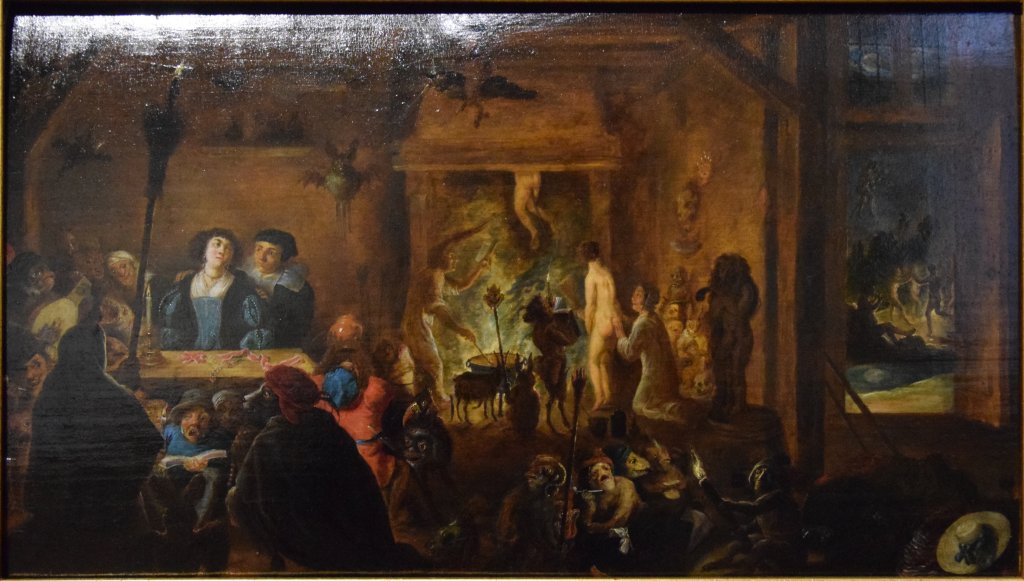
Scene de Sorcellerie – 1633 – Musée de la Chartreuse, Douai
When Francesco Goya created his stunning Witches’ Sabbath (1798), the witch motif no longer captured the imagination of Dutch and Flemish painters. Only in the early twentieth century did innovative artists revisit the timeless theme.
Between 1917 and 1919, Willem van Konijnenburg (1868-1943), one of the most prominent Dutch artists during the interbellum period, created a collection of six impressive drawings. The drawings, including Dance of the Witches, symbolise various traits of the human condition.
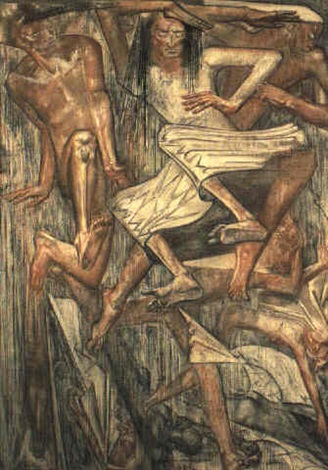
Dance of the Witches – crayon – 122 cm x 87 cm – 1919 – Artnet
Dance of the Witches is intense. The leading witch is ghastly. The emaciated limbs, the pointed features, the stringy hair, and the horrendous expression all culminate to create a terrifying image. As the background begins to dawn, the brownish hues reveal a handful of bronze male figures. The top two brawny figures, like the witch, are rugged and angular. By contrast, the lower figures are malleable. They dive downwards, no doubt plunging into the abyss. Their fall reminds me of harrowing murals that decorate the walls of Italian medieval and Renaissance churches. Van Konijnenburg’s drawing projects fear and destruction. Little wonder that this haunting image was created in 1919.
Pieter den Besten (1894-1972) abandoned the broomstick, forsook the chimney, and discarded the cauldron; only four horrendous witches remain. These erotic creatures are rendered in stark angular lines. The bare female figures move along a background of sharply defined geometric planes. The underlying blue setting suggests depth. The intermediary plane, a landscape of warm hues, creates a formidable backdrop for the slender, tormented female figures.
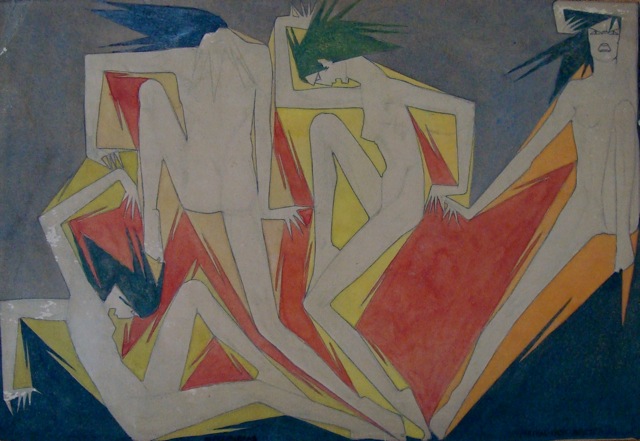
Witch Dance – watercolour and pencil – 39 cm x 27 cm – 1921 – private collection
Pieter van Besten, perhaps best known for his wonderful Art Deco murals in the Tuschinski Cinema in Amsterdam, was a keen enthusiast of film and modern dance. His powerful image evokes the essence of expressionistic films and Ausdrucktanz. The witches in Van Besten’s are uncompromising. Their dance is ugly. Their lines are harsh and unrelenting. Notice how the wrists are bent at a right angle, that the fingers have turned into spikes, and that the arms act like tentacles trapped in geometric structures. In the early 20th century the German expressionist dancer, Mary Wigman, choreographed a solo with the title Hexentanz. Her movements, similar to Witch Dance, are expressive, dynamic, and of indescribable anguish. Van Besten’s work navigates a similar domain.
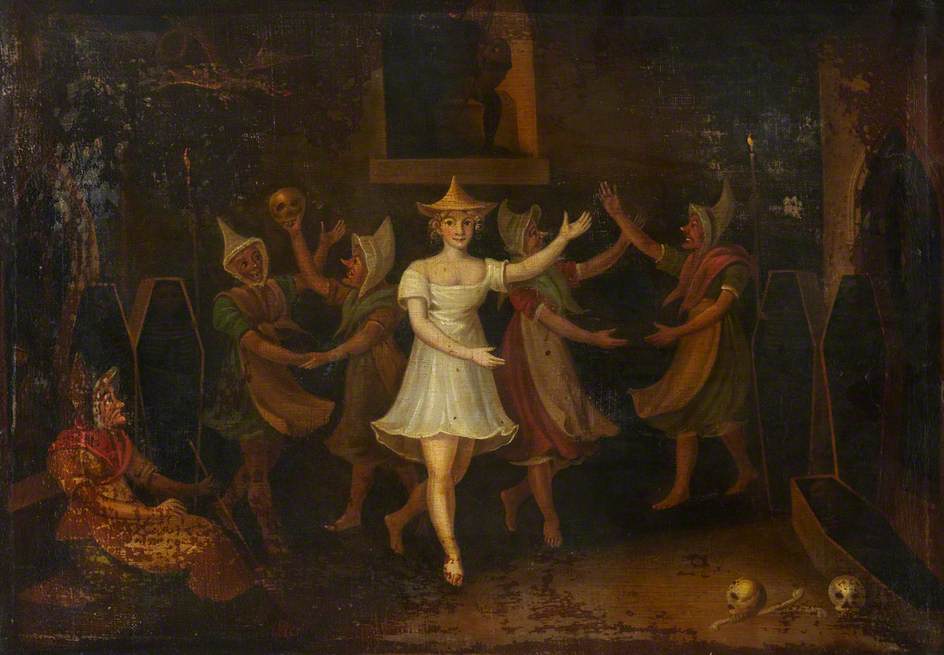
To finish on a lighter note. I discovered the following image of a very friendly witch dancing with her companion witches. The identity of the artist remains a mystery, yet whoever he was, he undoubtedly possessed a sense of humour. Happy Halloween.


 DANCE IMAGES IN THE ART OF THE NETHERLANDS
#/media/File:Francisco_de_Goya_y_Lucientes_-_Witches_Sabbath_-_Google_Art_Project.jpg)