An extensive online list presents nine hundred and twenty-three works by David Teniers the Younger (1610-1690). The Wikidata list featuring related thumbnails, labels, places, and creation dates provides a glimpse into the varied oeuvre of the prolific Flemish Baroque artist. Teniers the Younger, son of the illustrious artist David Teniers the Elder, was celebrated for his history paintings, landscapes, and portraits. He was also the foremost 17th-century artist of rural life. His genre paintings, the subject of this post, covered a large range of themes, including festivals, tavern scenes, and weddings. In many of these works dance plays a pivotal role.
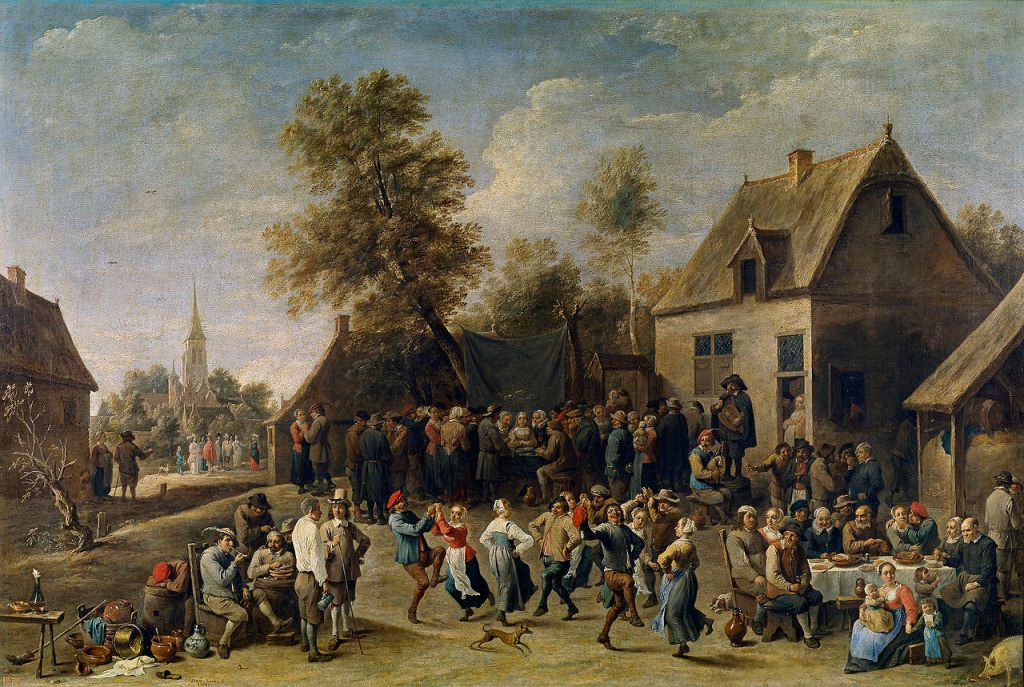
Country Celebration – oil on canvas – 75 cm x 112 cm – 1647 – Museo del Prado, Madrid
When discussing the dance paintings of David Teniers the Younger, it is noteworthy to keep in mind that Teniers the Younger married Anna Brueghel, daughter of Jan Brueghel the Elder, who was the son of Pieter Bruegel the Elder and sibling of Pieter Brueghel the Younger. It is also helpful to remember that Pieter Paul Rubens, guardian of Anna Brueghel after her father’s passing, acted as witness to the Teniers’ wedding (1637). Teniers the Younger’s marriage to Anna Brueghel fused the Brueghel and Teniers dynasties and, significantly, provided the artist with a heritage of drawings and cartoons created by Pieter Bruegel the Elder.
Initially, however, Teniers was inspired by the Flemish painter Adriaen Brouwer (1605-1638), who had worked in Haarlem, a major art centre in the 17th-century Dutch Republic. Brouwer, a contemporary of Frans Hals (1580-1666), Rembrandt (1606-1669) and Adriaen van Ostade (1610-1685) painted genre scenes. He emphasised the sordid aspects of peasant life by illuminating the dissolute, the rowdy, and the ribaldry. His characters are uncouth, not to say bizarre. The artist limits the narrative to a small group of figures inadvertently located in a confined setting. Brouwer’s scenes are dimly lit, frequently leaving one side of the canvas in virtual darkness.
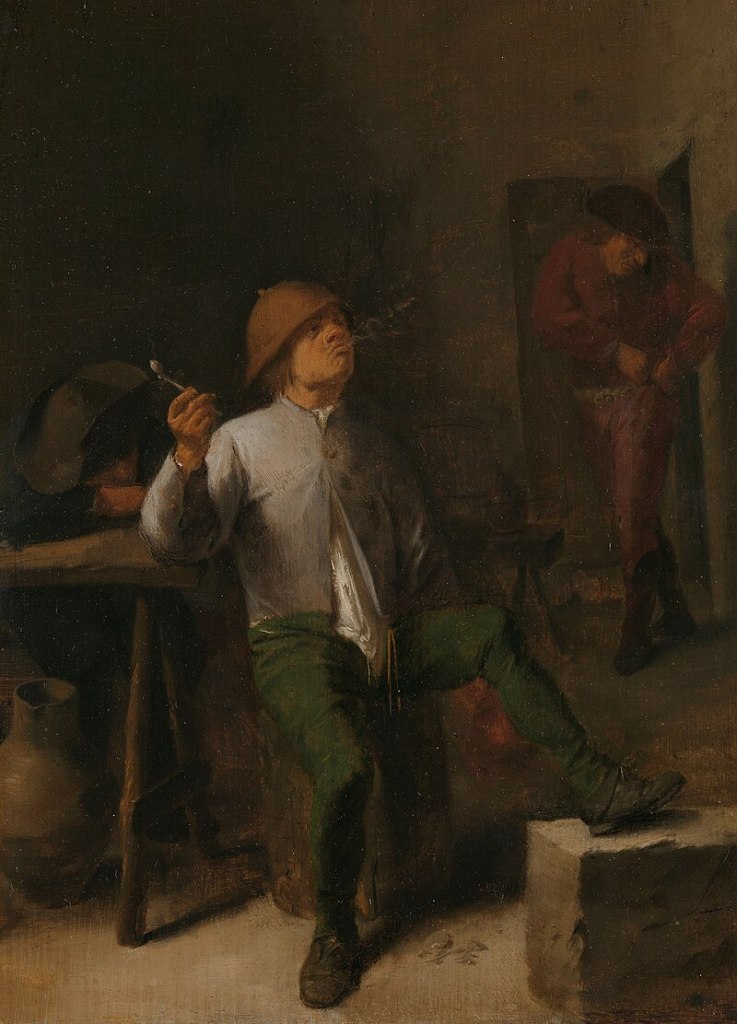
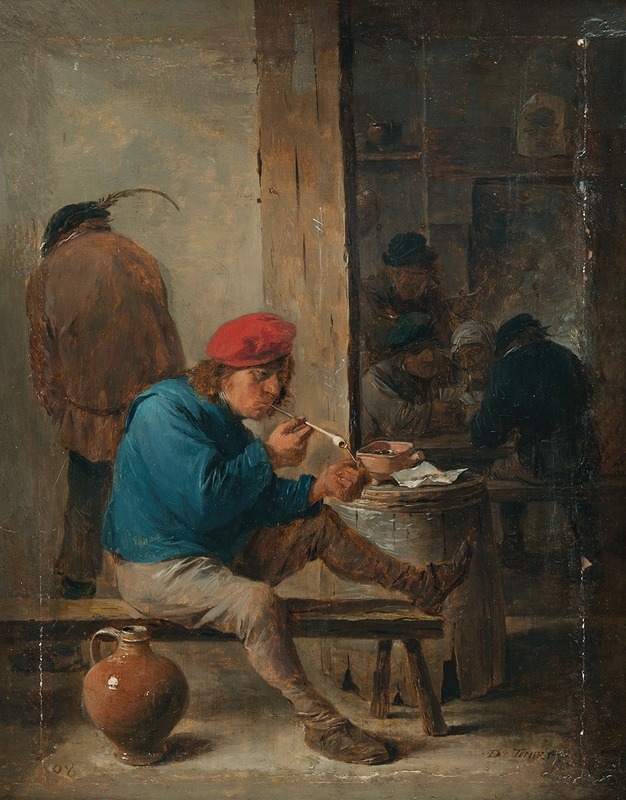
Right: David Teniers the Younger – Interior with peasant lighting his pipe/Tavern Scene with Smokers – oil on panel – 23.5cm x 19 cm – date unknown – private collection – image from RKD, Netherlands Institute for Art History
In his earlier work, Teniers, like Brouwer, employs a dim, often brown palette, and his characters are crude and ungainly. Teniers painted many tavern scenes depicting drinking, smoking, and loitering ruffians, but none, to my knowledge, with dancing figures. I could only find one early painting (1633-34), an outdoor scene in front of a lowly cottage, with actual dancing.
Teniers draws your attention to a bagpiper positioned on a rock. This rough musician, clad in a brown outfit, stands out against the lighter background. His playing accompanies a group of peasants participating in a circle dance. The rustics are robust and lack finesse. Their dance vocabulary is limited to basic forward and sideways steps, combined with an improvised lift of the leg. Their facial expressions are coarse, akin to the unsophisticated figures in Teniers’ tavern scenes. And what to think of the boorish figure vomiting near the old tree trunk? Unexpected features like a friendly cow poised in the doorway, a sailing ship, the skull of an animal, and a meticulous still life cannot mask the general coarseness portrayed by Teniers.
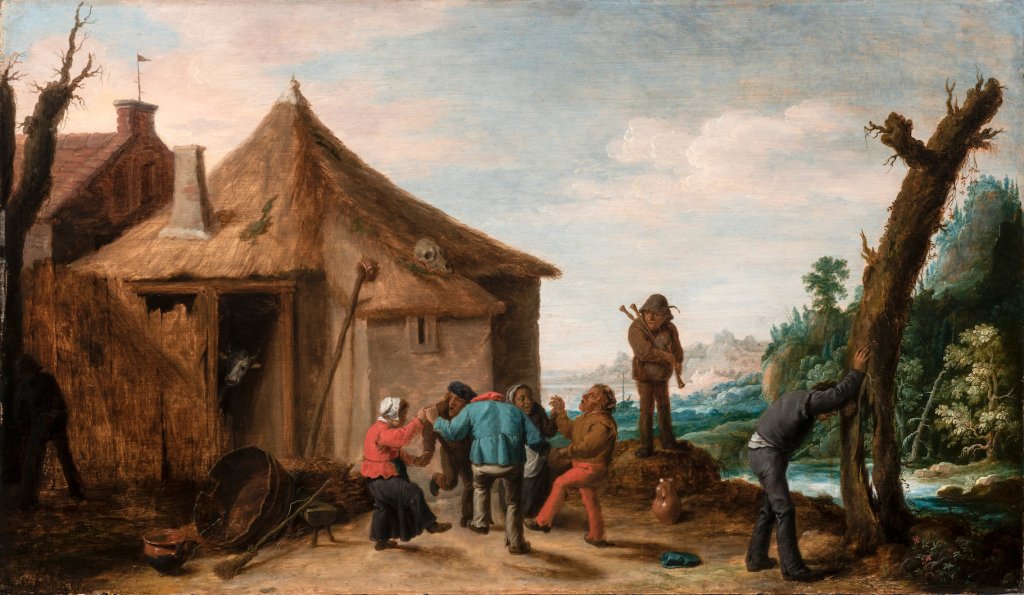
Peasants dancing in front of a cottage – oil on panel (wood) – 31.3 cm x 53.7 cm – 1632-1633 – RKD, Netherlands Institute for Art History, The Hague
Despite the similarities in tone, brushstroke, and narrative, Brouwer and Teniers differ in their approach to the social and moral implications. Brouwer sees the tavern as disorderly and the guests as rowdy folk. Teniers, on the other hand, sees the tavern as a meeting place where rural folk can revel and enjoy themselves.
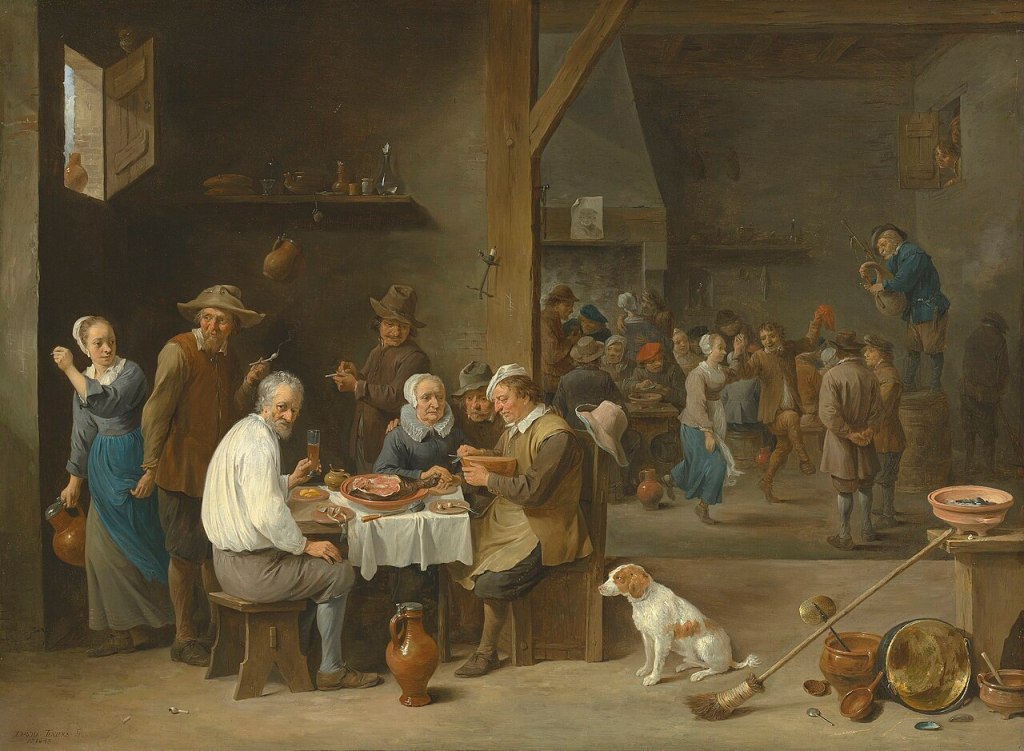
Le déjeuner au jambon – oil on copper – 63.5 cm x 85.3 cm – 1648 – private collection, Christie’s
In Le déjeuner au jambon (1648), Teniers expands space and offers his viewer a glimpse into adjoining rooms. The foreground, evolved from Brouwer, is reserved for a peasant gathering. Teniers had added an open window, allowing sunshine to enter the otherwise subdued room. In the back room, inspired by the work of Pieter Bruegel the Elder and his son, Pieter Brueghel the Younger, rural folk wassail, caress, and dance. There is a musician perched on the beer barrel, a chap peeping through the open window, a still life in the corner, and a faithful dog. And just above the mantelpiece a drawing is tacked onto the wall; possibly a feigned self-portrait of the artist. These features recur intermittently in Teniers’ genre paintings, just like a chap wearing or waving a red cap. In Le déjeuner au jambon, we see the man at the back table sporting a red cap, while a second red cap is raised in the air by the male dancer.
The tavern scene below, Dancing peasants in an inn, adheres to the same structural format as Le déjeuner au jambon, but with a noticeable difference. The carefree dancers, along with a group of country folk, are now in the foreground, while a subdued Brouwer-like scene occurs in the back room. The familiar elements of Teniers’ work, such as the man peeping through the window, the musician, a dog, and a ‘self-portrait’ above the mantelpiece, are all present. You may have noticed that while the peasants are still shown drinking, flirting, and enjoying themselves, they are not portrayed as grotesque figures. Teniers has refined the portrayal of rural life.
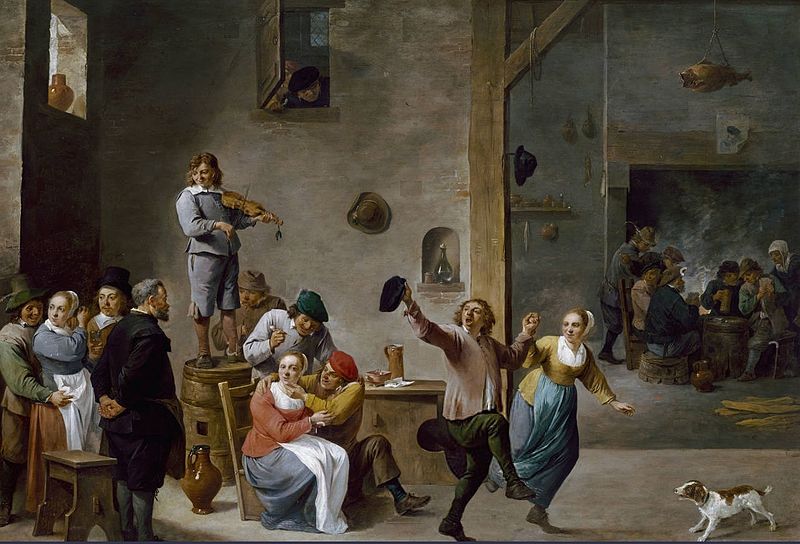
Dancing Peasants in an inn – oil on panel – 58 cm x 81 cm – 1645 – Alte Pinakothek, Munich
Regardless of whether Teniers depicts a tavern scene, an outdoor scene, a festivity, or a wedding dance, the dancers are always vivacious. Couple dances are interchanged with circle and maypole dances, and from time to time dancers are arranged in square dance formation. The dancers are frequently monumental figures. None of the dancers are performers, nor are there instances of solo dancing. The dance is always integrated within a social activity. It’s worth mentioning that the townsfolk who visit the rural festivities never participate in the dancing. These elegantly dressed and gracefully poised guests observe the peasants from a proper distance.
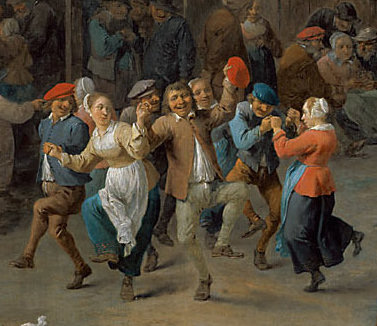
In the three scenes below, Teniers presents amiable and fun-loving dancers. The musician, whether a bagpiper or fiddler, is always located on a higher level, while the ever-present dog participates in the excitement. The dance movements pose no choreographic difficulties; lively steps, kicks, and hops are executed at a brisk tempo. Often the couples join their inside hands or place their hands on their hips. The dancers usually give the impression of swiftly moving forward; however, occasionally, the dancers, as in Country Kermis, perform a basic supported turn, a movement reminiscent of The Wedding Dance (Bruegel the Elder).
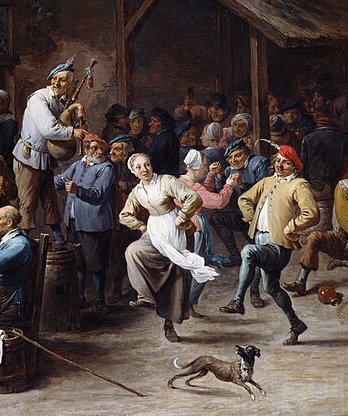
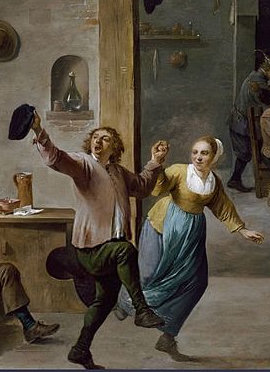
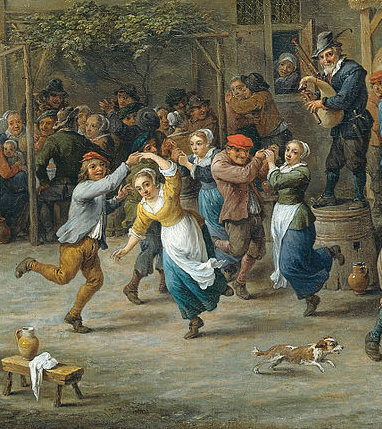
Left: A Kermis on St. George’s Day – 1649 – Royal Collection Trust, UK
Centre: Dancing Peasants in an inn – 1645 – Alte Pinakothek, Munich
Right: Country Kermis – 1650 – Rijksmuseum, Amsterdam
The high-spirited male dancer invariably assumes the leading role. He habitually carries a red cap, which he is apt to wave high above his head. He, as no other, gazes well beyond the frame, making eye contact with the viewer. The central male dancer in Village Fair, for example, is a jolly character encouraging everyone to participate in the festivities. Likewise, the frisky fellow on the right gives the viewer more attention than he does to his charming dancing companion.
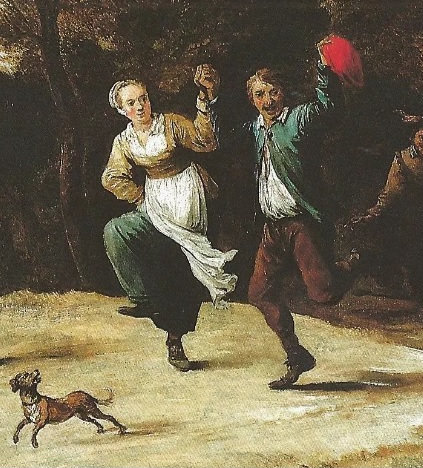
Left: Village Fair (detail) – c. 1647 – Kunsthistorisches Museum, Vienna
Right: Bagpiper with Dancers (detail) – 1649 – David Koetser Gallery, Zurich
The jovial painting, Village Fair, captures villagers celebrating St George’s Day. Teniers, similar to Bruegel the Elder and Brueghel the Younger, depicts the festivities from a high vantage point. He offers a panoramic view displaying various facets of rustic life. There is a group gathered at the table, a woman caring for her children, an elderly man resting on his cane, peasants drinking, and some flirting, among other activities. Every individual narrative conveys an original tale. The focal point, however, is the dance scene, which occupies the central place in the artwork.
You cannot fail to notice the friendly dancing fellow flaunting his red cap. His vibrant expression is welcoming to all. He, together with some other villagers, performs a bustling line dance. There is also a slightly older man swinging his legs energetically with an equally sprightly younger woman. And if you cast your attention to the background, you will discover a second dance scene: a maypole dance just in front of a row of peasant dwellings.
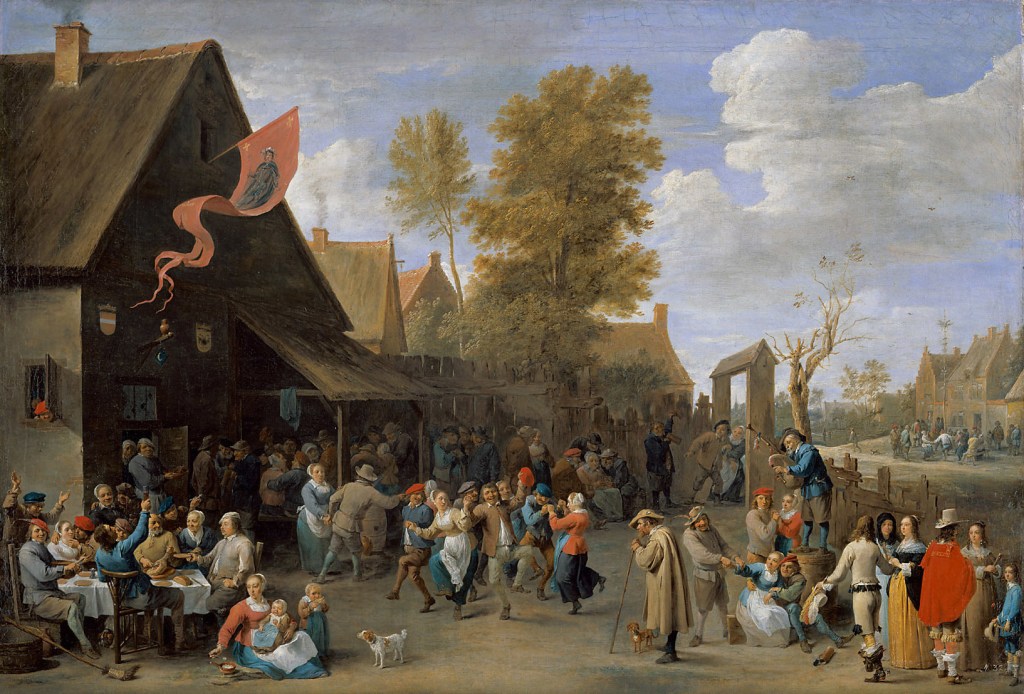
Village Fair – c. 1647 – 76 cm x 112 cm – Kunsthistorisches Museum, Vienna
Teniers, in contrast to his predecessors, held a positive view of rustic life. Moral issues like drinking and ribaldry were not avoided but rendered without criticism. Teniers depicted cheerful scenarios, showcasing lower-class characters in a jovial spirit. His artworks were fashionable and highly sought after. In his genre pieces, dance was an essential element. To be continued…


 DANCE IMAGES IN THE ART OF THE NETHERLANDS


.jpg)