Is it her beauty, her poise, or the sheer dynamics of her movements that capture the visual artist’s imagination? Or is it the woman concealed by the illusion of theatricality that mesmerises the artist? Dancers have inspired artists throughout history. Edgar Degas immortalised the hard-working ballet girl at the Paris Opera. Toulouse-Lautrec celebrated the performers of the Moulin Rouge. The Dutch artist Theo van Doesburg transformed a figurative image of a dancer, step by step, into an abstract composition. The dance images of Isaac Israëls, Jan Sluijters, Kees Maks, and Kees van Dongen, to mention four artists inspired by dance, are powerful, exploring both the dancer and the woman dancing. I have extensively discussed these Dutch artists in this blog. This post introduces several remarkable pieces created by innovative artists starting in the early 20th century and working through to the present day.
The city of Gouda embodies a hidden treasure. The Café Central, a café/restaurant situated on the market square, is embellished with a fascinating series of female figures painted in Art Deco style. The mural, which decorates the top half of two lengthy walls, consists of oil paintings composed on canvas and subsequently placed against the surface. The mural was created by painter and graphic designer Pieter den Besten (1894-1972). Besides the Café Central, den Besten was one of the artists to decorate the Tuschinski Cinema, a breathtaking example of Art Deco architecture in the heart of Amsterdam. He was also an acclaimed stage designer, designing costumes and sets for various theatrical productions.
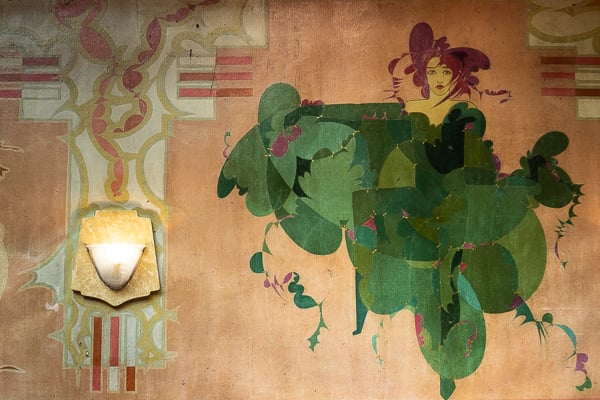
1924 – mural – Café Central, Gouda
The figures on the walls of Café Central are all dressed in elaborate, not to say flamboyant, robes. The ladies, shaded in red, rose, green, and yellow, are partitioned by a stylised geometrically arranged plant motif. Each lady wears a voluminous gown formed by circular and oval shapes that extend far beyond the dancers’ physical forms. The ‘green lady’, shown above, may not appear to be a dancer at first glance; however, have you noticed the dark shadow faintly visible beneath the robe? This deep green linear shape emerges as a dancer poised on one leg, the other leg raised to waist level. The knee is flexed at a right angle. The artist has contrasted curvilinear forms to illustrate the robe with the angular lines to represent the dancer’s physical form.
Some thirty years after the creation of the splendid Art Deco figures, Den Besten painted ‘Dancer’, a full-length image of a young ballerina waiting in the wings. You can see the concentration on her face. She is about to make her entrance onto the stage. Her downward glance, her non-balletic foot position, and her unusually placed arms give no indication of her dance movements. She does, however, wear a tutu, which suggests that she is a ballet dancer.
‘Dancer’ does not bear any similarity to Den Besten’s Art Deco figures. The vivid colours evident in the earlier works have been replaced by subdued hues. The dancer, for instance, is clad in a calm pink costume that impeccably merges with the background. Moreover, the clearly defined lines, so prominent in the Art Deco figures, have evolved into soft, looser brushstrokes, rendering the subject of the painting both realistic and sympathetic. ‘Dancer’ takes on an almost impressionistic manner.
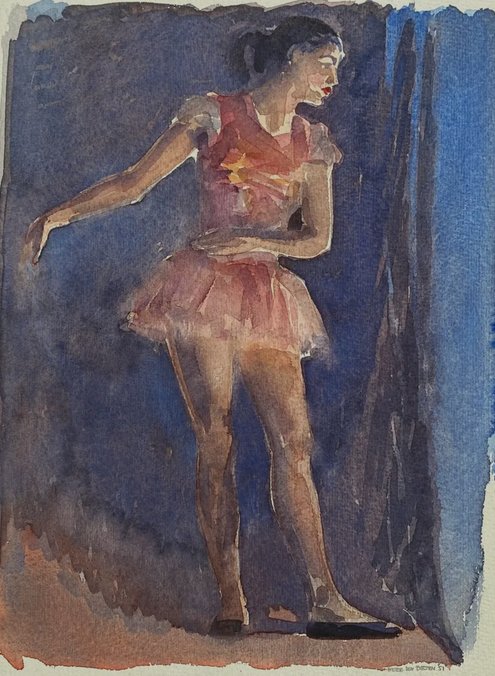
Dancer – aquarel/watercolour – 35 x 26 cm – 1951 – IN STIJL, Assen – art dealer (right hand slightly cropped)
Jaap Nanninga
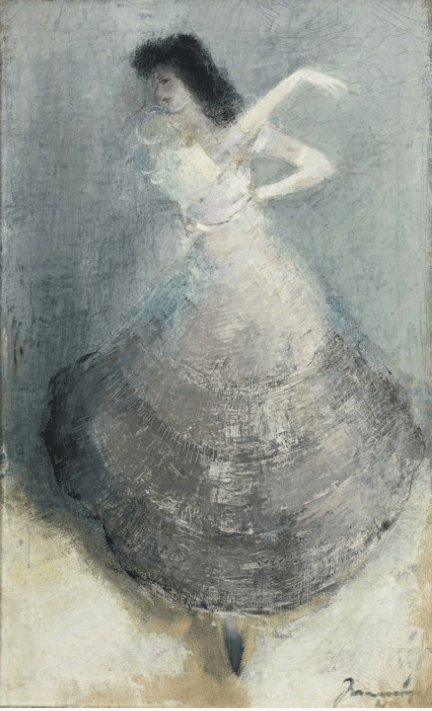
Dancing woman – oil on canvas – 72 x 45 cm – 1946 – Christie’s
The artist Jacob (Jaap) Nanninga (1904-1961) initially worked as a draughtsman and commercial artist, beginning his professional artistic journey just before World War II. His early work can be described as figurative. Dancing Woman originates from this figurative phase. Geer van Velde, friend and artist, triggered Nanninga’s interest in abstract art. Nanninga emerged as one of the leading abstract artists in the post-war Netherlands.
The title Dancing Woman is overly simple for this delicate work of a dancer whose opaline skirt evokes a glistening scallop shell. Each layer of her ephemeral skirt appears fluorescent. The artwork’s colouring — grey, soft pink or mauve, faint green, and a subtle black — is both appealing and distinctive. The colour of the dancer harmonises with the surrounding shades; the dancer’s skirt, her petite torso, and white arms blend seamlessly with the background. Amid this unity of colour, the dancer’s dark hair stands out, just like her dark eye makeup and crimson lips. Her lowered head and explicit arm movement evoke the illusion of movement. Even clearer is the faint shadow running along the side of the skirt, an unmistakable sign that the dancer is performing a rotary movement.
Freek van den Berg (1918-2000) was an autodidact. Colour was his motivation, his inspiration, and his objective. Several Fauvist artists (Matisse, Dufy, Van Dongen, and De Vlaminck), along with the expressionist works of Macke and Nolde, inspired his vibrant cityscapes, landscapes, and numerous paintings featuring attractive women. Indeed, the alluring female was the predominant subject of his entire body of work. Van den Berg, often referred to as the last of the Dutch Fauvist painters, produced quite a few paintings depicting Spanish dancers. It is noteworthy to mention that the artist rarely focussed on the actual dancing. Rather, he stressed the dancer herself, dividing his attention between the striking colour design and the character’s inner expressiveness.
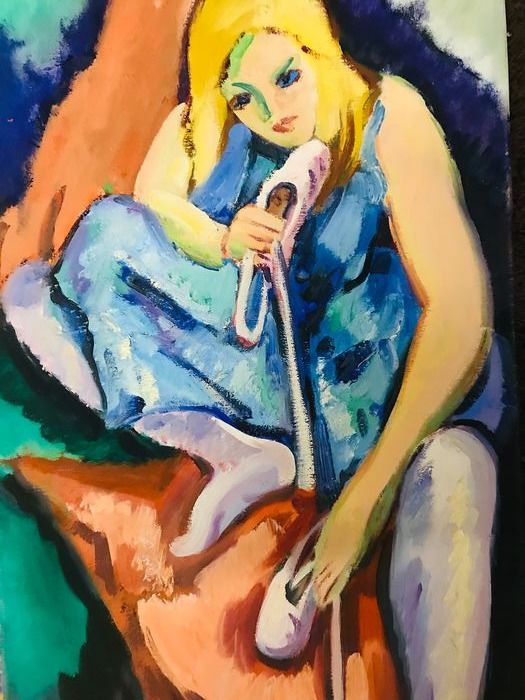
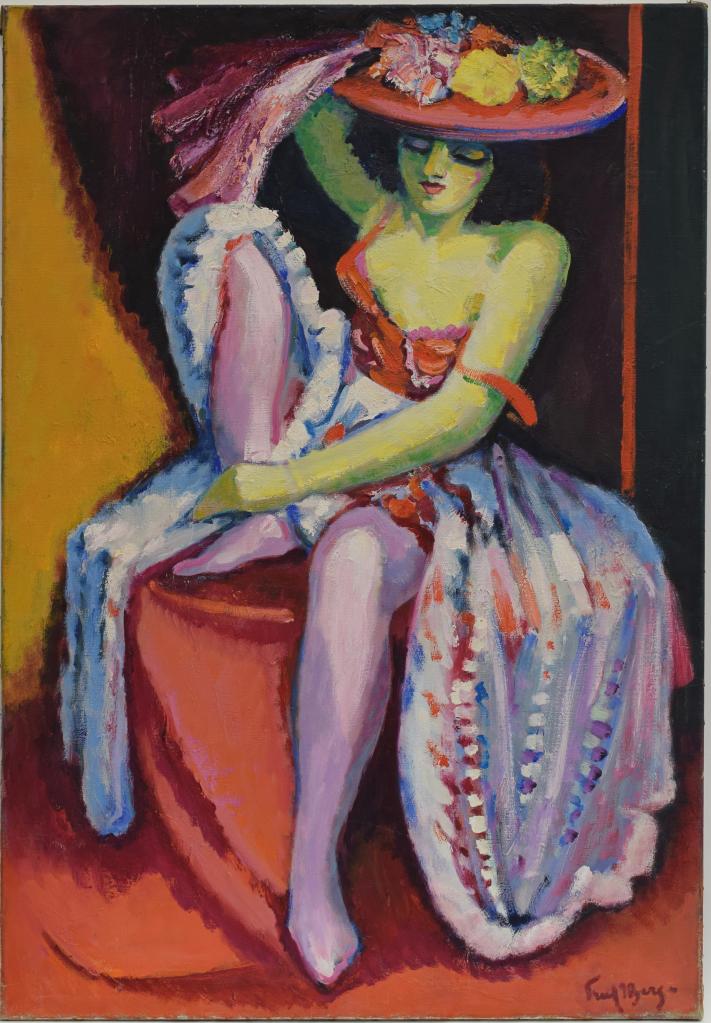
Balletschoentje (Ballet Shoe) – oil on canvas – 80 x 50 cm – date not stated ( described as ‘an older work’) – LOT-ART
Dancer Red Jacket – oil on canvas – 80 x 120cm – around 1970 – Invaluable
Neither Balletschoentje nor Dancer Red Jacket shows the dancer in action. The paintings focus on the exhausted dancer, resting after a performance. Both dancers sit indifferently, with one leg raised inelegantly, on a stool. The weary dancers are unassuming. The ballerina has discarded her pointe shoes, which, I can assure you, is not unusual for ballet dancers. One dancer stares into nothingness, while the other is busy soothing the pain in her ankle.
Balletschoentje is a stark close-up. Van den Beek compels the audience toward the preoccupied expression of the dancer. The intense yellow hair and the dark eyes set against a palette of orange, black, and various shades of blue demand the viewer’s interaction. The dancer depicted in Dancer Red Jacket is more withdrawn. The audience becomes the observer, scrutinising the dancer from a safe distance. Though she is resting, her beauty and sensuality have not lost their appeal. The colours, in contrast to Balletschoentje, have a more muted quality. The artist highlights the theatrical costume, accentuating the elaborate hat and the embellishments on the skirt while drawing attention to the dancer’s unexposed shoulders and slightly hidden breasts.
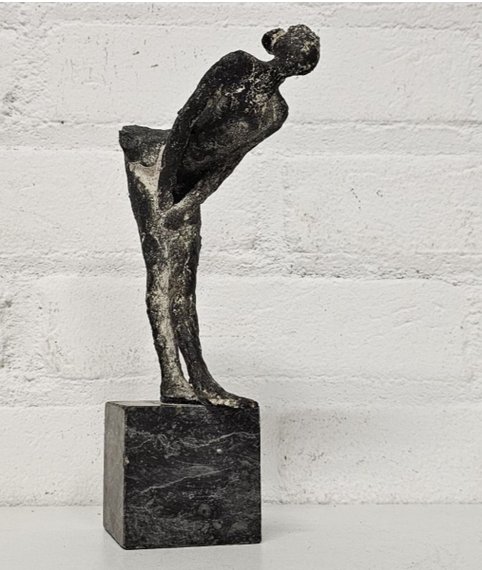
Paul de Swaaf – Ballet Dancer – Bronze statue – Mantorini Art & Interiors (date not given)
height 19 cm,
breath 9 cm ,
depth 4 cm
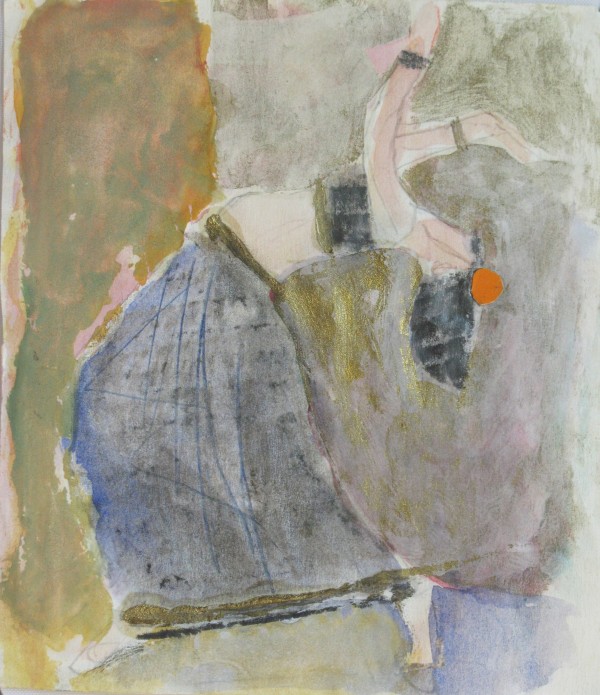
Paul de Swaaf (1934-2008) was a painter, draughtsman, portraitist and sculptor. He worked extensively in bronze, often creating life-size sculptures. As a painter he produced a small number of dance images, including a series of belly dancers. These delicate works, watercolours and gouache, depict a female figure performing characteristic Arabic dance movements.
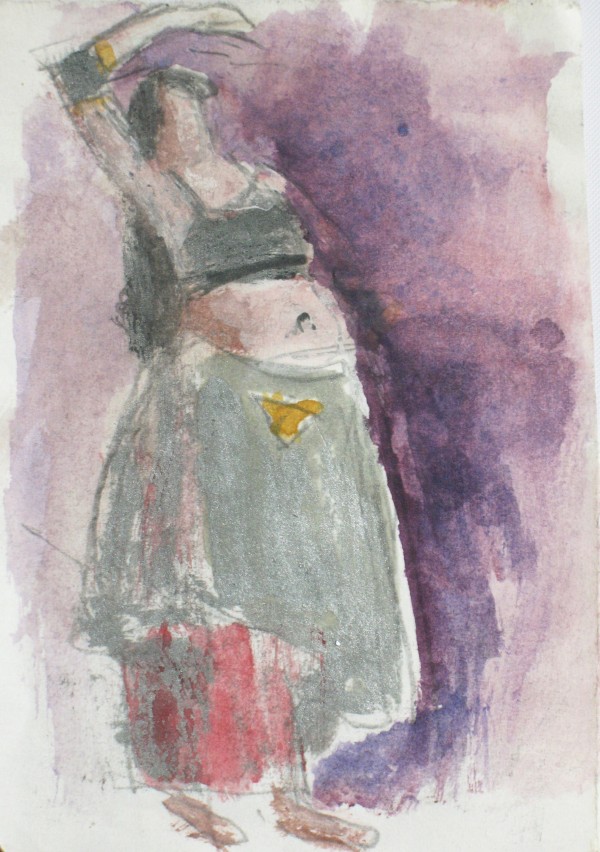
Buikdanseres (Belly Dancer) watercolour 7,5 x 10,5 cm
Buikdanseres (Belly Dancer) watercolour 11,5 × 13 cm
website Paul de Swaaf
De Swaaf conveys a remarkable sense of movement. I am also drawn to the translucent, almost luminous colours in each work. The mauves, the greens, a flash of red and, in the case of the right dancer, a definite patch of orange create a unique ambiance. I have not yet discovered who or what inspired De Swaaf to paint these wonderful illustrations. It is evident, however, that the artist has genuinely captured the spirit of Middle Eastern dance. He expresses the sensuality and the continual flow of movement characteristically inherent to belly dancing. Note the alluring dancer in the left image who leans into a subtle backward arch, intentionally drawing attention to her arresting belly. The other dancer is not only flexible but also overtly tantalising. To achieve such a deep backbend demands strength, flexibility, and a significant amount of flair. This is exactly what De Swaaf has depicted.
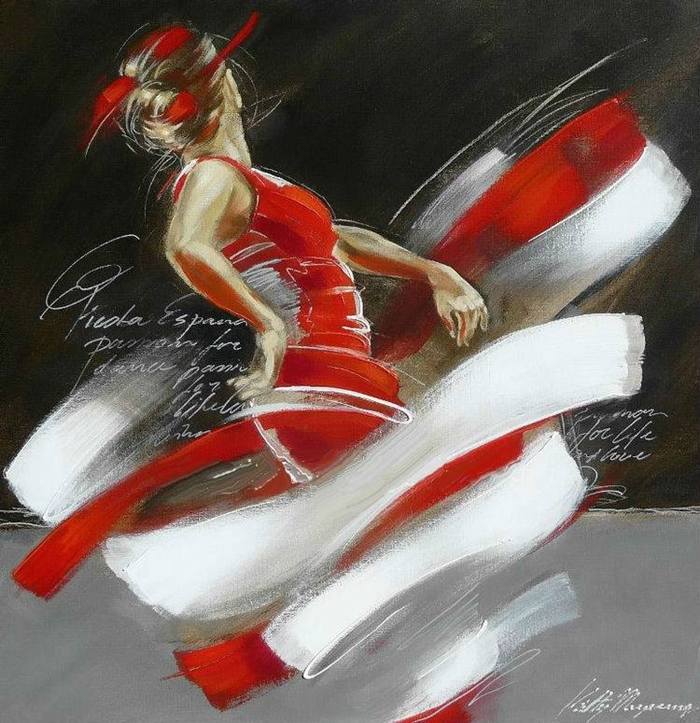
Dance, in particular ballet, is a vital source of inspiration for the modern Dutch artist Kitty Meijering (1974). She has produced a large collection of dance images. Meijering often works in a set of paintings, frequently using a specific colour scheme for the entire series. Red, for instance, is the predominant colour in the series called Pasión. Dance Fusion is mainly a combination of blue and white. Meijering is known to inscribe the paintings with prose or poetry. Her artwork, mainly acrylics on canvas, depicts dynamic dancers in the midst of movement. The ballerinas are frequently airborne, spinning, and executing explosive leaps. Every dynamic gesture showcases the dancer’s vigour and the undeniable emotional enthusiasm required to perform these technically demanding movements.
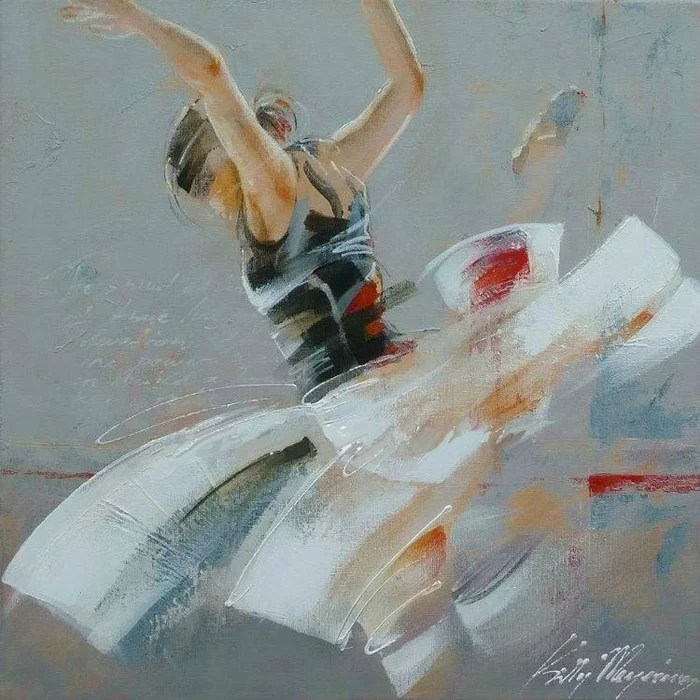
Left: Dance Fusion I
Right : Pasión II
The performing dancer occupies the entire canvas. Indeed, every artwork captures a close view of the crucial moment in the dancer’s performance. In Dance Fusion I, for instance, the dancer ‘falls’ toward the floor. Meijering captures the dancer in mid-action. The dancer appears to be frozen in time. Pasión II reveals the impetus with which the dancer is about to burst into action. I can only compare these works to exhilarating action photographs.
This post opens with an impressive Art Deco image, created by Pieter den Besten, which adorns a wall of a café located in the heart of Gouda. In conclusion, I return to Gouda to showcase two works by the contemporary artist Anita Gaasbeek (1964), who resides and works in that very city. Gaasbeek has a passion for dance. As a youngster, she accompanied her friend to ballet class and was so charmed by the dance that she sketched the young ballet dancers. Today, she is a regular visitor at various ballet companies, sketching professional dancers during classes and rehearsals. “The challenge,” Gaasbeek explains, “lies in capturing the tension of the moment.” Bright, the artwork shown below, captures that precise moment. I can envision the sensation of the dancer’s sweeping movement and truly sense (having been a dancer) the drive of the downward lunge and the rotary thrust of the torso. Bright captures the dancer in a fleeting moment when backlight fortuitously highlights the gracefully moving figure.
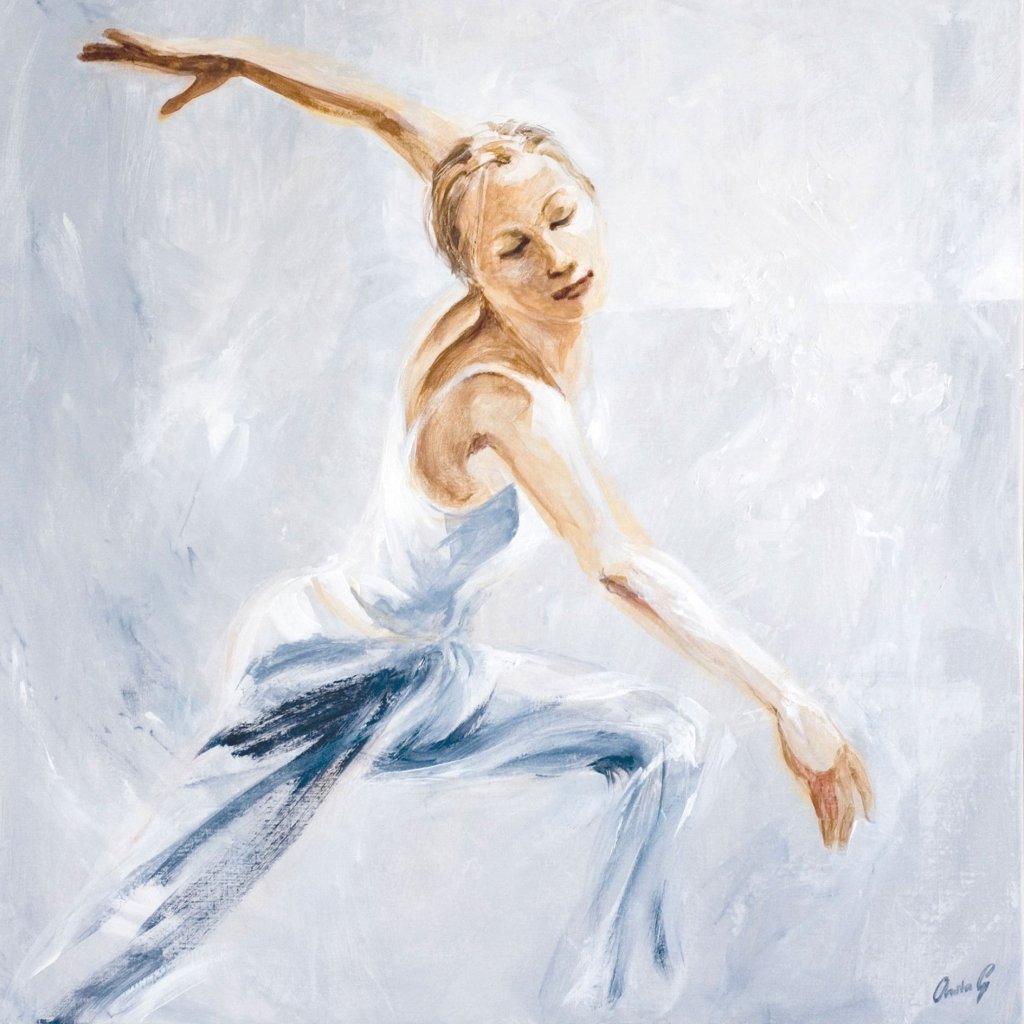
Bright – acrylic paint on linen – 100 cm x 100 cm – 2006 – private collection – this image was provided courtesy of the artist
Bright is a perfectly chosen title. The most obvious reasons are the brightness of the light and the general radiant hue of the dancing figure. However, it’s not just that; Bright is a close-up of a rapturous dancer. She moves effortlessly, brightly if you wish, rendering her striking in her lithe simplicity.
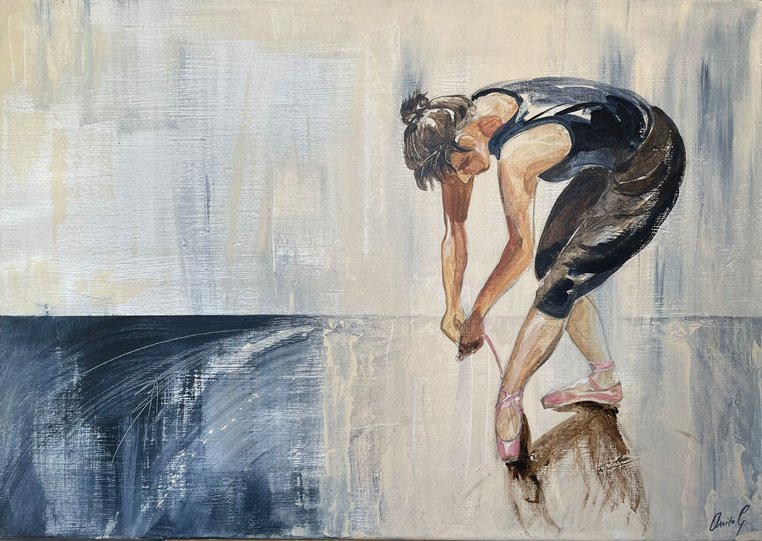
Dancer on Pointes (Danseres op Spitzen) – acrylic paint/mixed technique – 70 cm x 100 cm – reproduced by kind permission of the artist
What is more common than a ballerina adjusting her ribbons? The French impressionist Degas painted many images of dancers performing precisely that. Gaasbeek’s painting, Dancer on Pointes, presents a familiar sight found in ballet studios worldwide. The dancer is positioned in the right section of the artwork and occupies the same amount of space as fields of cool hues. The straight line that travels across the painting places the dancer in a ballet studio. The focus is on the ballerina. This ballerina may not be dancing, but the indistinct setting juxtaposed against her curved form, gently raised shoulders, and delicate physique radiates grace and a feeling of tranquillity.
In my opening remarks I wondered how the dancer inspires the visual artist. This post does not pretend to have discovered the answer. It suffices to say that dancers, regardless of their background, dance style, or beauty, are and continue to be an endless source of inspiration.


 DANCE IMAGES IN THE ART OF THE NETHERLANDS