The Dutch word ploeg means ‘to plough’. And that is exactly what a collective of artists, writers and architects living in and around Groningen, a major city in the northern Netherlands, achieved. The artists of De Ploeg delved into impressionism, constructivism and expressionism, exploring new paths, ploughing, as they put it, the artistic soil in Groningen and surroundings. They created breathtaking works of rural Groningen, depicting farmhouses, vast fields, churches, and rivers in addition to café, music hall, cabaret, and circus scenes. Their dynamic portraits were unique. The group boasted its most groundbreaking era during the 1920s. The defining feature of their work is innovation, employing bold colour contrasts, vibrant hues, sharp angular lines, and spontaneous brush techniques.
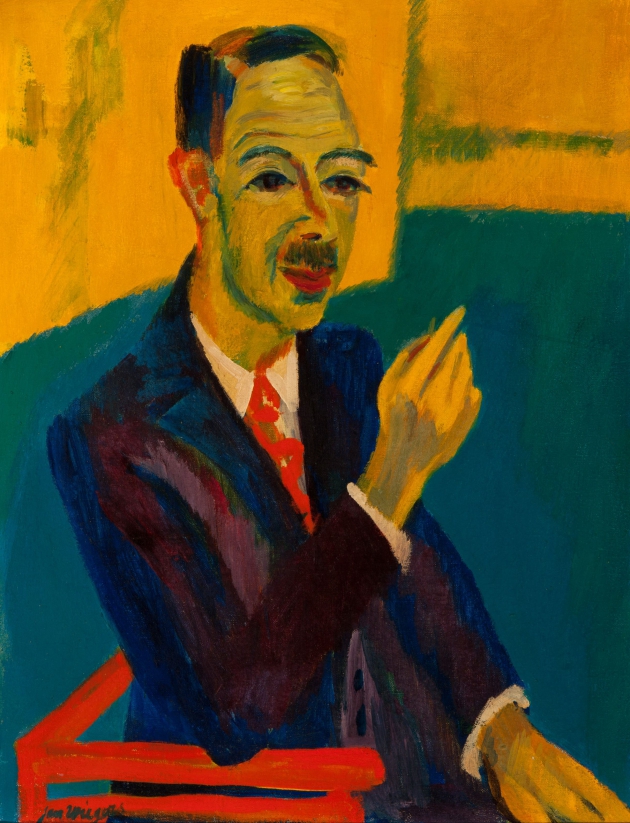
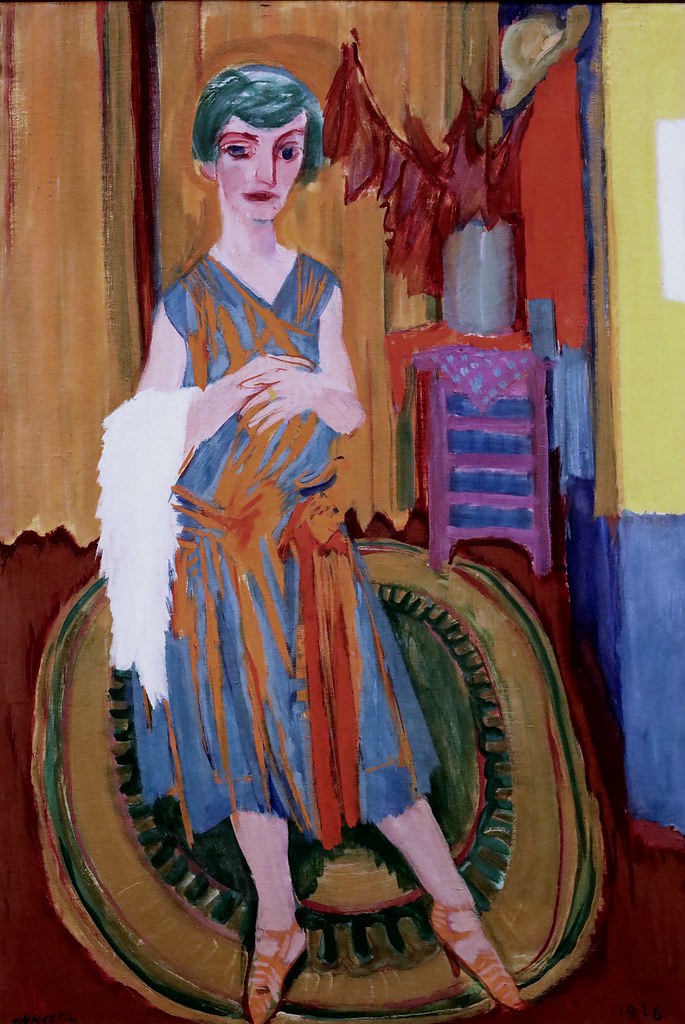
Portrait H.N. Werkman – 60 cm. x 52.5 cm. – mixed technique – 1926 – Museum de Fundatie, Zwolle en Heino/Wijhe
Johan Dijkstra (Right)
Marie Dijkstra-Van Veen – 1926 – Groninger Museum, Groningen
In 1920, the foremost De Ploeg artist, Jan Wiegers, met Ernst Ludwig Kirchner, foreman of the artistic group Die Brücke. The two men developed a friendship, and Kirchner’s expressionistic style and concepts notably impacted Wiegers and subsequently the work of De Ploeg.
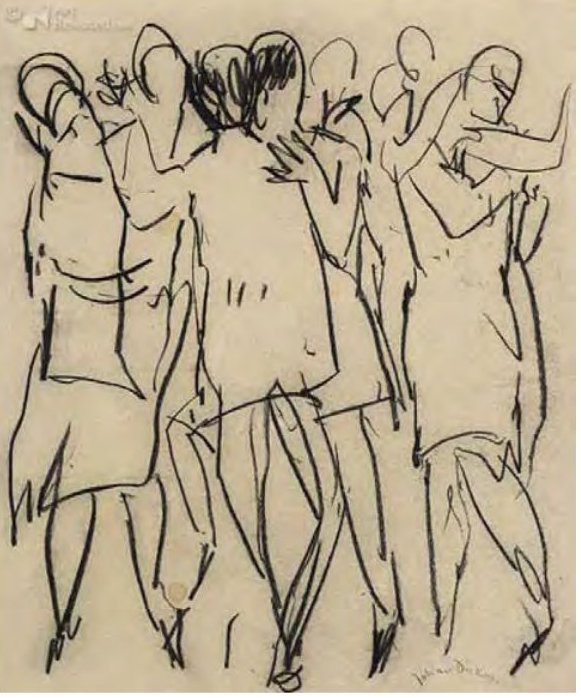
I cannot ascertain whether De Ploeg artist Johan Dijkstra was directly influenced by Kircher. I propose that Kirchner’s unique style—slender and elongated figures—can be recognised in Dancing Figures (Ploegfeest). Similarly, the various dancing couples in Johan Dijkstra’s sketch span the entire height of the page, just like the figures in Kirchner’s drawing. The swift, imprecise lines, the rough shading, the cropping, the overlapping, and the unnaturally tapered feet are shared characteristics of both works.
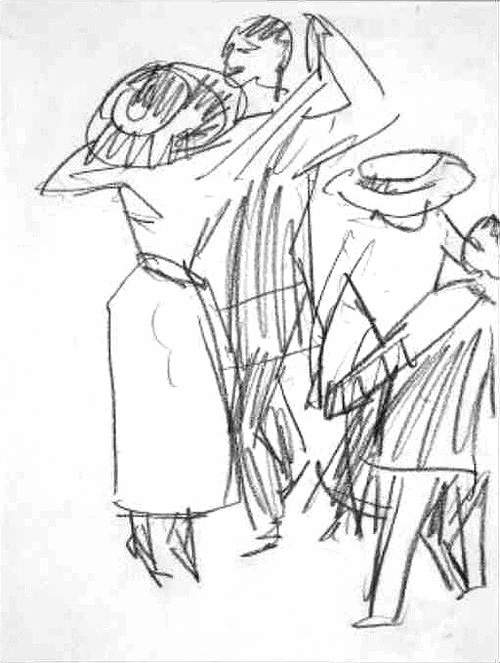
Two couples dancing – no date or measurements given – image WordPress Blog Sketchuniverse
Johan Dijkstra (Right)
Dancing Figures (Ploegfeest) – no date or measurements given – image. Art Revisited
Amongst the traits that define the De Ploeg are a daring choice of non-local colours, harsh lines, distorted shapes, and areas of contrasting shades. Prominent De Ploeg artists Jan Wiegers, Johan Dijkstra, and George Martens, influenced by Die Brücke, portrayed innovative scenes of dance, music halls, cabaret, and circus. These artists, along with Jan Altink, also portrayed ballet dancers. The issue now is how these innovative, avant-garde artists depicted an art form shaped by three centuries of classical ballet tradition.
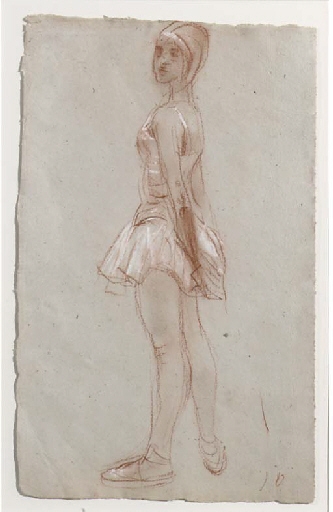
Not surprisingly, I found only a handful of ballet images. All the images depict a solo ballerina, posing, resting, or adjusting a shoe. None present a ballet performance, and only one ballerina is shown in action. To complicate matters, the majority of the paintings and drawings are undated and all carry general titles such as ‘ballerina’ or ‘ballet dancer’. There is no indication regarding the identity of the ballet dancer. The only exception is a full-length drawing (below left) of a ballet dancer by Johan Dijkstra, the artist of Dancing Figures (Ploegfeest).
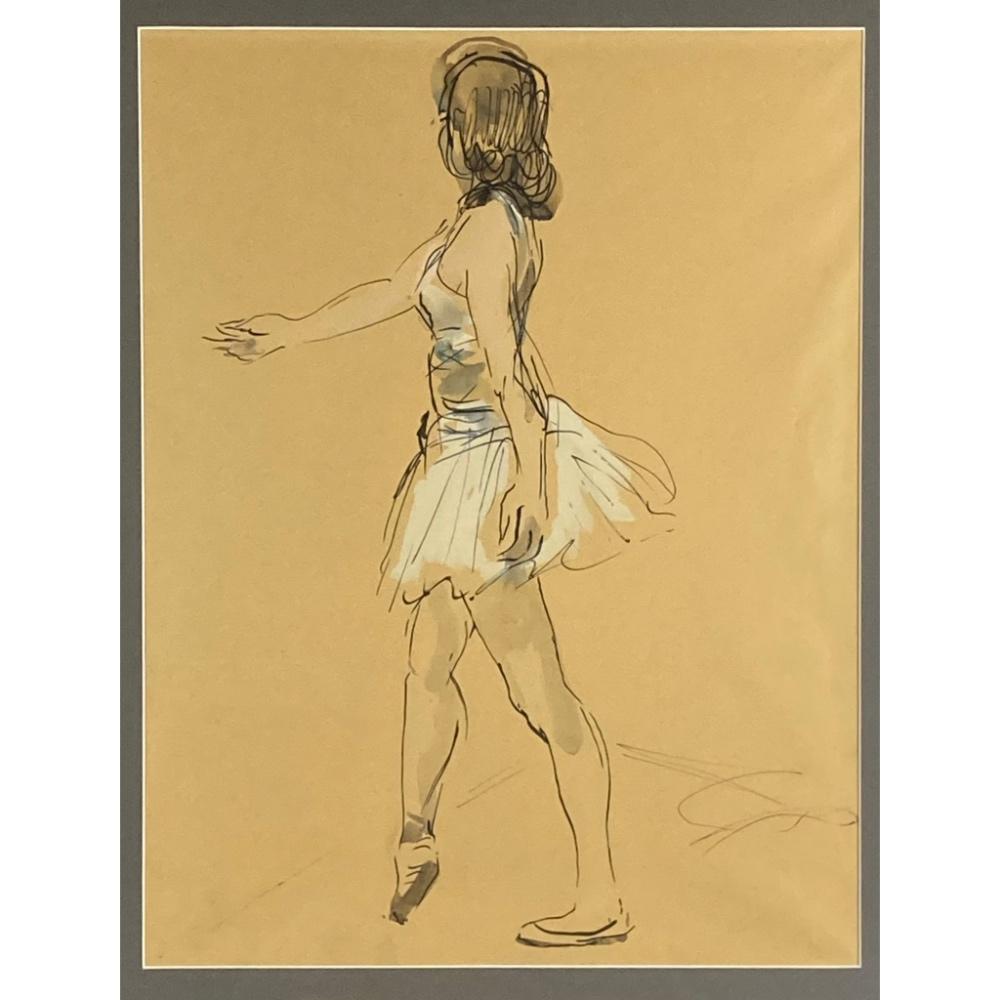
Left: Ballerina bij Gretel van Bruggen – sepia/ reed pen – 65 cm. x 50 cm. – Richard ter Borg Kunsthandel, Groningen
Right: Ballet dancer – signed with initials ‘JD’ (lower right) – red chalk heightened with white on paper- 33.5 cm. x 21 cm. – Christie’s
Dijkstra’s two delightful ballet images represent a marked departure from his vivid, expressive works. These line drawings appear effortless, merely a casual sketch. The artist, in contrast to the style used in Dancing Figures (Ploegfeest), now employs delicate lines and subtle shading to portray the dancers.
The title of the sepia sketch includes the name of Gretel van Bruggen, a well-respected ballet teacher who lived and worked in Groningen. This leads me to believe that Dijkstra visited van Bruggen’s studio, depicting the dancer in class. The young ballerina appears to be preparing for a turning or jumping exercise. This is the only ballet image that I could find where a figure actually appears to dance. Dijkstra has illustrated the other dancer in a static pose. This young dancer evokes Degas’ ‘Little Dancer of Fourteen Years’. Similar to her famous counterpart, this ballerina also has her hands joined behind her back and her feet arranged in a pose that reflects the balletic fourth position; however, unlike her predecessor, she is attractive and raises no questions about the vulnerability of the ballet dancer.
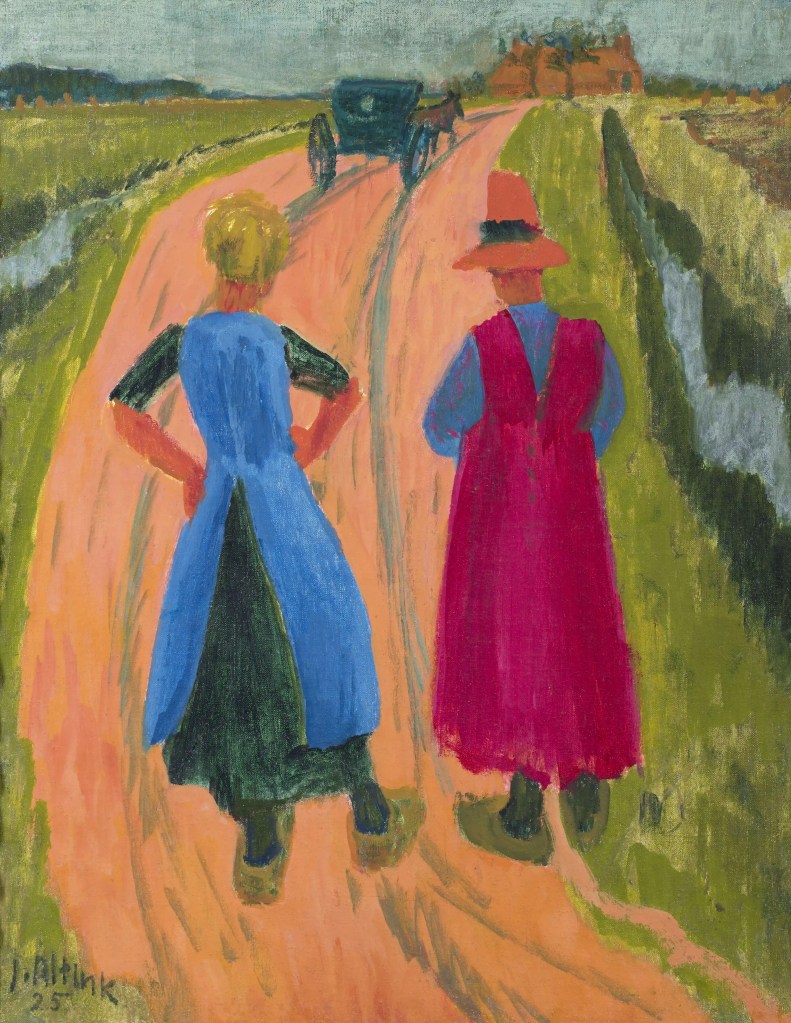
Left: Na het bezoek/ After the Visit – wax/oil paint on canvas – 100 cm. x 84 cm. – 1925 – Groninger Museum Collectie, Groninger Museum
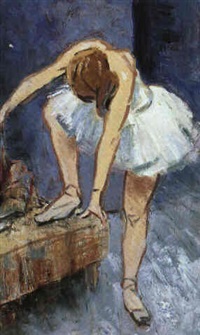
Right: Ballerina – oil on board – 65 cm. x 40.5 cm. – date unknown – ArtNet
In the previous post that discussed dance images created by De Ploeg artists, I briefly referred to Jan Altink. Altink, one of the foundling members, coined the name De Ploeg. As far as I know, he never depicted dance or cabaret scenes, opting instead to paint outdoors. His expressionist artworks illustrating landscapes, rivers, farms, and fields employs vibrant colours. I adore the lively hues and the genuine feeling of tranquillity depicted in Na het bezoek (1925). That same stillness characterises Ballerina. After 1927, Altink’s limited his colour selection to three or four hues. Taking this into account, we can deduce that Ballerina was not an early work. Additionally, although there is no known link between them, there is a comparable depiction of a ballerina lacing her shoe from 1956.
The painting Ballerina presents a typical backstage scene. Altink captures the dancer at an unguarded moment; her elongated limbs gripping a steady support, her torso leaning forward and her head inclined downward. The dancer could be catching her breath, feeling disheartened, or merely fatigued. Regardless of the circumstances, the dancer requires a moment of solitude. The blue background, combined with her body language, enhances the sense of withdrawal in this evocative portrayal of an unnamed ballerina.
Jan Wiegers, the leading figure of De Ploeg, created a few splendid ballet images alongside his celebrated dance pieces. The dancer depicted in the lithograph below is, according to the title, taking a break. Based on her pose, focus, and reflection in the mirror, I would assume she is sewing. That small container lying on the bench is possibly a sewing kit. Dancers frequently engage in these routine activities during breaks. Undoubtedly, Wiegers was present in the ballet studio when he composed this piece.
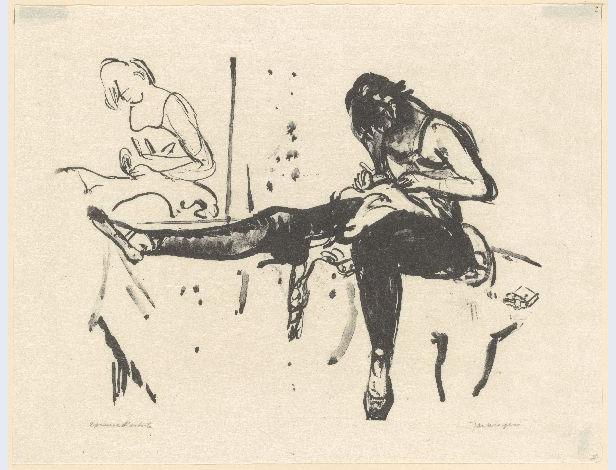
Break-resting dancer – lithograph – 26.5 cm. x36.5 cm. – 1956 – KunstMuseum Den Haag
In Dancer, Wiegers, known for his daring, unconventional colour palette, features a traditional ballerina in natural colours. She wears a short white tutu complemented by a light coloured satin bodice. The figure stands in front of a dark blue background, gently softened by lighter blue smudges around the dancer’s feet and legs.
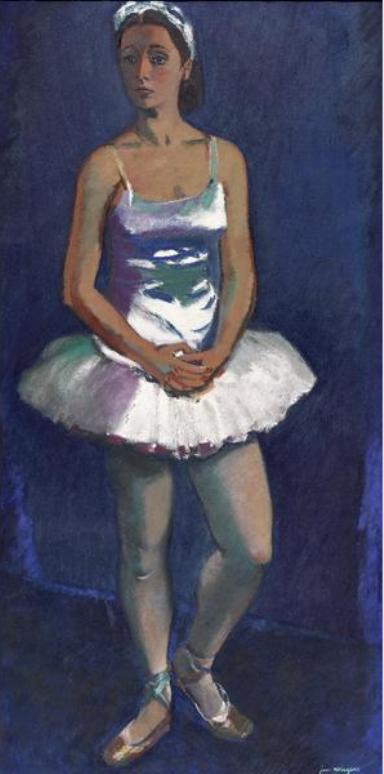
Dancer – 80 cm. x 160 cm. – oil on canvas – undated Kunstmuseum Den Haag – bequest private collection
The full-length portrait, standing at one metre sixty, probably reflects the true height of the depicted ballerina. The pensive, melancholic dancer spans the canvas from the crown of her head to the tips of her toes. Her head significantly ‘touches’ the upper frame, and the open area below her feet is very limited. Her glistening bodice captures my attention. The light and shadow that fall effortlessly on her satin bodice inspire a sense of smoothness. Wiegers has utilised the identical satin finish on her pointe shoes. At the same time, her radiant costume overshadows her lacklustre complexion that, illustrated in soft tones, appears to blend into the background.
I consider this an intriguing portrait. In my opinion, this is a depiction of a captivating woman who is a dancer rather than a portrait of a ballet dancer. Queries continue to emerge. Who is this dancer? Where did Wiegers see her perform? What attracted him to the contemplative woman? What motivated Wiegers to paint this full-length portrait? A ballerina is often illustrated performing, resting, or engaging in activities related to dance. This is a woman entirely absorbed in her own thoughts. Perhaps that was the attraction.*
The 1920s is regarded as De Ploeg’s most inventive period. The ballet images discussed in this post, though the exact dates are not specified, were produced after this initial stage. The woodcut named Russian Dance Couple undoubtedly belongs to the era of innovation. Although this illustration does not present a ‘real’ ballet dancer, Wiegers may have drawn inspiration from a ballet performance. The Ballets Russes, led by Serge Diaghilev, staged performances in The Netherlands in 1924. They toured Amsterdam, Rotterdam, and The Hague, presenting a total of eight performances. Among the ballets performed was Petrushka, a ballet based on Russian folklore, featuring several vigorous folk dances. This is, of course, merely my conjecture, but it is interesting to think about. I should point out that Kirchner produced an impressive artwork named Russian Dancers in 1909. As previously mentioned, Kirchner was an important source of inspiration for Wiegers.
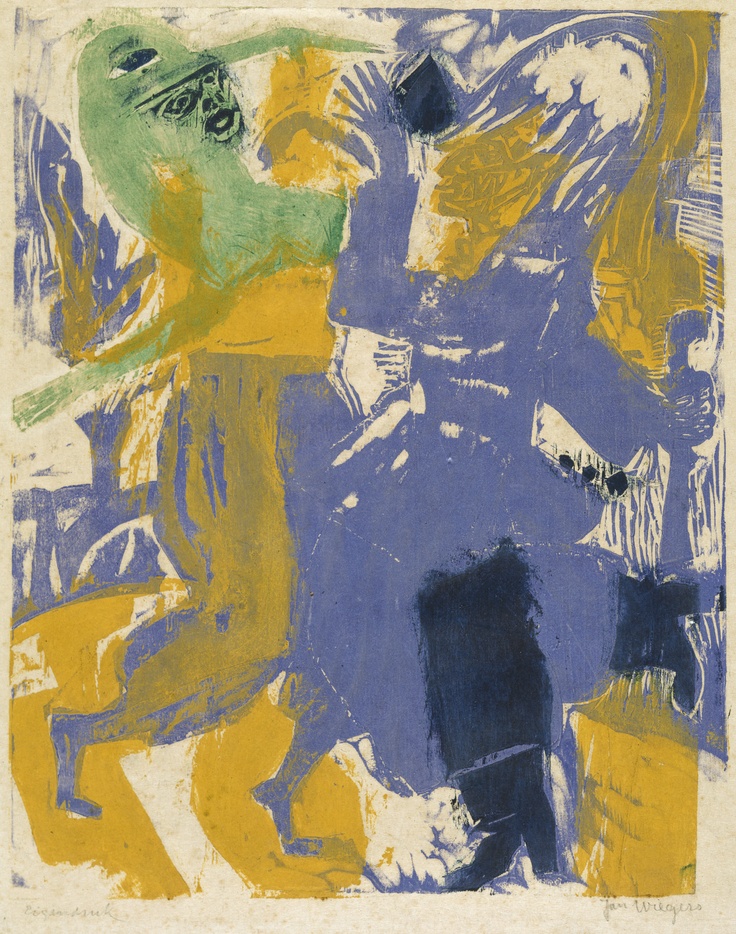
Russisch Danspaar, Russian Dance Couple – woodcut/ print – ink on paper – 66.8 cm. x 44.5 cm – Groninger Museum, Groningen
It takes a little patience, but close examination of the above image reveals a male and female performer. The couple appear to embrace one another; their gestures and footwork suggest that they are dancing rapidly. The striking black Cossack boots attract attention. The male dancer is probably leaping from one foot to the other, tossing his feet quickly behind him, which is characteristic of Russian folk dance. The female dancer, whose face and headdress are somewhat discernible, tilts slightly backward as she follows her partner in this brisk dance.
In this image, Wiegers abandons the realistic, the identifiable. The dancers blend into the colour. The artist only requires three colours, a whirlwind of curved strokes, a mix of vague shapes and lines alongside Cossack boots and dynamic motion, to create an image that embodies the spirit of Russian folk dance.
De Ploeg artists, pioneers of German Expressionism in the Netherlands, only created a few ballet images; yet, similar to their dance artworks, these pieces are unique and invite dialogue.
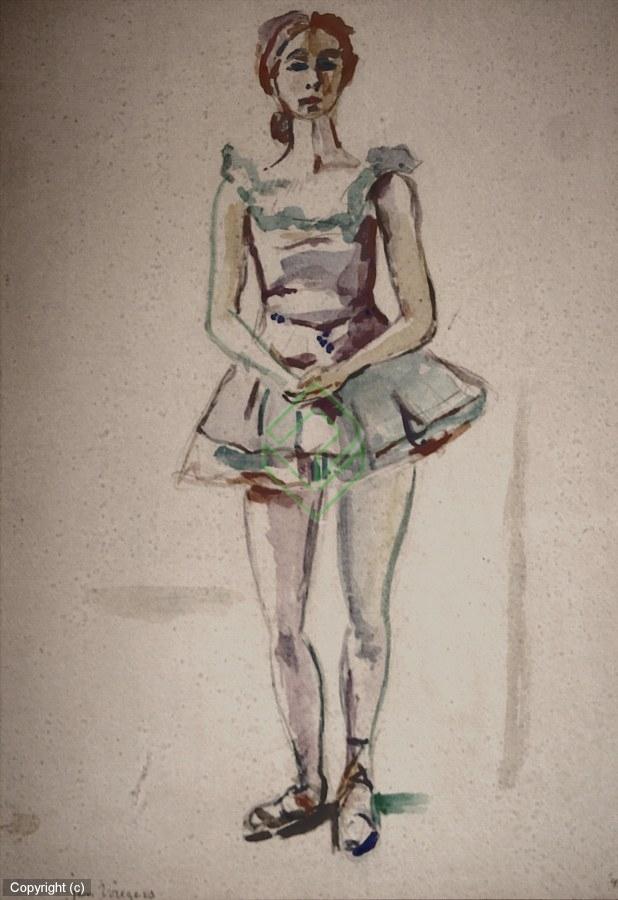
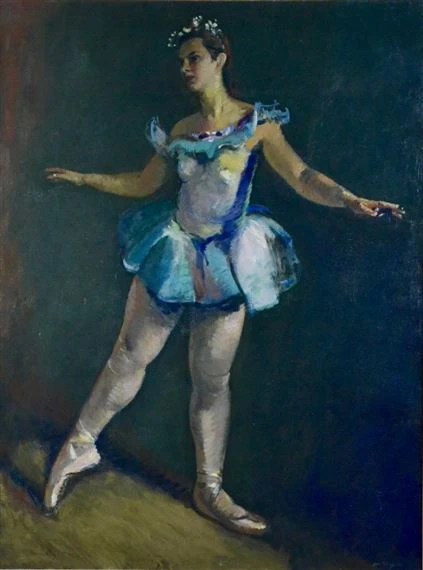
* Wiegers created two other images of a ballerina. A drawing which looks rather similar to the painting discussed and a painting of a ballerina in a blue tutu. Left : Ballerina – 1943 – Source unknown Right: Ballerina oil on canvas – 115 x 86 – date unknown – Mutual Art


 DANCE IMAGES IN THE ART OF THE NETHERLANDS