In Groningen, a city located in the northern Netherlands, a collective of innovative young artists, writers, and architects united to establish new opportunities for prime movers to showcase their work. They sought to discard the traditional and explore new paths. A creative association, De Ploeg, was formed in 1918. The term De Ploeg, meaning ‘the plough’, was coined by founding artist Jan Altink (1885-1971) to convey that art in Groningen and its rural vicinity required tilling and nurturing. The other founding artists were Jan Wiegers (1893-1959), Johan Dijkstra (1896-1978), and George Martens (1894-1979). De Ploeg had neither an artistic manifesto nor were its creators bound to a specific style. All serious artists were welcome. Most, regardless of style, originally distinguished themselves in rural scenes and portraits.
In 1920, Jan Wiegers travelled to a sanatorium in Davos where he met Ernst Ludwig Kirchner foreman of the artistic group Die Brücke. The two men became friends, and Kirchner’s expressionistic style and ideas strongly influenced Wiegers and subsequently the work of De Ploeg. Strong colour contrasts, exuberant hues, sharp angular lines and impulsive brushwork are characteristic to De Ploeg.
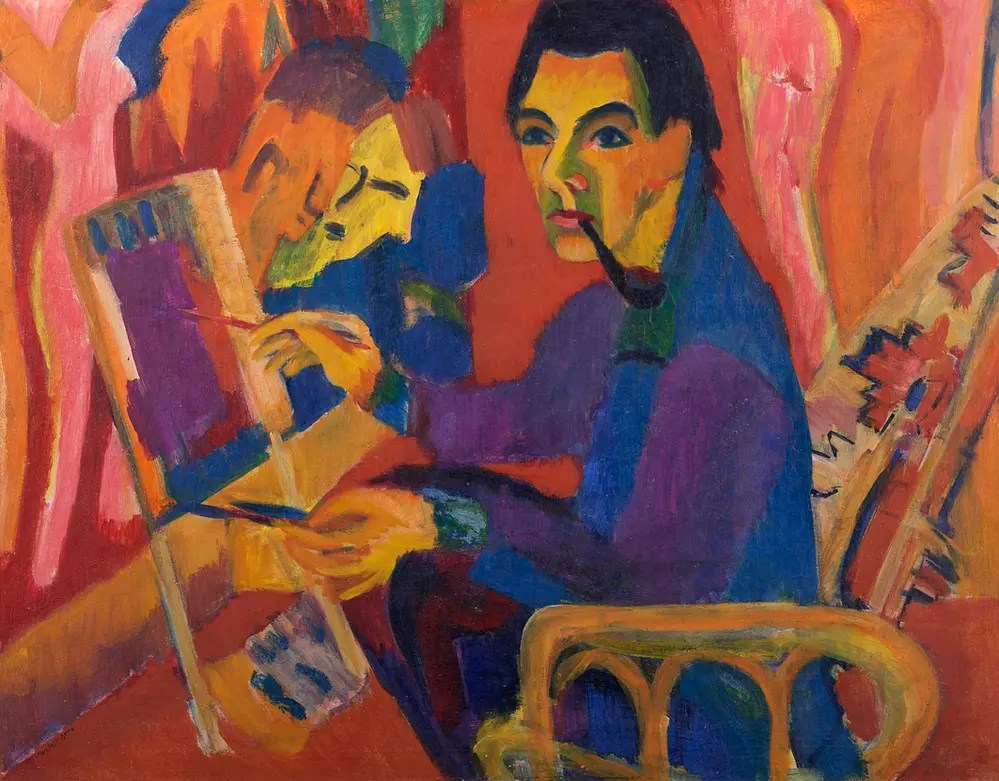
Kirchner in his atelier – oil on canvas – 69 cm x 108.80 – 1925 – Groninger Museum
Kirchner composed a considerable number of dance images. His paintings and sketches of Mary Wigman and Gret Palucca are extraordinary. Kirchner’s love of dance, circus, cabaret, and café life inspired Wiegers. Dancing Room (1922), one of Wiegers earliest dance-inspired works no longer exists, but fortunately a black and white photograph still remains. Even without colour the characteristic style of Die Brücke expressionism—harsh lines, distorted forms, strong contrasts—is evident
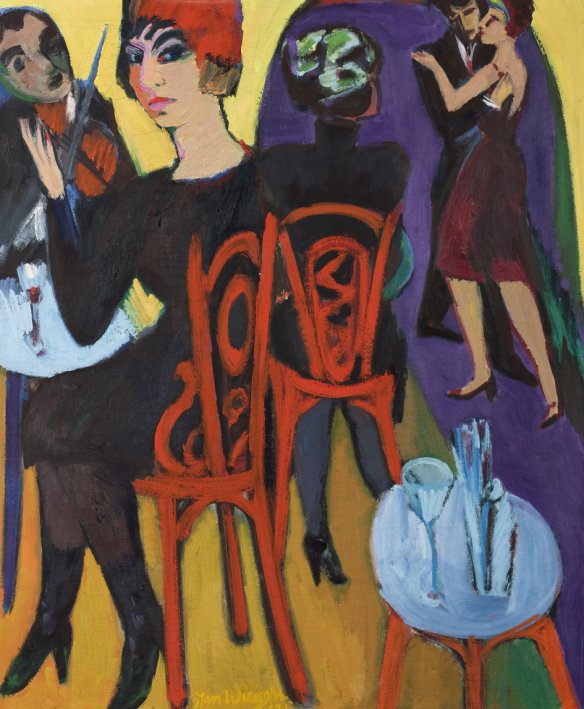
Early in the 21st century, a painting titled Music Hall, signed by J Wiegers and dated 1921, emerged on the art market. The artwork sparked a great deal of controversy. Specialists raised significant concerns regarding its dating. Following in-depth technological investigations, restaurateur Marjan de Visser uncovered incredible findings; Music Hall was painted over another painting, and all indications pointed to the underpainting being the missing artwork, Dancing Room; Jan Wiegers presumably revisited his original artwork during the 1950s.(1)
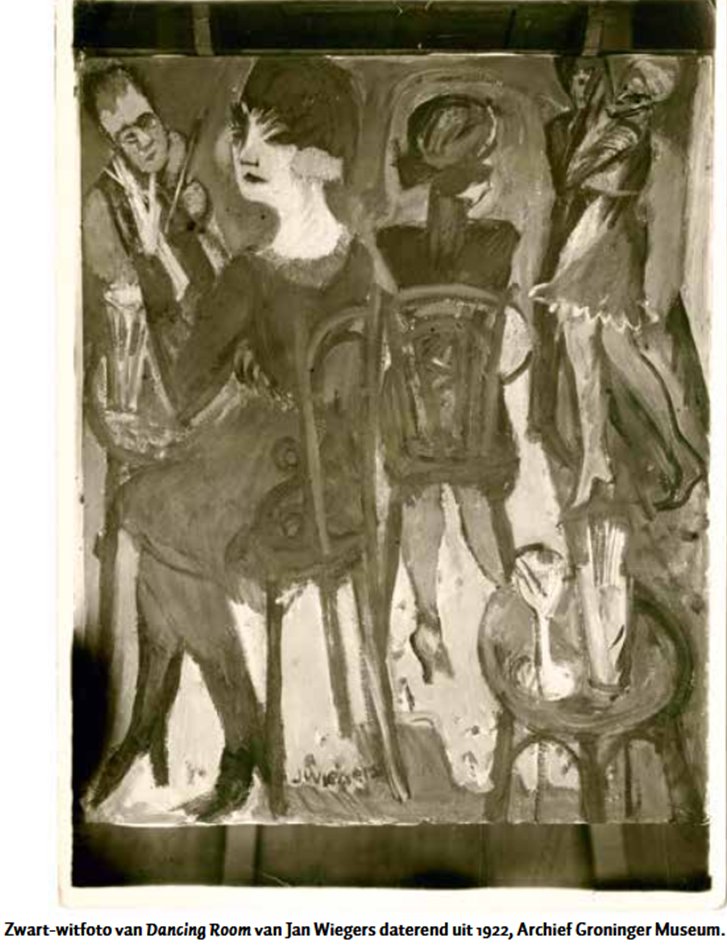
photograph of Dancing Room – Gedenkboek Groningen 1672-1922 – photograph E. Thijszen 1922
Music Hall – wax/oil paint on canvas – 100 cm x 82.5 cm – date – presumably in the 1950s – Groninger Museum
Flashback to the Roaring Twenties: society flocked to the dance hall to enjoy the latest trends in music and dance. De Ploeg artists focussed their attention on new and exciting forms of entertainment. In Music Hall, Wiegers plays with vivid colours, spatial distortion, cropping, and demonstrates a sharp contrast in colour and perspective. Research reveals that Dancing Room possesses similar properties.
The bold gaze of the seated woman is compelling. Why, you may wonder, has her table companion turned her back on her? That woman wearing a green headdress observes the couple dancing in the upper right-hand corner. At this moment, it is interesting to contrast the two dancing couples; they resemble each other but are different. The figures in the older artwork, Dancing Room, are rough, contorted, not especially tender, and possess mask-like characteristics. The ‘newer’ couple, depicted with a smoother brushstroke, dances affectionately. Unlike the dancers in the monochrome photo, this couple is portrayed in a more realistic manner.
The artists of Die Brücke captivated by nightlife and entertainment frequently painted dance, cabaret, revue, and circus motifs. De Ploeg embraced comparable themes. The etching below, Circus, presents a Pierrot and a dancing girl, performing on a podium. The audience is positioned at the front of the stage, and on the right, a pianist is seen playing a grand piano. I wonder if this scene is not set in a nightclub. One thing is certain, the dancer can definitely kick her legs high into the air. However, upon closer examination of the dancer’s leg shape and length, it becomes clear that her exceedingly high leg is entirely out of proportion. The elevated leg that aligns with the grand piano’s lid is significantly longer than her supporting leg. Equally strange is the remarkable expression on the performers’ faces. Admittedly, Pierrot is known for being melancholic, but his companion appears truly wretched. Her makeup, reminiscent of actors in a German expressionist film, is bold and applied with dark markings.

Circus – found on Catawiki – no date or information given
There is no hint of movement, exuberance, or vitality in Circus. The scene is harsh and unaesthetic. In reality, Circus can be viewed as a fixed ‘snapshot’. That is not the case in Revue Cabaret Dancer, Orchestra, and Public, the animated sketch shown below. The artist, George Martens, one of the founding artists of the Ploeg, is acclaimed for his cityscapes, landscapes, still lifes, circus and cabaret scenes. Striking colours and vivacity, together with a unique sense of humour, define his work.
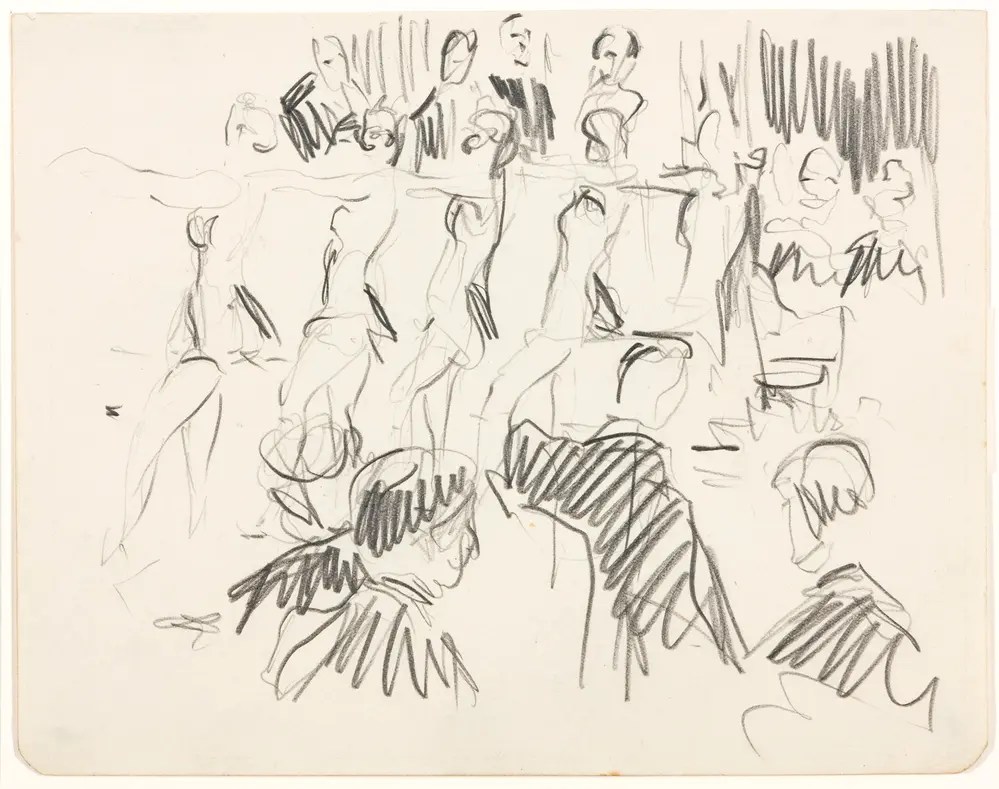
Revue Cabaret Dancers, Orchestra, and Public – Groninger Museum
Even though the dancers’ faces are not visible, you can sense the joy and energy of the chorus line. These slender, scantily dressed dancers all look forward, enchanting both the spectators and viewers. They are arranged in a chain-like formation, with one arm stretched over the shoulder of the dancer in front of them. The repetitive movement of arms and legs suggests both desirability and motion.
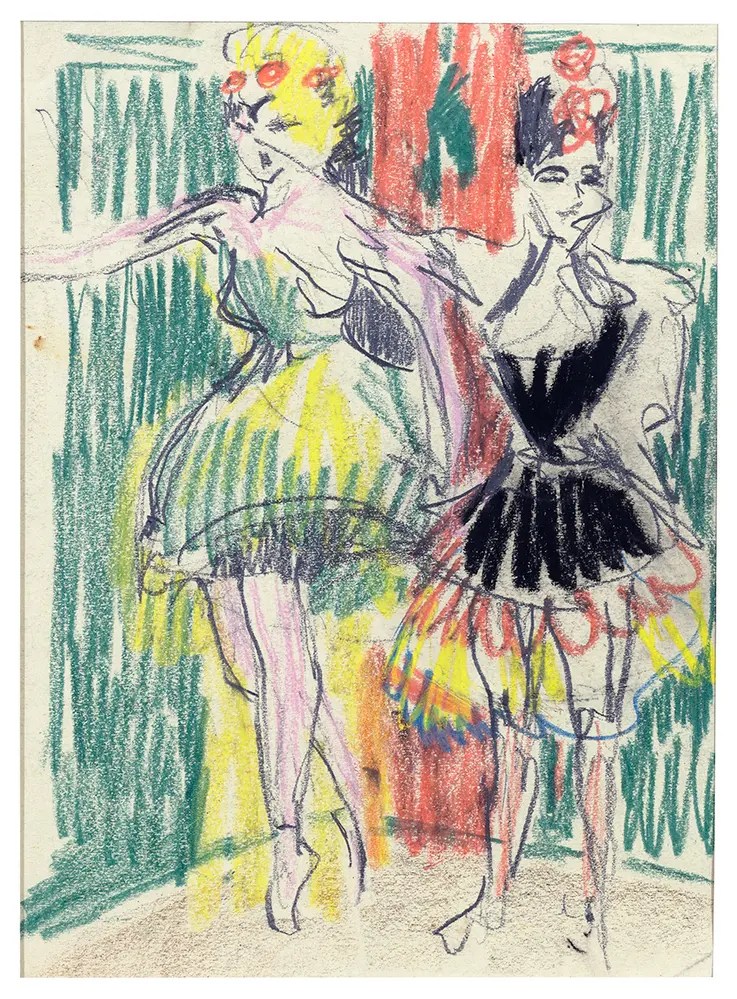
Movement is precisely what Martens suggests in his illustration of the Café Figge, a highly popular dance venue in the city of Groningen throughout the Roaring Twenties. Note how the artist plays with body language; a gentle tilt of the hip, a slight slope of the torso, an inclined head, and subtle arm movements all indicate motion. These well-dressed couples, dancing amorously on the dance floor, starkly contrast to the two flashy showgirls depicted in the second image. Despite the two pieces displaying entirely different dance styles, both works highlight Martens’ playful attitude and captivating vitality.
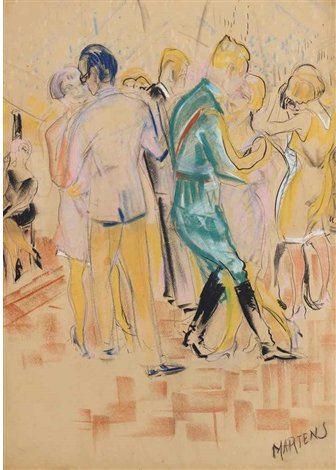
Dancing in cafe Frigge Groningen – chalk and pastel on paper – 78.5 cm x 57.5 cm – c. 1927 – Artnet/Christie’s
Two Variety Dancers – drawing, chalk on paper – 30 cm x 21.70 – 1925 – Collectie Stichting De Ploeg, bruikleen Groninger Museum
Before you assume that I mistakenly positioned Johan Dijkstra’s artwork Dancing Couple sideways, I must clarify that if you visit the Groninger Museum, you’ll find this striking painting displayed in this manner. The painting has a captivating history.
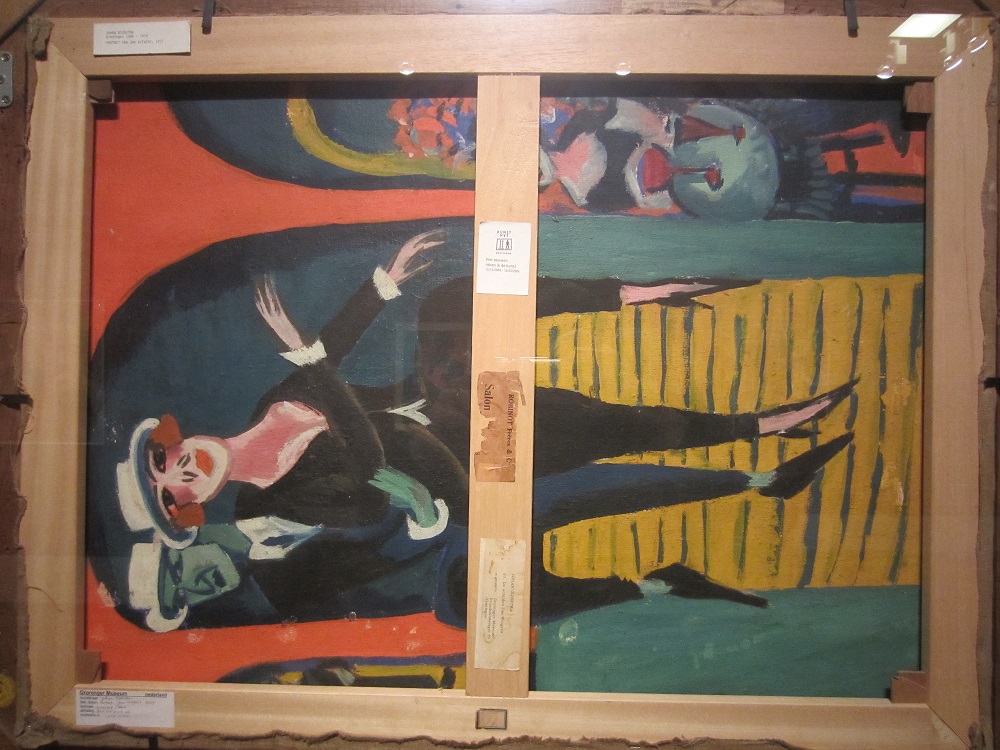
Danspaar/Dance Couple – oil/wax paint on canvas – 76.5 cm x 100 cm – 1927 – Groninger Museum, Groningen
Artists frequently repurpose canvases. Johan Dijkstra chose to discard his painting, Dance Couple, and use the canvas’s reverse side to create his unique portrait of Jan Wiegers. The portrait was subsequently exhibited. The older artwork, Dance Couple, received a frame and crossbar and was then entirely overlooked. Thankfully, circumstances have changed. Starting in the second decade of the 21st century, both the recto and verso are displayed at the Groninger Museum. The public, however, must tilt slightly to the side to view the previously overlooked artwork as it was originally intended.
It’s difficult to fathom that Dance Couple was lost for such an extended period. The dancers are not only commanding but also bizarre. She appears pleasant enough, but he has a cruel look, intensified by his absinthe-hued complexion. He is truly green everywhere, from his hands to the green skin visible above his shoes. The pair, propped under a red arch, are enclosed by green slabs of an undecipherable shape. The couple performs side by side and lifts their legs in unison. Dijkstra draws particular attention to the entertainers’ hands. Her hands are delicate and naturally rendered; his hand is unnatural and contorted. Audience members, a man and a woman, are seated at the side of the stage. They are enjoying a glass of red wine atop a single lopsided table. There is so much to see in this painting, so many amazing colours and shapes, that one wonders why Dijkstra chose to discard it.
Another stunning dance image, Bal Nègre, was created by Jan Wiegers in 1930. The colour scheme is absolutely dazzling; light skin tones resting against a large patch of deep blue, and all set in front of a red surface. Every aspect of this painting is unnatural yet utterly recognisable. The woman is attractively dressed in a modern tight-fitting gown that accentuates her slim waistline, her buttocks, and her provocative neckline. She tenderly embraces a tall, broad man whose dark, strongly outlined head hovers just above her very stylish hat. The couple dances intimately, her body pressed firmly against her partner, who reciprocates by spreading his exceptionally large hand on her derrière.
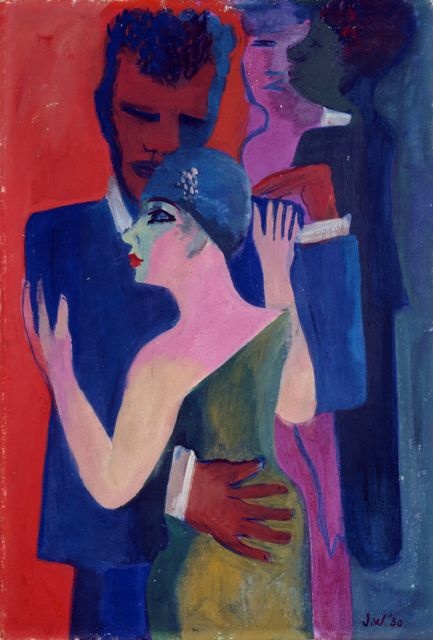
Bal Nègre – 1930 – Groninger Museum Collection, on long-term loan from Stichting De Ploeg
Yet there is more than meets the eye. Behind them, rendered in a sketchy fashion, is another couple; both couples are of a mixed race. This, considering that this work was painted in 1930, was not a widespread occurrence. The title of the painting, Bal Nègre, offers the explanation. In the twenties and thirties of the last century, Le Bal Nègre, a nightspot in Montparnasse, was the place to be. There, where tout Paris came to listen to the outstanding jazz musicians and to enjoy the latest dance crazes, men and women, regardless of nationality or race, danced together. Performers and clientele included Josephine Baker, Maurice Chevalier, Mistinguette, May Ray, Albert Camus, Jean-Paul Sartre and the Dutch artist Kees van Dongen. Jan Wiegers and his friend Hendrik Werkman, also a member of De Ploeg, had visited Paris and like so many before them, found their way to this fashionable establishment.(2)
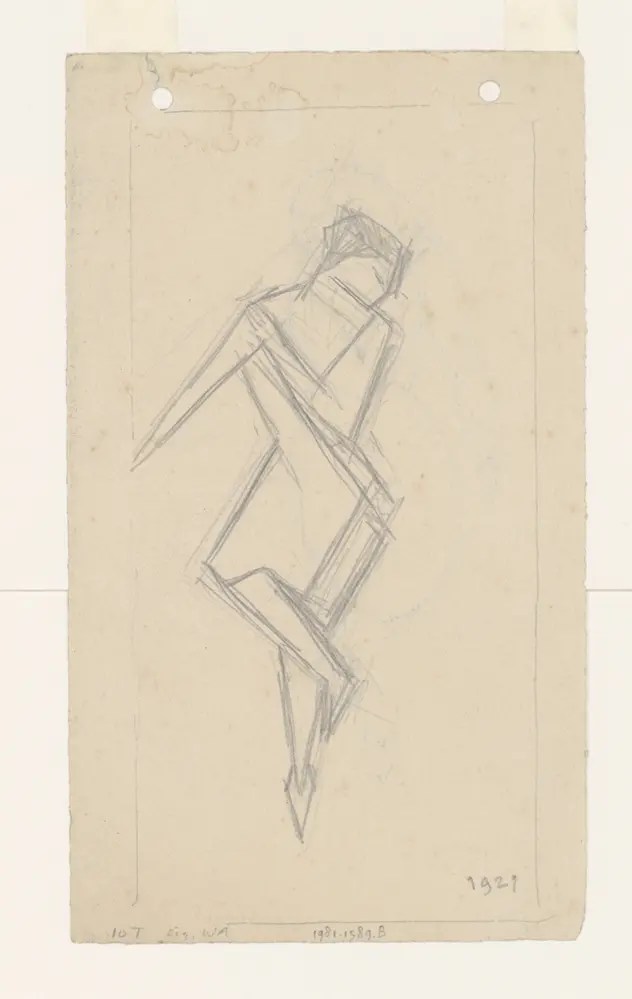
Constructivism emerged as a distinctive style within De Ploeg, embraced by Wobbe Alkema (1900-1984), Jan van der Zee (1898-1988), and the printmaker Hendrik Werkman (1882-1945). Alkema was a member of De Ploeg for a brief period, from 1924 to 1925. He soon positioned himself as an independent Constructivist artist. The two figures titled ‘Dancer’ originate from an early sketchbook. Which dancer inspired him? There were few professional dancers in Groningen around 1920. Could Alkema have travelled to Amsterdam or The Hague, where dance performances occurred more frequently?
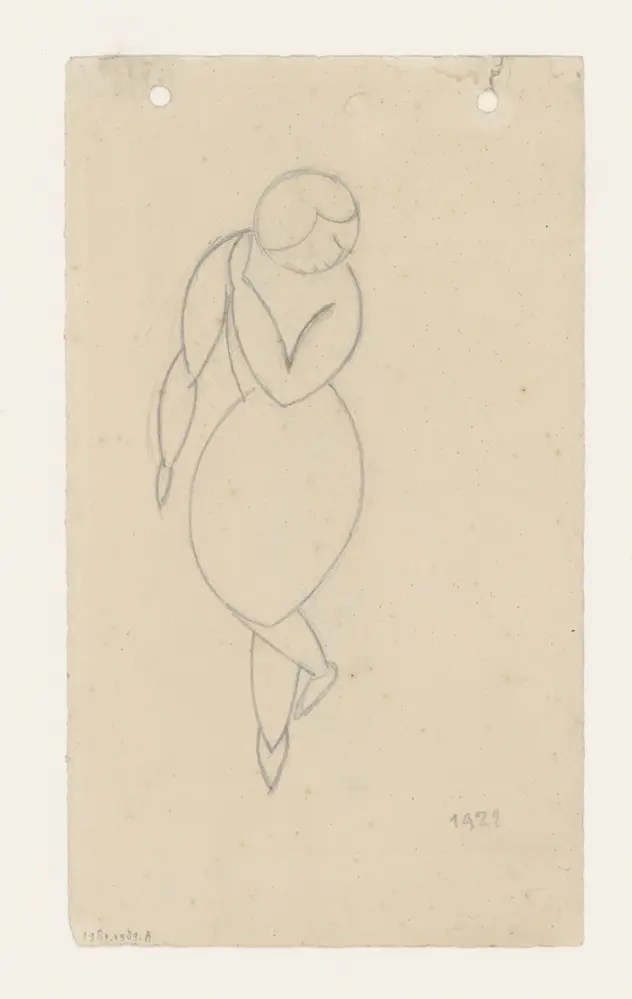
Left – drawing/ graphite on paper – 21.7 cm x 12.6 cm – 1920
Right – drawing/ graphite on paper – 21.7cm x 12.6 cm – 1921
Although neither drawing is realistic, both are distinctly identifiable as physical shapes. In the 1920 illustration, except for the angular, pointed foot, all the extremities and shapes are soft and curved. The identical dance stance is depicted in the 1921 sketch. In this instance, Wobbe employs straight lines. Each appendage and section of the body is constructed with angular geometric lines and shapes. Wobbe’s stunning work progressed, over time, into pure constructivism, devoid of any reference to physical reality.
De Ploeg marked its most groundbreaking era during the 1920s. Innovative artists, embodying various styles and concepts, collaborated to rejuvenate and energize art in the northern Netherlands. The Groninger Kunstkring De Ploeg Association is still active today, upholding the principles of the enterprising artists from the past.
- (1) My thanks to the Groninger Museum for sharing their illuminating article on De Ploeg & De Roaring Twenties.
- (2) Also my gratitude to Esther Schreuder, researcher and historian; her blog Dance in Art (1). From the Black is beautiful catalogue: Jan Wiegers’ Bal Nègre is informative and a pleasure to read.
- Many thanks to the Groninger Museum, Groningen for sharing their awesome images.


 DANCE IMAGES IN THE ART OF THE NETHERLANDS
