Dutch and Flemish artists are renowned for their paintings of peasant and social dances. Images of dance classes, ballet lessons, or dancers in a studio setting, though, are less common. In my last post, I discussed images of dance lessons prior to the 20th century. This post examines how later Dutch artists portrayed young and professional dancers working and relaxing in the dance studio.
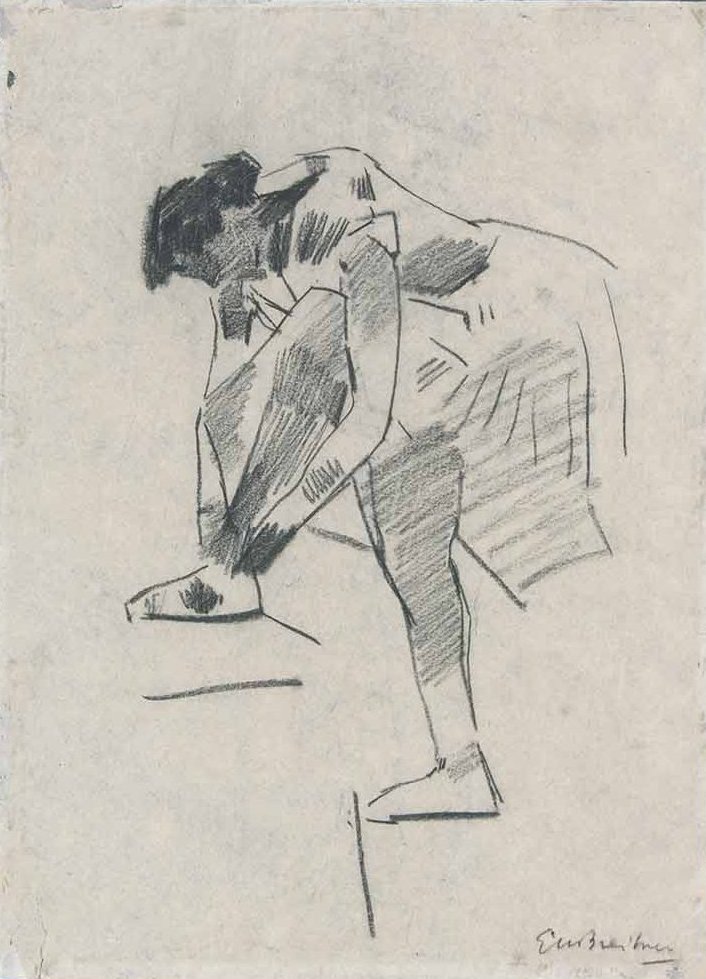
Dancer – black chalk – 33 cm x 24 cm – datum unknown – verso – drawing of Standing Lady – Hein A.M. Klaver Kunsthandel, Baarn
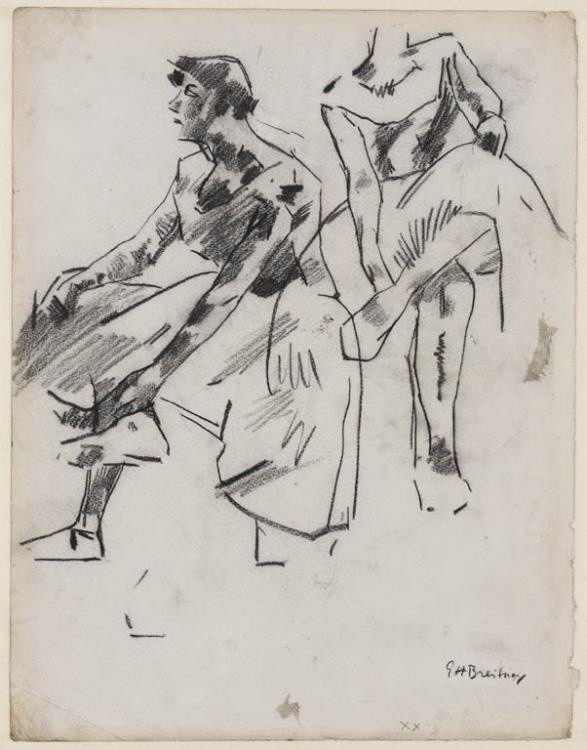
Two Dancers Resting – drawing on paper, charcoal & pencil – 34.9 cm x 26.8 cm – after 1877 and before 1923 – Teylers Museum, Haarlem
George Hendrik Breitner (1857-1923), an artist I featured in the previous post, was an ardent advocate of realism. Consider, for instance, the two drawings displayed above. The dancers are not particularly elegant. These ballerinas are neither poised nor refined; one dancer quickly adjusts her ribbons, and the other dancers slouch and recline. The two weary dancers in Two Dancers Resting grip their sore ankles. The artist makes it perfectly obvious that dancing demands considerable effort. Breitner uses swift, rounded, and angular strokes, along with light and darker shading, achieving a completely unromantic effect. Breitner’s drawings are timeless. They illustrate the everyday routine of any dancer.
The Dutch impressionist Isaac Israëls (1865-1934), friend and rival of Breitner, lived in London from 1913 until 1914. While there he painted a number of ballet images. Unlike Edgar Degas, whom he greatly admired, Israëls did not limit himself to professional ballerinas; he portrayed young girls practising their ballet exercises in normal classroom situations.
Ballet School in London resembles a snapshot. It provides an informal and completely realistic view of girls practising before their ballet class begins. One girl is on pointe, another is performing a stretching exercise, and a third is simply waiting. The knee-length practice skirts adorned with colourful sashes, the long socks, and the free-flowing hair tied with large ribbons place the scene in the early years of the twentieth century.
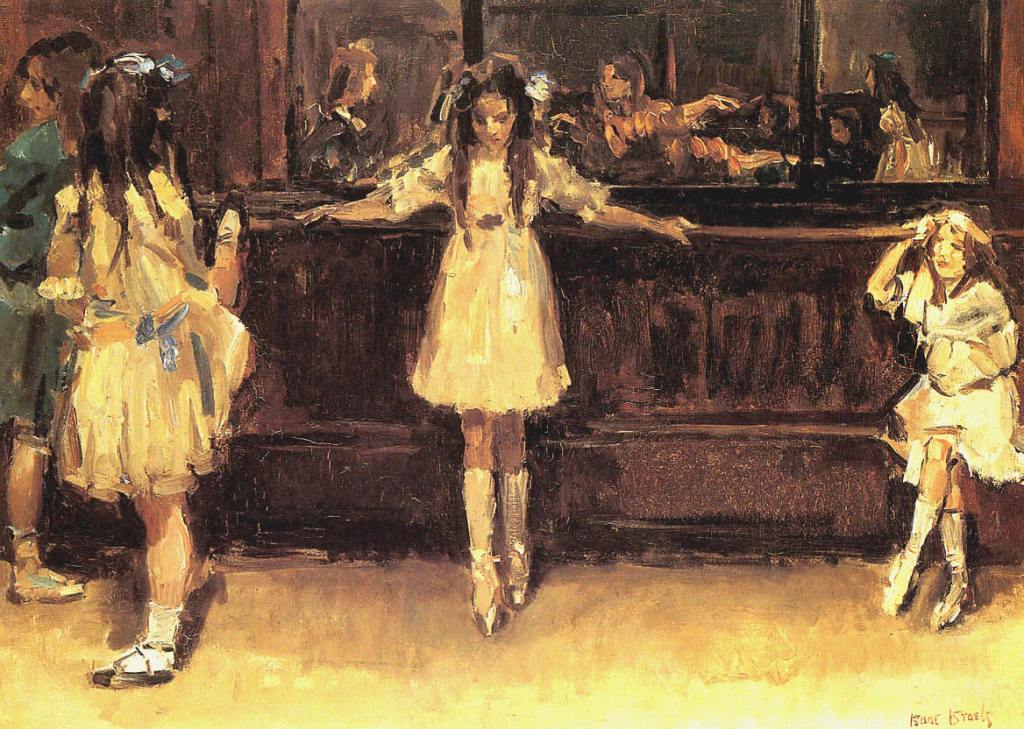
Ballet School in London – 1913-14 – art dealer Frans Buffa & Zonen, Amsterdam – RDK
The young dancer practising her pointe technique appears uncertain. She looks down at her feet to check her placement. The girl turned away from the audience has placed her leg on the barre; a useful exercise for building strength and flexibility. This scenario is typical in every ballet studio. The background, however, is perplexing. Are we peering through a window into a secondary studio, cum waiting area, or is this a mirror showing the opposite side of the studio? Regardless of what it is, the background reveals a young girl practising one of the most graceful ballet movements, an arabesque. Slightly to the left, there is a woman who appears to be playing the piano. She may be the ballet teacher. In yesteryears it was not uncommon for ballet teachers to the accompany the class themselves.
The Dutch artist Willem Dooijewaard (1892-1980) was an enthusiastic traveller. An adventurous individual, who even ascended the Himalayan Mountains, Dooijewaard depicted local cultures along with dancers and performers during his extensive travels in Asia. In 1938, living in Nice, the management of the local theatre invited him to paint the company’s dancers as well as the students of L’École de Ballet de Nice.
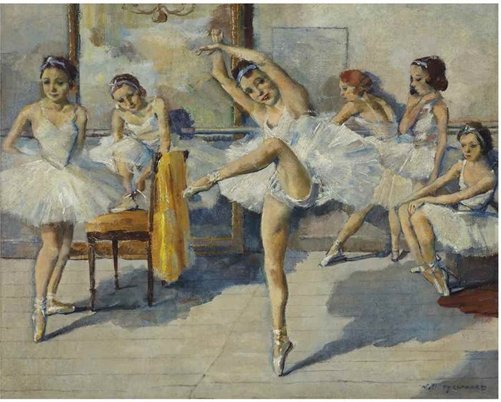
A Ballet School in Nice – circa 1938 – oil on canvas – 43.5 cm x 53 cm – Christie’s / MutualArt
The scene of A Ballet School in Nice is set in a ballet studio, yet these young ballerinas are not preparing for class. Their graceful tutus indicate that they about to perform on stage. Dooijewaard depicts six individual dancers, with each one participating in a unique activity. The central dancer, with her gaze fixed directly at the audience, performs a challenging stance on pointe. One girl is tying her shoe, while another, even with her foot extended high on pointe, is deep in thought. Perhaps she is visualising the choreography. Equally contemplative are the three dancers positioned in the background.
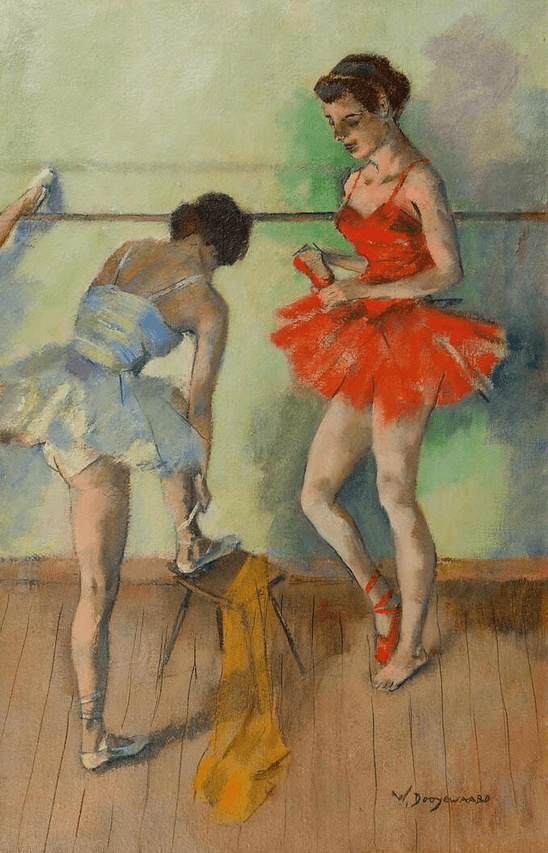
Dooijewaard possesses a distinctive style. His impressionistic style evokes a dreamlike atmosphere. The figures, with an occasional exception, tend to cast their eyes downward as if absorbed in their own thoughts. Whether painting an oriental dancer, an Indonesian farmer, a geisha girl in Kyoto, a Balinese cockerel fighter, or one of his many ballerina portraits he employs a loose brush style and subdued colours. He never used models but rendered his subjects as he encountered them, either in the street, on a podium, or as in 1938 as a regular visitor to the classes and rehearsals at the Theatre of Nice.
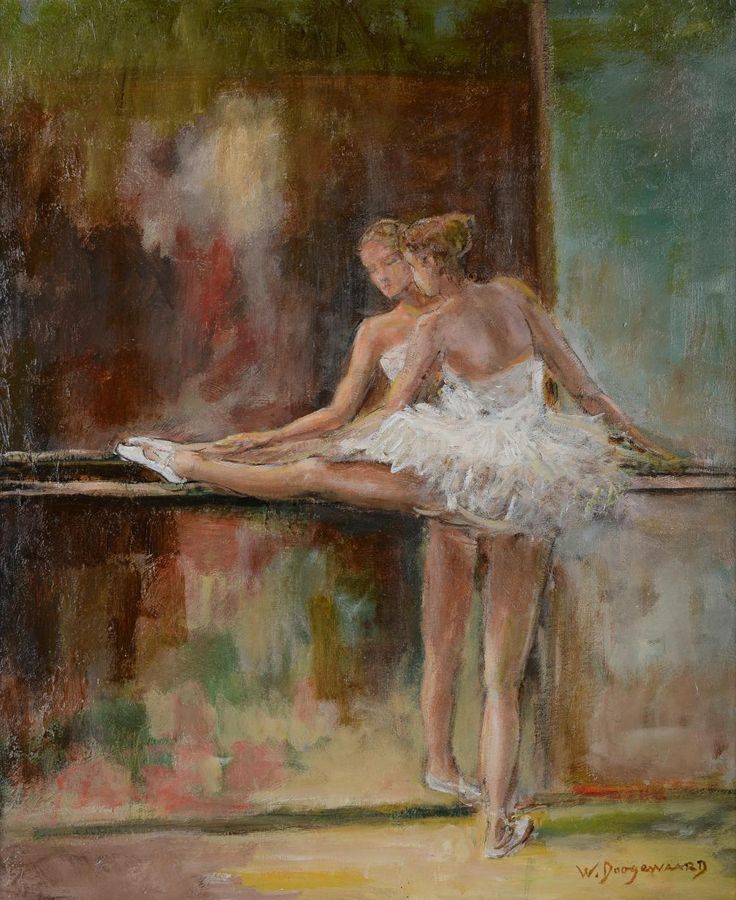
Ballerina – oil on canvas – 60.5 cm x 50.5 cm – date not given – Invaluable, private collection.
Twee ballerina’s- oil on canvas 62 cm x 40 cm – date not given – Mark Smit Kunsthandel
Gerard Hordijk (1899-1958), a contemporary of Willem Dooijewaard, travelled to Paris in 1927. He found rooms near another Dutch artist, Piet Mondrian, painting his portrait, which is displayed in the Kunst Museum, The Hague. An avid admirer of the celebrated French artists, Henri Matisse and Raoul Dufy, Hordijk produced oil paintings, gouaches, and watercolours. He enjoyed sketching and painting scenes of beach life, amusement parks, theatres, circuses, and he was captivated by dancers. The majority of his dance images showcase professional dancers performing on stage. I did, however, discover several classroom examples in a collection of drawings titled, 6 Images de la Danse.
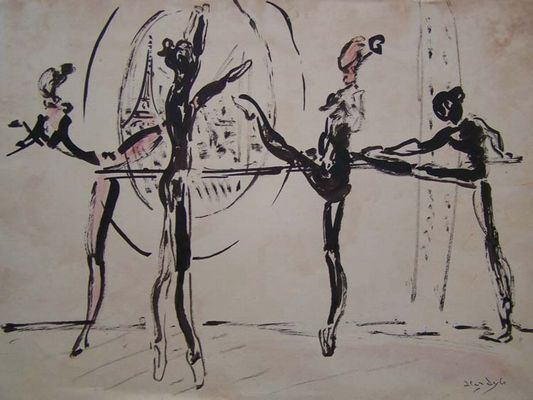
one of the sketches from ‘6 images de la Dance ‘ – Lesson 3 – Ballerinas in Paris – 1930
The view through the window not only indicates that this scene is set in Paris, but these large windows reveal that the dancers are training in a ballet studio of the Palais Garnier. The women are all executing different exercises so we can confidently conclude that the image neither displays a daily ballet class nor a rehearsal. Possibly the dancers are warming-up before class, or perhaps Hordijk has sketched four individual dancers and arranged them into a single composition. The artist’s relaxed, loose style is typical of his oeuvre. Also observe how Hordijk contrasts the slender, elongated forms of the front dancers with the oval shape of the window frame. Note too how harmoniously he blends the curved torso of the dancer stretching her leg on the barre with the oval shape. As a former ballet teacher, I appreciate how precisely Hordijk has captured the dancers perpendicular stance and refined carriage. This image provides an intriguing glimpse into the ballet skills of the 1930s.
The Amsterdam based artist, Peter Smit (1957), continues the tradition of the Impressionists. He enjoys working en plein air, and is influenced by the ever-changing light, colours, and ambiance that outdoor work provides. Colour holds great significance for him. His art is defined by a loose brushwork, vibrant colours, and brilliant application of light. Smit, a figurative artist, favours using oil paint which he applies directly on the canvas without any preliminary sketch.
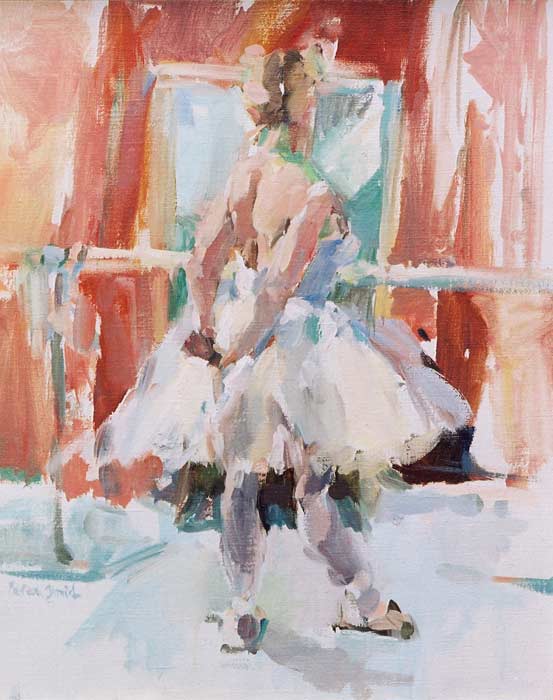
Ballet Dancer – date & measurements not given – copyright Peter Smit & Lucien den Arend
Ballet Dancer immediately evokes Degas’s Little Dancer of Fourteen Years. Smit’s dancer poses in a balletic fourth position, gazes upward, and clasps her hands behind her back. Her features are indistinct as are the contours of her feet and legs. The hazy red background forms a vivid contrast with the pastel ballerina. She poses on an ambiguous white floor that seems to float in mid-air. The combination of the artist’s characteristic loose brushstrokes and the abundance of light transforms Smit’s dancer into an ethereal vision.
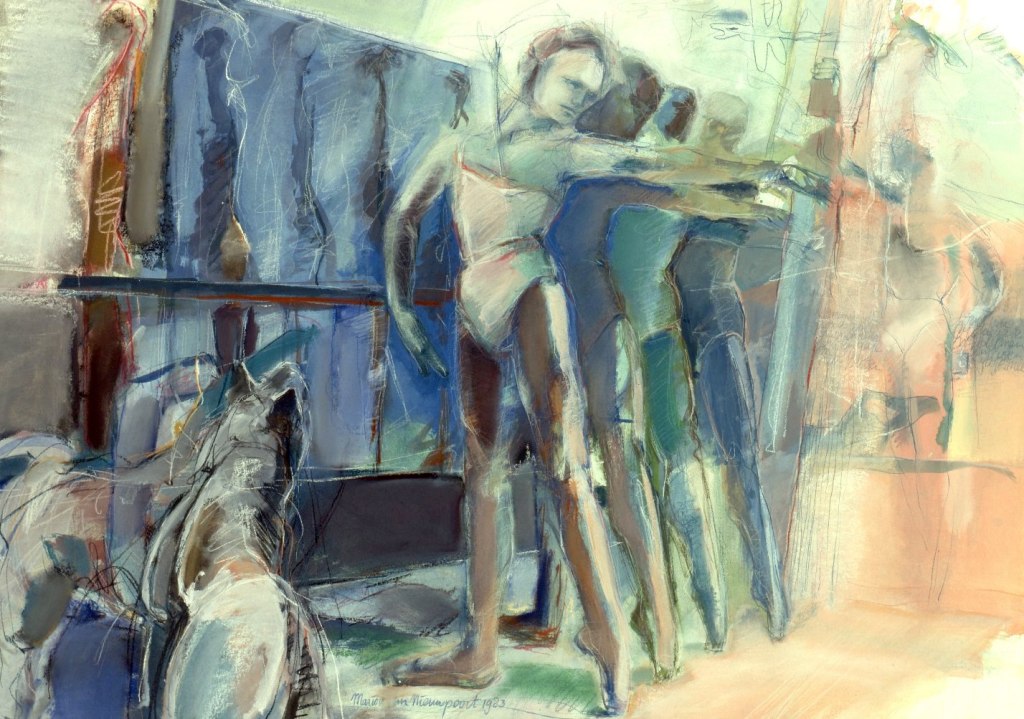
The Ballet Class – watercolour & pastel – 100 cm x 70 cm – 1983 – private collection – copyrighted work, shared with courtesy of Poen de Wijs
Colour and a vibrant sense of motion characterise the (dance) artworks of Marion van Nieuwpoort (1950-2008). She had a passion for dance, engaged in dancing herself, and depicted various dance styles, such as African dancers, Greek dancers, contemporary dance, and, as in the watercolour above, classical ballet. The blend of hues—aquamarine, a faint yellow, and peach, along with different tones of translucent green—exemplifies her bold originality. The primary emphasis is on the leading dancer. She and the next three indistinct dancers execute a standard ballet exercise in which dancers typically hold onto the barre. What is intriguing is that every dancer, despite being displayed in repetition, is truly unique. My ‘ballet teacher eye’ notices an array of leotards and a distinct variation in hip placement. Remarkable is the way the artist contrasts the flowing lines of the dancer’s reflections in the mirror with the elongated, straight lines of the dancer’s legs and the bold slanting line of the barre and mirror. But what about the confusing shape in the lower left corner? It required some time to figure it out, but that unclear shape is, in reality, a set of lower legs. Van Nieuwpoort encourages the observer to adopt the same viewpoint as the truncated figure resting on the ground.
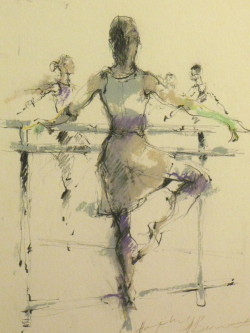
Ballet class – date not given – Dutch National Ballet, Amsterdam
Moving forward to the latter half of the 20th century, I would like to present a British artist who has resided and worked in the Netherlands for over thirty years. Humphrey Bennett (1948-2020) made weekly visits to the studios of the Dutch National Ballet and Scapino Rotterdam, where he sat in a discreet corner and drew the dancers. Bennett worked with pencil, frequently blending it with acrylics, watercolours, and ink. He was captivated by motion, swiftly sketching his fluid lines that embodied the essence of movement. For this post, I’ve selected artworks depicting dancers in a studio, practising at the barre and enjoying a well-earned break. I will revisit his vast array of dynamic images of dancers at a later date.
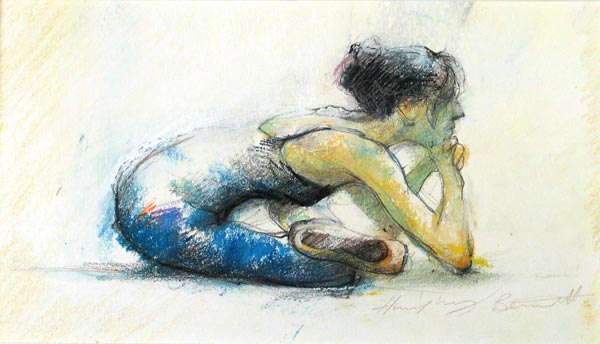
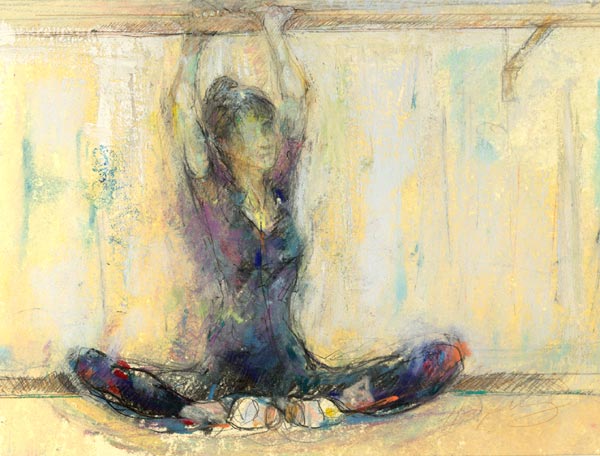
Danseuse au repos 1&2 – mixed technique – no date given – Humphrey Bennett Website
You can almost ‘sense’ Bennett’s nearness to the dancers. His portrayal of the dancers seems intimate, almost affectionate. The slender lines and subtle shapes evoke a sense of both fragility and strength. His close collaboration with the dancers resulted in genuine and timeless images.
The ballet lesson presented an intriguing theme for Dutch painters. The portrayal of the female dancer proved to be even more appealing. Therefore, in the following post, I will explore the professional ballerina as portrayed by modern and contemporary Dutch artists.


 DANCE IMAGES IN THE ART OF THE NETHERLANDS