In the 16th century, Haarlem was the epicentre of Dutch Mannerism. Change, however, was imminent. The early 17th century saw, in part due to Flemish influence, the emergence of an enterprising artistic approach. Mythological and biblical representations were supplanted by contemporary narratives. On the one hand, paintings depicting the young and affluent in a merry company became fashionable. On the other side of the spectrum, scenes of peasants in taverns and in the countryside were popular subjects. The artistic innovations, religious tolerance, and economic prospects that Haarlem offered attracted many artists. In the 1620s, the Antwerp-born Adriaen Brouwer arrived in Haarlem. Artists from other regions of the Netherlands soon followed, including Willem Buytewech, Esaias van de Velde, and Hendrik Pot. These artists, together with those who were born in Haarlem, such as Dirck Hals, Adriaen van Ostade, Isaac van Ostade, Judith Leyster, and Jan Miense Molenaer, made Haarlem the capital of genre painting.
This post highlights Jan Miense Molenaer (1610-1668). He and his spouse, Judith Leyster, might have been pupils of Frans Hals (1582-1666). The famous Flemish painter escaped with his family to the Northern Netherlands during the Fall of Antwerp (1584-1585).
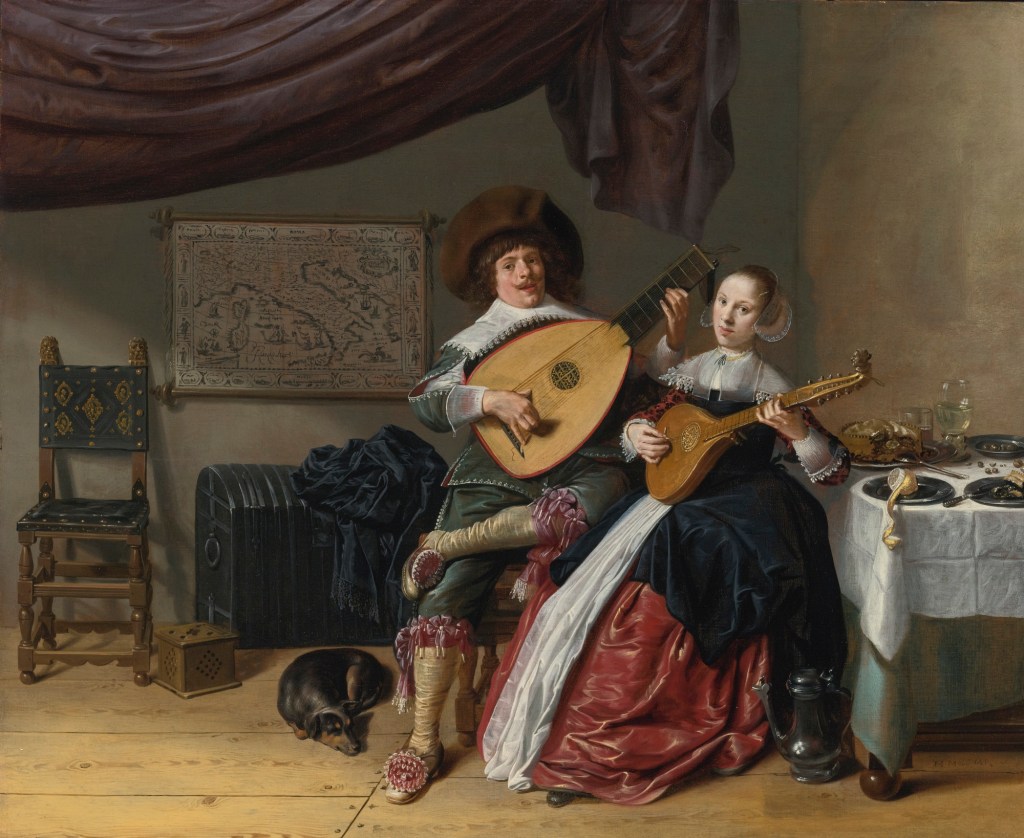
Left: The Duet: A Self Portrait of the artist with his wife, Judith Leyster: probably their Marriage Portrait – oil on panel – 42.2 cm x 51.4 cm – circa 1640 – private collection / Netherlands Institute for Art History
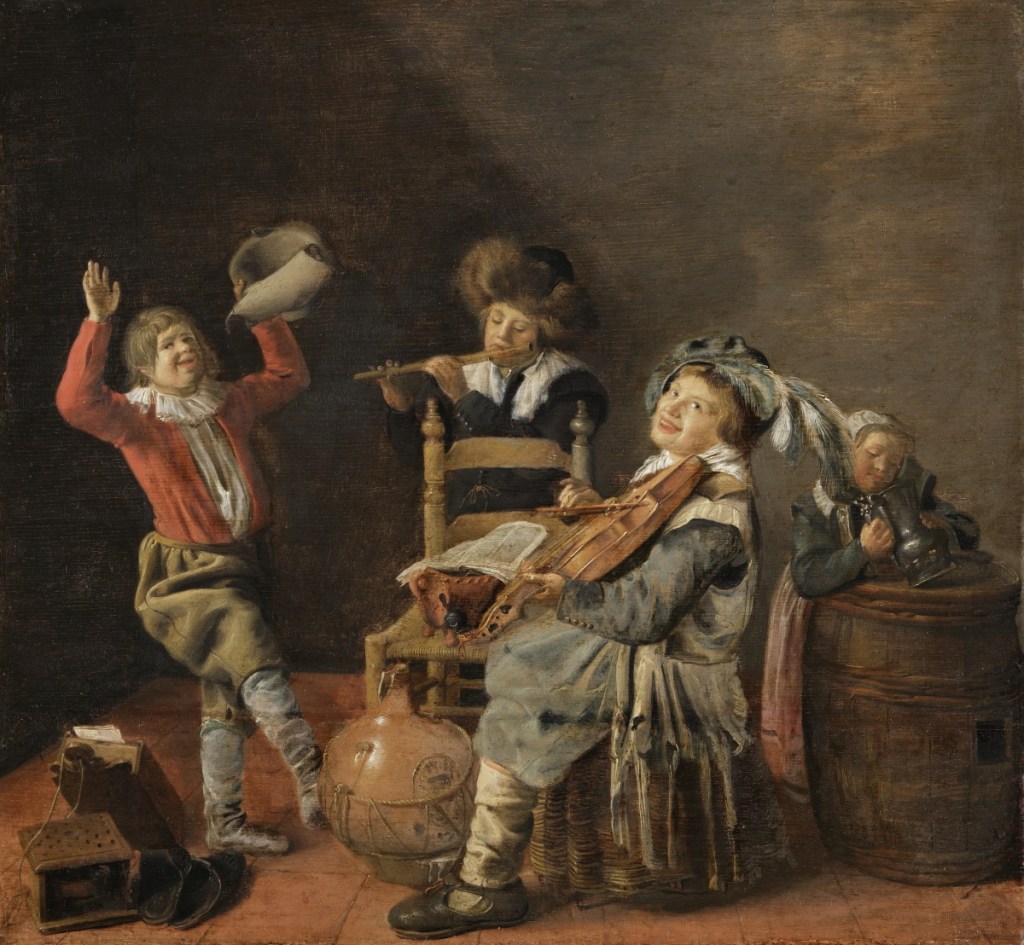
Right: Children Playing Music in an Interior – oil on panel – 40 cm x 44.5 cm – 1630s – Museum Wawel Castle, Poland/ Useum
In contrast to his peers, Jan Miense Molenaer did not concentrate on any one genre. He painted a broad variety of subjects, from low-life scenes to exquisite settings and portraits. His art often featured images of dance. Molenaer painted merry companies, dancing youngsters, dancing dogs and cats, peasant dances, bridal dances, egg dances, and tavern scenes.
How do you teach a cat to dance? Jan Miense Molenaer apparently had some idea; merely pull on the cat’s ears until it stands on its hind legs. Merry Company playing Music and Dancing in an Interior, created in the 1630s, shows youngsters cruelly abusing a cat. The unfortunate cat is lifted mercilessly upwards and forced to dance, to the hilarity of the surrounding children. Regardless of the wretched animal’s squealing and visible display of anguish, the youngsters continue their merriment. The dog looks much more at ease, dancing willingly with one of the lads. The dog enjoys the children’s attention and is quite happy to comply. The cat, in contrast, has no intention of performing any involuntary action.
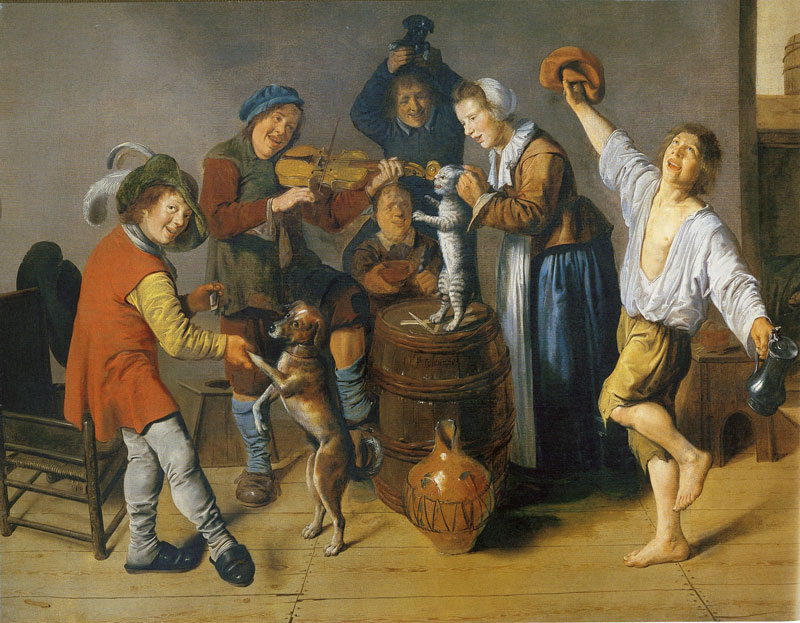
Merry Company playing Music and Dancing in an Interior – 1630’s – Private Collection Gebruder Douwes/Wikipedia
The artwork conveys an underlying theme. 17th century society placed significant emphasis on a the education of children. Facets of human nature are personified by the tormented cat and the easygoing dog. Like the cat, some children are uncooperative; they tend to have a challenging, stubborn nature. The dog, on the other hand, personifies a friendly, curious disposition and can be trained to dance.
According to the old Dutch proverb, “As the old sing, so pipe the young,” children mimic the actions of their parents. Jacob Jordaens, a Flemish artist, was among the first to explore this theme (1593-1678), and Jan Steen (1626-1679) created an absolute masterpiece. Molenaer, a precursor to Jan Steen, places his rendering of the proverb in a modest dwelling. We see a young child dancing exuberantly. The shoeless dancer springs from one foot to the next, enthusiastically swinging both arms in the air. The cat takes no notice. The child and the boy playing the flute are surrounded by undesirable role models; the old man holds a nearly empty jug of beer, his pipe and ashtray lie prominently on the table, and a couple is openly embracing. This innocent dancing child and the youthful musician will involuntarily inherit the flawed traits from their elders. Molenaer not only warns the viewer to guard against unsavoury habits but also incorporates another much-admired theme, the allegory of human senses. He visualises Touch with an embracing couple, Sight through an old woman reading, Hearing through the sound of music, Taste is represented by the consumption of beer, and Smell is symbolised by the smoking utensils resting on the table.
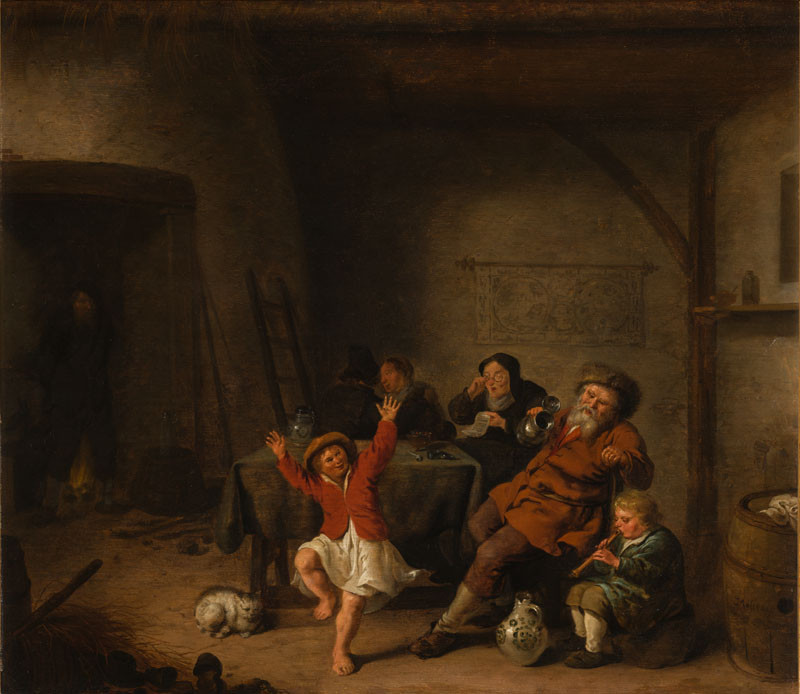
As the Old Sing, So Pipe the Young – oak panel – height 37 cm/ width 44 cm – 1648-1650 – National Gallery, Prague
The dancer is not the first figure you notice in “Outside of ‘de Kroon’ Inn,” a painting that addresses the same issues as described above. It is the woman and her child that catch the eye. Molenaer has aligned them directly with the distant church. The devoted mother, a model of a parent providing her child with a proper upbringing, divides the narrative into two distinct parts. To her right, the tavern guests drink, gamble, flirt, smoke, make music, and generally behave poorly. Especially poignant is the young drunken child leaning over the beer barrel. On the opposite side of the painting, Molenaer imparts the consequences of a misguided upbringing. None of the peasants work: one is relieving himself against a wall, others have just managed to rise from their beds, and the cow waits to be milked. One of the lads, disregarding his duties, plays the fiddle, while the other, just as useless, revels in a spontaneous dance. As spectators, we are reminded that dancing is synonymous with laziness, intoxication, vulgarity, and indecency.
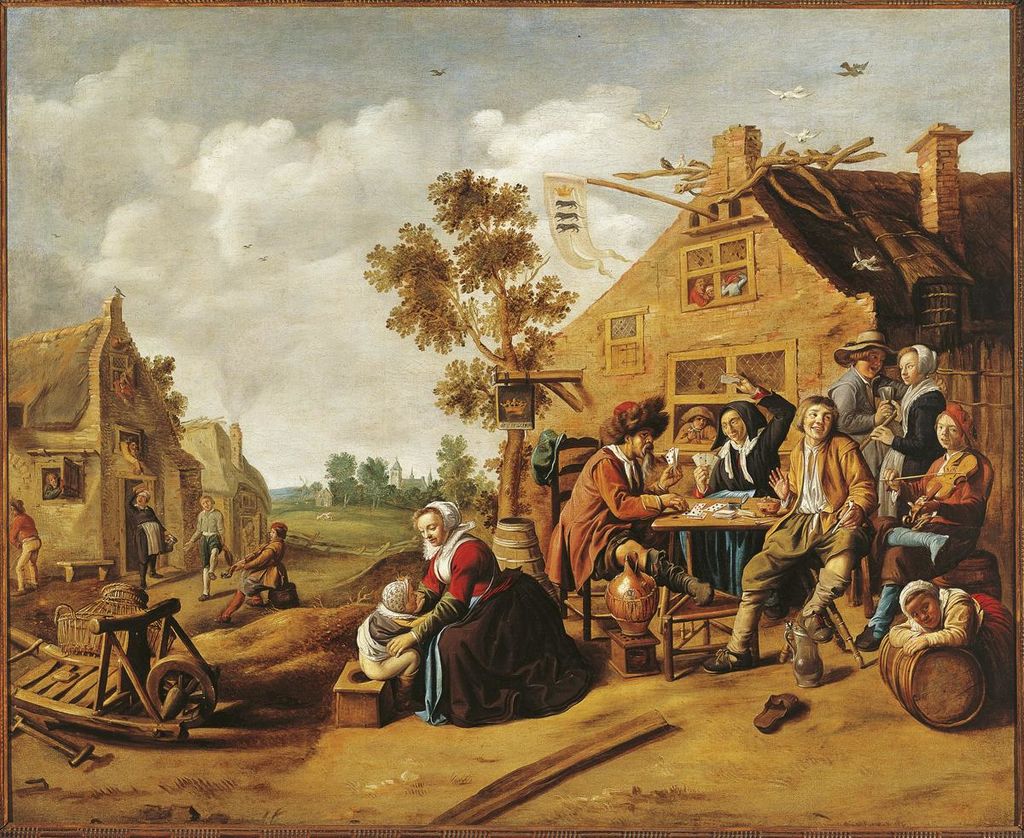
Outside of ‘De Kroon’ Inn – oil on canvas – 95 cm x 116 cm – c. 1630-32 – Frans Hals Museum, Haarlem/Wikipedia
To all appearances, Merry Company presents a cordial scene of wealthy town residents amusing themselves in a stylish chamber. There is music, song, and wine in abundance. The man playing the theorbo even invites the onlooker to join in this musical gathering. The only dancer in the company, a fashionably dressed man near the door opening, has no objections to his girlfriend’s overt advances. In contrast to a peasant dancer, who is typically depicted with a curved torso, bowed knees, and awkward posture, this well-to-do man is slender, stands upright, and possesses, despite his frivolity, a certain amount of grace. Molenaer, as in the paintings above, has integrated the allegory of the five senses. The girlfriend, who is caressing the young man’s groin, symbolises Touch. The other senses are represented by musicians (Hearing), the pipe smoke (Smell), the wine (Taste), and the old man reading (Sight).
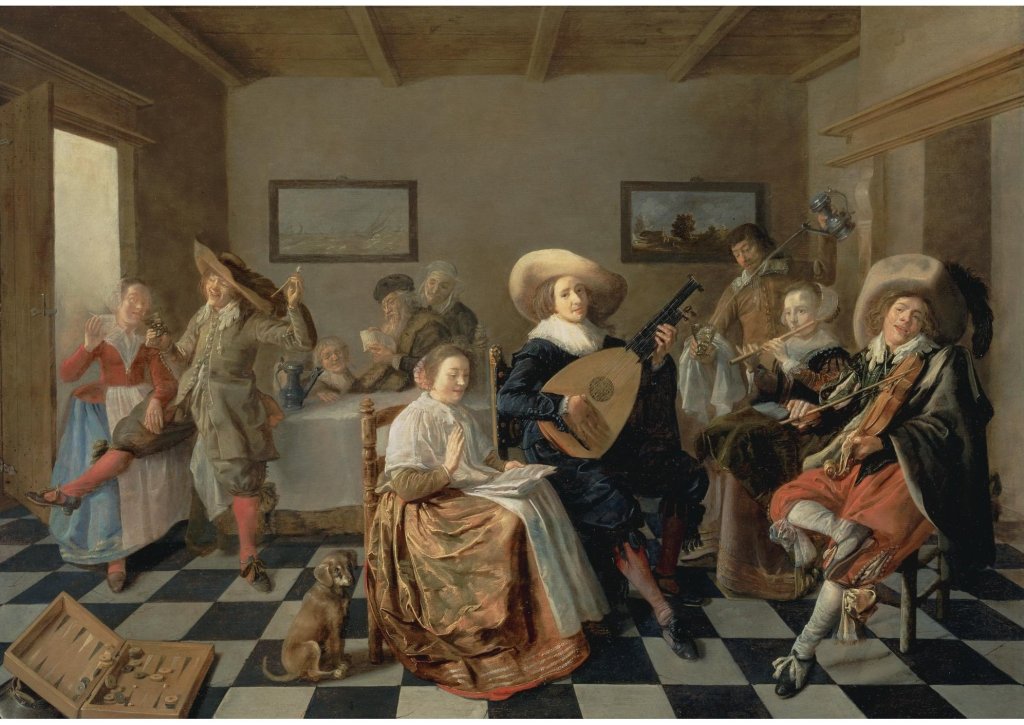
Merry Company – oil on panel – 56 cm x 79 cm – ca. 1631 – Private collection France – Sotheby’s
A few years ago, a different version of this panel emerged, depicting two skeletons: one standing between the elderly couple and the young child, and the other posing at the doorway. Close examination of the original painting revealed that the skeletons had been painted over. With the discovery of these misplaced figures, the painting regained its original meaning. In 17th-century Dutch art, the skeleton is frequently utilised as a vanitas motif. The skeletons encircle an elderly man, a dancing man, and a young lad. The trio represents the Three Ages of Man. Additionally, the observer is reminded of the fleeting nature of life by the skeleton grasping the hourglass. (1)
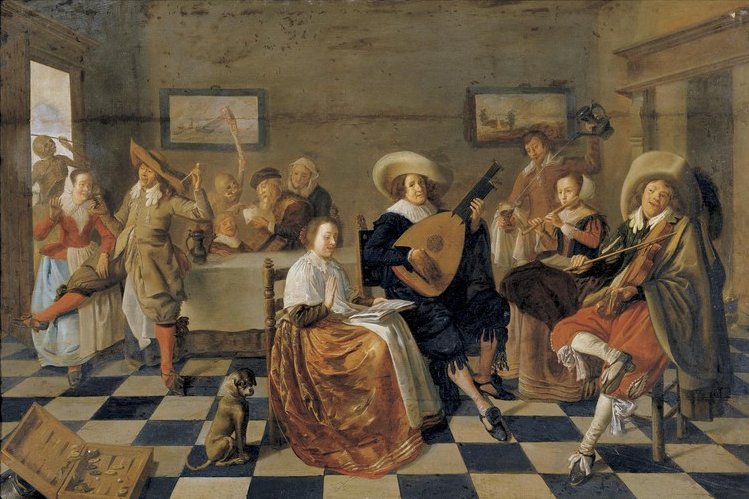
an other version – Merry Company in an Interior – oil on panel – measurements not given – 16(30?) – Sotheby’s
Jan Miense Molenaer’s painting, The Artist in his Studio, presents a unique self-portrait of the artist in his atelier. We enter the painting as the artist refills his palette while the personages enjoy a well-earned rest. Among them is the elderly man on the hurdy-gurdy, who plays a delightful melody, prompting the dwarf and his dog to dance. It soon becomes evident that the studio figures are indeed the models featured in the easel painting. The artwork on the easel features an additional figure not found in the studio. This theatrical character moves in a humorous fashion, flexing at the hips and kicking his leg into the air. The fact that the dwarf and his friend have switched places is another obvious distinction.
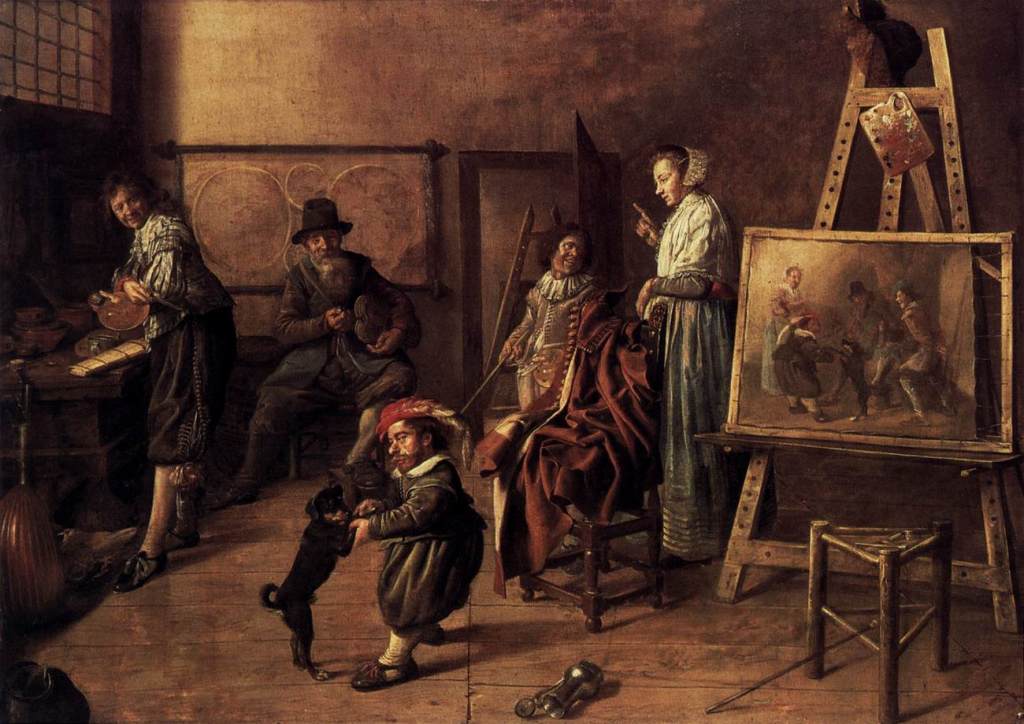
The Artist in His Studio – oil on canvas – 86 cm x 127 cm – c. 1631 – Staatliche Museen zu Berlin, Gemäldegalerie
The narrative is challenging. The easel painting shows the dog gazing intently at the dwarf. In the studio, however, the dog is distracted. He is the only figure looking outside the canvas. Is the dog, possibly a street performer, seeking the audience’s attention? Equally puzzling is the meticulously tailored coat draped over the chair. The lavish deep scarlet coat is certainly not a prop. It does not appear in the easel painting. The open door may provide an answer. Has a wealthy guest entered the studio? Did this opulent visiting gentleman commission the painting? Is he the dog’s owner or, for that matter, the master of the dwarf? Jan Miense Molenaer offers no answers, yet the dog’s intense gaze undeniably ignites the viewer’s curiosity.
At first sight Dancing in a Village Street illustrates a joyful street scene on a pleasant summer day. In the centre foreground of the composition, a rural couple enjoys a spontaneous dance. A soldier pauses to observe the dancers. Meanwhile, a dwarf, traditionally a street entertainer, accompanies the jovial couple. It is interesting to note—and question why—the peasant woman points her finger toward the musician. The dog, the street entertainer’s companion, stands on its rear haunches as if mirroring the dancers. On the right, two rustic youngsters imitate the dance of their elders. Nevertheless, this cheerful moment sparks the imagination. Why is that? The man dancing is undoubtedly intoxicated, and his wife is certainly more than slightly tipsy. There are farming tools lying idle on the ground, and there is also a large empty beer vessel rolling about. As if that weren’t enough, the boy is perched on a beer barrel, and the young girl, like the peasant woman, has a decorative feather adorning her bonnet. (2) The message is explicit: children will imitate their elders’ overindulgence, laziness, and excessive drinking from one generation to the next.(3)
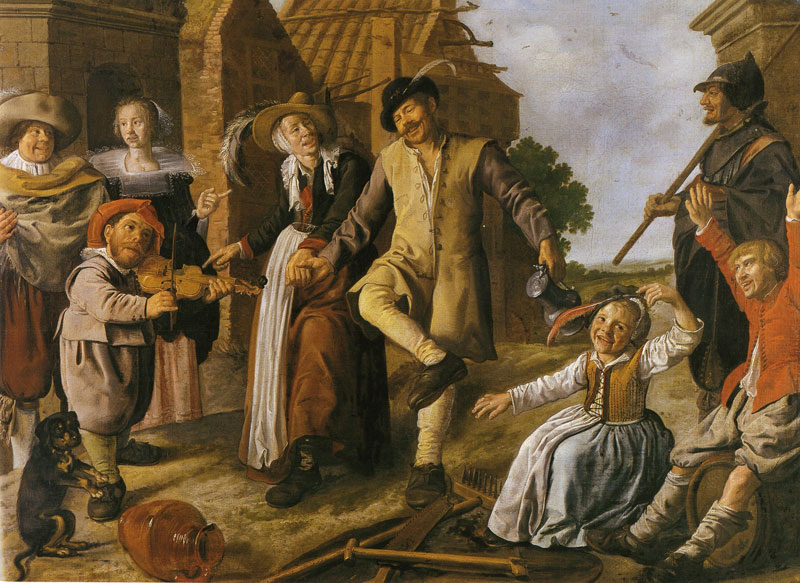
Dancing in a Village Street – oil on canvas – 72.5 cm x 101 cm – c. 1630 – Rheinisches Landesmuseum, Bonn
Have you noticed the discreet couple observing the festivities from a little further back? The well-dressed urban woman gestures openly toward the dancing couple. She has appraised their actions and discusses her disapproval with her partner. There’s an uneasy smile on his face. Art historian Dennis P. Weller clarifies her role.
From the perspective of her social position, she confirms the message that one must constantly be on guard against falling prey to the vices continually indulged in by the lower classes.
Jan Miense Molenaer, Painter of the Dutch Golden Age – Dennis. P. Weller p. 82 ( footnote 3 – Buijsen in The Hague and Antwerp p. 242)
Jan Miense Molenaer, an acclaimed artist of the Dutch Golden Age, followed in the footsteps of Pieter Bruegel and the Flemish tradition, while also paving the way for the exceptional Jan Steen. The upcoming post examines this journey.
(1) My gratitude to Sotheby’s and, by association, Dr Dennis Weller for sharing information about the painting Merry Company in an Interior.
(2) A feather was a metaphor for vaniety
(3) My thanks to Dr Dennis Weller and his fellow writers for extensive information about Jan Miense Molenaer.
Jan Miense Molenaer, Painter of the Dutch Golden Age – Dennis. P. Weller – North Carolina Museum of Arts – 2002 ISBN 0-88259-987-9 (Hardcover), 0-88259-988-7 (Paperback)


 DANCE IMAGES IN THE ART OF THE NETHERLANDS