Adriaen van Ostade, a distinguished artist who resided and worked in Haarlem his entire lifespan, was renowned for his depictions of genre scenes. He, as his peers, Adriaen Bouwer and Isaac van Ostade, painted rustics and commoners drinking, frolicking, flirting, smoking, fighting, making music, and dancing. The prolific Adriaen van Ostade was influential. He possibly inspired the celebrated artist Jan Steen who lived in Haarlem for a number of years. He definitely inspired three young artists — Cornelis Pietersz. Bega, Richard Brakenburgh, and Cornelis Dusart — who as their master painted peasants merrymaking in taverns or enjoying themselves at a village festival.
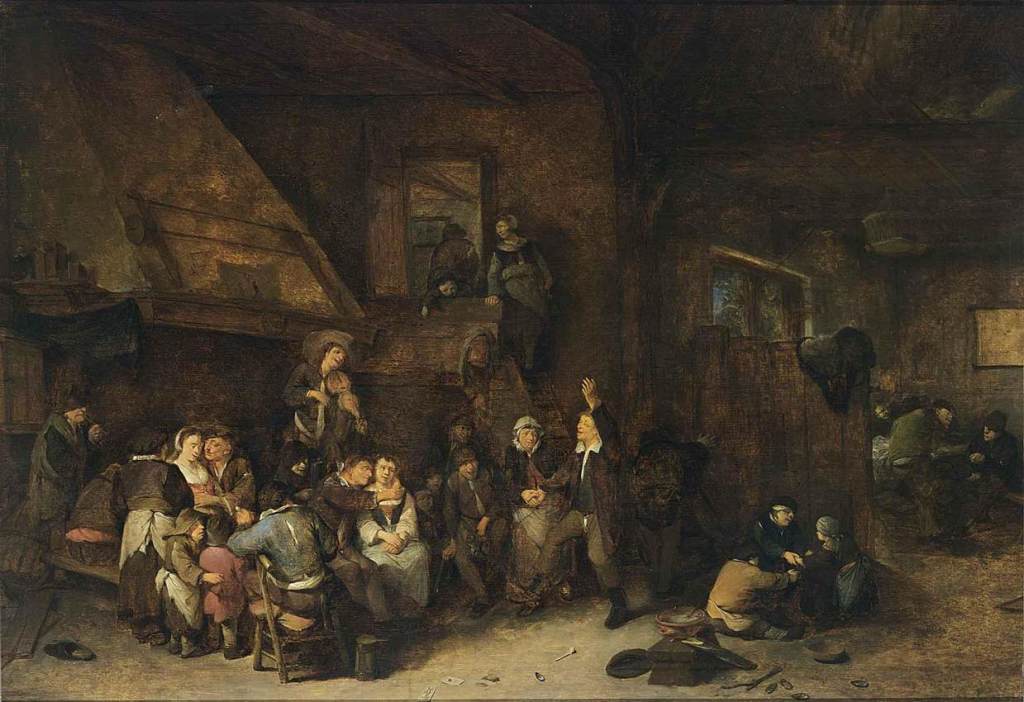
Cornelis Pietersz. Bega (1631/32 – 1664), creator of Tavern Interior, was born in Haarlem and studied with Adriaen van Ostade. Bega, like his master, was an accomplished artist of genre pieces. The dark monotone background, the chummy group of illuminated figures, the repetition of subtle blue and red hues, the scattered attributes, and the musician perched on a pedestal all echo Adriaen van Ostade’s characteristic style.
Bega’s dancer is a spirited rustic. He eagerly grabs the hand of a reluctant lass and proceeds to caper amid caressing couples, playing children, and gambling peasants. The frisky fellow is a light-footed dancer. He is mischievous, kicks his leg forward, and flings one arm into the air. His wary partner follows in measured steps. Within Bega’s body of work, Tavern Interior is novel piece. His works typically present couples or a limited group of individuals. The paintings frequently depict nursing mothers, prostitutes, drinkers, smokers, gamblers, fools, and quacks. They are predominately situated in an indoor setting.
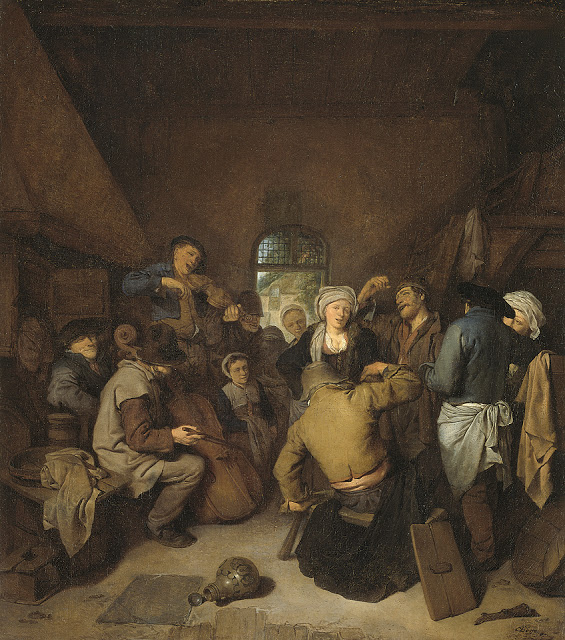
The dancing couple in Bega’s Peasants Making Music and Dancing is unimposing. The musicians—one playing a cello, the other a violin—are clearly evident, but the dancing couple is half concealed behind the seated man. Bega gives very little visual information as to how the couple dances. We merely see the woman from the waist up. She is brazen, looks unblushingly towards the audience, and is oblivious of the jolly fellow rollicking next to her. Even though the painting’s title mentions “dancing,” I’m uncertain whether the couple is genuinely dancing or just playing around.
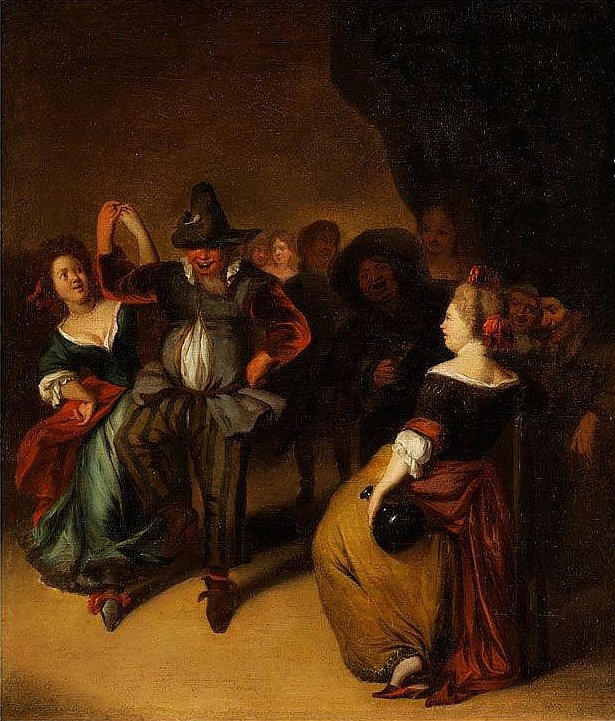
Right: Richard Brakenburgh – Dancing Couple in Cheerful Society – oil on oakwood – 23.5 x 20 cm – active between 1650-1702 -Hampel Fine Art Auctions
Dance thrives in Richard Brakenburgh’s entertaining painting, Dancing Couple in Cheerful Society. We find ourselves in an establishment of dubious reputation; the focal point is divided between a dancing couple and a voluptuous woman clasping a decanter. A distinct spotlight falls on the woman’s face and shoulders. Likewise, her exposed foot and her delicately accented heel are intended to draw attention. Behind her are a number of strange-looking characters lurking in the shadows. All are enticed by the woman’s low décolleté. But she expresses no interest in them. Rather, the flamboyant dancer captivates her attention. And with good reason. This remarkable guest clad in harlequin-like striped trousers, exquisitely ribboned shoes, velvet sleeves, and an ostentatious hat is truly exceptional. His dancing partner, a youthful cocotte, is evidently thrilled. Their vivacious, impromptu duet is improvised; the movements are exuberant, and the tempo is brisk. The flashy figure wittingly takes the lead. The absence of a musician raises the question of whether the curious visitor, who appears to sing, is accompanying the dance with his own voice.
Richard Brakenburgh (1650 – 1702) was a painter of low-life genres. He was born in Haarlem, briefly resided in the Frisian city of Leeuwarden, before returning permanently to Haarlem. He studied under Hendrick Mommers and Adriaen van Ostade. Brakenburgh was also highly familiar with Jan Steen’s paintings. His work — composition, colouring, character development, and narrative — demonstrates a particular affinity to Steen’s oeuvre. His stylistic approach is so similar to the renowned artist’s that some Brakenburgh paintings have mistakenly been credited to Steen. Brakenburgh portrayed pleasant scenes illustrating peasant life in the village tavern. He seldom passes judgement, nor does he preach or moralise. Essentially, the artist depicts ordinary, humble individuals in a light-hearted and approachable way.
Peasant Company Dancing to the music of a Hurdy-Gurdy Player in a Tavern is an amusing illustration of festivities at a local inn. A drunken man welcomes a hurdy-gurdy player in a tavern crowded with revellers. There are also a few well-dressed men intermingled with the common folk; possibly some townspeople out for an escapade. The foreground is in absolute disarray, a feature typical of Jan Steen’s work. Brakenburgh’s floor is littered with a white pipe, a chamberpot, a tankard, many jugs, a barrel, and playing cards.
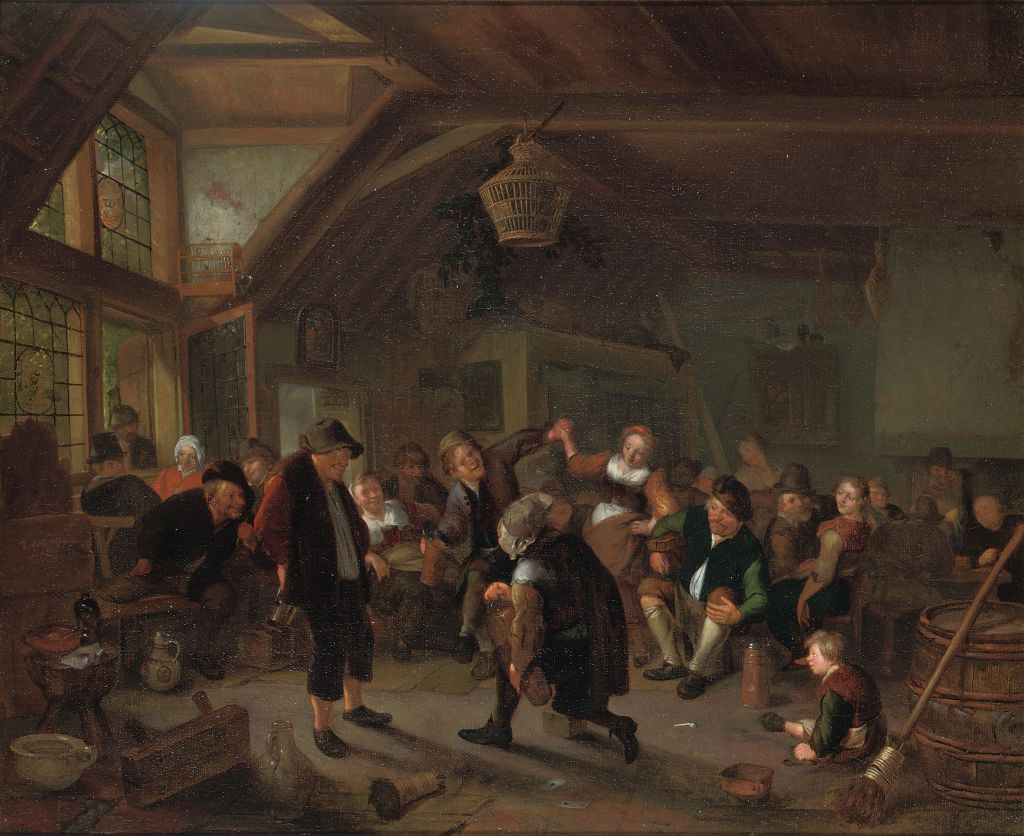
To all appearances, the hurdy-gurdy player, a travelling musician, has just entered the tavern. He strikes down in the centre of the tavern, kneeling on top of his money tin. His arrival and his music draw attention; all eyes turn in his direction. One of the guests, a crude fellow with a tankard still in hand, spontaneously flings himself into an impetuous dance. His demure companion follows suit. The dancer exhibits numerous characteristics associated by the 17th-century artist when depicting rustic dance, like a raised leg, curved spine, tilted body, flexed knees, rough arm movements, and uncouth gestures.
Cornelis Dusart (1660-1704) was a well-known artist who excelled in painting, drawing, and printmaking, focusing on images of peasant life. He resided in Haarlem for his entire life, with the exception of a brief stint in Amsterdam. Dusart was one of van Ostade’s last students and took over his master’s studio in 1685. Following van Ostade’s death, Dusart completed various paintings that the late master had left unfinished. Like van Ostade, Dusart frequently featured dancers in scenes his genre pieces.
The main focus in A Village Fair is on the three dancers. The woman in the red skirt and the jolly man holding a jug immediately attract attention. Both figures are brightly illuminated. His white blouse and her white cap and collar distinguish them from the other revellers. The surrounding figures are generally more indistinct, though in some cases the face is aglow. The woman’s partner, mainly clad in black gear, is less striking.
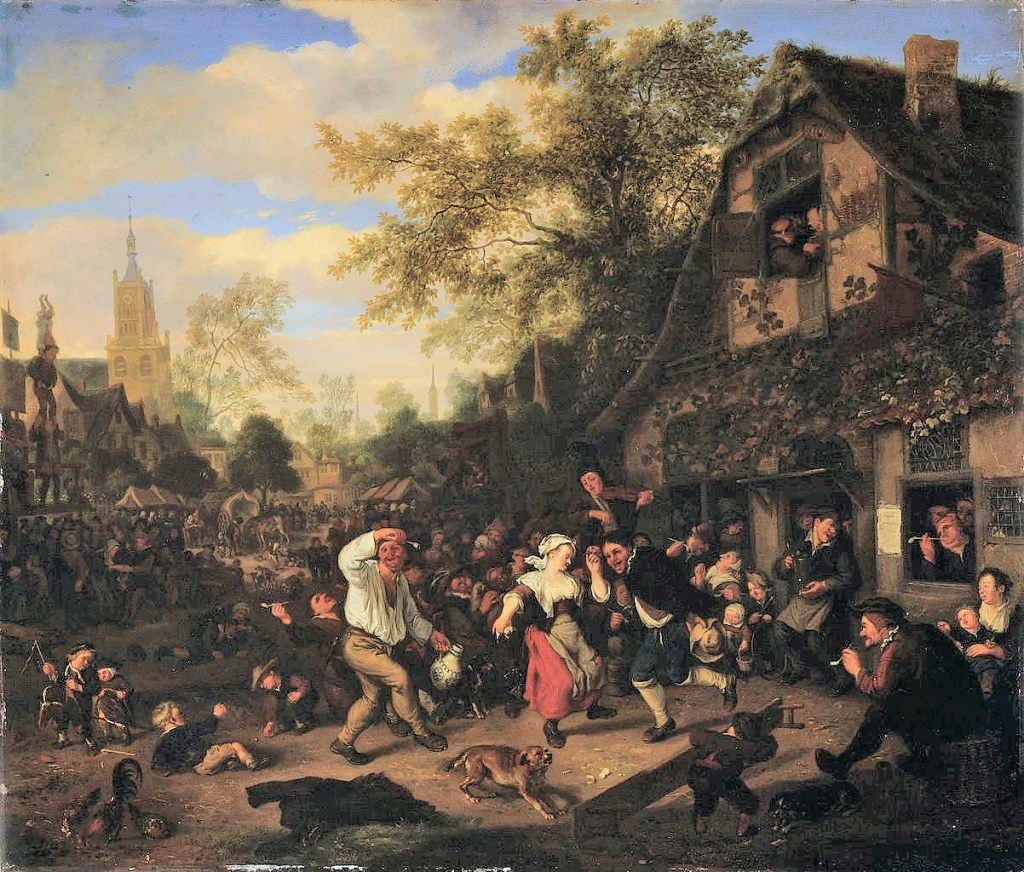
The dancers are surrounded by a substantial group of revellers, playing children, mothers holding children, tavern guests peering out of windows, a merry tavernkeeper, and frisky dogs. The fiddler’s appealing tune spurs the barmaid and her partner into an energetic dance. They are joined by a drunken dancer enjoying his pipe and jug of ale. Their dancing is unrefined, and their expressions are coarse. Dusart illustrates peasant dancing according to the conventional standard. Very little factual information has been passed down as to how the peasant dancer actually danced; the 17th-century artist adhered to the prevailing tradition.
In Village Feast, the musician and the dancer command the foreground. They are the most prominent figures on the panel. They wear, in contrast to all the other figures, colourful clothing and are further highlighted by beams of sunlight. The musician’s broad brimmed hat, adorned with a flute, pipe, and fox brush, emphasises his indefatigable presence. The dancer, a relatively older man, is portrayed following the conventions of the time. He is cheered on by two intoxicated men. These jolly characters sway too and throw, tossing their arms into the air. There is also an inquisitive urchin who plunges his head between the legs of the musician, and farther back you can discern an inebriated man. He is drawn to the music but appears a little unsteady on his feet. Fortunately, two friends offer support. *
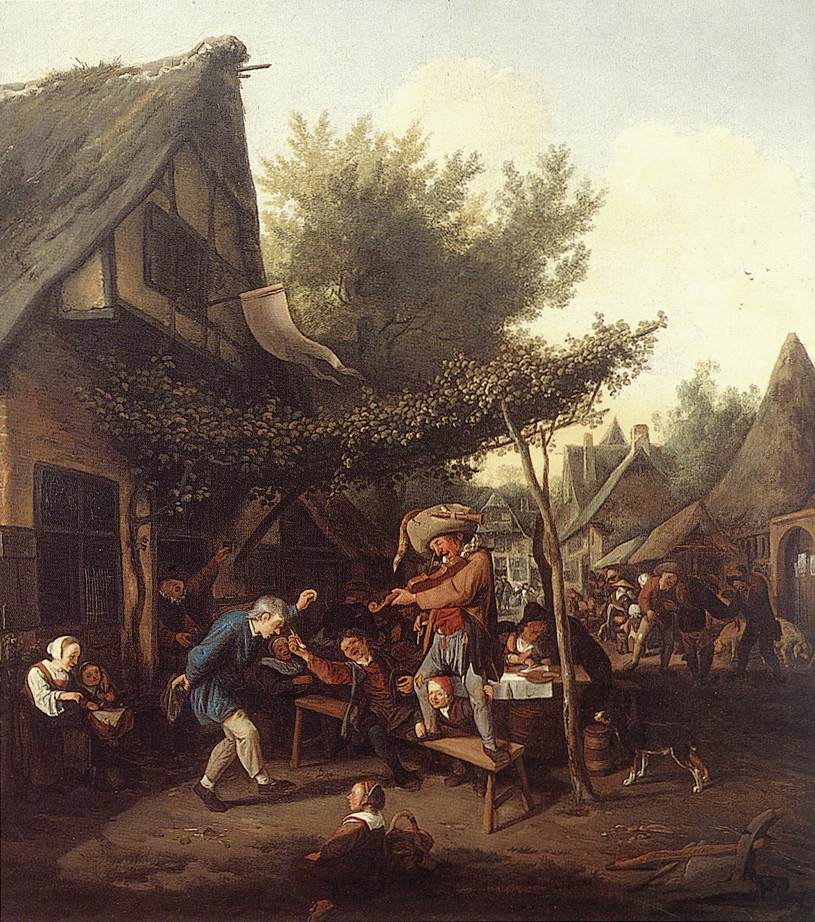
In the late 17th century, Classicism gained in popularity. Genre painting, though still in demand, had to compete with classical subjects. All the more fascinating that Dusart selected a controversial figure, the wandering musician, as protagonist in Village Feast. During his lifetime, it was believed that wandering musicians were unreliable, idle, and completely dishonourable. Dusart literally places the ‘unsavoury musician’ at a higher level than all other characters. He is the pivotal figure in the painting. It remains intriguing to ponder who commissioned this artwork. Was Village Feast showcased in an affluent estate or displayed in the residence of a middle-class family?
- My thanks to A Peasant Quest, A search for identification, characterization, and contextualization of late seventeenth-century Dutch Peasant Painting (1670-1700) – Teun Bonenkamp – Master Thesis, December 2013. The text presents a detailed overview of art and artists working in Haarlem in the late 17th century.
- * I found the article Village Feast, Cornelis Dusart by Anna Tummers very helpful and informative. The article is printed in the catalogue Celebrating in the Golden Age – Frans Hals Museum, Haarlem, NAi Publishers , Rotterdam. 2011 – ISBN 9788-90-5662-835-2


 DANCE IMAGES IN THE ART OF THE NETHERLANDS