During the 17th century, the city of Haarlem was bustling with activity. In a time of economic hardship and religious persecution, protestant Haarlem attracted many Flemish citizens. The Antwerp-born Frans Hals (1580-1666) arrived in Haarlem as an infant, trained as a painter, ultimately settling there permanently. Hals established himself as Haarlem’s most prominent artist and ran his own workshop. Artists, especially those from the Southern Netherlands, were drawn to the northern city. The Flemish painter Adriaen Brouwer (1605-1638), master of the low-life genre, worked in Haarlem until 1631. Possibly he studied with Frans Hals. Adriaen van Ostade (1610–1685), born in the Southern Netherlands, spent his entire life in Haarlem. He was primarily a painter and etcher of peasant genre scenes. Isaac van Ostade (1621–1649), younger brother of Adriaen, was born in Haarlem. He was well-known for his genre and landscape paintings. Brouwer and the Van Ostade brothers painted peasants drinking, frolicking, flirting, smoking, fighting, revelling, making music, and dancing. All three portrayed dancing peasants with an unparalleled zest for movement.
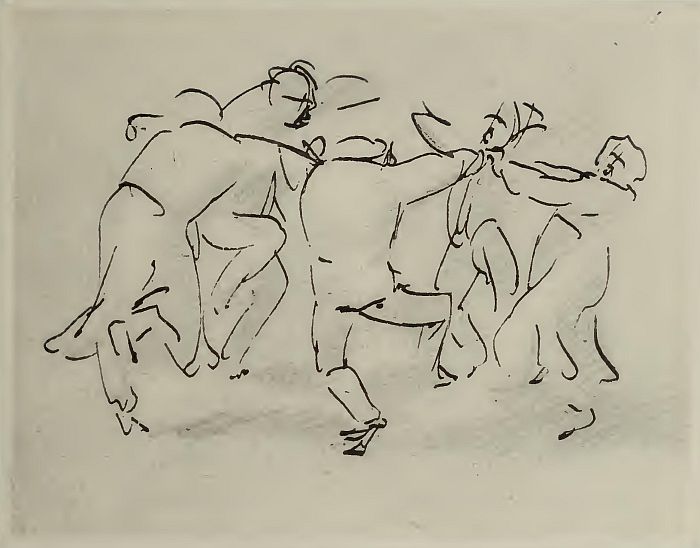
With little more than a few fleeting lines, Adriaen Brouwer sketches a jovial group of dancers scampering in a circle. Brouwer makes it quite obvious that these are rough peasant dancers. He emphasises their downward posture, their unpolished leg positions, and their hefty movements. Brouwer, renowned for his innovative genre works, composed small works of peasants invariably set in a wretched tavern or at a local fair. He drew and painted the sordid, vulgar aspects of life. He illustrated the dissolute, the rowdy, and the ribaldry of the common people. His portraits of intoxicated, uncouth, and gawky figures, despite the realism, verge on the caricatural. His models enjoy bizarre expressions. The grimaces range from comical to outlandish and dramatic. This exaggerated effect was achieved by a bold brushstroke, accented with a specific use of light and dark. Brouwer was known for his dimly lit scenes, leaving one side of the canvas in virtual darkness. His ‘rough’ style highlighted the intense emotion of his characters. Brouwer’s work was lavishly praised. Rubens and Rembrandt so admired his work that they collected and studied his paintings.
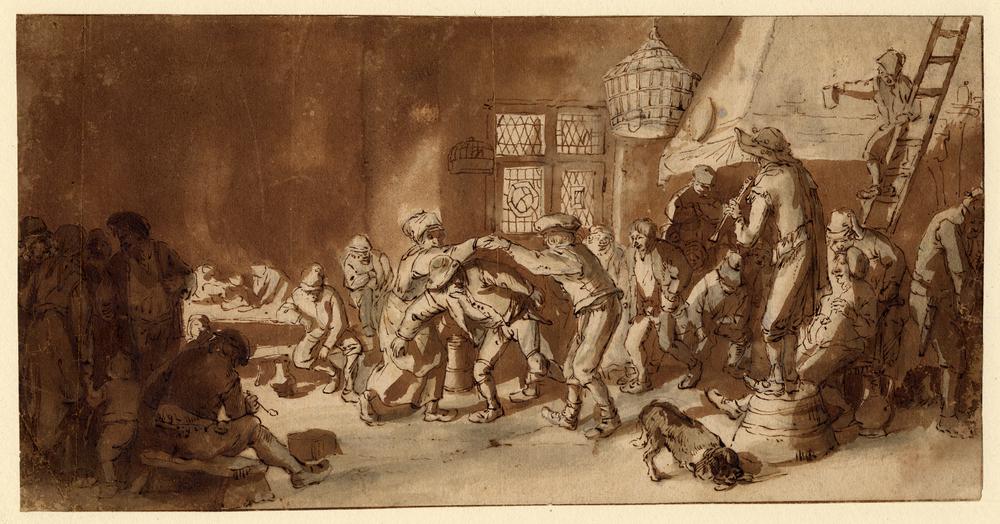
The scene is a downtrodden tavern: liquor is in abundance and rustics smoke. Elsewhere, peasants play card games, lounge, and in the right-hand corner, a man is relieving himself. A musician standing on an upturned tub plays the flageolet. A group of revellers perform a simple, improvised dance spurred on by a lad standing on a ladder. The dancing figures are painted in a ‘traditional’ low-life style, marked by stooped carriage, bent knees, and crude shapes. A cumbersome appearance and graceless lower legs complete the picture. The dancers, in contrast with the surrounding peasants, are animated. The leading couple extends their arms to create an arch for the other dancers to pass under, as is traditional in many folk dances. The first man to pass under the arch twists, bends, and protrudes his hip forcefully to the side. He also seizes the opportunity to grab the peasant woman’s backside. Right behind him another dancing couple scurries friskily towards the arches.
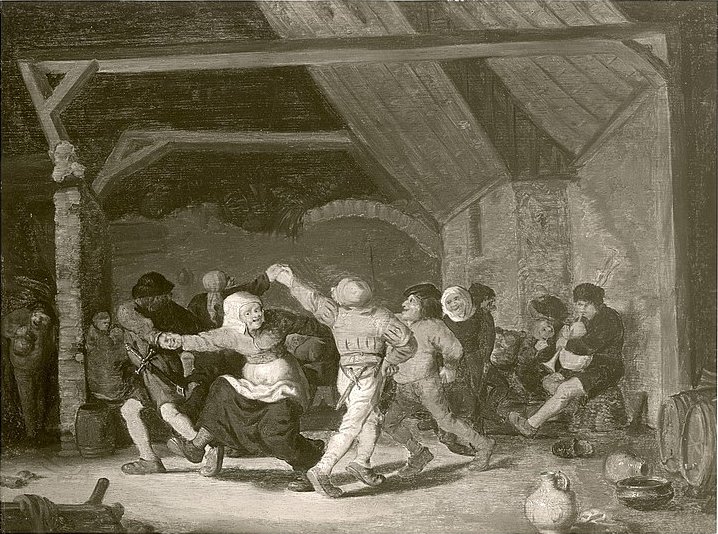
An equally riveting scene is Peasants Dancing, of which only a black/white copy is available. But this certainly does not spoil the sheer fun of this rowdy tavern scene. Our attention is drawn to the striking dancers. There is no escaping the humorous expression of the front peasant or, for that matter, the other figures just behind her. With unwavering energy, the dancers scurry in a line dance. In turn, each dancer passes under the arch. Brouwer has captured the unrestrained humour and lively spirit of these joyful peasants.
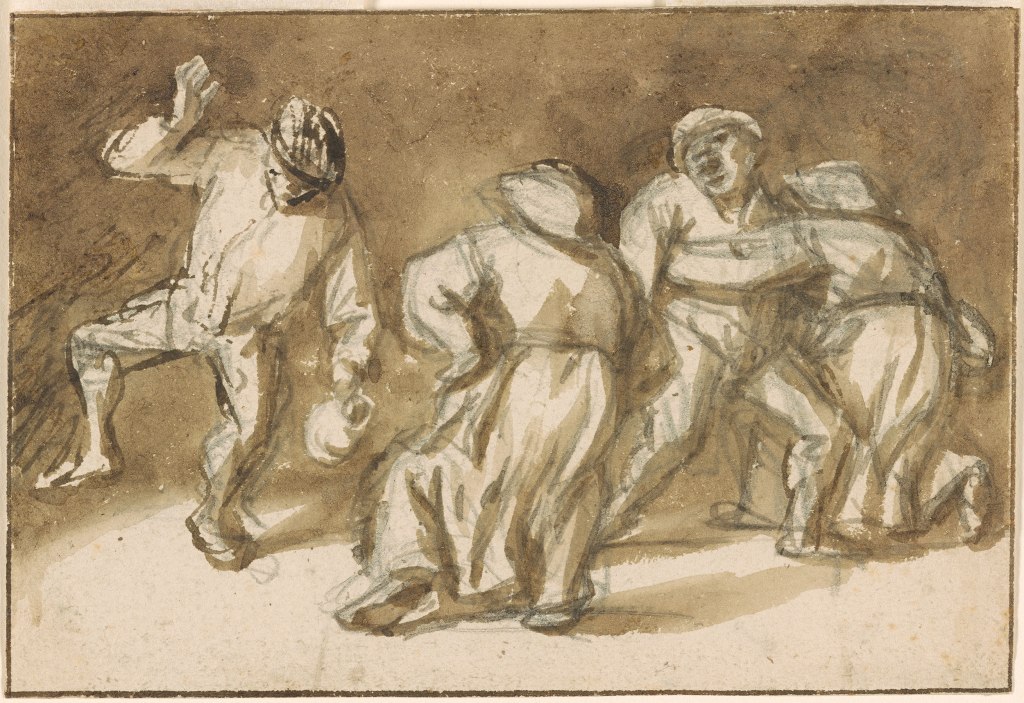
How graphic can a drawing be? In this miniature, monochrome drawing, Isaac van Ostade captures the fun, the vivaciousness, and the boisterous movement of two very jolly couples. He draws lines of various thicknesses to represent the figures’ contours, highlighting the limbs with a darker, more expansive stroke. Quite remarkable is the sense of velocity conveyed by the markings on the women’s skirts. The dancers are hefty, rounded, and move in an uncouth manner. But look at the way they move! The woman on the right grasps her partner tightly. She appears to swing around with all her might. And the front couple capers from one leg to the next, rocking exuberantly from side to side. The foursome is obviously having a great time. The sprightly male peasant carries a jug. Undoubtedly, a little ale does wonders for dance skills.
Isaac, also spelled Isack, studied with his brother Adriaen. During his short life span, he created more than four hundred works. His initial art, which was influenced by his brother, frequently features rural interiors. Later, he blended the peasant genre with landscape painting. He depicted villagers working and feasting in country settings. Isaac excelled at winterscapes. A distinctive feature of his mature work is the frequent presence of a white horse hauling a cart or sleigh.
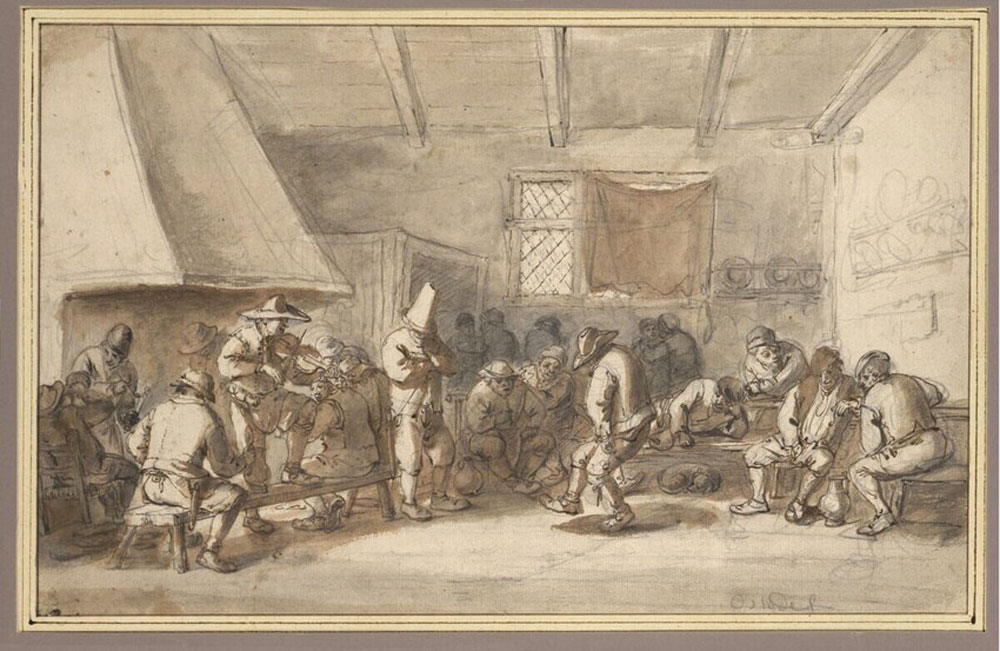
Peasants at an Inn with Fiddler and Dancer illustrates a not too youthful man frolicking alone in an unfashionable tavern. Only the fiddler, a man with a high hat, and an elderly couple bestow him any attention. All present, and that includes the dog, are occupied with other activities. The rustic possibly performs a merry jig. He is neither nimble nor light-footed. The fellow bounces steadily from one foot to the next. His chest and head are inclined, his legs are bent, and his feet are hooked; all of which are indicative of how peasants and dancing peasants were traditionally portrayed.
Adriaen Jansz. van Ostade was a prolific painter and etcher. Eight hundred of his works are extant. His oeuvre can be divided into two main categories. The early period, from which the following dance images originate, shows scraggy peasants in every conceivable form of loutish behaviour, revelling in decrepit taverns and barns. After 1650, influenced by the Leiden School of Fijnschilders, he developed a more refined style.
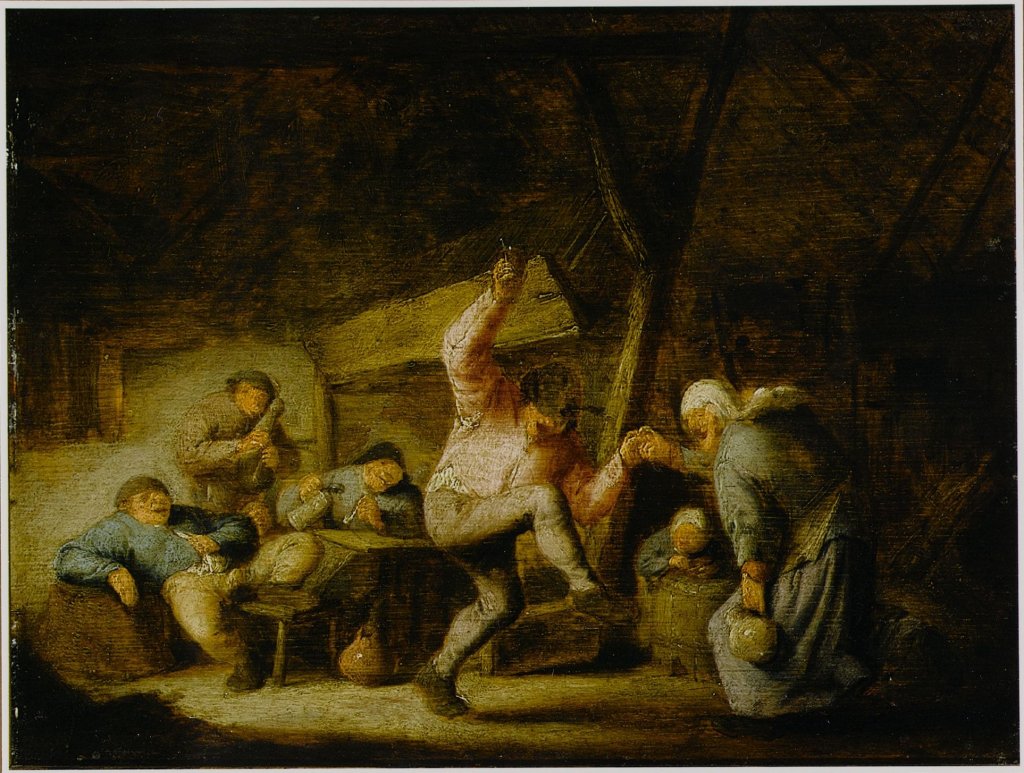
The tavern scene shown above is anything but refined. Rest assured that the peasants shown in the artwork were not the intended audience for this work. Peasant theme paintings were meant to adorn the walls of the well-to-do. This caricatural scene with one man sprawled out on a bench, another sipping alcohol, and a musician accompanying elated dancers was intended as comic relief. The more privileged appreciated the low-life paintings for their keen social critique and ridicule, in addition to their amusing subject matter.
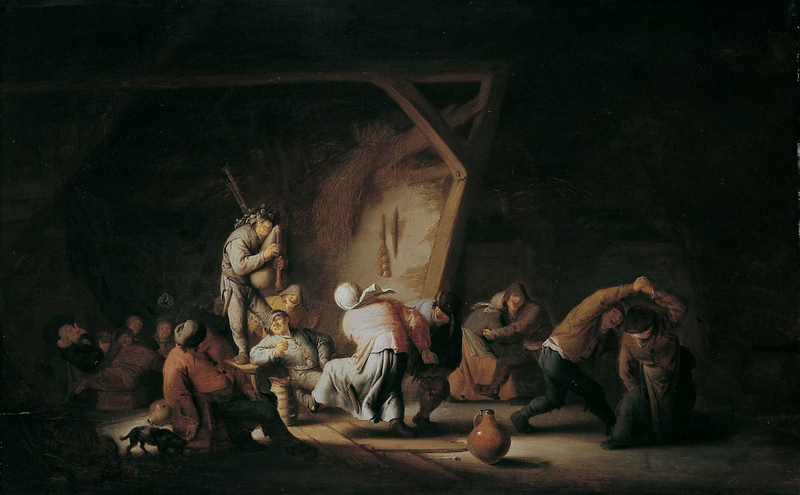
The body language of the three dancing couples in Peasants Dancing in a Barn leaves no doubt about the rhythm, speed, and vitality of their impromptu dance. These rustics dance raucously. They pull, jerk, and rotate in an uncontrolled manner. Van Ostade’s (dance) figures abound in passionate emotions. Their exaggerated gestures and facial expressions convey their character and individuality. Van Ostade’s characters, especially in his early work, were impulsive, brimming with vitality, and prone to making wild, free-spirited gestures.
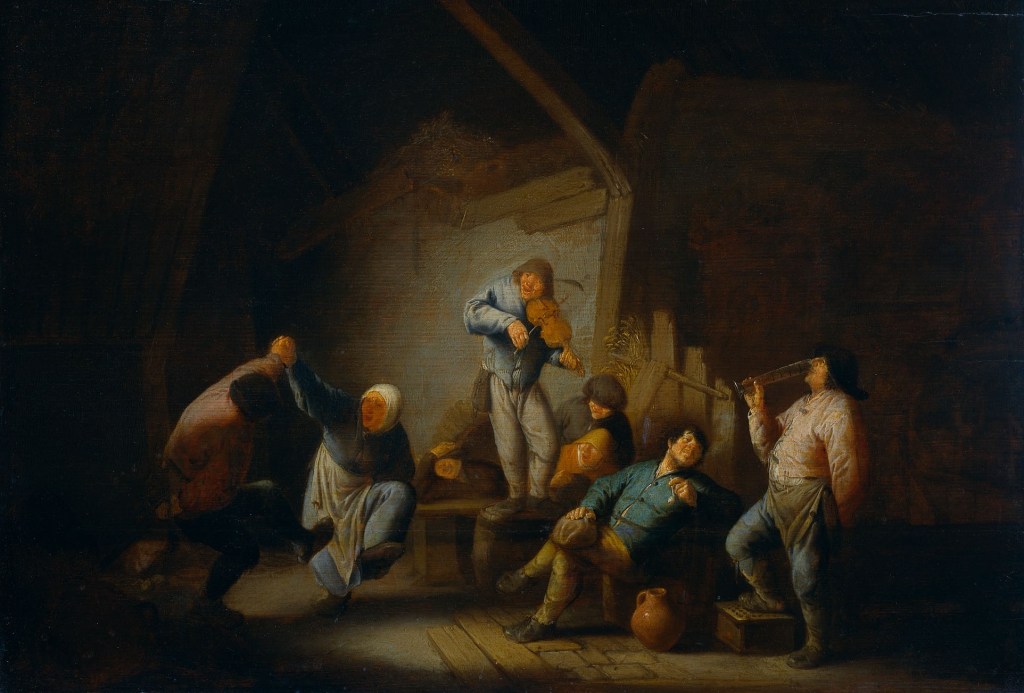
A shabby old barn is the setting for The Dancing Couple. The action takes place under a triangular glow of light, which partially illuminates the canvas. The outer edges and background are dark. The violinist is the life of the party. He is perched atop a high barrel. Beside him, rustics linger, lounge, and slouch, except, of course, the provincial sipping from an extremely long flute. Every character’s body language conveys their disposition, not to mention their level of intoxication. But it is the bulky, earthbound woman that steals the show. Her coarse, bold movements are just as ungainly, and they are enthusiastic. Her exuberant dance is duplicated by her partner, who, for the most part, is concealed in the shadows. Adriaen van Ostade has painted a whimsical piece that mimics commonplace life but additionally serves as a light-hearted reminder of forbidden vices.
The illustrious painters Adriaen Bouwer and Isaac van Ostade tragically passed away when still young. Adriaen van Ostade, however, enjoyed a lengthy and accomplished career. In this post I focused on his early years. The following post will look at dance and dancers in his later work.


 DANCE IMAGES IN THE ART OF THE NETHERLANDS


.jpg)