The tavern is crowded. Chaos abides. The floor is scattered with toys, vessels, drum sticks, a pipe, and much more. The bagpiper looks directly at the viewer, inviting all to enter the boisterous bedlam. Everywhere you look, there are delightful, intriguing, and questionable characters. There are a number of amorous couples caressing on the stairs. Elsewhere, a shady man is propositioning a member of the fair sex, a seated couple is deep in conversation, children play, and dogs scurry around. At the foot of the stairs, a group of peasants revel in a spontaneous improvised dance. A closer look reveals an egg in the centre of the dancer’s circle. They perform the traditional egg dance. The exuberant foursome fling their bodies cheerfully to and fro as they step, hop, and quickly manoeuvre around the circle. The laughing woman at the back of the circle catches the light. Her vibrant, fun-loving glance is directed at the musician. Not surprisingly, the stooped fiddler reciprocates passionately. The other woman looks at the ground, suddenly realizing that her foot is terribly close to the egg. But no one else seems concerned; the dancers continue merrily on their way.
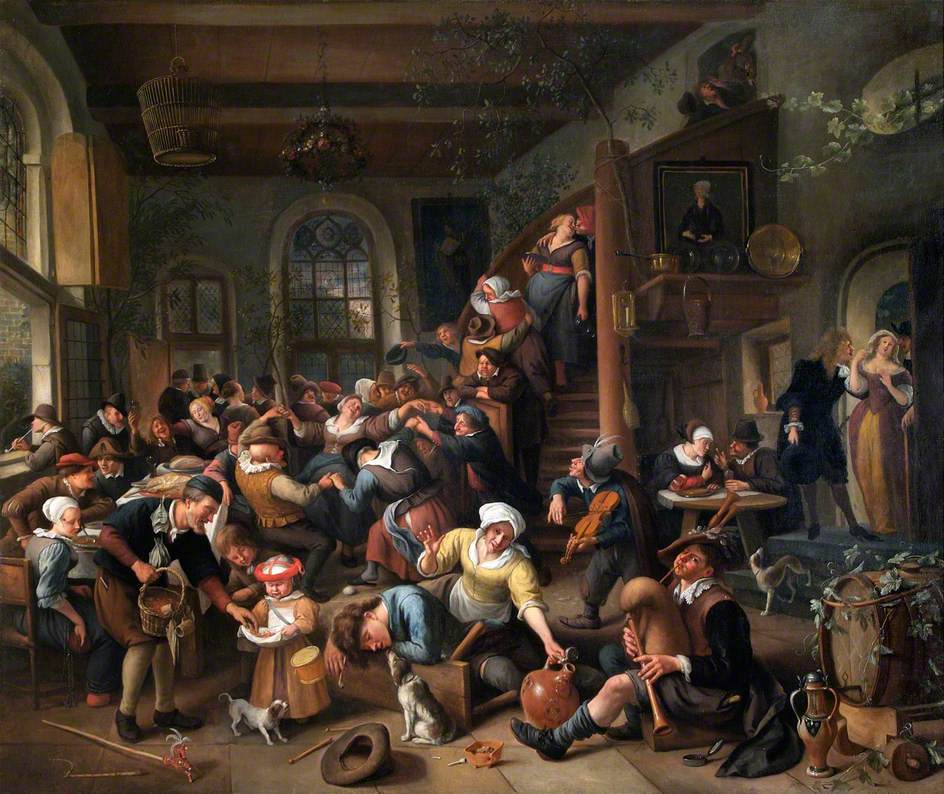
Jan Steen (1626–1679), the artist of this disorderly scene, was a brilliant storyteller. As chaotic as some of his paintings seem to be, each figure or group of figures has a unique tale to tell. All these different tales, together with the various props and attributes, repeatedly culminate in a didactic work. Steen discusses religion, morals, human nature, and life in the 17th-century Netherlands. He is apt to discuss these issues with humour, respect, contempt, or irony. Steen was a master of characterisation. His figures are often exaggerated, even theatrical. Never one to spare himself, Steen frequently included his own witty portrait amid the array of characters. In the bustling work Revelry at an Inn, Jan Steen jovially greets his audience with a jug of liquor in one hand and a raised glass in the other.
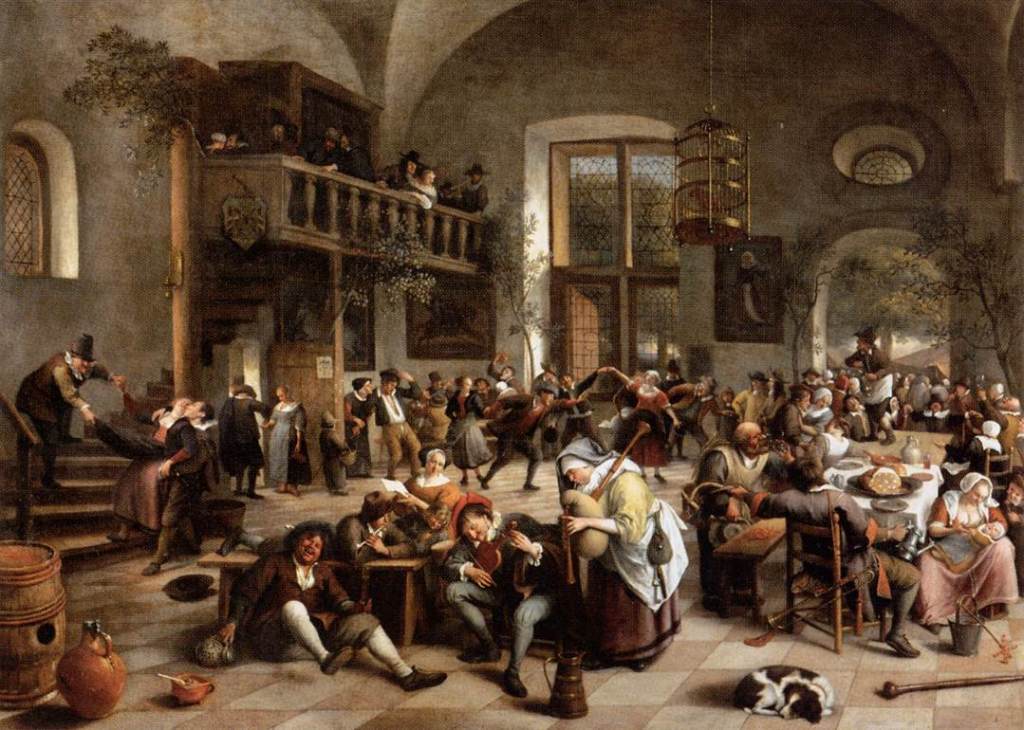
The canvas is teeming with activity; peasants and townsfolk are celebrating. Steen highlights an array of human traits. He juxtaposes tender scenes — a mother nursing her baby or a sleeping dog — against an indiscreet man offering a maid money for her services. Further along, at the foot of the stairs, two brazen men grapple an obliging woman. These indiscretions elude the revellers.
Bagpipe players are usually male. A feminine bagpiper is a rarity. Her prominent position and her commanding posture immediately draw attention. If you visualise a straight line moving from her head to the windowsill, we pass by couples enjoying a traditional social dance. The back couple has raised their arms, forming an arch for the front couple to pass under. Pieter Bruegel the Elder, who inspired Steen, uses this composition in The Peasant Dance. Steen, as was common in his time, painted men as robust movers. They are unrestrained. The rustic dancer darts, twists, bends, lunges, and propels himself into crude poses, disregarding symmetry and constraint. He is earthbound. Equally ungainly are his overstretched steps, which invariably result in deep knee bends.
Compared to the vibrant, often hectic activity and disorder of the above paintings, where the viewer is invited to meander along conflicting scenes, Country Wedding feels uncluttered. Even though there are more than twenty figures lounging along the table, standing in the archway, or looking through the window, the foreground is exclusively reserved for the dancing couple. Only a loyal dog shares their space. Two other figures also attract attention: the fiddler standing tall upon a bench and, at the far end of the table, a man strongly resembling Jan Steen, who beckons the viewer to join the festivities.
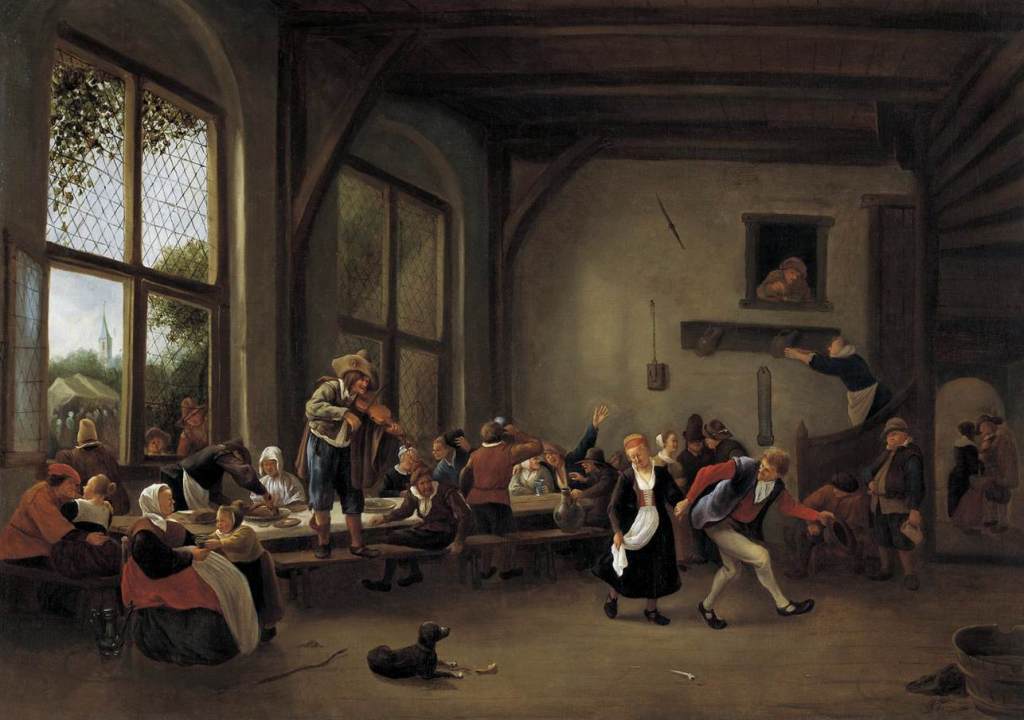
The fiddler has a calm disposition. No doubt, he plays a moderately cheerful tune. The young dancer, probably the bride, looks modestly down, holds her apron gently to the side, and tentatively follows her partner. Her body is subtly curved, and her head is inclined. Her gait suggests that she is walking, yet, for all we know, she is about to burst into a vivacious dance. The male dancer adopts a familiar pose, frequently seen in dance images. The question that now arises is whether Steen selected this specific action because it conveys movement or if he painted an actual dance movement.
Relatively little is known about the specifics of village dancing. Country dances, in contrast to court dances, were never documented. These social dances were intended for young and old. Everyone participated, so it can be assumed that the steps, movements, and rhythmical variations were rudimentary.
The following two dance scenes offer food for thought. The couples, despite obvious differences, are similar in their manner and body language. If we direct our attention specifically to the male dancer, it becomes evident that whether depicted from the front or the back, his actions are comparable; the elevated leg, the inclined and marginally rotated torso, the extended front arm and raised supporting heel.
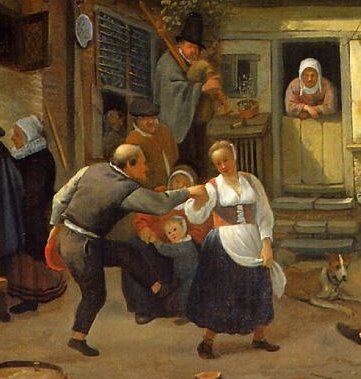
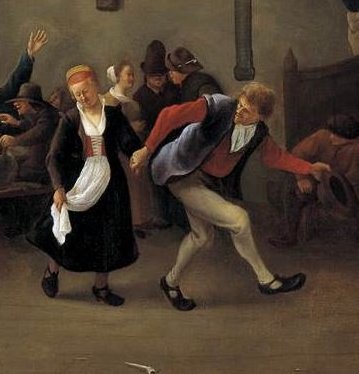
Peasants Before an Inn (detail)- 1650 s – Toledo Museum of Art
The Country Wedding / Merry Company in an Inn (detail) – 1662-66 private collection
In the next painting, Jan Steen highlights two perky male dancers. They, as the previous rustics, are portrayed in the customary manner. The stouter, balding man has his back to the viewer, and the other, wearing a red cap, is in full view. There is absolutely nothing graceful about these fellows. They are uncouth and cumbersome. The older man, though no longer agile, nevertheless manages to raise a leg. The brash guy exaggerates his gestures to the fullest. Is he challenging his dancing companion? Are his burlesque arm gestures and his bizarre facial expression menacing or merely entertaining?
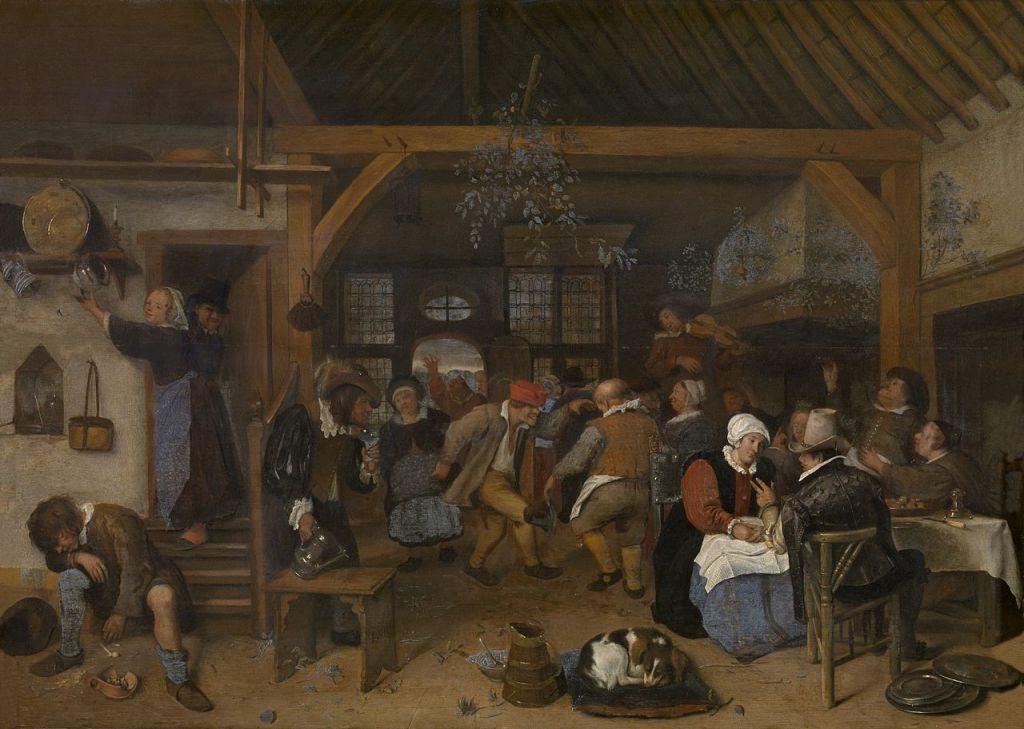
As we have come to expect from Jan Steen, ‘Wedding Feast’ presents various storylines: a fiddler is installed on a platform, a woman is about to entertain a wealthy man, and an intoxicated fellow sits at the foot of the stairs. But where, you may ask, is the bride? This is a wedding feast, after all. It takes a little meandering before you find the subdued bride tucked in the space between the elegantly attired gentleman and the woman wearing a white cap. A simple crown serves as a distinguishing feature. The fact that Steen concentrates on the crude man with the red cap is intriguing. He could be highlighting the bridegroom. On the other hand, Steen may have chosen this representation to emphasise and criticise the foolishness of the peasants. He was probably inspired by Adriaen Brouwer (1605–1638) who regularly portrayed coarse, low-life figures adorned with a red cap.
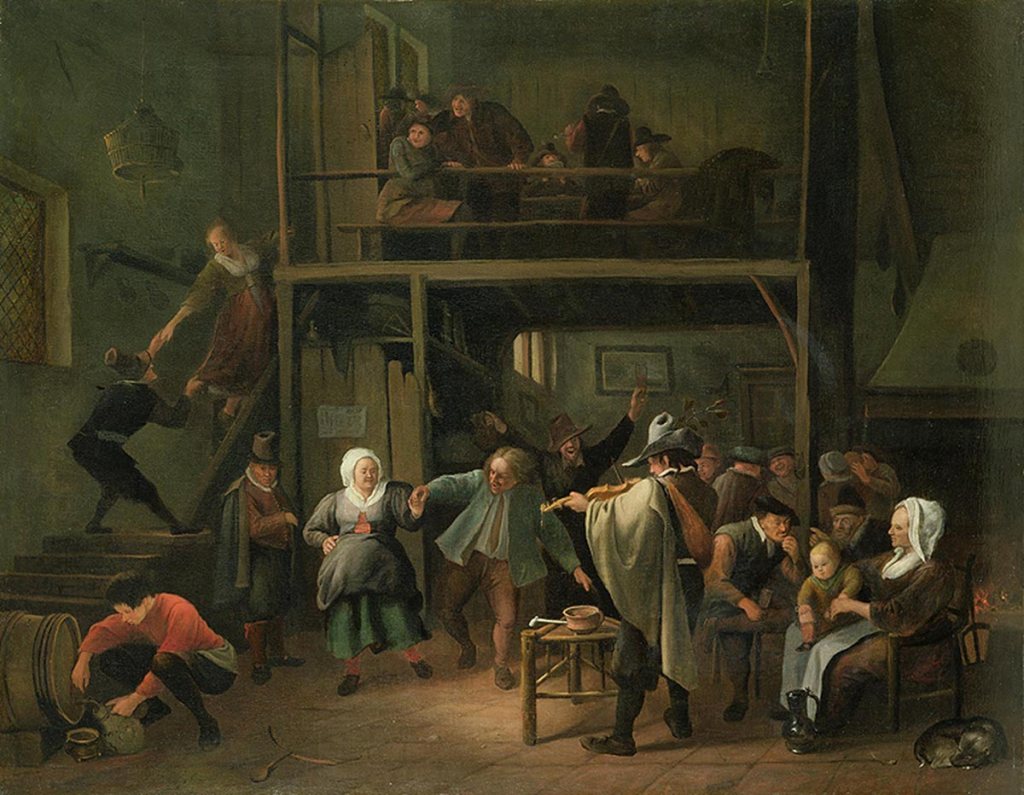
‘The Interior of a Tavern with a Couple Dancing to the Music of a Fiddler‘ seems more appropriate as a description than a title. Perhaps a more apt title would be ‘Find the vices‘. This comical scene of tavern life is not merely a decoration for a dining room wall. It served as a reminder of human frailty. In this thriving genre scene, merrymakers drink, smoke, seduce, play cards, gamble, are idle, and generally enjoy themselves in every way, but in a virtuous manner. Only the mother with the baby on her lap adds some propriety. Amid all the hustle and bustle, a mature woman and an equally mature man perform an amusing dance. Dancing, however, was by no means considered an innocent pastime. Many forms of dance and music were spurned by church authorities. This couple may appear endearing, but there is a message there. Do I spur a glance of disapproval from the well-dressed gentleman?
The Robbed Violin Player is not a dance image, but I cannot conclude these posts about Steen without presenting this scintillating work. It personifies the genius of Jan Steen. His humour, his theatricality, his pointed criticism, his narrative, and his intense compassion are all embodied in this small work.

The fiddler is theatrically dressed. He resembles a figure from the Commedia dell’arte. Jan Steen has portrayed himself as a portly musician infatuated by a girl half his age. He has a twinkle in his eye and grins from ear to ear. The unwary character is distracted by the old hag, who offers him a glass of wine. Overcome with lust, the violist fails to notice that he is being robbed. The strategically placed pipe leaves no room for speculation.
With his background as a brewer and tavern keeper, the well-educated Steen met people from many walks of life. He depicted both the reprehensible and the honourable. His irony, sarcasm, and sense of humour are unmatched. Steen’s captivating narrative was invariably moralistic, even in his amusing dance paintings.


 DANCE IMAGES IN THE ART OF THE NETHERLANDS
