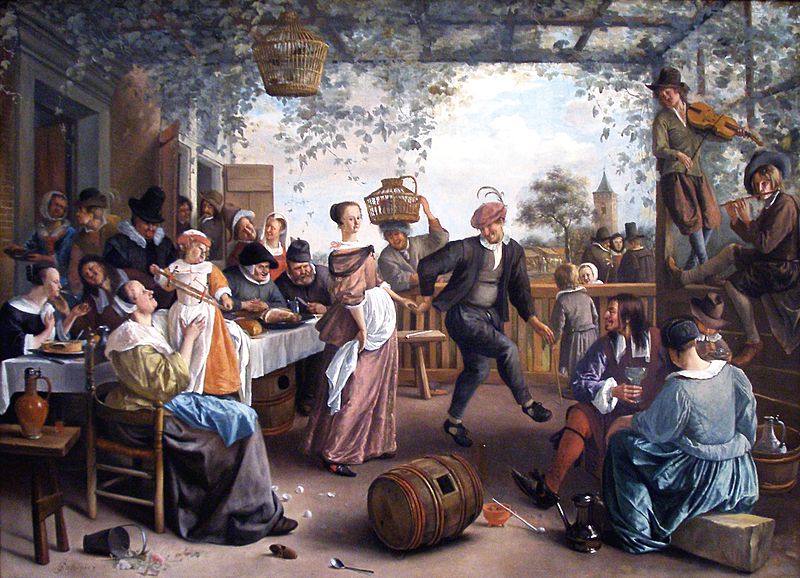
The Dancing Couple, a large painting by Jan Steen, never ceases to amaze. Steen transports his audience to a delightful festive scene in which young and old eat, drink, flirt, play, and make merry. A dancing couple immediately springs to the fore. The man is a boorish peasant. He wears rough garments and a silly cap decorated with ostentatious feathers. He creates a spectacle of himself. She is a lovely, slightly reluctant maiden. Her demeanour and attire make it quite evident that she is not a rural girl. Her gaze seems distant. The foolhardy peasant encourages his hesitant companion to dance. There is something unique about these dancers. Why would a country bumpkin invite a city girl to dance? What is really happening in The Dancing Couple? The painter, Jan Steen, was a storyteller. The Dancing Couple, like the majority of Steen’s art, delivers more than meets the eye.
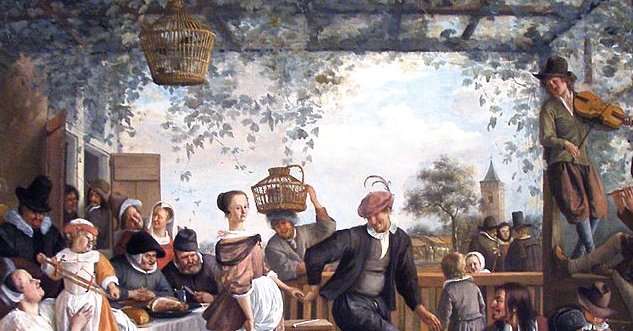
But before attempting to unravel the narrative of The Dancing Couple, it is riveting to look at an earlier work. A Terrace with a Couple Dancing to a Pipe and Fiddle, Peasants Eating, and Merrymaking Behind is about half the size of the Washington painting. The figures, the setting, and the attributes are astonishingly similar to the larger painting. In fact, The Dancing Couple is a practically reversed version of the earlier work. In both instances, the dancing figures steal the limelight.
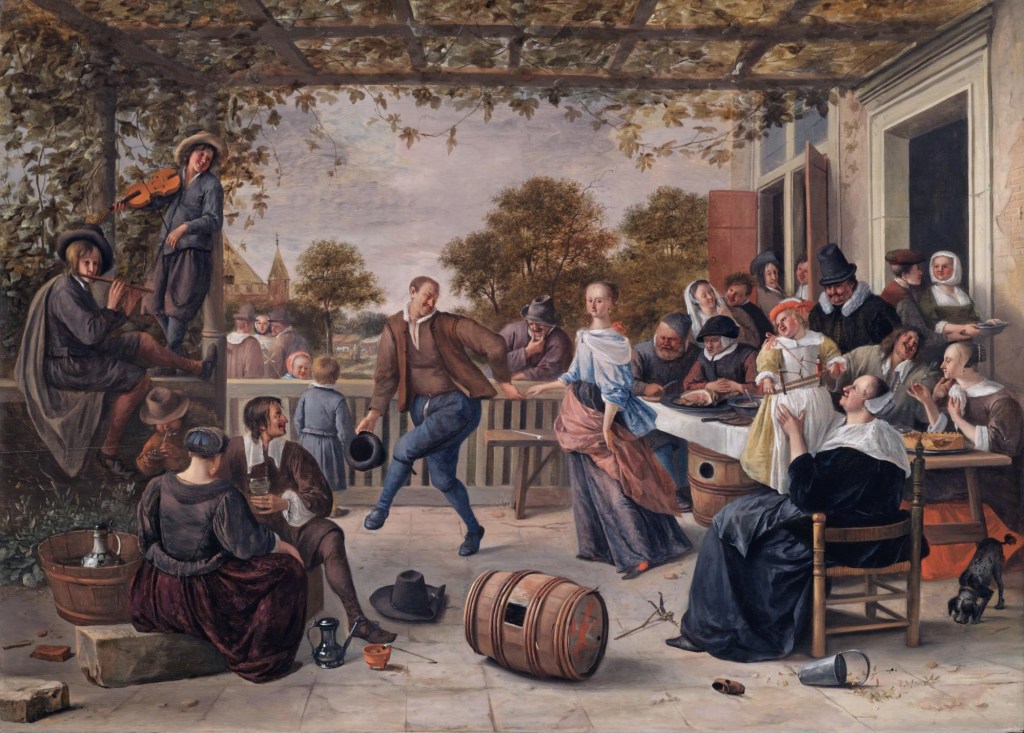
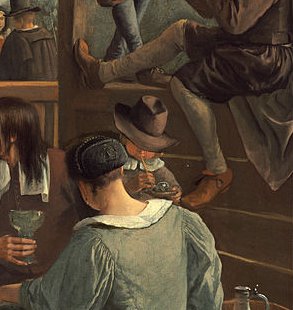
The scene stages a festive day, possibly a kermis, a local fair, where country and city folk celebrate a religious holiday. In the foreground, merrymakers gather under a vine-covered arbour. Around a nicely prepared table, a mother lovingly supports her young child, an elderly couple enjoys the entertainment, youthful couples flirt, and a middle-aged pair enjoy the wine. Jan Steen regularly depicted himself in his paintings. Here, he can be seen fondling the chin of the woman, who is sipping a glass of wine. On the opposite side of the terrace, there are two musicians, a man and a woman seated on a stone block, and a young boy is blowing bubbles. And true to Jan Steen’s reputation for untidiness, objects —flowers, a shoe, a barrel, eggshells, a pipe —are strewn in a haphazard manner in the foreground. The objects, as so often with Steen, have a symbolic or emblematic connotation. More about this later.
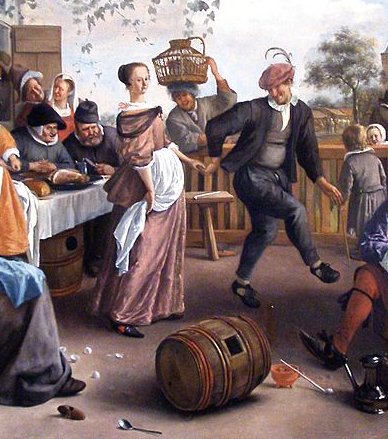
The portrayal of the dancing couple in both paintings is nearly identical, despite the inverted position. The girl is a little shy. She is schooled in etiquette and approaches her dance partner prudently. Steen has given her very little movement. She stands elegantly, facing towards the viewer. In contrast, the robust male dancer is energetic. His spontaneous moves are rough. Steen depicts this male dancer, like he did in many other works, stepping and hopping on one leg while raising his free leg at a right angle.
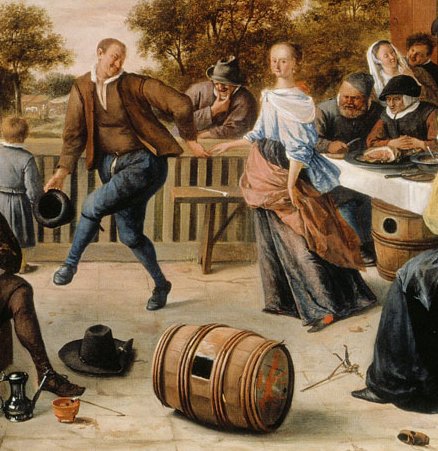
Left: A Terrace with a Couple Dancing to a Pipe and a Fiddle, Peasants eating and Merrymaking behind (cropped) – after 1660
Right: The Dancing Couple (cropped) – 1663
In the earlier painting, the male dancer is presented as a friendly country rustic who persuades a charming city girl to dance. His simple jacket is enhanced by a small collar. He has short hair, and carries an ordinary hat in his hand. Steen has notably altered his appearance in the larger painting, assigning him a beret with cock’s feathers and enlarging his collar. The modest rustic has transformed into a mischievous, crafty character, enticing, not inviting, the somewhat naive but not unwilling city girl to more than a social dance.
Another notable transformation is the laughing peasant who leans over the fence. Steen originally depicted him as a reveller enjoying the festivities, not as a poultry seller holding a caged fowl on his head. The merchant, a passer-by, has stopped to watch the bizarre dancing pair. In an excellent article, art historian Arthur K. Wheelock explains;
By making the peasant into a poultry seller Steen changed not only the nature of the man’s participation but also his thematic impact. The Dutch verb vogelen means both “to bird” and “to have sexual intercourse,” … The poultry seller, thus, was almost certainly intended to highlight the sexual undertone of the dance taking place directly before him.
The Dancing Couple, Arthur K. Wheelock Jr. – August 2017 – National Gallery of Art, Washington (1)
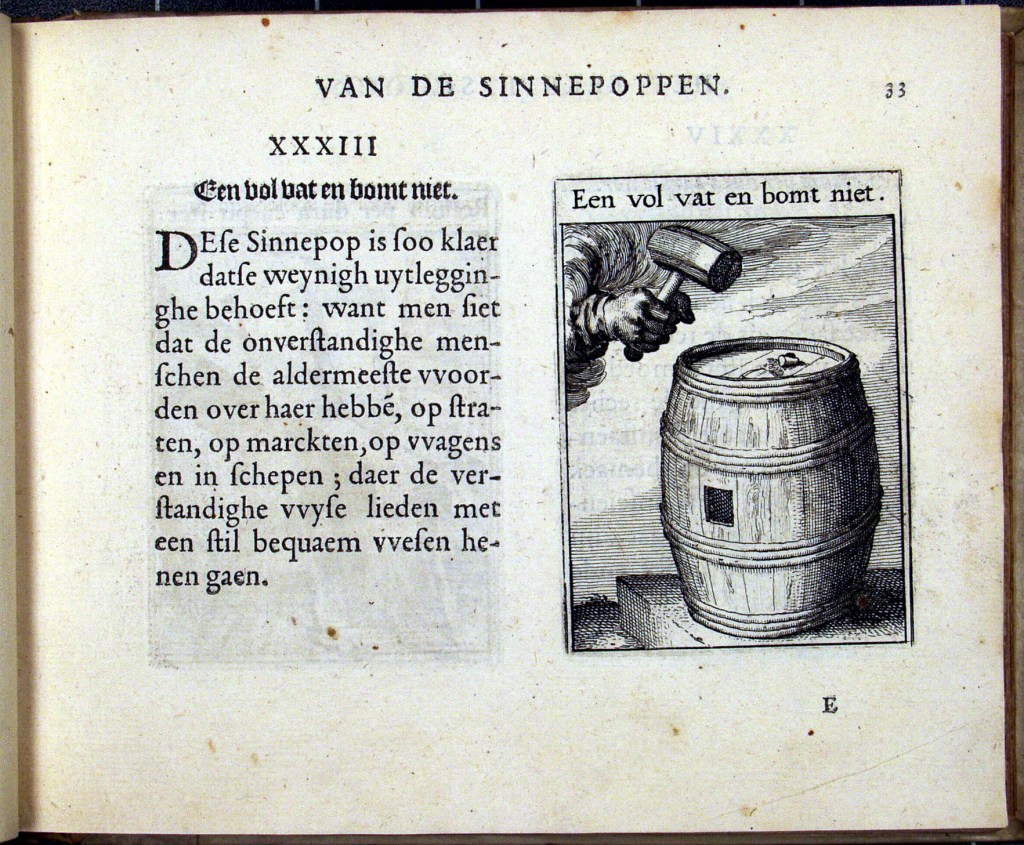
The city girl and the country bumpkin are an ill-matched pair. He is a buffoon. She is charming. Steen employs a well-known Dutch folk maxim to highlight the absurdity of their union. It is no coincidence that he has placed the pair directly behind an empty barrel. (2) In Dutch symbolism, this emblem signifies how the ignorant are exceedingly talkative, whilst the wise remain upstanding. The barrel unambiguously reflects the foolishness of the situation. Steen continues to comment on the fleeting character of their illicit pleasure, placing broken eggshells and cut flowers at their feet. These traditional Dutch objects, along with the young boy blowing soap bubbles, symbolise the couple’s transitory relationship. Soap bubbles, a vanitas symbol, are frequently seen in 17th century Dutch art; glistering bubbles are beautiful, but ephemeral. The image, homo bulla, symbolises that man’s life is but a bubble.
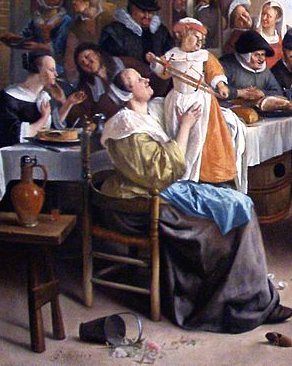
Right: detail of mother supporting her child. The child plays with a hammer toy where two wooden figures work in perfect harmony.
After establishing that the relationship between the dancers is imprudent and fleeting, Steen pursues this issue, showcasing the enduring relationships between other couples. The commitment of mother and child, the enduring relationship of the elderly couple, the intimacy of a middle-aged man and his companion, and the tender longing of the surrounding couples are all examples of positive relationships that stand in stark contrast to the unsuited pair. And if that is not clear enough, Steen has hung a basket with two caged birds above the older couple. This image, most likely inspired by an emblematic image in P.C. Hooft’s Emblemata Amatoria, underlines that love is stronger when restrained and that freedom brings peril. It is difficult to imagine a more striking dissimilarity between these two birds and the single fowl resting in a basket on the poultry seller’s head.
Jan Steen, painter, brewer, and tavern keeper, explored human nature. He felt at ease with all classes of society. In The Dancing Couple, he depicts the wealthy and the less prosperous, the elderly and the young, the wise and the foolish. Despite the painting’s numerous figures, each character maintains their own uniqueness. Each figure tells their own personal tale, which, in turn, relates to the Three Ages of Man: the innocence of youth, the passionate love of young couples, and the inevitability of old age. The playful and amorous interaction of the revellers also calls attention to The Five Senses that Steen has embodied within the scene. My personal favourite is Touch, visualised by the cheerful man (a self-portrait of Jan Steen) lovingly stroking the chin of the woman drinking wine from an elegant glass.
The Dancing Couple exceeds the delightful, exceeds the entertaining. Jan Steen, master storyteller, reflects on humanity, evaluating the virtues and weaknesses of human behaviour. The dancing couple epitomises the essence of the story. They command the stage.
- With thanks to National Gallery of Art, Washington – The Dancing Couple, Arthur K. Wheelock Jr. – August 2017 – for Wheelock’s excellent article click on Entry
- The emblem is derived from Roemer Visscher’s Zinne-poppen: “Een vol vat en bomt niet” (A full barrel doesn’t resound) – with thanks to Arthur K. Wheelock Jr.

 DANCE IMAGES IN THE ART OF THE NETHERLANDS