Mommie Schwarz (1876-1942) and Else Berg (1877-1942) were among the earliest modernist painters in The Netherlands. They formed part of an ‘artist colony’, The Bergen School, founded by the French artist Henri le Fauconnier and Dutch artist Piet van Wijngaerdt. The artists of the Bergen School rejected impressionism. Their figurative work was influenced by cubism, expressionism, and often defined by dark hues.
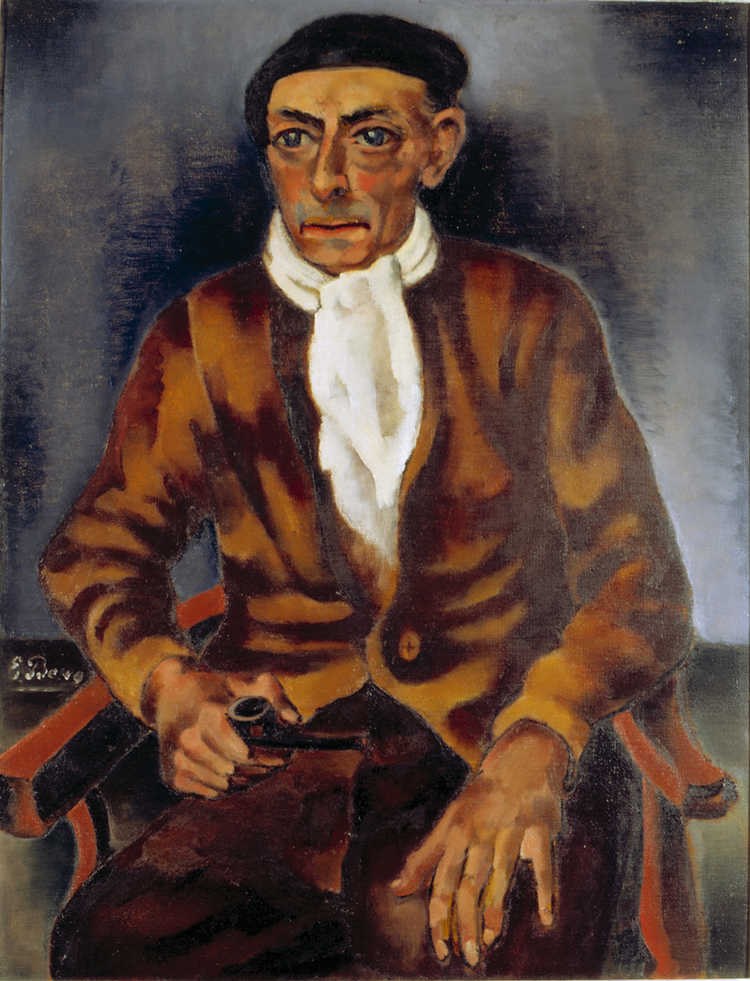
The Dutch artist Samuel Leser “Mommie” Schwarz was born into a Jewish merchant family. After working in New York, studying in Antwerp, and travelling to Berlin, Paris, and Mallorca, Schwarz settled with his future wife, Else Berg, in The Netherlands, joining the Bergen School. Besides being a painter, Schwarz was also a graphic designer and illustrator, designing posters, book bindings, brochures, and calendars. He regularly designed posters for the City Theatre (Stadsschouwburg) in Amsterdam, for a variety of theatrical performances, and for the expressionistic dancer Gertrud Leistikow. The poster, left below, created for De Kring, displays the modern expressionist dancer in a flurry of colours moving passionately, totally unbridled, as customary to the newly found freedom of expressionist dance as performed by the American dancer, Isadora Duncan, and German dancer, Mary Wigman.
The slender, long-tailed bird that perches on a colourful curve adds a touch of humour. Humorous, though in a very different way, is the lanky sailor clinging onto his topless partner. This is undoubtedly an animated dance. The woman’s lusciously whirling skirt and the fact that the sailor is practically swept off his feet presents the viewer with sufficient insight as to the swiftness and momentum of this free-flowing couple.
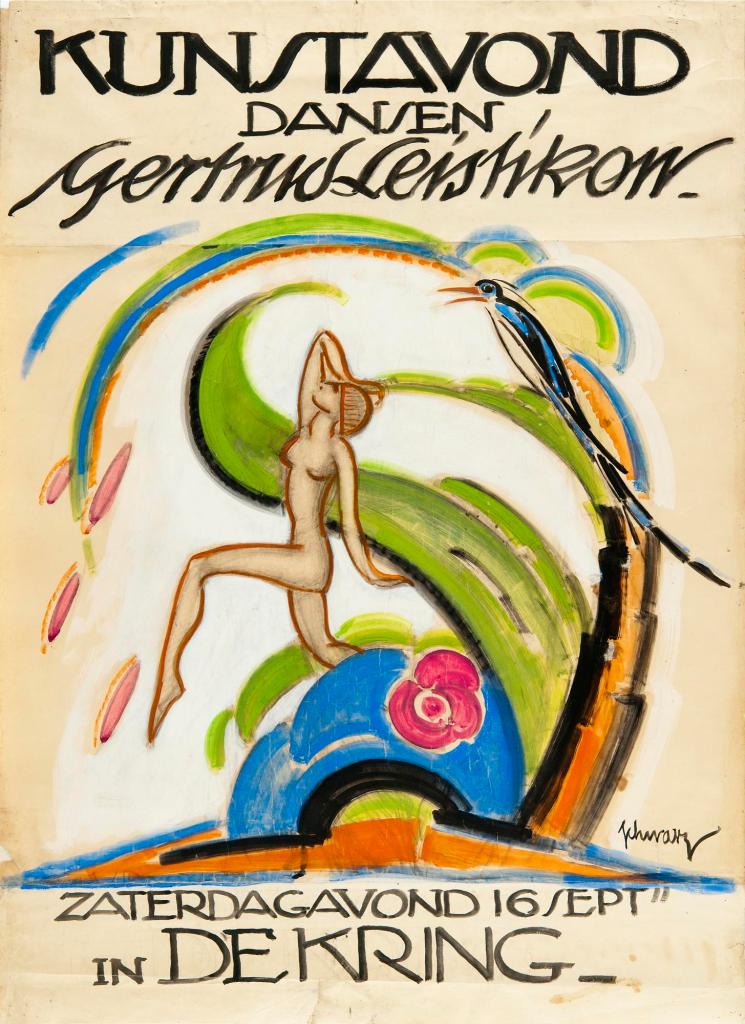

Book cover Brak Water – Sailor Dancing with topless lady in a café – 1930 – 20.8 cm x 30.1 cm – paper – Joods Historisch Museum /Jewish Historical Museum, Amsterdam
Gertrud Leistikow (1885-1948) first toured The Netherlands in 1914, introducing the ausdruckstanz to Dutch audiences. The German-born expressionist dancer was highly successful throughout Europe, acclaimed by critics and the public alike. After her second tour in 1917, she settled in The Netherlands, residing, for a time, in the town of Bergen. There she became acquainted with various Dutch artists, becoming a close friend to Mommie Schwarz and Else Berg.
As far as I can ascertain, Schwarz never used dance subjects for his oil paintings. On the other hand, dance played an essential role in his more commercial work, and his poster designs for Gertrud Leistikow are no exception. The two posters illustrated represent the essence of simplicity: a monochrome stylistic dancer placed against a light background. On one poster, the dancing figure rocks to and fro on a large semicircular base, and on the other, she darts upward, mirroring the strong oblique line passing through the black crescents. The light background, especially in the rocking figure, integrates into the dancer’s skirt and her ‘physical’ presence. Schwarz unambiguously contrasts light and dark. This distinction not only highlights the dancing figure, but also vividly underscores the typography. To complement the roundness of the rocking figure, Schwarz uses linear lettering. He places considerable emphasis on the dancer’s surname, printing each letter in large, bold, unyielding lines. The other poster, illustrating a delicate, lithesome dancer enclosed within crescents, is supplemented with softer,’handwritten’ lettering.
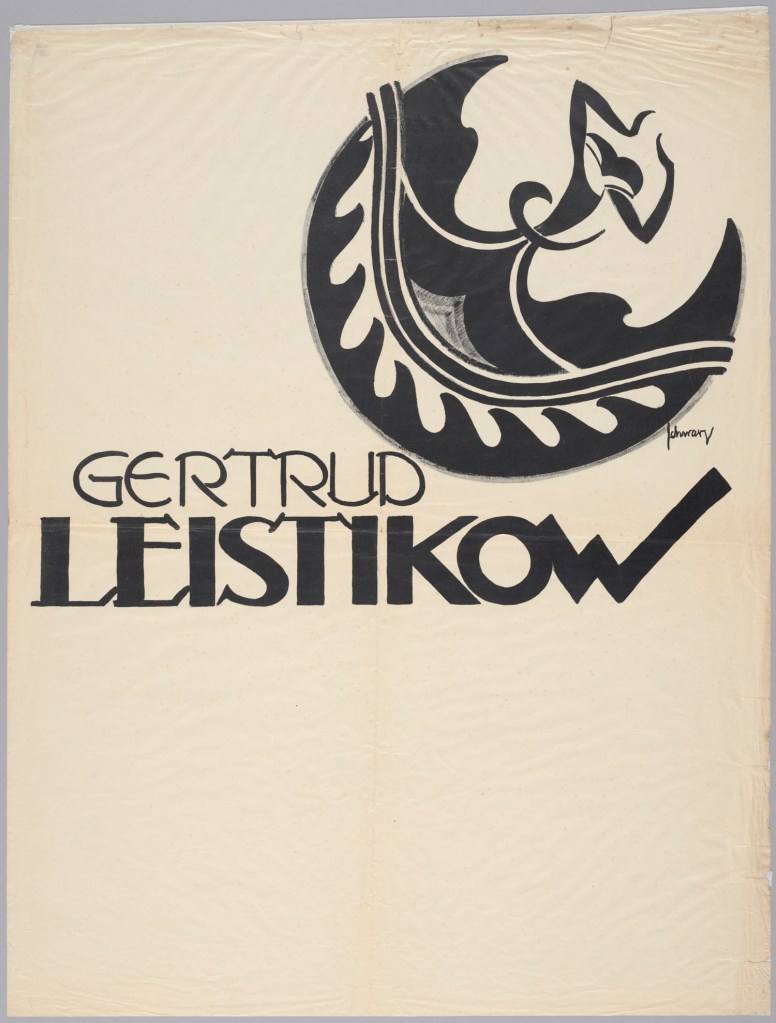
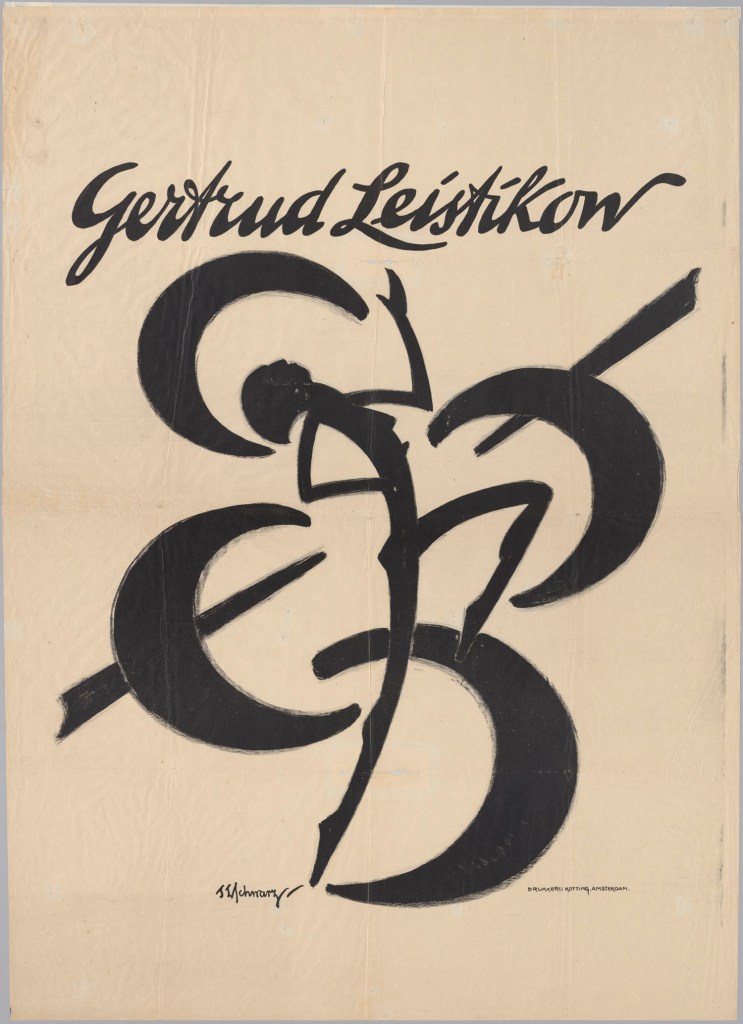
Left: 80 x 110 cm & Right: 65 x 86 cm
Source – The Memory, Collection Poster Project – Theater Institute Netherlands
Gertrud Leistikow was a source of inspiration for many Dutch artists. Jan Sluijters, Harmen Meurs, and Ernst Leyden painted the alluring, passionate Leistikow. The groundbreaking dancer also inspired the sculptors Chris Agterberg, Theo Vos, and Hildo Krop. Krop designed extraordinary masks for Leistikow. Equally exceptional are the six colourful plates that Mommie Schwarz created for the Gertrud Leistikow Calendar.
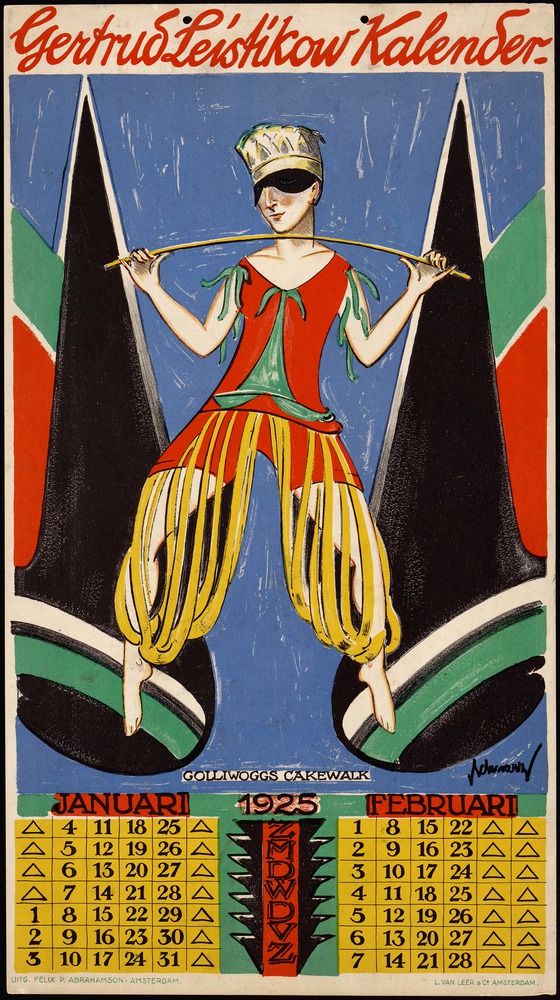
Golliwogg’s Cakewalk – January & February 1925
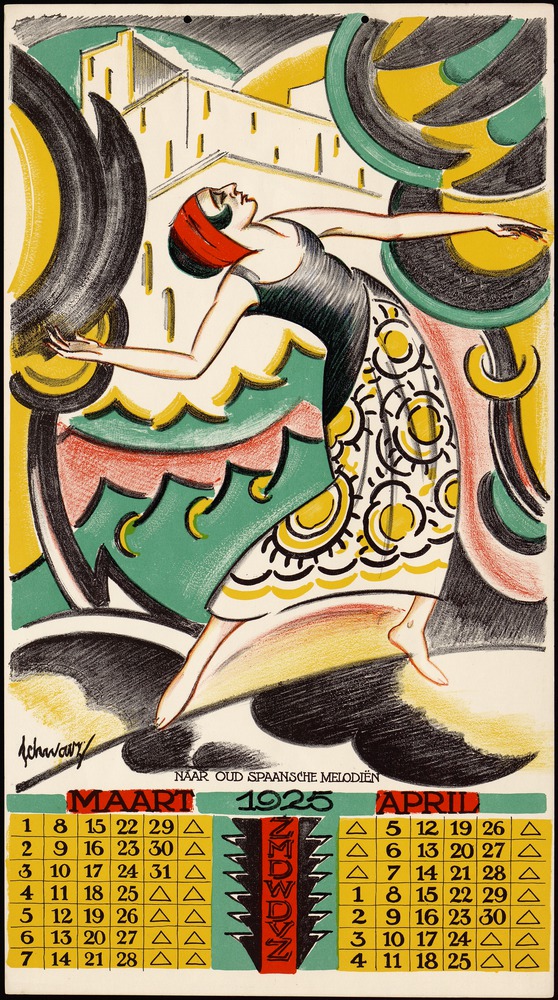
After Old Spanish Melodies March & April 1925
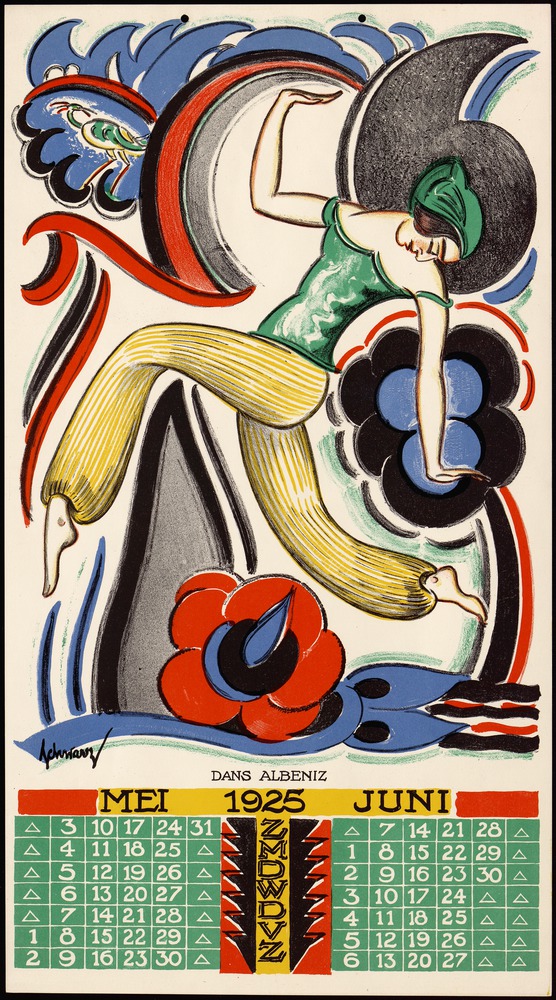
Dance Albeniz May & June 1925
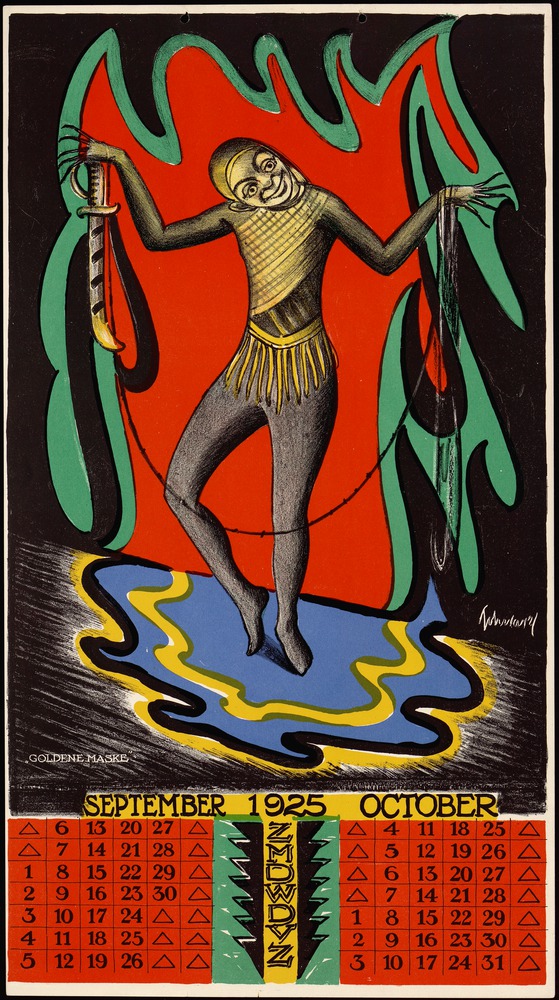
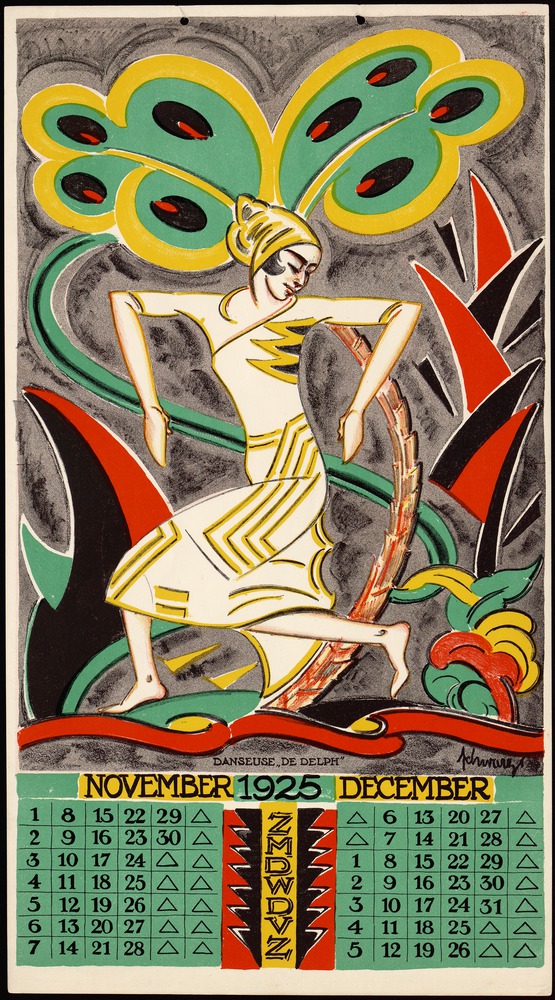
Above each calendar section, Schwarz has drawn a dance scene, which occupies approximately three-quarters of the lithograph. Every one of the six leaves depicts a full-length illustration of a dancing figure performing one of Leistikow’s well-known roles. Without exception, the colourful figures are eye-catching. The dancer, whether performing a golliwog cakewalk, a Spanish dance, or a dance with a golden mask, is buzzing with energy. At times, the dancer, as in Dans Albeniz, appears to hover in the air, and then, turning the leaf, she becomes the paragon of elegance in Old Spanish Melodies. The November/December leaf, Danseuse ‘de Delph’ presents a nobly earthbound dancer whose frontal positioning and sharply bent elbows and knees are reminiscent of ancient dance.
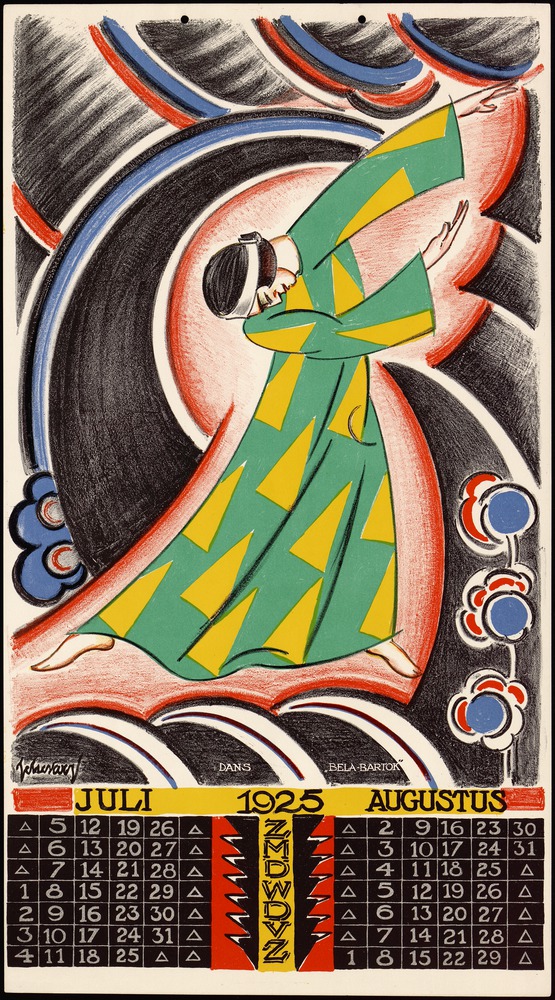
Dance ‘Bela Bartok’ – July & August 1925
Golden Mask – September & October 1925
Danseuse ‘De Delph’ – November & December 1925
Common to all six illustrations is the imaginative background: circular shapes that evolve into large flowers or branches, a potpourri of small and large crescents, decorative triangular shapes, the occasional bird, and a Spanish castle appearing from behind nondescript exotic curves. Each background is unique. Take, for example, the flowing circular shapes that complement the graceful lines of the dancer performing Dance ‘Bela Bartok‘. Her gentle, elongated line extends diagonally over the illustration, merging into the harmonious setting. Or, the Dance with the Golden Mask, where the figure seems to have passed through an open stage curtain to continue dancing upon a serpentine plateau. The calendar’s various background designs bear similarities to Schwarz’s watercolours and paintings of the 1920s. When I first saw the complete calendar at an exhibition at the Stedelijk Museum in Amsterdam some years ago, I was struck by the abundance of colour, the juxtaposition of complimentary though contradictory forms, and the vivacity each design emanated.
Else Berg (1877-1942), who painted the masterly portrait of her husband, illustrated at the top of this post, was also a foremost member of the Bergen School. Dance images are rare in her work. During an extended stay in Mallorca, Berg applied herself to cubism. Two dance-related works, Spanish Dance House and Spanish Lady Holding a Fan, come from this period.
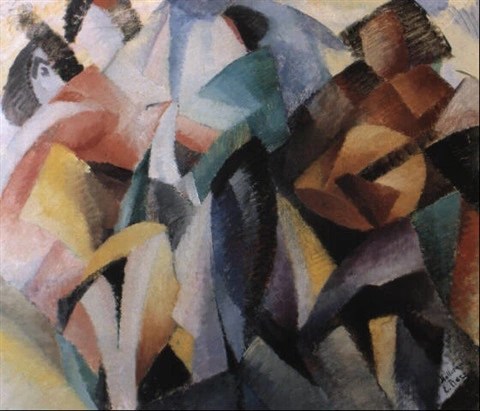
In the near-abstract painting, Spanish Dance House, a number of figures emerge amid a conglomeration of hushed colour and form. On the left, a vague semblance of a flamenco dancer materializes embedded within a multitude of curved and oblique shapes. Only her head, eyes, and eyebrows are clearly defined. There is also a musician playing a guitar on the right side. Berg has camouflaged him within brownish diamond and circular shapes. And there is a barely discernible third figure, merging imperceptibly with the ambiguous shapes and colours. The woman in Spanish Dancer Holding a Fan is conceivably a dancer, although Berg provides no indication of any movement. The lady and background share the same pastel colour scheme. Moreover, the artist adopted the roundness of the fan to compose an environment of circular forms, achieving a synthesis of shape and colour, divulging only the slightest suggestion of depth.
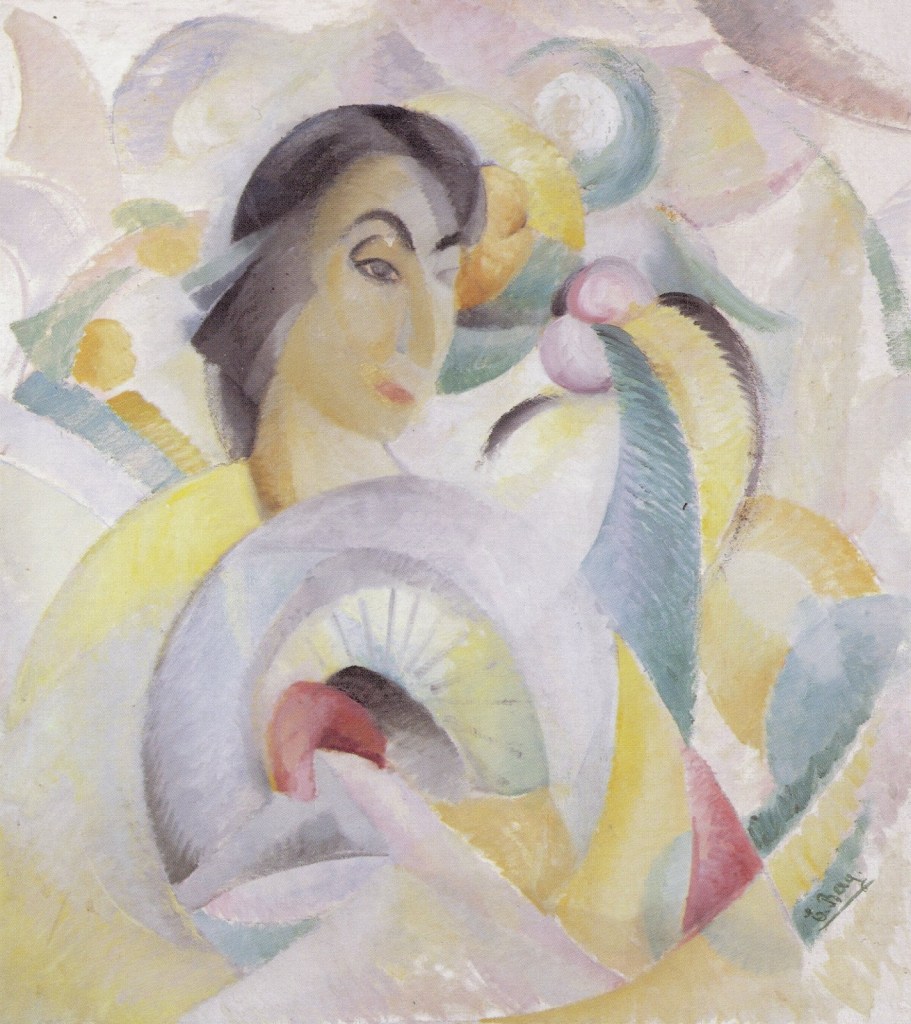
Image: Else Berg (1877-1942): schilderijen,
aquarellen en tekeningen, a publication produced for an exhibition in the
Frans Hals Museum, Haarlem – 1989
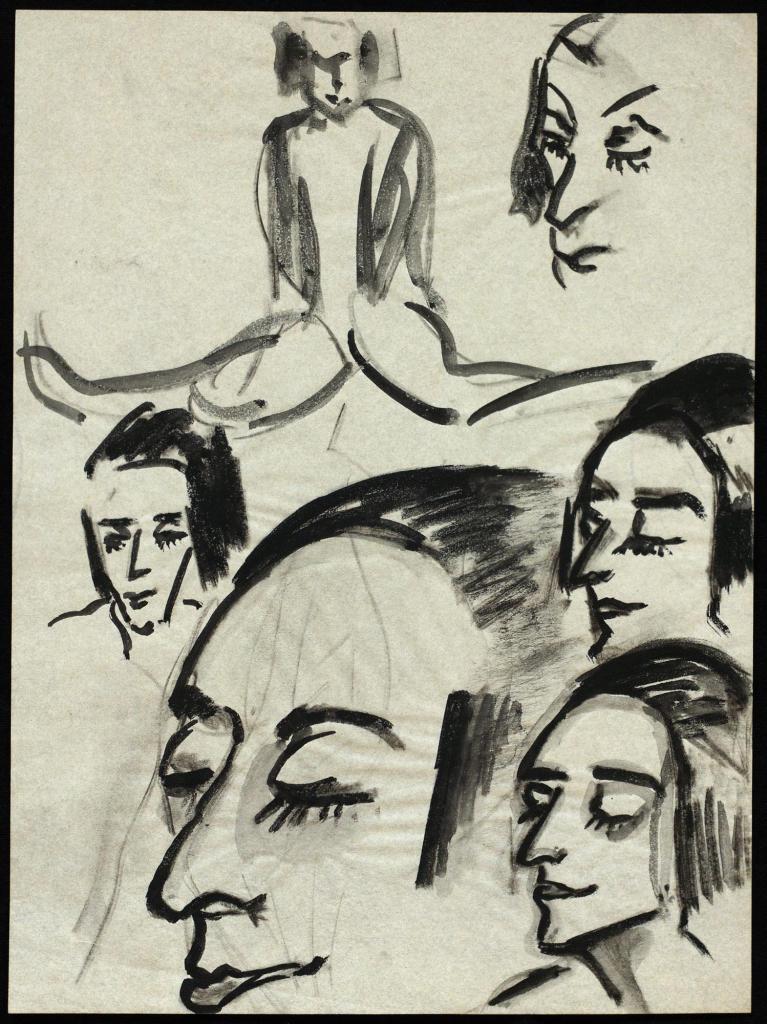
Else Berg sketched Gertrud Leistikow in a number of movement studies depicting her standing, kneeling, and in locomotion. In the ink wash drawing below, Leistikow is seen practising the splits. The larger part of the sketch is filled with five three-quarter profiles of the dancer’s head, with particular emphasis on her facial features. Even though all the portraits show Leistikow with closed or practically closed eyes, each sketch renders a distinctive emotional and dramatic disposition. As far as is known, these sketches never evolved into paintings.
In 1942, the artistic couple Mommie Schwarz and Else Berg were arrested in Amsterdam and deported. They perished soon after their arrival in Auschwitz. Their legacy is timeless.


 DANCE IMAGES IN THE ART OF THE NETHERLANDS