In the previous post I wrote about a number of grisailles portraying dancing peasants and beggars by the multi-talented artist/poet Adriaen Pietersz. van de Venne. This post will look at yet another facet of van de Venne’s work, focusing on dance images featured in an exclusive album, on paintings illustrating the five senses, on a series of works depicting the rise and fall of man, but for starters, a set of endearing pendants.
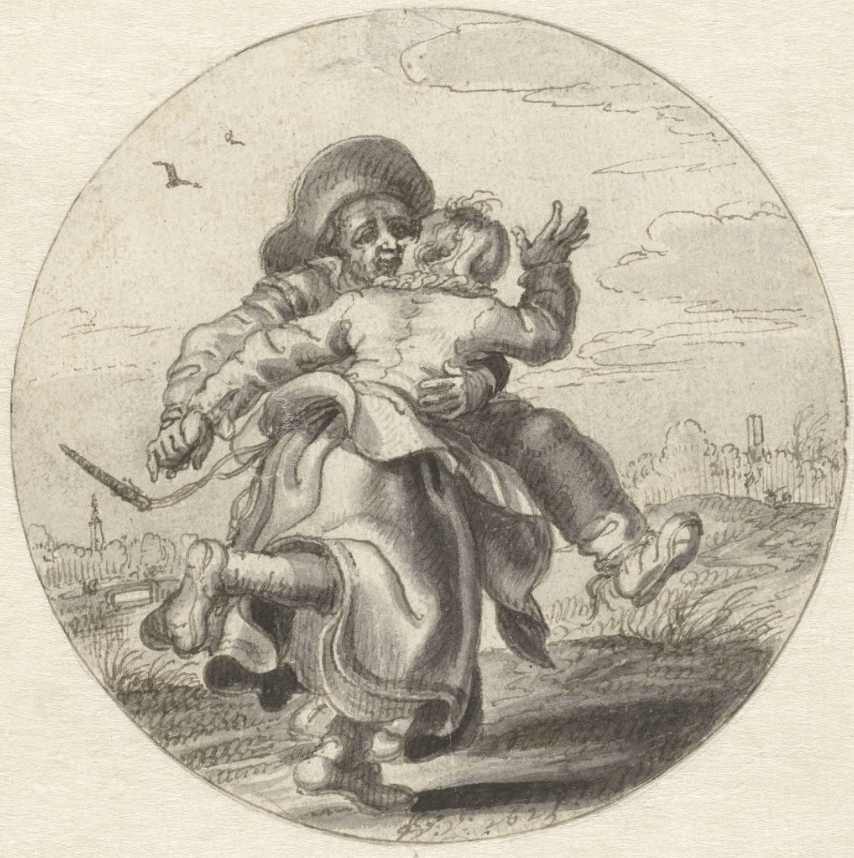
The following two works, each only 117 mm in diameter, immediately recall Albrecht Dürer’s Dancing Couple. Similar to Dürer’s engraving, these drawings are small; the dancing couple is predominant, practically occupying the entire composition. But where Dürer places his dancers on a blank, neutral background with only a slight slope to provide any indication of depth or place, van de Venne has drawn a low horizon with a typical Dutch landscape. Roughly sketched, but nevertheless present, are a windmill, a wooden bridge, and a few seagulls flying in the distance.
The peasants, despite the man’s more mature age, are animated movers. The pot-bellied older man is no less sprightly than the leg-tossing lass next to him. The other couple dance face to face, heartily flinging their feet upwards and nimbly balancing from foot to foot. Van de Venne’s drawings of these easygoing provincials are similar in size, subject, colour, and design. From a business point of view, it is no doubt advantageous; a potential buyer would be enticed to purchase both.
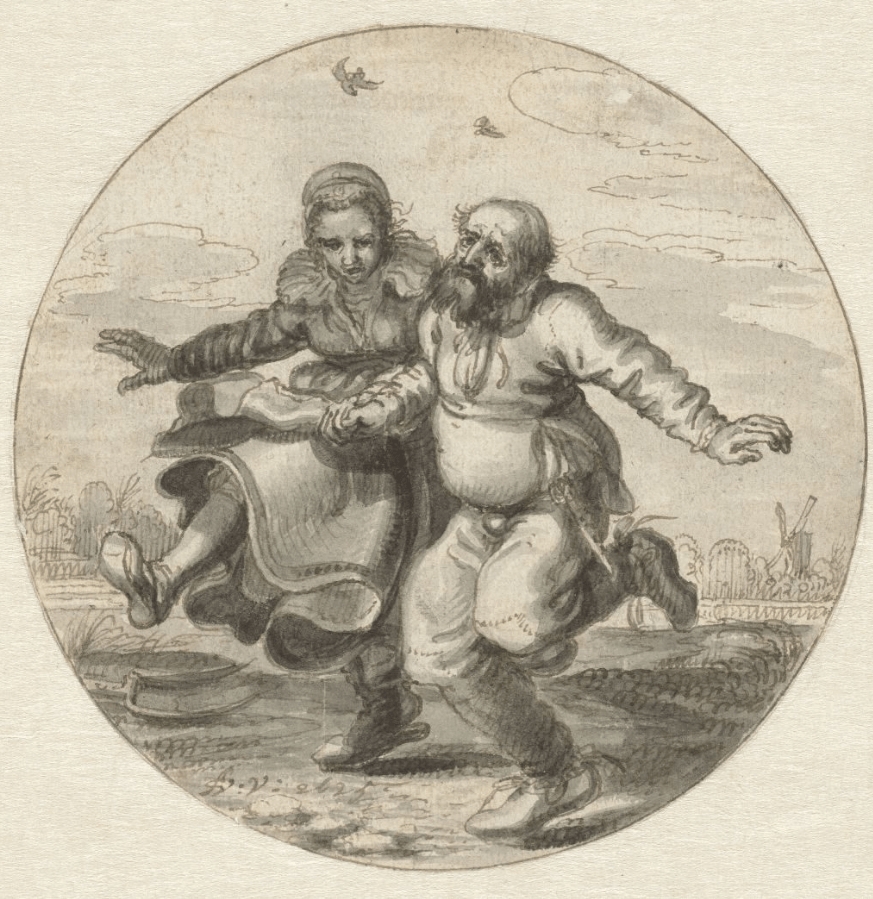
An older man dancing with a younger woman – drawing – diameter 117mm – c. 1625 – Rijksmuseum, Amsterdam
Dancing Couple – drawing – diameter 117mm – c. 1625 Rijksmuseum, Amsterdam
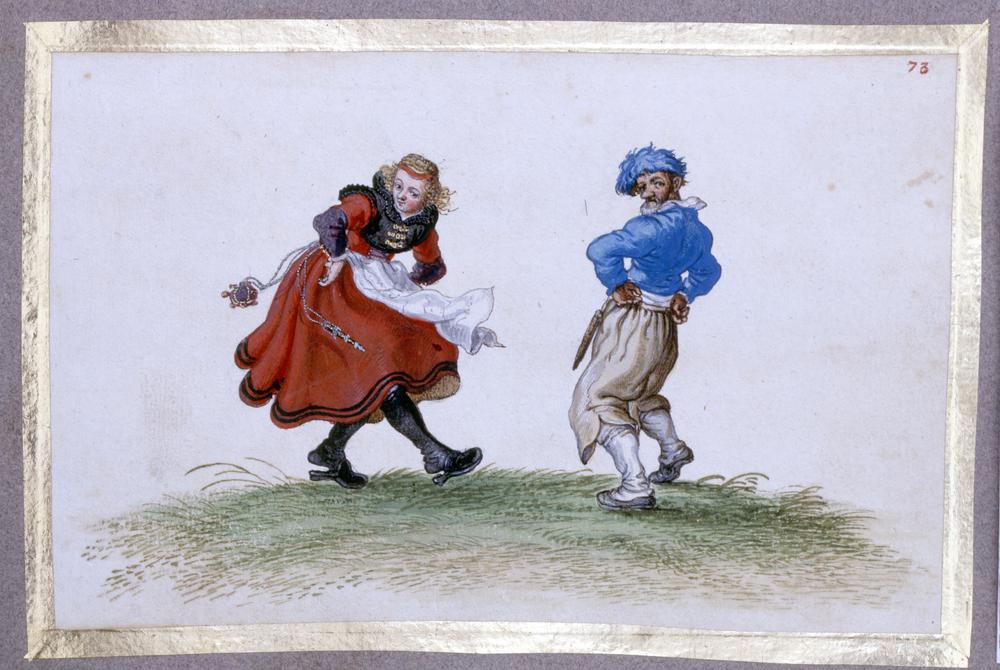
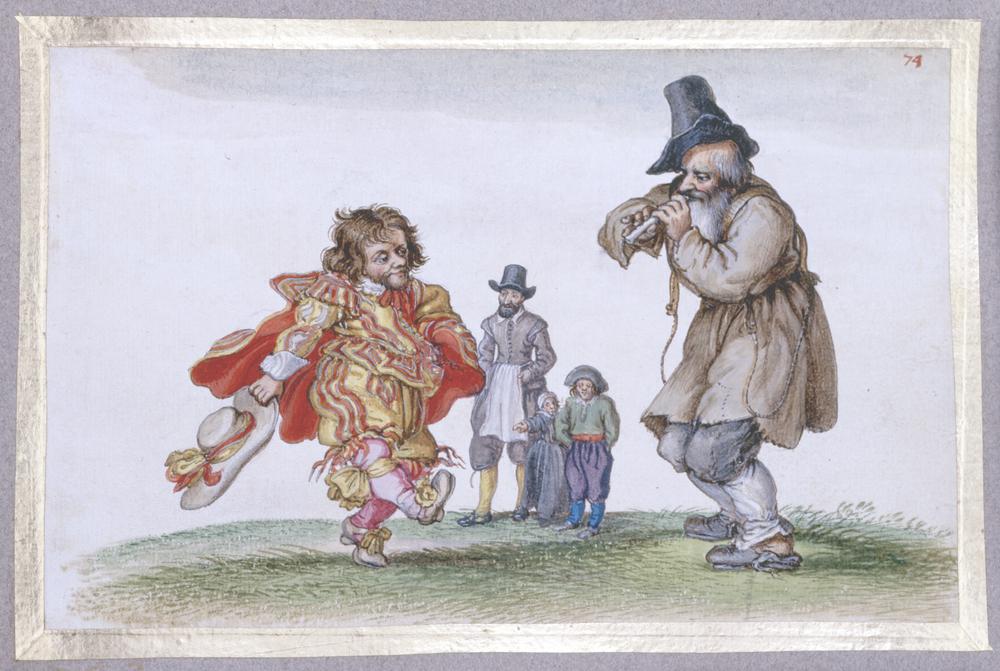
Van de Venne, the book illustrator, drew a hundred-and-two polychrome illustrations for a splendid album which is presently in the collection of The British Museum. The name of the patron is not known, but an illustration placed early in the album of Frederick V of Bohemia and Mary Stuart mounted on horseback followed by Stadholder Frederick Hendrik and his wife Amalia van Solms may offer some clue. Furthermore, the colourful illustrations are often heightened with gold and/or silver, leaving no doubt that the album was commissioned by royalty or a highly placed individual. The impressive album, often referred to as Adriaen van de Venne’s Album, features the various classes of Dutch society in their daily lives and occupations, commencing with royalty, the aristocracy, the military and gradually bypassing city dwellers to move to the country folk. There are illustrations of the elite hunting, courtiers enjoying a game of tennis, ladies playing shuttlecock, and also fishmongers, cheese makers, a milk maid, a washing woman and three delightful dance images.
The illustrations are acclaimed for their sparseness. Van de Venne employs a low horizon, ushering the figures directly into the foreground. The remainder of the page is frequently left bare, though on occasions smaller figures may be added to deliver commentary on the events taking place.
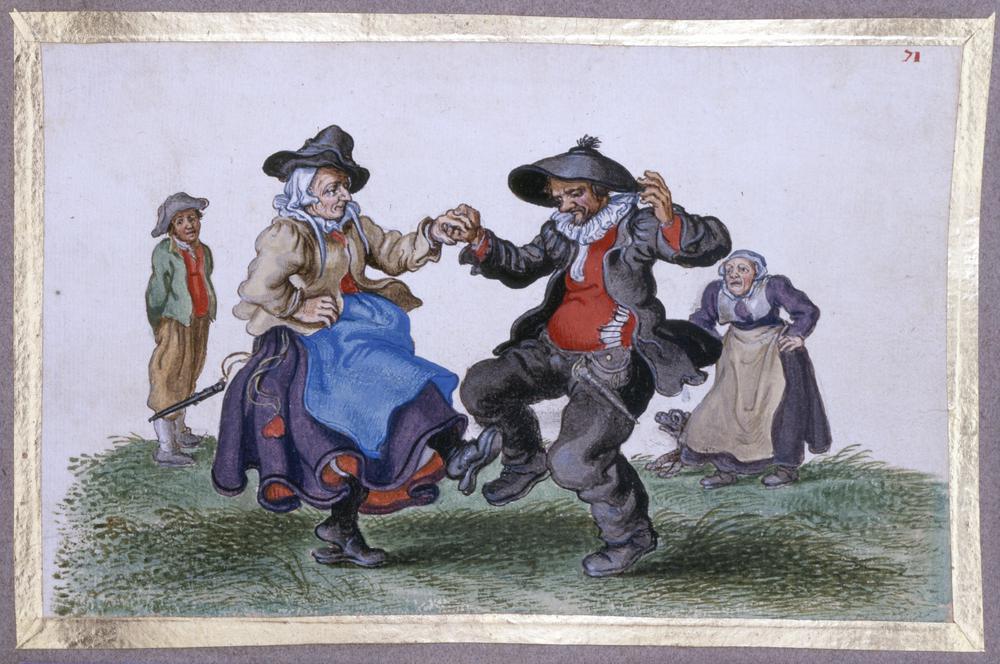
Left: An old peasant couple dancing (nr.71)
Centre: A young girl dancing with a fisherman ( nr. 73)
Right: A dancing dwarf and a peasant piper (nr. 74)
The above three illustrations are designated, as all peasant images are, to the latter half of The Album. The jolly elderly couple could possibly be ‘distant’ relatives of the figures featured in the two drawings at the top of this post. The centre girl and her perky fisherman friend gaze continually at the audience as they turn, twist, and bend energetically. The last image is more curious, picturing a dancing dwarf. He is meticulously attired, complete with a red cape, an ornate hat, and fancy high-heeled shoes embellished with delicately fastened bows. He is certainly not a rustic. Rather, this privileged person is probably visiting the countryside and happens to encounter a penniless piper, who is more than happy to play a jolly tune. Looking at the spectators’ reaction, particularly that of the little girl, it was apparently a most unusual sight.
Van de Venne characteristically portrayed the peasant as rough, ugly, coarse, dressed in rags, intoxicated and lustful. In The Album, quite to the contrary, they are portrayed as hard-working, diligent figures. They have lost much of their surplus weight and unsightly features, are neatly and functionally dressed, and undertake their daily work in an arduous fashion. Interesting, moreover, is that among the numerous images of the elite entertaining themselves, there is not one dance image. The only exception is the ‘aristocratic’ dwarf, but he was a highly unique figure at court. You may recall that during van de Venne’s era, dancing was still associated with all forms of immorality. In The Album, created for the highest echelons of the Dutch aristocracy, only images of dancing peasants would be considered acceptable.
The Five Senses was a particularly popular theme in the art of The Low Countries. Jan Brueghel the Elder, Frans Floris, Anthonie Palamedes, and Jan van Bijlert, to name but a few of the artists who tackled the subject, chose to personify the senses in elaborate settings with a wealth of figures. Van de Venne, who approached this subject several times, broke with the traditional representation, preferring to present each of the five senses with a solitary female dancer. All these artworks, though varying from grisaille to polychrome tints, are comparable in context and composition. The following images originate from a number of series, all created in the late 1620s and early 1630s.
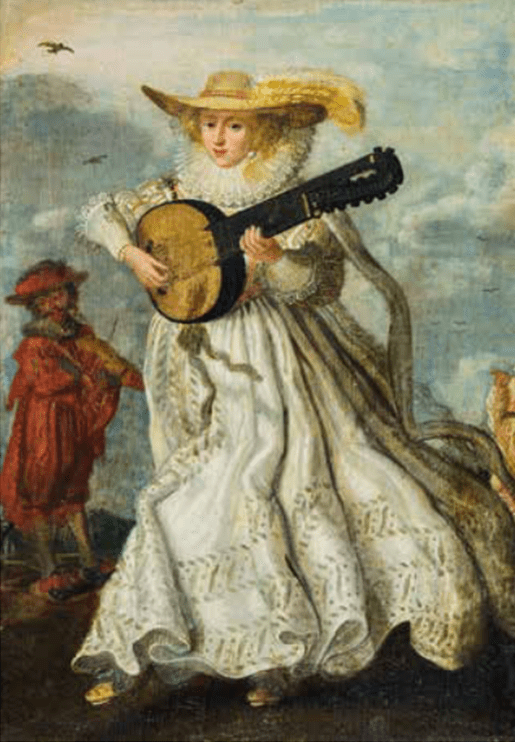
Left: Lady with the lute symbolizing the sense of sound
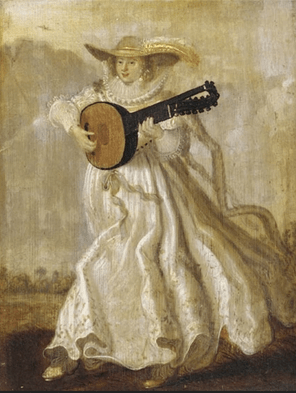
Right: Lady with A Dancing lady playing a lute in a landscape – MutualArt.
The sense of Sound is personified by a most distinguished dancer; an aristocratic lady whose keen gaze is aimed directly at the beholder. She is portrayed as a contemporary figure, unlike many of her predecessors, who were assigned the role of a classical goddess. This elegant lady, the epitome of flair and élan, accompanies herself on the lute, the instrument traditionally used to symbolize sound. Van de Venne has given her a fashionable, voluminous dress that sweeps effortlessly with her every gracious step. Furthermore, the artist, in his portrayal of both her buoyant leg movement and subtle upper body rotation, has captured a lightness that generates the sensation of swiftness. The sense of Sight is an altogether different story. The plodding dancer, also a contemporary figure, is a bespectacled elderly woman dancing alongside a ‘fierce’ cat. Judging from the background figures, a discourteous woman pointing her finger forward and a gawking man, the short-sighted woman is an object of ridicule. For the sense of Touch, van de Venne has chosen a farm girl. Just as Sight, she hops from one foot to the other, loosely swinging her leg forward. Perhaps you have already noticed; she resembles the young lass dancing with the fisherman from The Album drawings. In this rendition, however, the unfortunate girl’s calf is being ‘touched’ aggressively by a dog. Smell and Taste, the remaining two senses, are also personified as dancing women. ‘Smell‘, holds a rose in full bloom and ‘Taste’ dances with a wine glass held upside down.
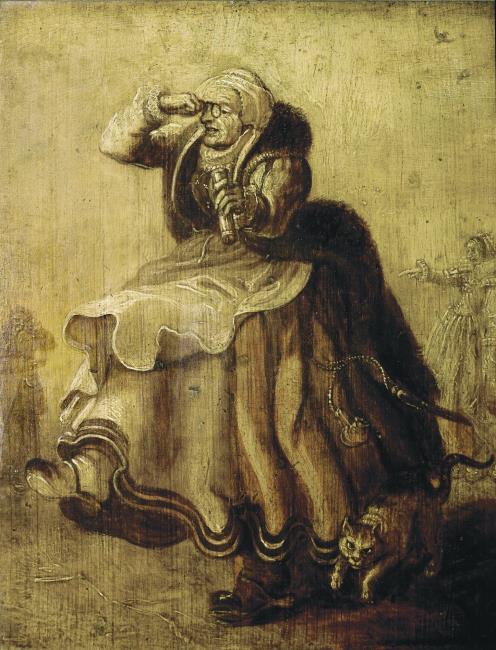
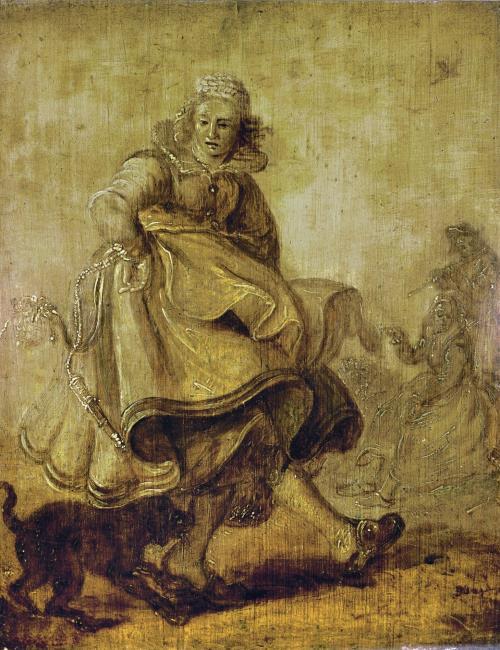
Old woman dancing with spectacles – 28.7 x 23.8 – c.1625-35 – Suermondt-Ludwig-Museum, Aachen – RKD
A young farm woman being bitten by a dog – 28.8 x 24cm – c.1625-35 – Suermondt-Ludwig-Museum, Aachen – RKD
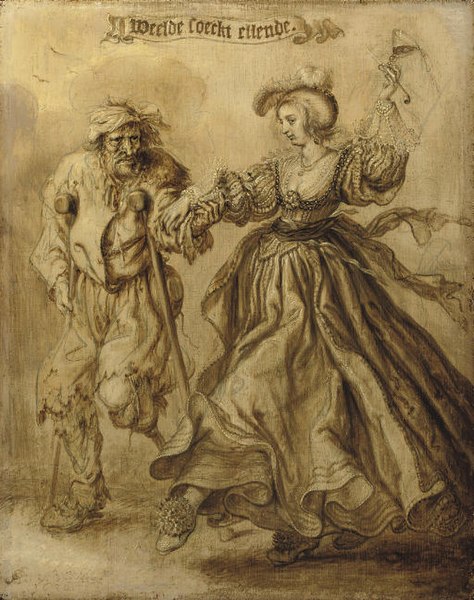
Adriaen van de Venne considered poetry and painting to be interlaced. In many of his works, he fused text and illustration to form an artistic union. In the early 1630s he composed various sets of five sequential paintings, which, if seen as a whole, depicted the rise and fall of man. Each painting is inscribed with a relevant saying. The banderole, on which the inscription is written, either lies on the ground or floats in the air. The inscriptions, in correct pictorial order, are:-
- Armoe’ soeckt list (Poverty leads to Cunning)
- List soeckt rijckdom (Cunning leads to Wealth)
- Rijckdom soeckt weelde (Wealth leads to Luxury)
- Weelde soeckt ellende (Luxury leads to Misery)
- Ellend’ soeckt de doot (Misery leads to Death)(1)
As the series progresses, we follow a man and a woman strolling, dancing, and finally trudging, on a path in an undefined landscape. Two of the five sayings, Wealth leads to Luxury and Luxury leads to Misery, are consistently presented in a dance setting. The last painting in the series, Misery leads to Death, shows no actual dance movements, but is a direct descendant of the medieval Dance of Death, where Death leads the inevitable way.
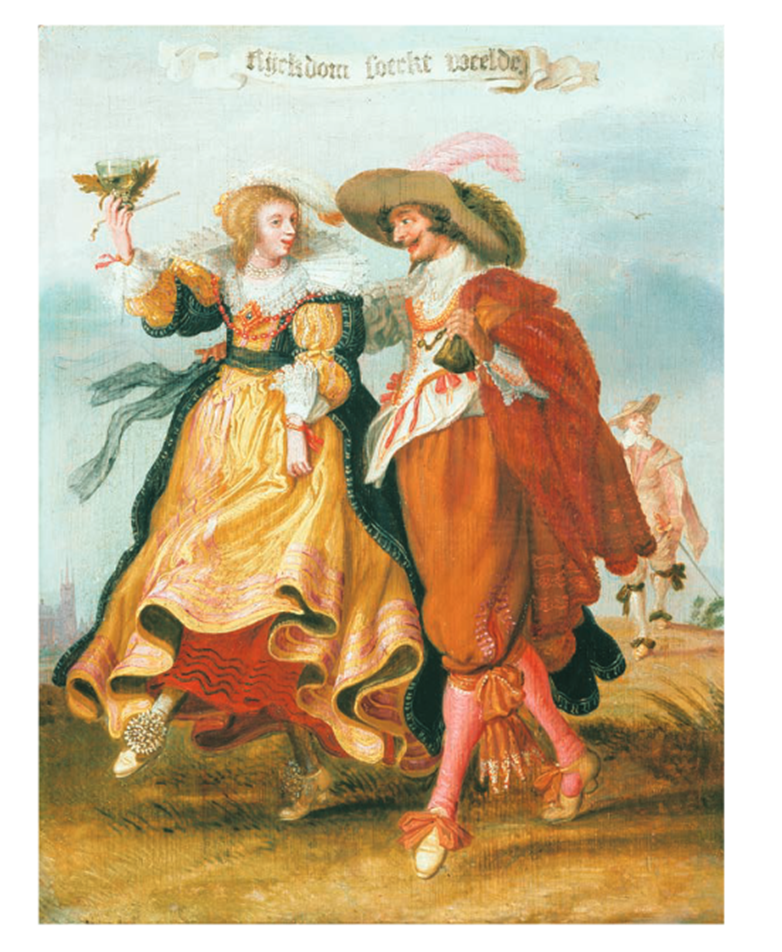
Rijckdom zoeckt weelde – Wealth leads to Luxury – polychrome, 30.5 x 23.5 cm – RKD, The Hague
Weelde soeckt ellende – Luxury leads to Misery – grisaille, 32.5 x 25.6 cm – c. 1630 – private collection, Zwitzerland
The gracious dancing lady and her escort featured in Wealth leads to Luxury, the third painting of the series, represent the paradigm of affluence. Her opulent dress, the rows of pearls, her excessive jewellery, and the lavish rosettes that embellish her shoes all substantiate her extravagance. The fair lady’s dancing partner, a gentleman of seemingly excellent standing, blatantly displays his well-filled money pouch. His expression is riveting, like a cat about to pounce on his game. I love the way she fails to reciprocate his inviting glance but turns complacently to the onlooker. In the fourth painting of the series, Luxury leads to Misery, the same dancing lady has acquired a new partner. You can easily mistake him for one of the beggars in van de Venne’s many grisailles(2). The lady, still clad in gracious robes, with the same exorbitant feather in her chapeau, now dances with a disabled man. Unwittingly, she continues her sumptuous life-style, squandering the wine and dropping the tobacco on the ground. Unbeknownst to the heedless lady, her dismal dancing partner, Misery, will escort her to Death.
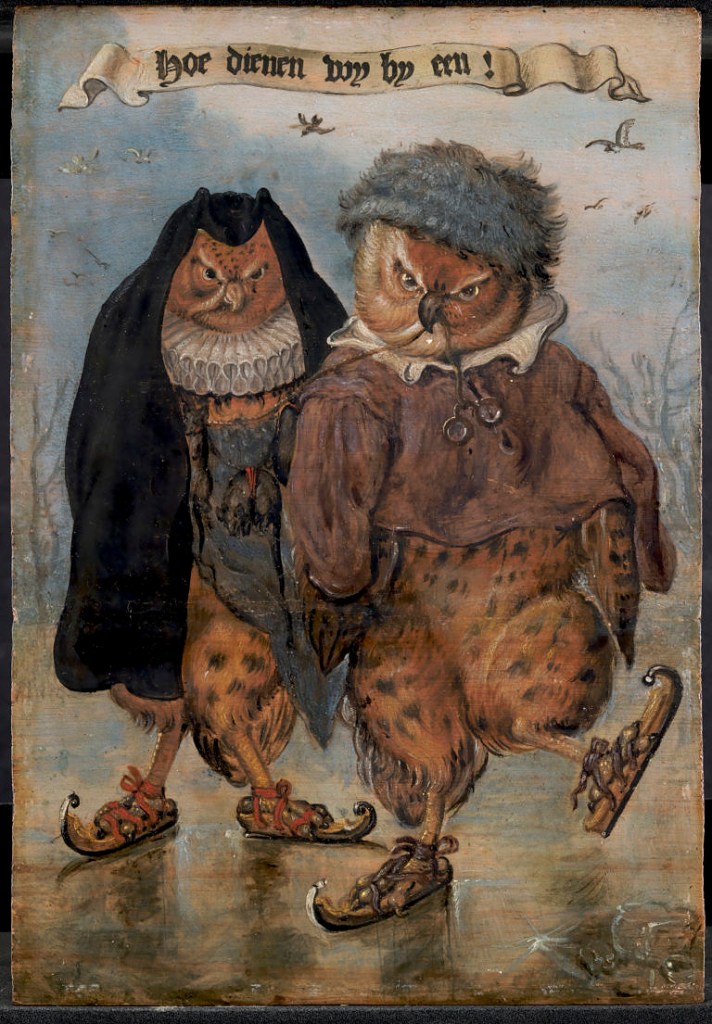
To finish on a more cheerful note. I wrote about a swanky aristocratic dog and cat in a previous post titled, Dancing dogs and cats. This anthropomorphic work was one of a series of paintings where animals dressed up as people. In the same series, van de Venne painted two frogs (3), two pigs dressed as farmers, two elite dancing monkeys accompanied by a musician and a pair of skating owls. I appreciate that skating is not actually dancing but these two vexed owls are so incredible that they deserve a place in this post.
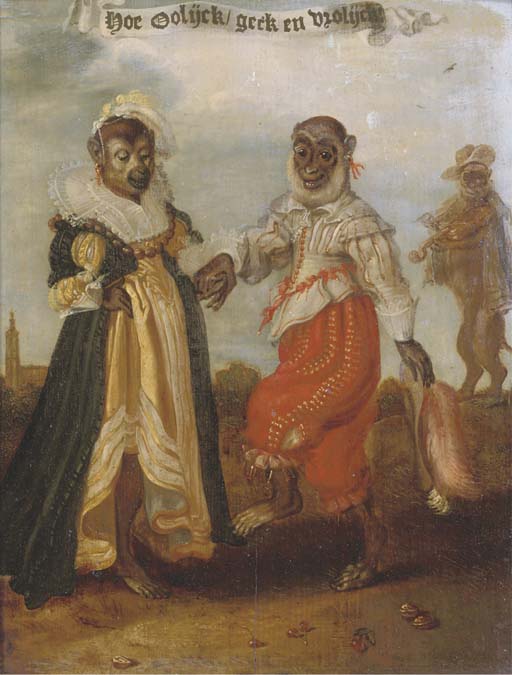
Two monkeys dancing in a landscape – How roguish, crazy and merry! – RKD
Skating Owls – How Well We Go Together – SMK National Gallery of Denmark, Copenhagen
Van de Venne painted many dancers and dance scenes in the course of his career. In his earlier years, influenced by Bruegel the Elder and his contemporaries, the artist composed large village scenes where dance and dancers were but one of the many narratives. Over time, the dance gained a more prominent role. The dancer, often together with a pertinent inscription, became the main subject. Van de Venne, whether he painted fashionable ladies, jolly peasants, wretched beggars or grumpy owls, invariably understood the intrinsic nature of movement and thereby captured the essence of dance.
(1) My gratitude to Edwin Buijsen (Mauritshuis/RKD) and Sotheby’s for the English translation of the inscriptions used by Adriaen Pietersz. van de Venne in The Five Senses series.
(2) Edwin Buijsen wrote a scholarly study on Adriaen Pietersz. van de Venne. Even for non-Dutch readers the study, with many illustrations covering van de Venne’s entire oeuvre, offers a wealth of information. Of special interest are images of The Five Senses starting from page 529.
(3) The painting of the two frogs has been lost.


 DANCE IMAGES IN THE ART OF THE NETHERLANDS

