Adriaen Pietersz. van de Venne (1589-1662), artist and versifier, is best remembered for his sharp political satire ‘Fishing for Souls’. This multi-talented artist was, furthermore, a renowned miniaturist, book illustrator, poet, and writer. Among van Venne’s satirical works, merry companies, historical and religious subjects, he painted an array of grisailles depicting dancing peasants and beggars.
The grisaille, a monochromatic painting executed entirely in shades of grey, appears in the work of early Flemish artists including Jan van Eyck, Robert Campin, and Hugo van der Goes. The greyish paintings, often the outer panels of a triptych, convey a sculptural illusion. One of the earliest artists to apply the grisaille to a free-standing painting was Pieter Bruegel the Elder. The grisaille, traditional to The Low Countries, found a keen advocate in Adriaen Pietersz. van de Venne, who from 1630 onward focused almost exclusively on the grisaille.
Thematically, van de Venne’s dance grisailles can roughly be divided into two sections — rustics and beggars — both of which have their origins in traditional Flemish peasant paintings and prints known to us through the works of Pieter Bruegel the Elder, Hans Bol, Pieter Baltens, Cornelis Massijs and their contemporaries. In turn, these artists are indebted to the 16th century peasant prints by the German artists, Albrecht Dürer, Erhard Schön, and Hans Sebald Beham.
In both his paintings and writings, van de Venne regarded, like many of his predecessors, the peasant with a certain degree of disdain. Peasants, farmers, and beggars lived outside ‘accepted’ society. They were deemed to be foolish, gross, aggressive, and lascivious. And peasants were considered to be notorious drinkers. These traits are displayed in many artworks presenting polite society, the purchasers of the artworks, with hilarious, satirical and, without doubt, entertaining conversation pieces.
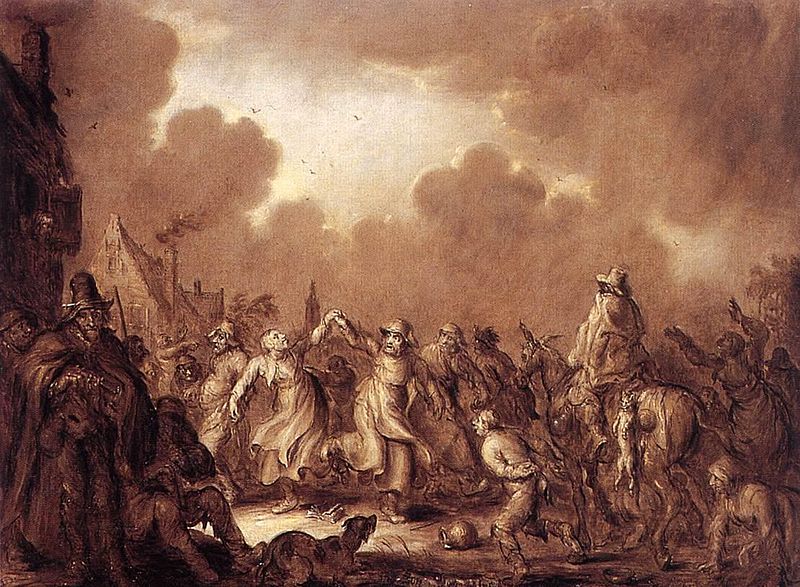
Van de Venne had the ability to actually ‘fabricate’ movement on a two dimensional plane. Take, for example, the impetuous couple in the following painting. They maybe rough, a little uncouth, but nevertheless they move instinctively. I especially enjoy van de Venne’s depiction of this peasant woman. She is spontaneous; the thrust of her lower leg prompts an impetuous twist of her shoulders in unison with agile arm movements together with a swift turn of her head. This, in conjunction with her lavishly swinging skirt and cheeky expression, make her genuinely irresistible.
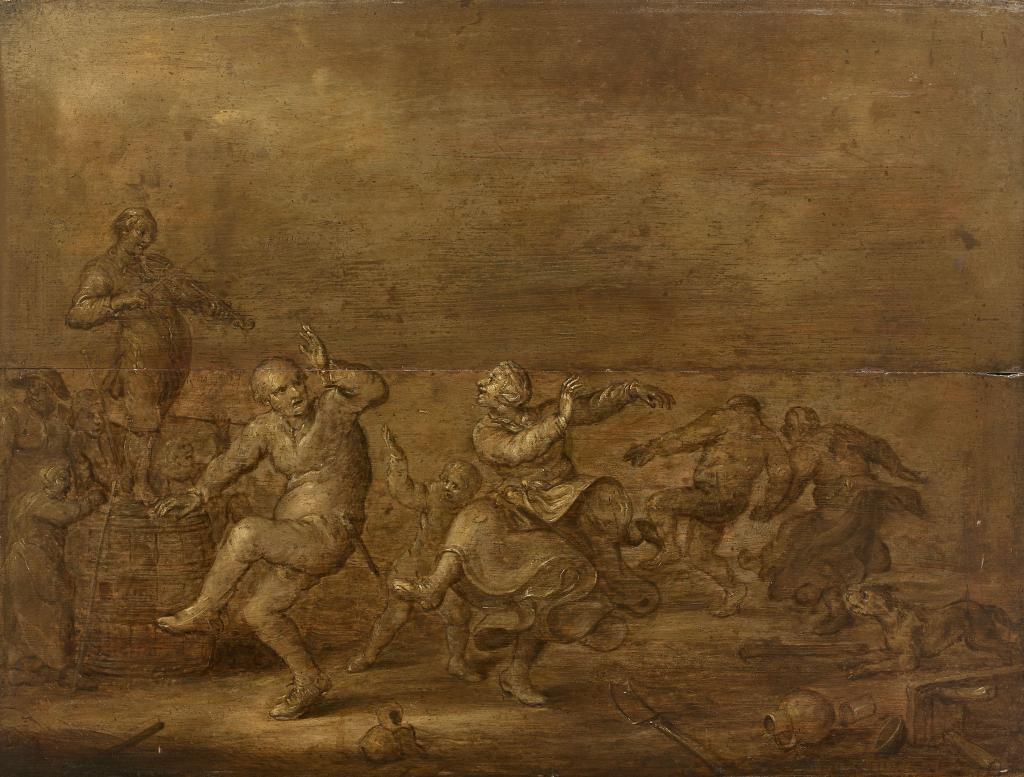
The following painting, displaying a group of peasants dancing in a circle, has the inscription Goed rond (Good round) enclosed within a banderole that is positioned just below the flautist’s foot. Van de Venne, the writer, invariably included banners or banderoles with traditional sayings or proverbs. In this case, Goed rond could allow multiple interpretations ranging from commentary on the peasant’s rustic life-style to the boorish circular dance they are undertaking.
Unlike his predecessors, who customarily painted village scenes from a high vantage point, van de Venne zooms right in to specifically highlight the dancers. In the foreground of Goed rond, he adds a musician with his dog, a wine barrel, an empty pitcher and in the far distance, just barely distinguishable, the contours of the village church and a maypole.
The centre of the painting is reserved for an ungainly couple whose heavy shoes and scraggly clothing add weight to their graceless movements. The unappealing couple turn their heads to look explicitly at the viewer. This entire circle, in fact, is laden with cumbersome dancers. As onlooker, you can practically feel the pull of gravity with each of their successive steps.
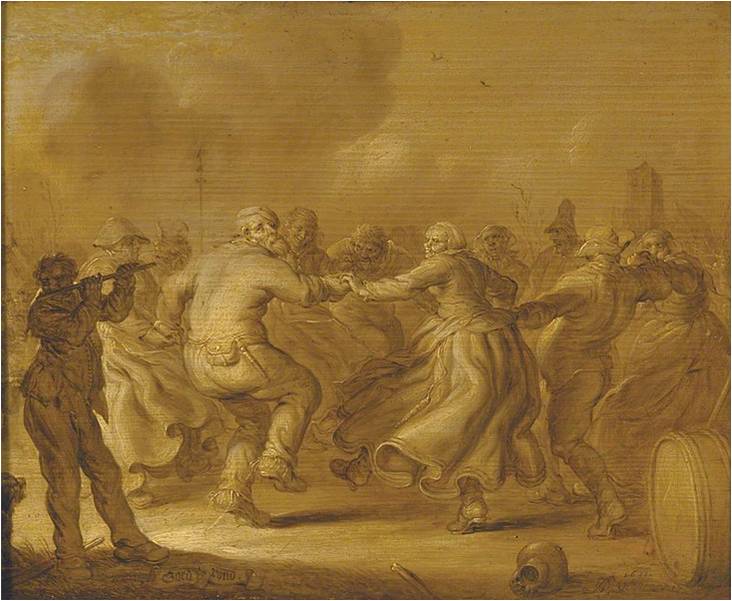
In essence, the grisaille shown below embodies the same components as the above two works; dancers, a musician, a dog, a wine barrel, and an indiscernible background with an indistinct church tower. On the banner, inserted in the lower right corner, the inscription Al te veel is ongesont which may be translated as Enough is Enough or Excess is unwholesome requires no explanation. The message evoked by the drunkard drooping over the barrel, the dog licking some hodgepodge from the ground and a man urinating in the foreground cannot escape anyone’s attention.

Similar to Goed rond, van de Venne places the emphasis on the centre couple. She, a robust and by no means attractive woman, acknowledges the viewer. But he, not a young man, also reacts with the audience presenting an unbridled view of his full-blown backside. Gaudy as this entire scene may be, the front couple move and dance enthusiastically. Her forward drive implies that she is moving swiftly, and he appears to be captured in mid-jump.
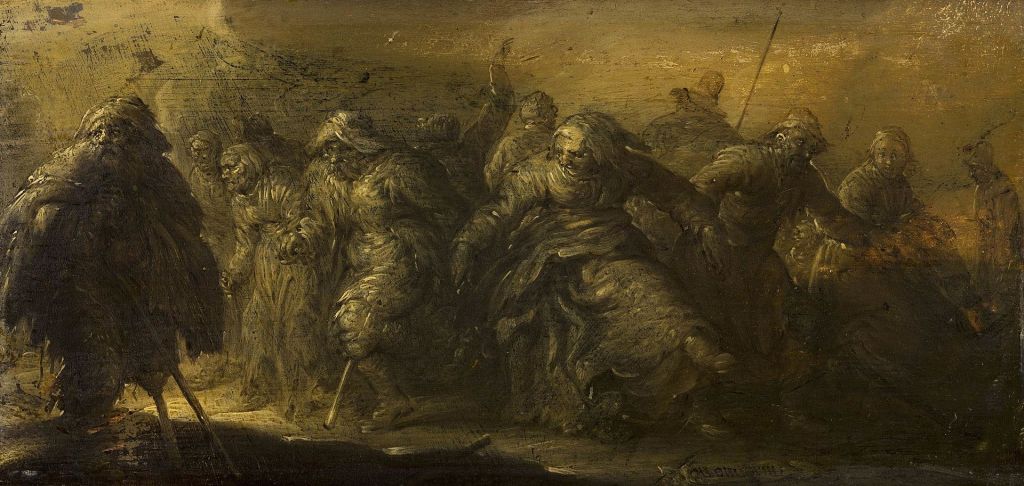
Apart from the unique combination of word and image, van de Venne’s rectangular grisailles are distinguishable by his idiomatic composition; frequently a silhouette figure inhabits the left side of the canvas. In the case of Enough is Enough, this is the urinating man, but invariably this spot is allocated to the musician. Van de Venne then lightens up the remainder of the painting, thus creating an illusion of depth. In Dancing Beggars, the silhouette of a slovenly rustic clad in tattered clothes, contrasts with the more illuminated group of disarray behind him. These figures, beggars, are hideously portrayed. Their faces are caricatures, their proportions distorted, and some are incapacitated, requiring the support of a wooden crutch. Yet, in a bizarre way, this unsavoury company enjoy themselves in a social dance. Quite possibly, although difficult to see, the forlorn beggar in the foreground is the musician. These battered paupers dance hand in hand in a haphazard circle. Once again, van de Venne underscores the leading couple; the old hag kicking her leg upwards and her disabled partner managing as best he can.
It was not unusual, nor considered improper, for 16th and 17th century artists to depict beggars, the disabled or the impoverished. An engraving by Hieronymous Bosch unfurls a variety of beggars and maimed figures. Pieter Bruegel the Elder and other Flemish artists inserted crude and wretched characters in their paintings. But it was the Flemish artist, Cornelis Massijs (1510 – 1556/7), triggered by Hans Sebald Beham and Erhard Schön, who composed a series of twelve minute engravings titled Dancing Cripples * (1538). Van de Venne continued their practice. Though distasteful by today’s standards, they were deemed comical at the time.
Van de Venne, as Massijs, draws the dancing couple to the immediate foreground; the background figures, all unkempt, are less pronounced. Pictured in Al kromme lappen, which literally could be translated as ‘all curved rags‘, is a hideous woman who droops so decisively forward that her chin practically touches her uplifted leg. She and her equally tattered disabled partner, despite their obvious hardship, dance with zest. With only her clutched hand for support, he hops and bounces to the tune of the scruffy, hunched old man playing a musical instrument in the background. And the title, accessibly written on a banderole, in the lower right-hand corner is ambiguous; as so often in van de Venne’s paintings. The curve could refer to the various hunched figures, the rags could allude to the clothing, but ‘kromme lappen‘ could also infer a group of loafers or derelicts.
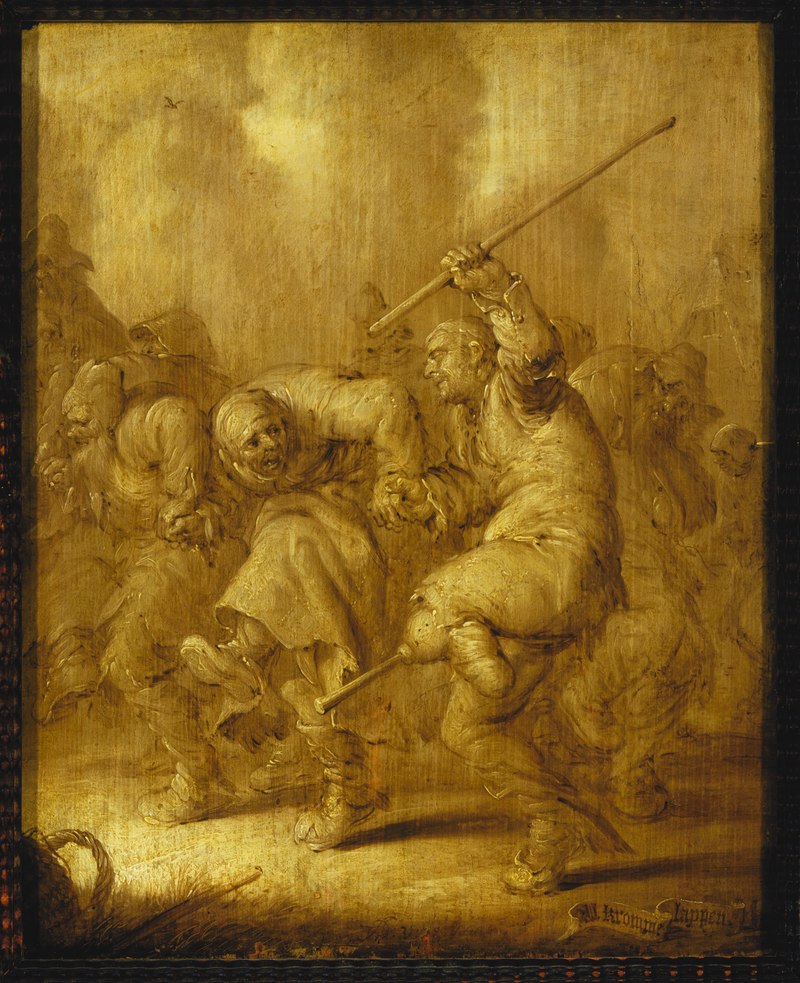
Al kromme lappen – 36.5 x 30 cm – Museum Mayer van den Bergh, Antwerp
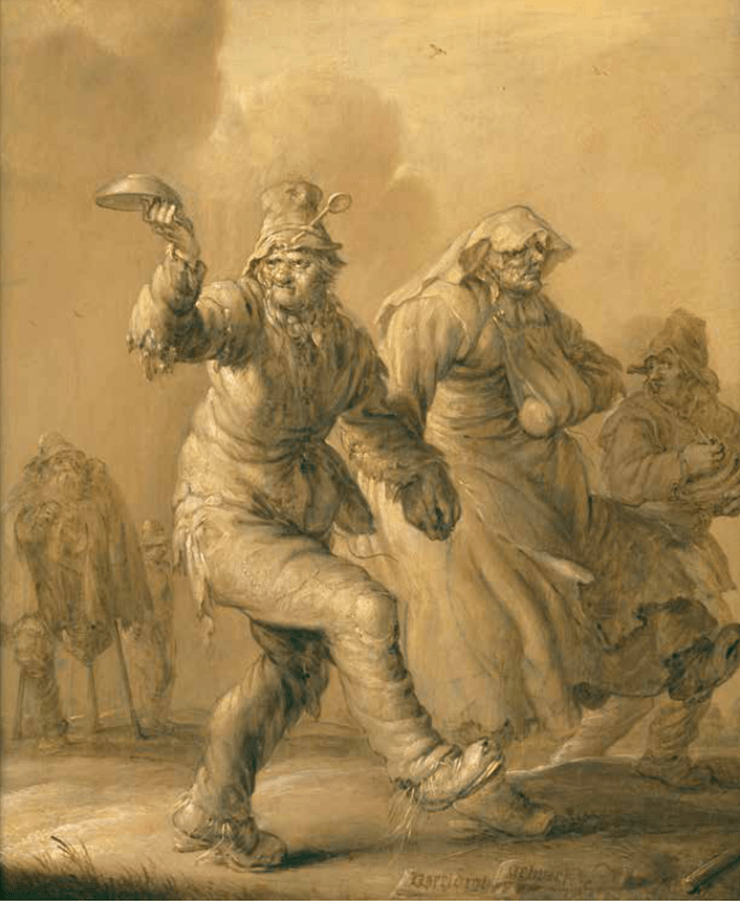
Weeldigh gebreck – grisaille, panel – 36 x 29.5cm – America – private collection
The title of the second grisaille, Weeldigh gebreck, is, as we have come to expect, inscribed on a banderole. The wearisome dancing pair are beggars; in the background a few disabled beggars accompany their ponderous dance on rudimentary music instruments. The striking beggarman shamelessly exhibits his empty begging bowl, and blatantly flaunts his spoon that he prominently displays on the brim of his cap. The beggarwoman, in spite of her ill-humoured countenance and painful arm, still manages to kick her leg in the air. What, I wonder, induces these beggars to dance under such miserable circumstances? Van de Venne’s inscription, freely translated as a wealth of lacking, unmistakably implies that these beggars have absolutely plenty of nothing. It would appear that dancing is their only livelihood.
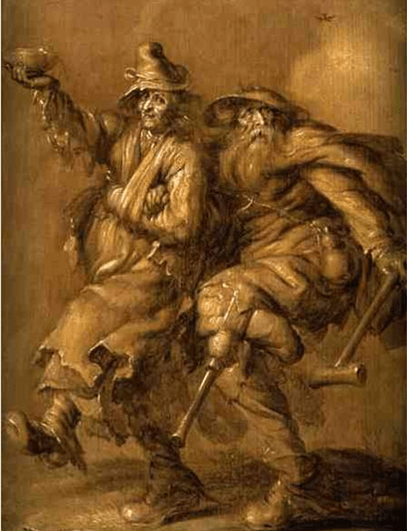
Arme Vreucht – A Crippled beggar dancing with a peasant woman – oil on panel – 31.8 xx 24.1 cm – Artnet.
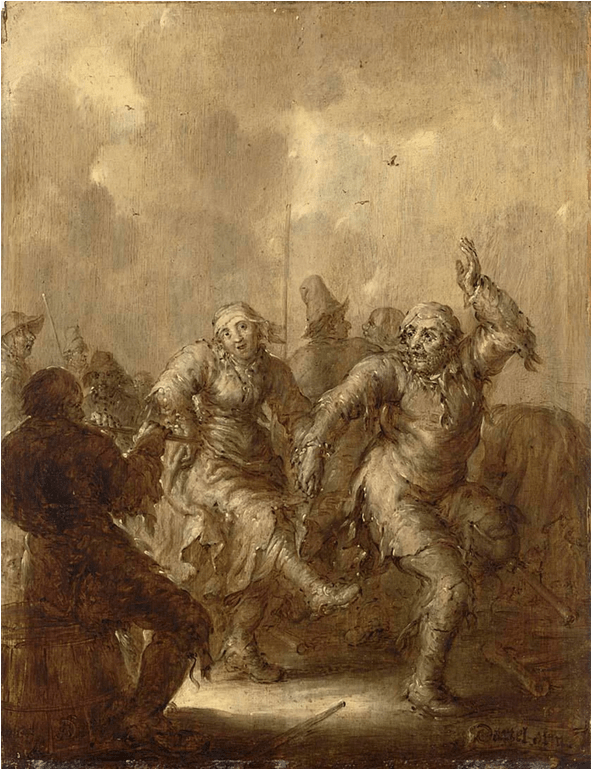
Dartel arm, A dancing couple with a flute player and other figures making merry – oil on panel – 50.8 x 39 cm – MutualArt
The last two grisailles are certainly more uplifting. Despite many disheartening obstacles, the beggars are full of life. The men may look aside, but the women both interact with the viewer. I especially enjoy the spirited woman in Arme Vreucht, who triumphantly lifts her bowl upwards for all who wish to see. Whether the woman is overjoyed that the bowl is filled or if the couple have danced in order to fill the bowl, van de Venne does not disclose; instead, he exhibits his uncanny trademark of merging text, movement, and dance.
*This link will divert you to a wonderfully informative site ‘Bosch to Bruegel: Uncovering Everyday Life’. Scroll down the page, past Joachim Patinir, past Hieronymus Bosch, Jan Provoost, and Albrecht Dürer to find an excellent image of the twelve engravings by Cornelis Massijs


 DANCE IMAGES IN THE ART OF THE NETHERLANDS


