There is nothing unusual about dogs and cats appearing in paintings. We frequently see them sleeping, eating, jumping and playing around. But how often have you seen a dancing dog or dancing cat? Now, I understand, I am pushing the term dancing to the very limits. When speaking of dance, dogs and cats are not exactly the first thing that enters your mind. That is, unless your thoughts go to Keith Haring’s dancing dogs. But Haring is an American and thus beyond the scope of the post. Images of dogs and cats were commonplace in 17th century Dutch art. More often than not, they were supplementary figures, complimenting the scene. Occasionally, cats and dogs ventured into the spotlight accompanying their masters in a frolicsome dance.
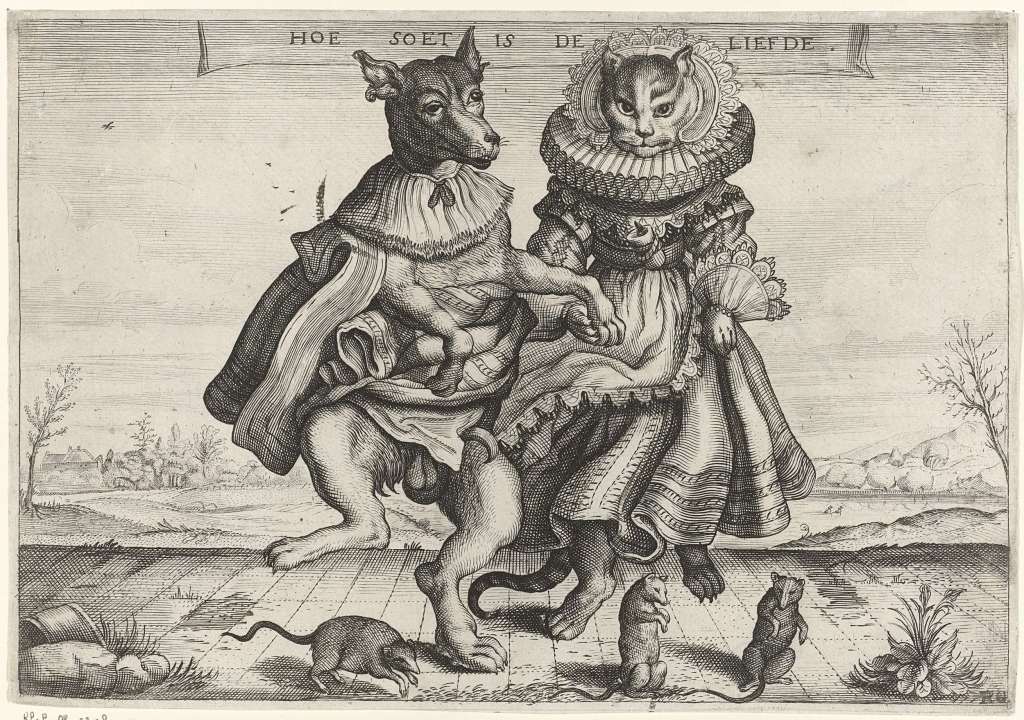
Before looking at representations of ‘real’ dogs and cats, permit me to take a brief anthropomorphic detour. Adriaen Pietersz van de Velde’s amusing engraving, of a dancing cat and dog, is more than meets the eye. This is not your everyday cat and dog dancing; the feline’s beautifully frilled collar, and meticulously decorated lace sleeve cuffs, definitely establishes that she is a cat of standing. He, a pleasant, friendly dog, is somewhat less affluent. And what to think about the three long-tailed rats roaming in the foreground? The inscription on the banderole,’How sweet love is‘ presents food for thought. Dutch sayings and proverbs come into play; promiscuous women are known to be portrayed as cats. And, it will not amaze you, men were rendered as mice or rats. Or, it has been suggested, the illustration reveals the breakdown of social order. Information from the Royal Trust Collection elaborates that ‘rats and mice will dance when they see cats and dogs doing so, just as servants will in the absence of their masters.”
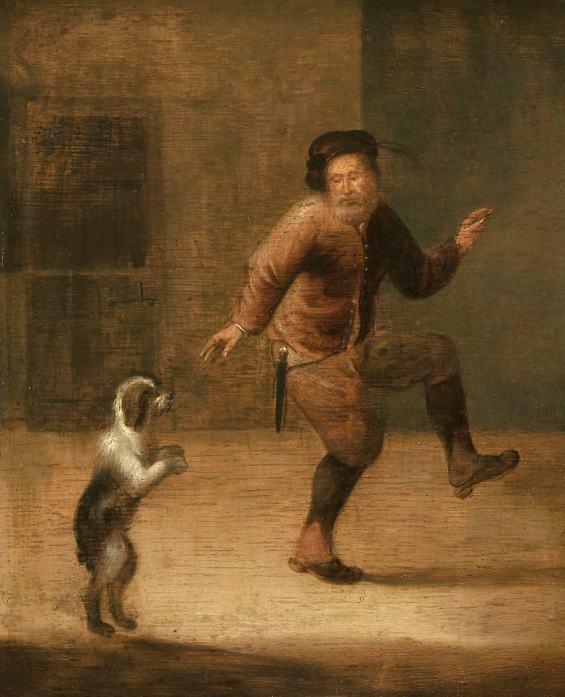
Leaving the anthropomorphic portrayal of animals where dogs and cats imitate any human action, we now move to the genuine animal, man’s best friend. Originally, this heart-warming painting of an older man dancing with his dog, was attributed to François Verwitt, a painter born in Rotterdam. Further examination by experts at the Rijksmuseum, Amsterdam led to a new attribution; the Amsterdam-born artist, Hendrick Bogaert (c. 1626 – c. 1673). Bogaert specialized in genre scenes. Bogaert’s small panel sublimely renders the friendship between a man and his dog. Where the action takes place is not clear, either outside or in a tavern. One could imagine that some fellow rustic is playing a joyful tune, inducing the man to perform a few awkward steps. His movements are wooden, somewhat rigid, which is not in the least surprising considering that those clogs could fall off his feet at any moment. Inspired by his master’s antics, the dog imitates the man’s light-hearted actions. Not unlike the man, who has raised one leg into the air, the dog stands upright on his hind legs, drawing his front paws close to his body. Most touching is the man’s affectionate glance and the reciprocal action of his delightful dog.
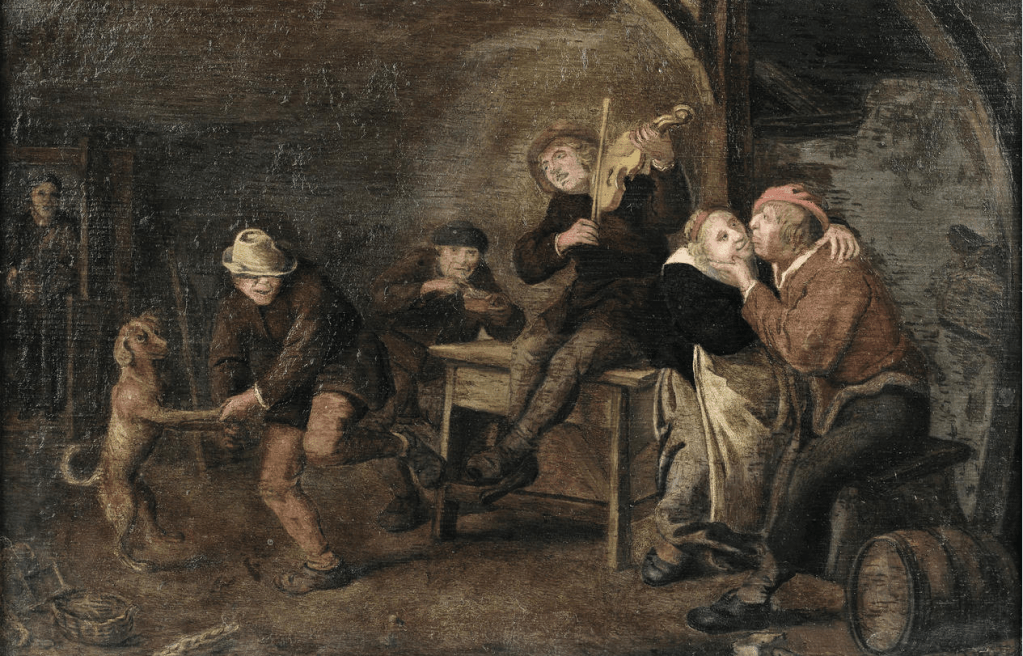
The Dutch painter Jan Miense Molenaer (1610-1668) was by no means vague. The tavern scene, shown below, includes a wooing couple, an old man enjoying his meal, a fiddler sitting on a wooden table, an innkeeper at the door and a tipsy man dancing enthusiastically with a lusty dog. The peasant dancer, with his hat practically concealing his eyes, looks enviously in the direction of the amorous couple. Without an available partner, the merry man has grasped the dog’s paws to dance a lively duet. Essentially, the man does all the dancing. His rounded back, his forward lean, bent knee and elevated leg clearly all indicate the vivaciousness of the dance. The dog, on the other hand, appears completely overwhelmed.
A contemporary of Johannes Vermeer, Gerard Ter Borch and Pieter De Hooch, Jacob Ochtervelt (1634-1682) a painter of genre pieces, specialized in indoor settings. Whether he painted a musical evening, a domestic scene, a housemaid, or a lady of the night, a dog was often present. Some dogs were frisky and playful, others stood steadfast and yet others lay sleeping, but in at least three of his paintings the dog danced. Ochtervelt habitually presents a characteristic Dutch genre scene set in a comfortable burgher room, with simple but stylish furniture. Most include a geometrically designed white and black tiled floor; typical for 17th century Dutch interior decoration. Common to all the ‘dancing dog’ paintings is a handsomely attired lady in the company of a musician. The small dog, either beckoning or responding to the music, ‘dances’ on his hind legs. All have a second figure, be it a gentleman, a lady musician, or a mature woman, inconspicuously placed in the background. Amiable as these domestic scenes appear to be, they are open to more than one interpretation. The first two images suggest an unsettling atmosphere, but the last image directly confronts the viewer with a dubious situation. The woman’s décolleté leaves no space for ambiguity, nor does the platter of oysters (a recognized aphrodisiac) resting just under her elbow. The elderly woman, vaguely visible behind the doorway, is, no doubt, a procuress. If you are still in doubt as to the artist’s intention, you may wish to enlarge the painted banner at the top of the canvas. The images, though hazy, represent Adam and Eve near the tree of knowledge, followed by their expulsion from Paradise.

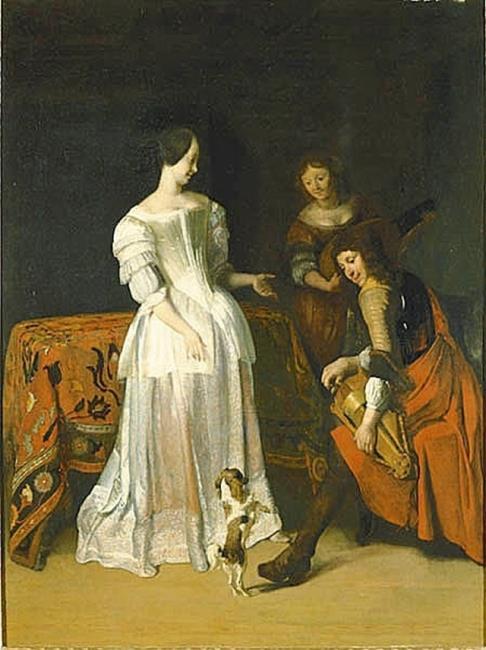
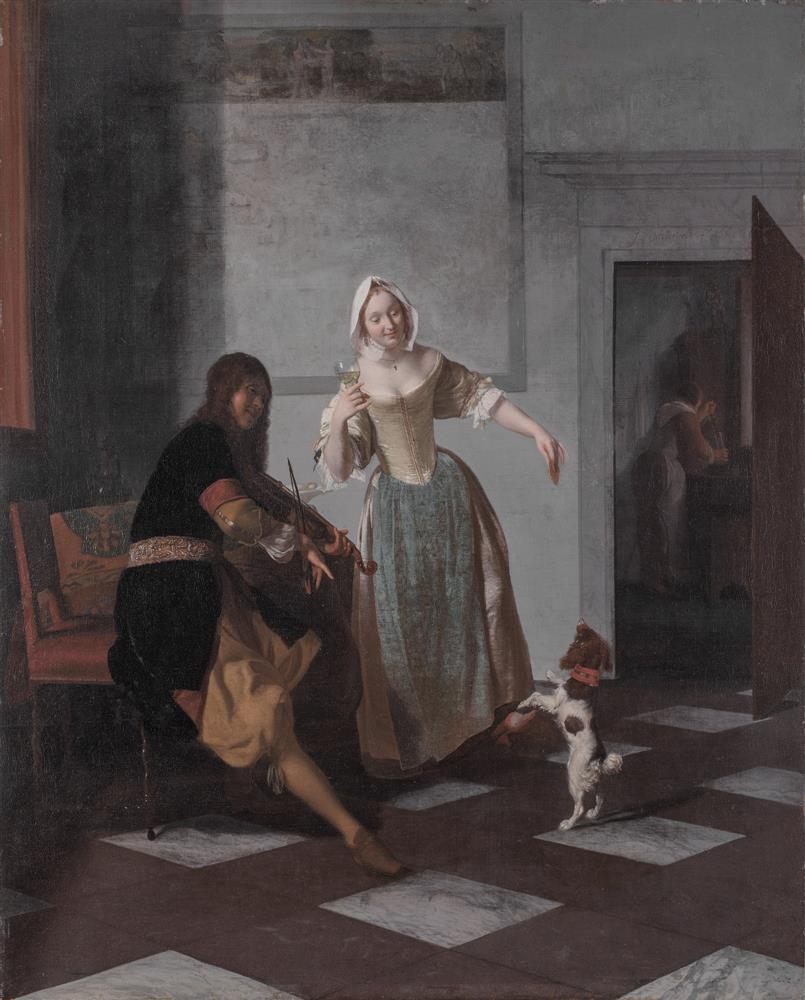
Left: Interior with Figures and Small Dog (also known as The Dancing Dog )- oil on canvas – c. 1669 – Museum of the Shenandoah Valley
Centre: Company with Dancing Dog – oil on canvas – 92 x 75cm – c.1674 -78 -Nationalmuseum Stockholm
Right: Violin player and young woman playing with a dog – oil on canvas – 72.5 x 58.5 cm – c. 1669 – Wadsworth Atheneum Museum of Art
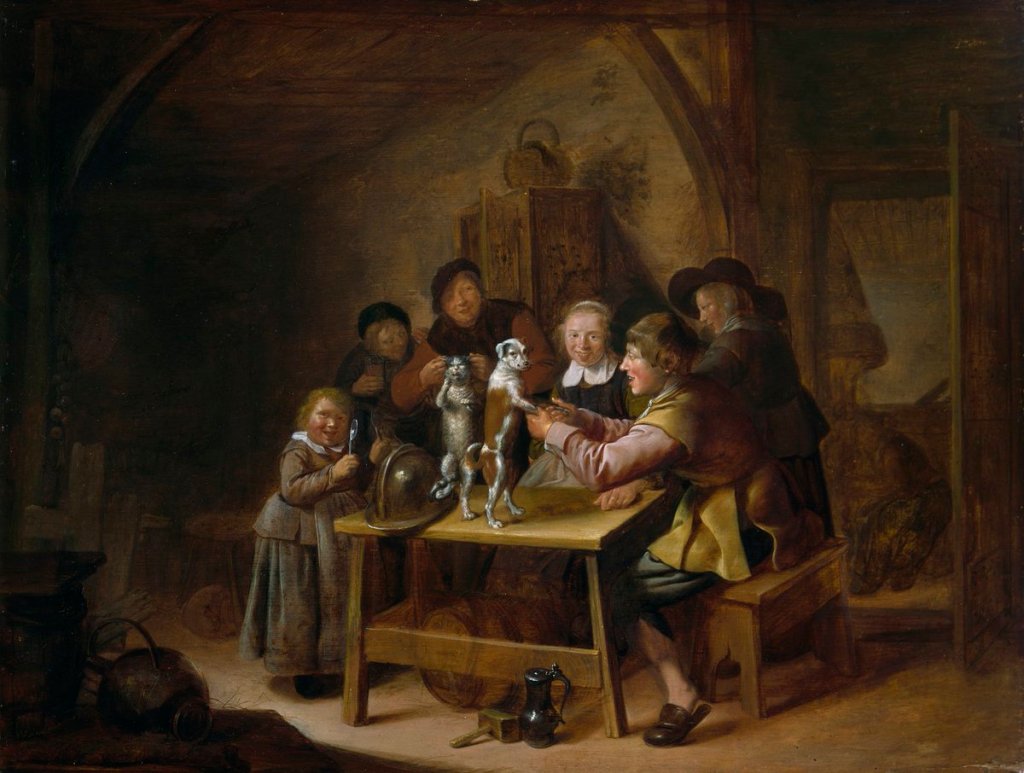
How do you teach a cat to dance? Jan Miense Molenaer apparently had some idea; simply pull on the cat’s ears until it stands on its hind legs. Two of his works created in the 1630s show youngsters cruelly abusing a cat. In each case, the unfortunate cat is lifted mercilessly upwards and forced to dance, to the hilarity of the surrounding children. Regardless of the wretched animal’s squealing and visible display of anguish, the youngsters continue their merriment. A dog, also present in both paintings, looks much more at ease, dancing contently with one of the lads. The dog enjoys the children’s attention and is quite happy to comply. The cat, in contrast, has no intention of performing any involuntary action. These paintings, regardless of our revulsion, embody an implicit theme. The tormented cat and the easy-going dog personify two facets of character. In the 17th century, inspired by Aristotelian ideas, society placed significant emphasis on a child’s upbringing. Some children, similar to the cat, are not compliant; they are inclined to display a troublesome, unyielding personality. The dog, on the contrary, who can be taught to dance, personifies a congenial, inquisitive nature.
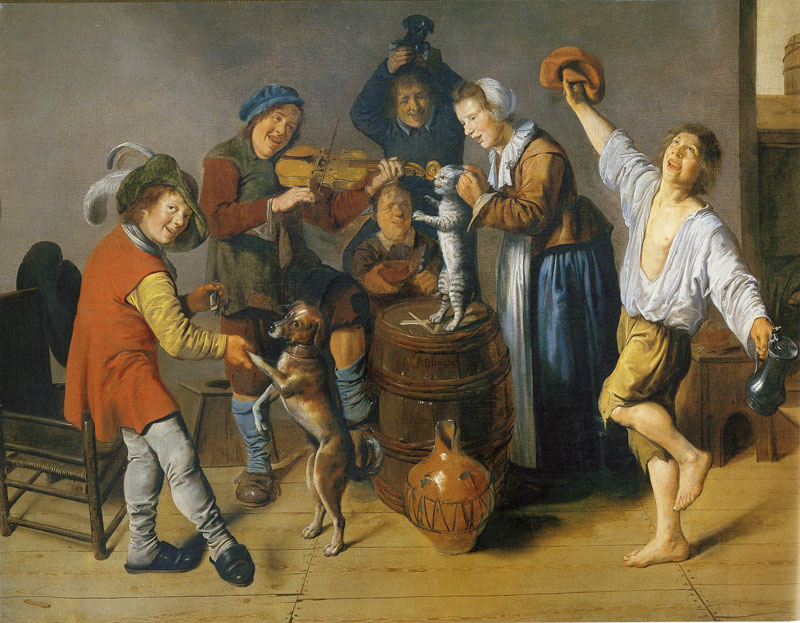
Left: Merry company playing music and dancing in an interior – 1630’s – oil on canvas – 88.5cm x 115cm – Private Collection Gebruder Douwes
Right: Peasants Teaching a Cat and Dog to Dance – late 1630’s – oil on canvas – 54.6 x 71.2cm – National Gallery of Ireland
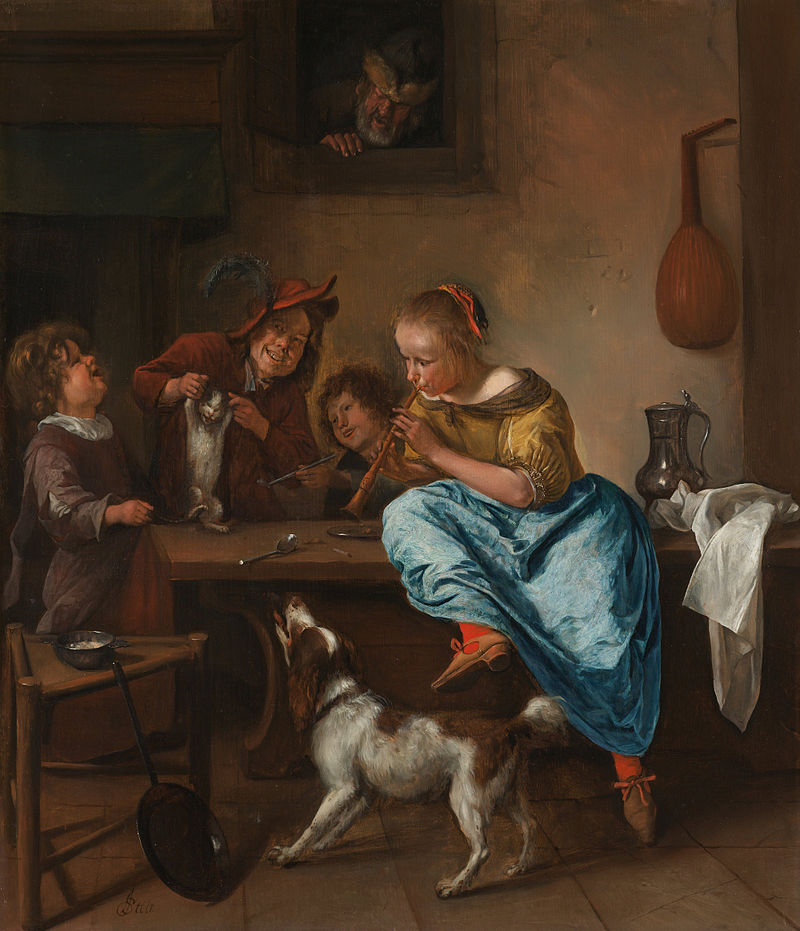
Some thirty years later, Jan Steen (c.1626 – 1679) a prolific artist of the Dutch Golden Age, master of genre paintings, presented a work on roughly the same theme. In his painting, Children Teaching a Cat to Dance, a youngster hoists a small cat onto his hind paws, stretching his front paws up as high as possible. The unfortunate cat is squealing desperately. Indifferent to the cat’s anguish, a young lass plays a jolly tune on her flute. And to make matters worse, if that could be possible, another youngster is further aggravating the cat, by forcing the animal to inhale the fumes of his smokey pipe. All the mischievous youngsters are thoroughly enjoying themselves. Even the barking dog is rapturous. Jan Steen seems to ask if these youngsters can still be reformed. Temptation, he forewarns, is on the lure. The tankard full of alcohol on the table promises little good. Molenaer in Merry Company explicitly illustrates the effect that alcohol exerts on the young man dancing boisterously with a tankard in hand. The result is no less than impropriety. The lute hanging on the wall represents an uncanny prediction. From a positive point of view, it can foreshadow a respectable (musical) education, but just as likely, Jan Steen presents it as an erotic symbol forecasting a hedonistic lifestyle. The children’s lack of regard does not go unnoticed. The old man, looking through the window, hopefully reprimands the youngsters.
And then there is a most unusual dancing couple, a dog dancing with an elegantly dressed dwarf. Jan Miense Molenaer’s painting, The Artist in his Studio, presents a unique self-portrait of the artist in his atelier. The various figures present, Molenaer’s assistant and a group of comical merrymakers, relax while the artist, standing at his table, restocks his palette. The hurdy-gurdy player, sitting at the back, enlivens the moment, encouraging the dwarf to dance with his four-legged partner. It soon becomes apparent that the figures are, in fact, models. The painting standing on the easel depicts the same theatrically dressed figures, with the exception of Molenaers’s assistant, arranged in a staged composition. The new figure on the easel painting is a fellow, performing a silly little dance on his crudely bent knees. He resembles a country bumpkin. And the dog and the dwarf have exchanged places.
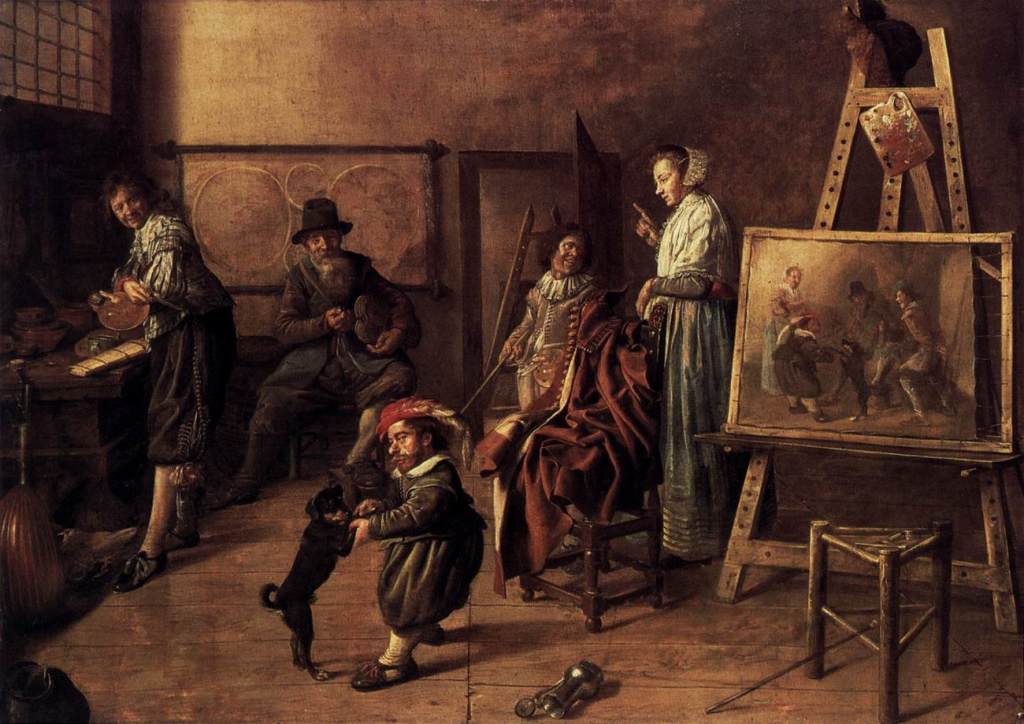
The painting within the painting shows the performing dog gazing intently at the dwarf, yet in the studio, the dog is preoccupied. Our four-legged friend is the only figure in the painting to gaze directly at the onlooker. Is this hard-working dog, an entertainer, beseeching the viewers’ attention? Or should we question who the owner is of the meticulously tailored coat that lays, spread out, on the chair? The lavish deep red coat is definitely not a prop. It does not appear on the easel painting. The door, directly behind Molenaer’s assistant, is open. In all probability, a visitor of some wealth has entered the studio. Did this opulent visiting gentleman commission the painting? Is he the owner of the dog or, for that matter, the master of the dwarf? Jan Miense Molenaer offers no answers, but the dog’s compelling focus certainly arouses the viewer’s curiosity.


 DANCE IMAGES IN THE ART OF THE NETHERLANDS