Just imagine standing on a hilltop looking down onto a village square where peasants and townsfolk are celebrating a holiday. Everywhere you look bustles with activity. There is a religious procession, a row of market stalls, horse-drawn carriages, peasants fighting, men on horseback, children playing, animals scampering and rustics partying, drinking, and dancing. And surrounding all this thriving commotion are handsome Flemish houses, a flourishing tavern and a church with an impressive tower. In the distance more churches can be seen, and thoroughfares offer vistas to the outskirts of the village and neighbouring towns. This sweeping view, seen from a bird’s eye perspective, showing countless small and even smaller figures enjoying the festivities, is a fair description of a 16th century Flemish Village Festival painting. To explore a work by artists as Pieter Bruegel the Elder, Hans Bol, Martin van Cleve, Peeter Baltens, Gillis Mostaert, and Jacob Grimmer, is an adventure. The onlooker is constantly amazed to discover fools dashing, children riding hobbyhorses, figures urinating, drunks sprawled on the ground, musicians playing and dancing peasants.
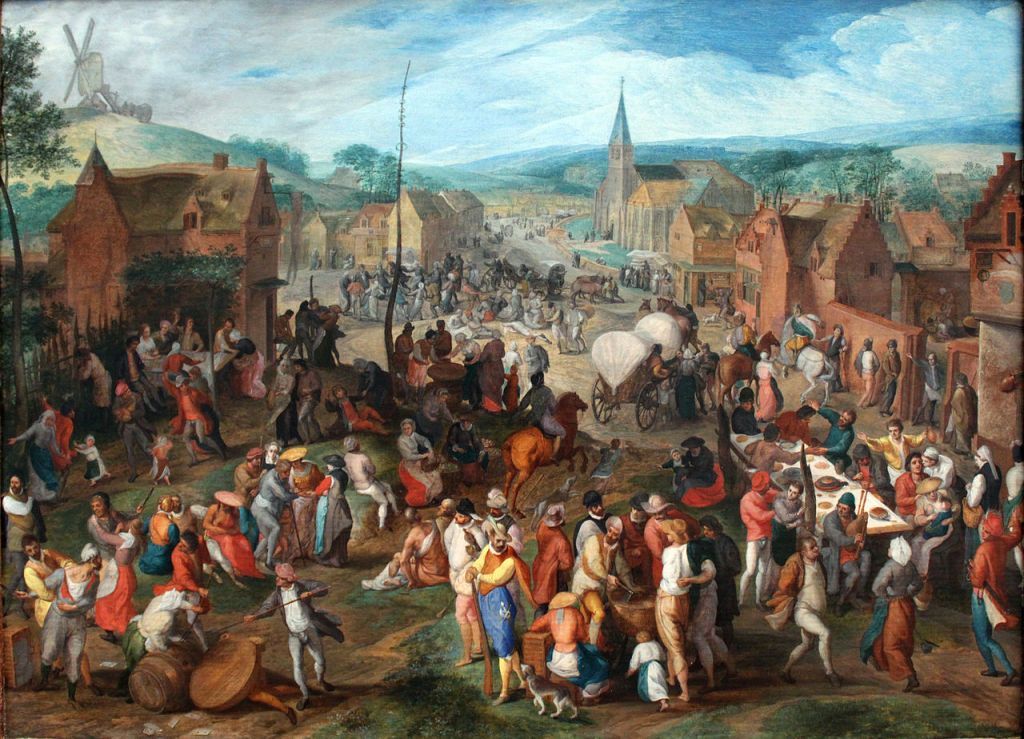
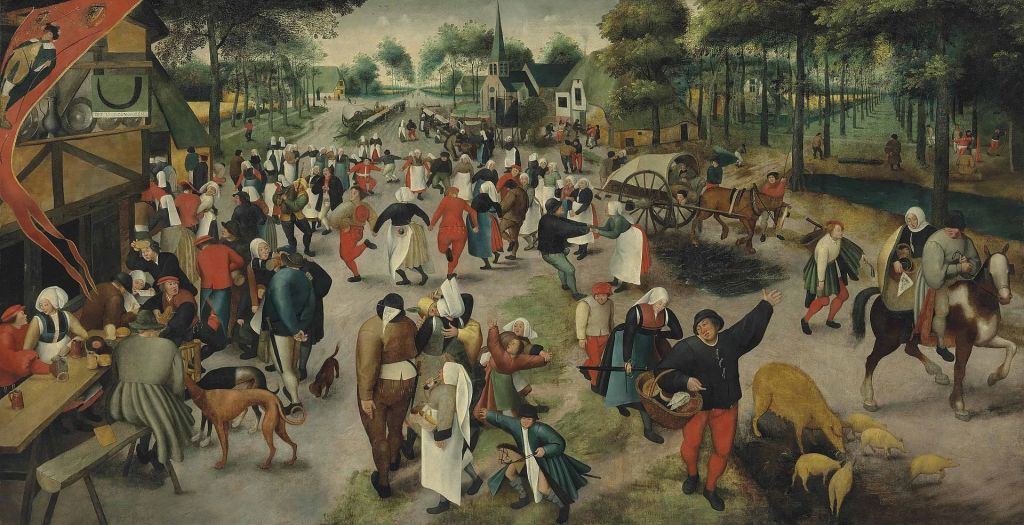
The festivities presented in Flemish Kermis, a painting by Hans Bol (1534 – 1593), celebrate a religious holiday. The red pennant, hanging from the tavern, denotes a festivity for a particular saint; in the distance a religious procession is in progress. There are so many figures and activities staged that you may need to expand the image to fully appreciate the three dance scenes. Along a path near the pond, where gentlemen are watering their horses, some peasant couples are dancing. Their movements and manner are comparable to Bruegel’s dancers. The most obvious dance is the May Day dance, with peasants dancing around the tall tree. In front of that same tree, a number of small children perform their own version of the dance. The musician, the well-known bagpipe player — a figure similar to Dürer’s famous print — leans against the tree. Innocent though this dance may seem, this circular dance has its roots in paganism, not to mention the association with fertility rites; not exactly what you would expect of a saint’s celebration day. To the left of the tree, a group of merrymakers is jumping and prancing exuberantly. This appears to be a type of follow the leader, where merry peasants dance behind yet another bagpipe player. Even though Bol has painted only three people dancing, I have the impression that other tipsy tavern clientele will join in with this frolicsome escapade. Not particularly obvious, but just behind this gleeful group are well-dressed placid towns folk haughtily observing the blatant overindulgence; no doubt a comment reflecting the moral attitude of 16th century society. It remains fascinating that Hans Bol paints all the less holy activities, and that most certainly includes dancing, in the first layer of the painting whereas the religious aspects are pushed to the background. Equally noteworthy is that the townspeople, versed in decorum and social graces, stroll and meander, but never dance.
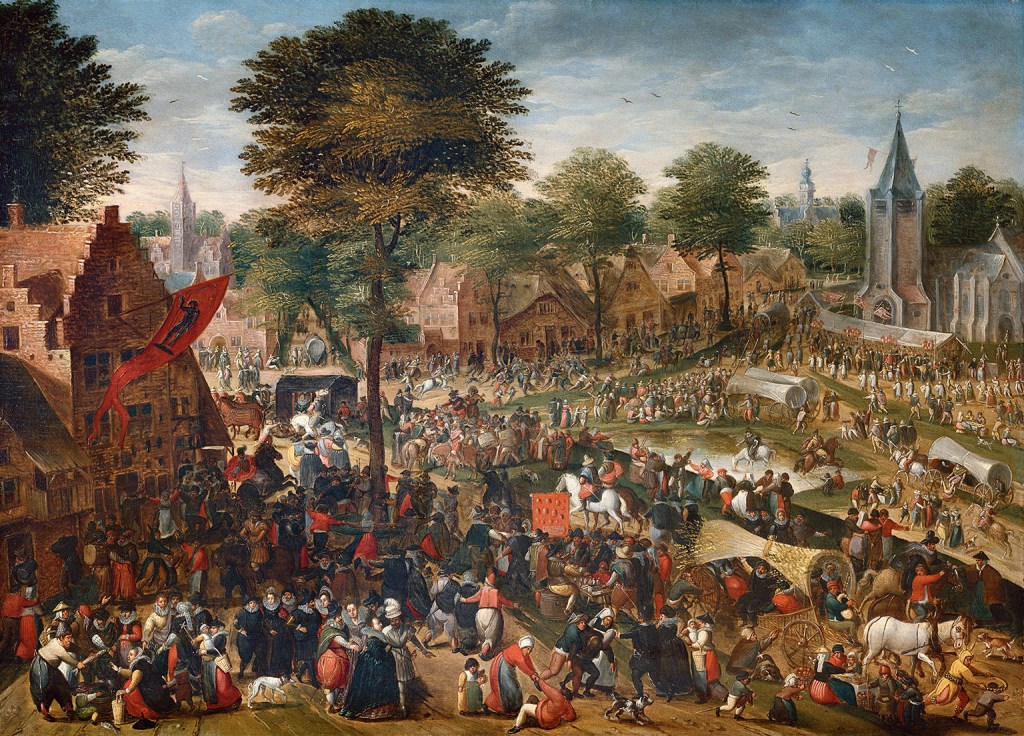
The Grand Kermesse of St. George in a Village, attributed to Peeter Baltens (c. 1527-1584), embodies all the ingredients generally associated with the Flemish Village Festival genre; the high vantage point, large figures in front and miniature figures in the distance, the church, the tavern, the fool, the religious procession and the dancing. Note that here, as in the previous painting, the opulently dressed elite, who patronize the festivities to see how the ‘other world‘ celebrates, saunters among the village folk but refrain from participating in any of their activities. I have yet to find dancing elite in late 16th century village scenes.
Marginally in front of the religious procession, a group of villagers has formed a circle. The artist has captured both the dancer’s speed and liveliness as the alternating men and women spin around, tugging and pulling each other in the process. There is a second group of dancers — three diverse couples — on the lower left hand side accompanied by the traditional bagpipe player. These figures are regularly encountered in paintings relating to village feasts and wedding dances. The closed position, where the couple faces each holding one another snugly, is commonplace. Also popular is the hand in hand position where the couple, at arm’s length, dance, swing, and spin energetically. Finally, the swirl under the partner’s arm motive will be spotted time and again.
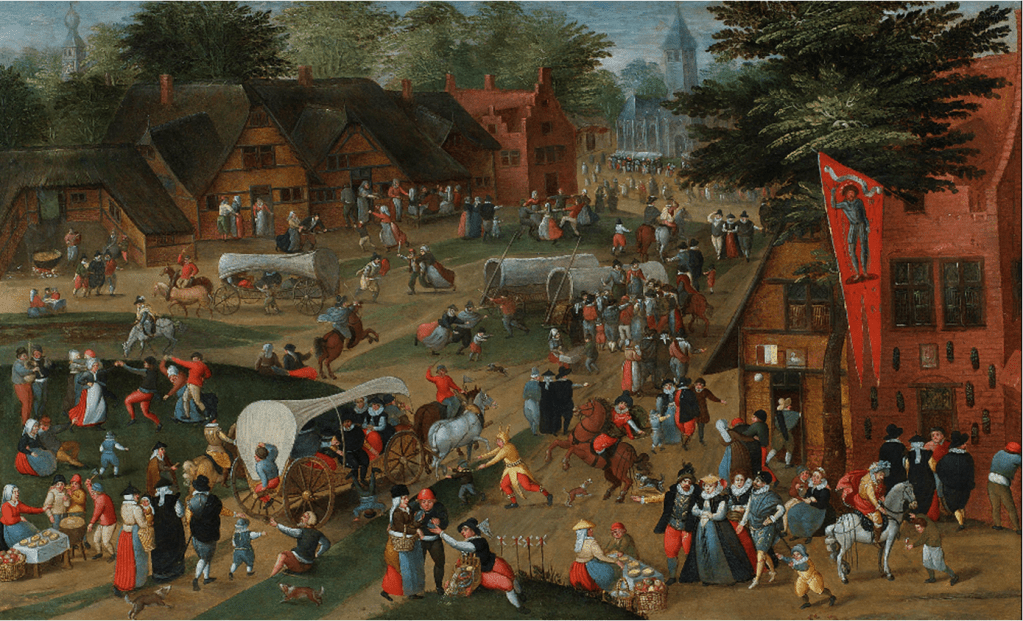
Villagers Celebrating the Kermesse of St George offers a panoramic view, of a village scene, from a relatively high vantage point. The dancing couples, arranged in the front centre of the painting, instantly capture the attention. The different dance motives are clearly recognizable; the closed position couple, the hand in hand couple and the swirl under the arm couple. Standing immediately behind them is a group of wealthy spectators. Apart from chatting to each other, these townspeople are motionless; except that the man on the right has extended his arm in the direction of the peasants. One wonders what the man is discussing with the very elegant lady at his side. Do they approve or disapprove of this unrighteous behaviour on the feast day of Saint George? And then there is that other couple dancing in the foreground, whose moves are reminiscent of Dürer’s famous print Peasant Dancing Couple. They, as in Dürer’s and Sebald Behams’ work, dance back to back with extended arms; only in this painting the positions of the man and women have been reversed. Both figures look decidedly out towards the viewer. The only other figures that look ‘out of the painting‘ are the well-dressed couple, who stand absolutely still; that is, apart from the man’s questioning gesture. This time addressed to the viewer.
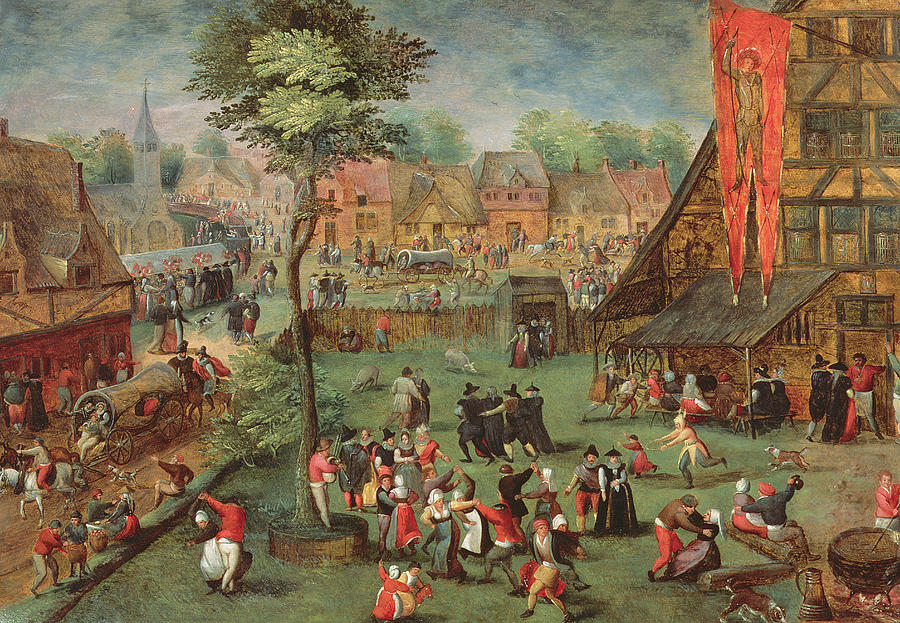
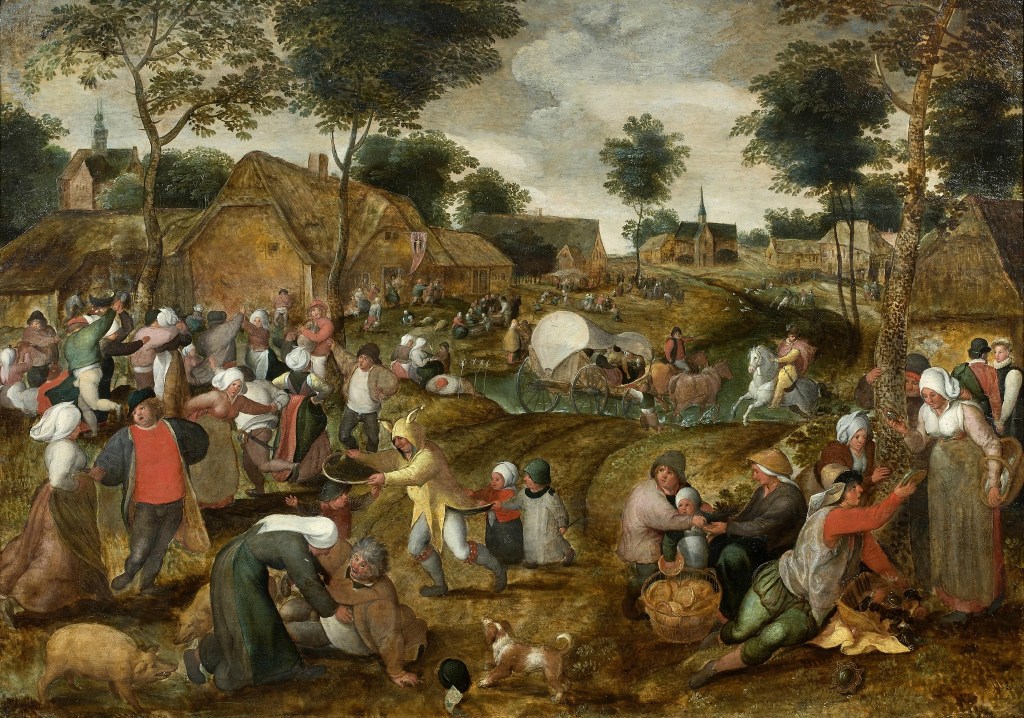
Marten van Cleve (c. 1527 – c. 1581), a contemporary of Pieter Bruegel specialized in low-life scenes, often working with landscape painters Gillis Mostaert and Jacob Grimmer. Though still using a bird’s eye perspective, the painting St. George’s Day, presents a somewhat lower viewpoint when compared to Bruegel the Elder or Hans Bol. The viewer no longer looks down onto the scene from a high vantage point, but from a spot just above the village, close enough to actually see the faces of the peasants, and, in the same instance, to enjoy the panorama. The vistas are boundless, reaching as far as the eye can see. With the exception of the man in the well-tailored green garment, accompanied by two greyhounds and the small, equally well-dressed child playing with a hobbyhorse, all the figures are peasants. The fool, a regular figure in village feasts, is partially concealed; his yellow hood, complete with ass’s ears, can barely be seen as he embraces the peasant woman. And the dance, a circular chain of jovially dancing peasants, is an eye catcher, forming a large section of the central layer of the painting. The bagpipe player accompanies both the tavern guests and the dancing peasants standing, not against a tree, but truly in the centre of the excitement. And the dancers, not surprisingly, are hefty, somewhat hunched, if you can exclude the front fellow whose entire demeanour is playful and high-spirited. Positively entertaining is the more elderly couple in front. Are they dancing or is she, the wife, urging her man to come home?
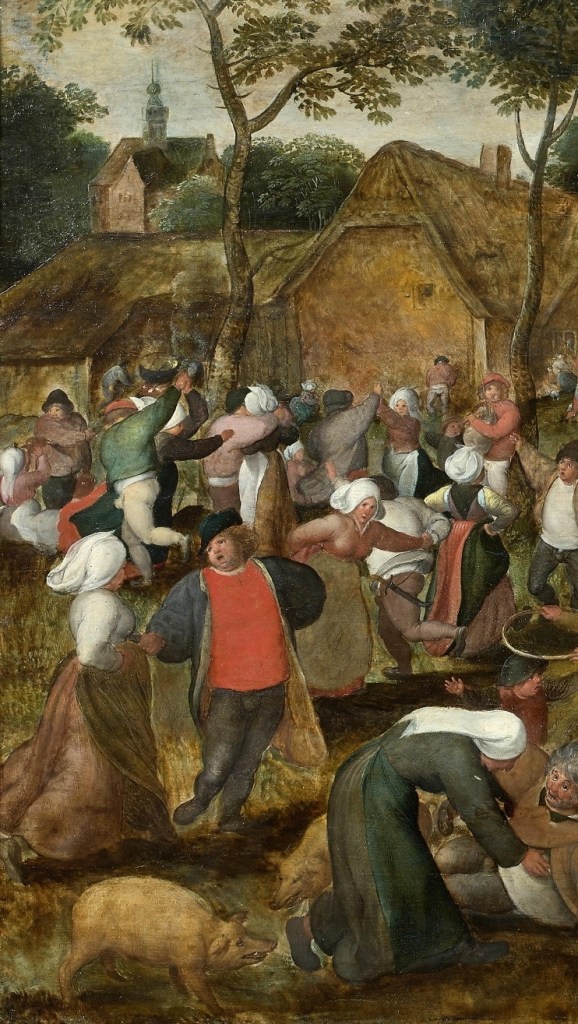
Pigs (a symbol of gluttony), a drunken man being nagged by his wife, a dog, and a fool playing with children are just some of the characters that inhabit the front of this village scene. As in the painting above, Marten van Cleve moves in close enough to allow the viewer to see the expressions of the front figures without forfeiting the extensive background. Where in the previous painting van Cleve concentrated on a circular dance formation, this time he focuses on dancing couples. The familiar figures, so in demand in the late 16th century, all make an appearance. Newcomers are the portly man in the long overcoat together with his female companion. This couple, judging from her whirling skirt and the man’s uplifted leg, are dancing, though his dumbfounded expression might convince you to think otherwise. This painting, of which I have no date, exists in at least five different versions.
Of special interest is that Pieter Bruegel’s son, Jan Brueghel the Elder, has a strikingly similar pair of dancers in La Kermesse de la Saint-Georges avec des paysans dansant devant l’auberge ‘In den Croon’, a work created around 1580. Martin van Cleve’s painting is not dated. Moreover, the year of his death cannot be confirmed, except to say that he died before the end of 1581. The question remains, who inspired who?
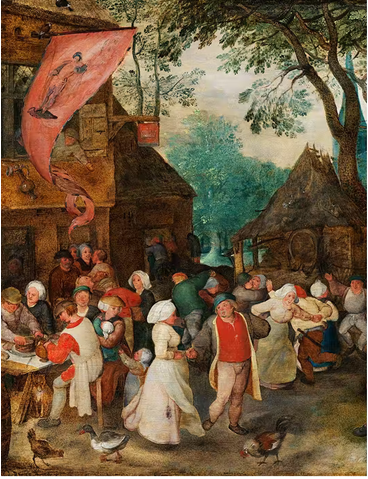
Right: Jan Brueghel the Elder – La Kermesse de la Saint-Georges avec des paysans dansant devant l’auberge ‘In den Croon’ c.1580 – private collection – detail
Generally speaking, the Village Festival painting is one of contrasts. The religious processions, invariably located in the background, contrast with the worldly activities of the village folk. The townspeople, richer and more refined, juxtapose with crude, rustic peasants, who are the personification of gluttony, avarice, intemperance and licentiousness. In Jacob Grimmer’s ostensibly carefree painting, these worlds collide. The vivacious dancing peasants, featured in the centre of the painting, strike the onlooker immediately. These fun-loving rustics skip and step around the tall village tree; the analogy to pagan dancing is explicit. Add, that bagpipes were considered a lewd instrument symbolizing rowdiness and bawdiness, and that dancing takes place in front of the church, make the apparently pleasant sphere rather ambiguous. As if that is not enough, a religious procession can be seen promenading towards the church gate, straight behind the dancing figures. You will have seen that the church gate and the tavern door are each other’s direct opposites; the sacred opposite the profane. What is more, in front of the church, you can spot the rich, mounted on horseback. Their refined style and demeanour is the absolute antithesis of the sprawling peasants in the foreground.
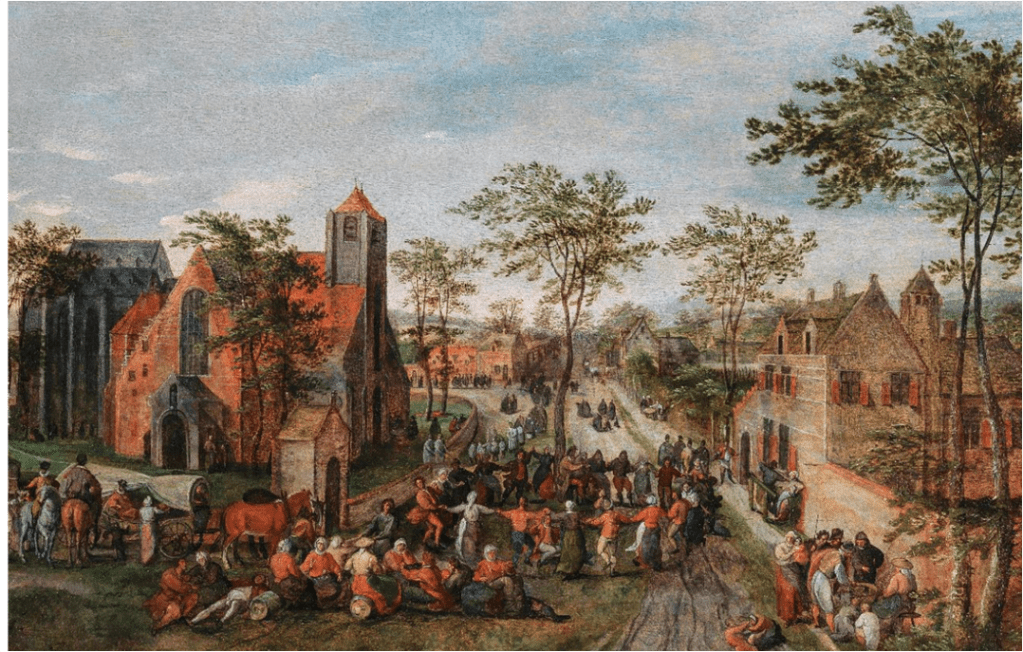
Grimmer’s delightful painting is full of nuances. The Village Festival paintings, discussed in this post, were created not long after the Reformation, in a time of religious upheaval throughout The Low Countries. When read within the context of their time, the Village Festival, with its multitude of figures, stunning vistas, arresting architecture, peasant dancing and bagpipe music, present a discussion between the sacred and the profane.


 DANCE IMAGES IN THE ART OF THE NETHERLANDS