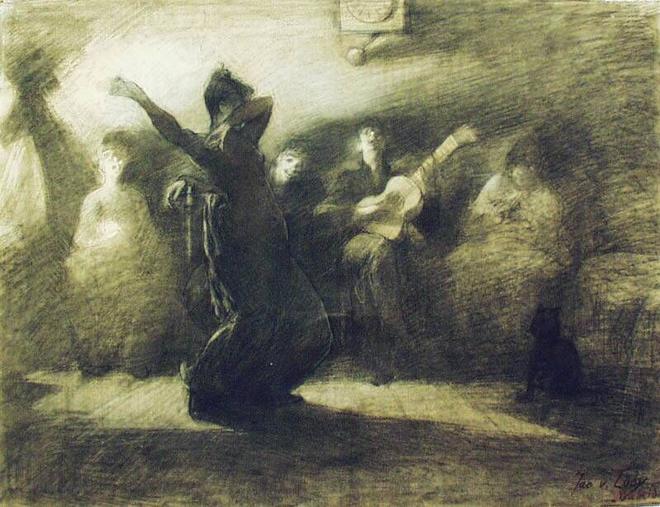
During the second half of the 19th century, Spain, a land of history, splendour, and folklore, intrigued Dutch society. Journalists and writers started to visit Spain, just as a select group of tourists. The author and painter Jacobus van Looy, about whom I wrote extensively in a previous post, travelled to Spain in the 1880s, living in Madrid for some time, to later tour the country. Spain with its breathtaking light and sumptuous colours caught his fascination, as did the Spanish dance. Whilst in Madrid he designed a black chalk drawing, The night of the tango. Do not allow the term tango to perplex you; this is a flamenco dancer. The flamenco has many faces, and the tango flamenco is but one form.
The Night of the Tango, also called Madrid, A Spanish Dance is one of the earliest, if not the earliest, images of the flamenco by a Dutch artist. The scene takes place in a tavern, patronized by local folk. The rough floor planks, an unadorned wooden wall clock, a plain table, and humble surroundings form the decor for a group of musicians and a striking dancer. The guitarist, his eyes closed, is utterly consumed with his music. Next to him sits a jolly fellow; his cheeky face is the only reasonably visible face in the image. He devotes his undivided attention to the dark figure. The dancer, together with the shadow she casts on the floor, dominates the image; her carriage suggests a strong earthbound dance. Although the viewer is deprived of seeing her face, she must be exciting, even enticing, given that the youthful onlooker cannot take his eyes off her.
Early in the 20th century there was a heightened awareness of Spain and the Spanish culture among many layers of Dutch society. Artists travelled to Spain, visiting local cafés where they encountered authentic Spanish dancing. Others visited La Feria, a flamenco venue in Paris, where the Spanish tablao was replicated. And yet others, had the opportunity of seeing Spanish dance troupes in the variety theatre or performing in the intermission programme at the one of the major cinemas in Amsterdam.
Frans Hogerwaard (1882-1921) visited Paris with Peter van der Hem in 1907. In 1910, he won de Prix de Rome, which provided him the opportunity of travelling to Madrid. In an undated etching, inspired by his stay in Madrid, he portrays a flamenco dancer in a masterly fashion. Hogerwaard has captured the movement irrefutably. With bent knees, feet pressed forcibly into the floor, a backward slant of the body topped by dynamic arms, his flamenco dancer is enthralling. As if the passionate movement is not enough, Hogerwaard adds a touch of sensuality. The sheer clothing displays the contours of her forceful legs, not to mention, that her breast is partially visible. All the more intriguing since we cannot distinguish the woman’s face, but can see her sinuous fingers holding the castanets. What does this powerful, expressive woman look-like? The shadow she projects on the wall is near diabolical.
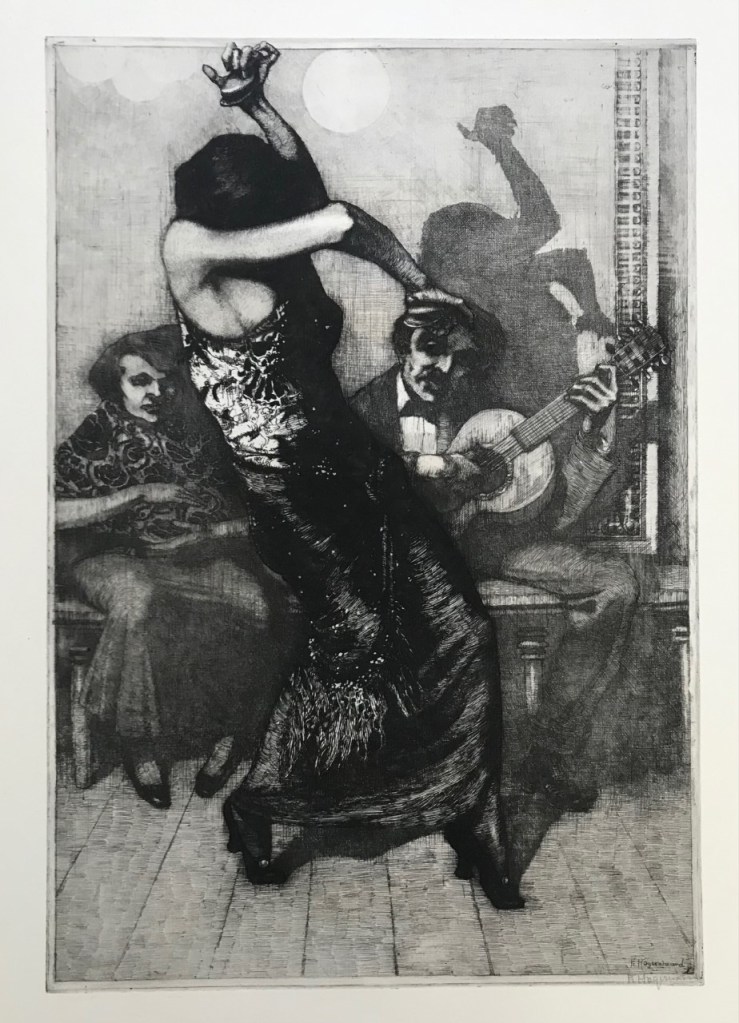
The etching is very detailed. The dancer’s shoes are adorned with tiny gemstones, the dress is sprinkled with sequins, and the bodice has a decorative pattern. Also, noteworthy is that the bench, on which the musicians sit, demonstrates craftsmanship and the round lamps in the background display a well-ordered design. Likewise, the musicians are depicted with an abundance of detail. The woman, playing the pendereta, wears a typical Spanish shawl embellished with a floral pattern. Moreover, her body language reveals her personality; she slumps, her legs are sprawled, and her feet placed leisurely in a haphazard fashion. Her face and that of the guitarist is craggy, as if carved. The man too reclines, apparently weary. Hogerwaard applies these details to provide the figures with a specific characterization. As energetic as the dancer is, so unassuming the musicians are; just a weathered couple, playing their music, on a wooden bench.
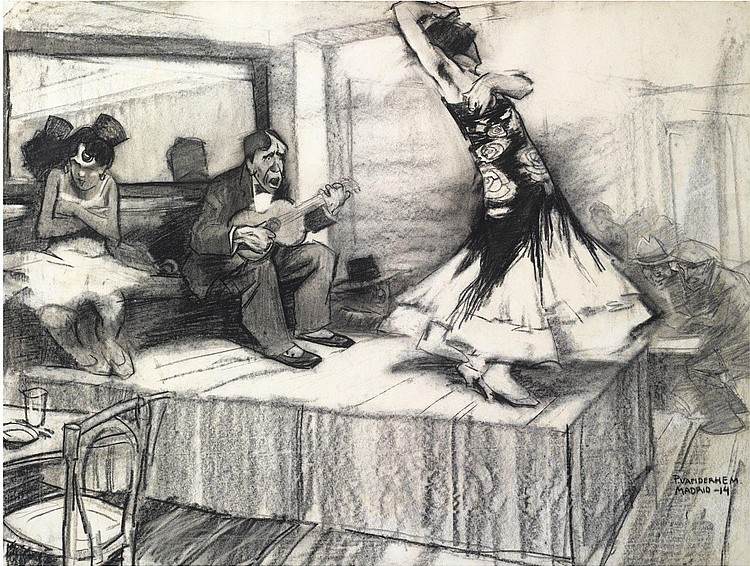
The café cantante, originating in 19th century Seville, were night bars offering flamenco entertainment. Performers sang, danced, and made music on an elevated stage, a tablao. A local café cantante, frequented by some regulars, forms the setting for one of the many images of flamenco dancers by Piet van der Hem (1885-1961). The artist was an avid traveller, travelling to Madrid before the First World War. He was known for his many dance images and various portraits of Mata Hari.
Van der Hem’s amusing charcoal drawing offers a glimpse of exactly such a setting. In this particular café the dancer performs on a small platform; she has very little space to move on. An irritated dancer is seated on the bench, her back turned away from her companions. Why is the woman vexed? The musician, regardless, is not deterred; he continues to play his guitar and to sing in earnest. All in all, a lacklustre situation. Even the patrons are not particularly responsive to the dancer; the seated men are occupied with other matters. Only the man wearing the sombrero, who practically lunges over the tablao, seems interested in the unflagging performer.
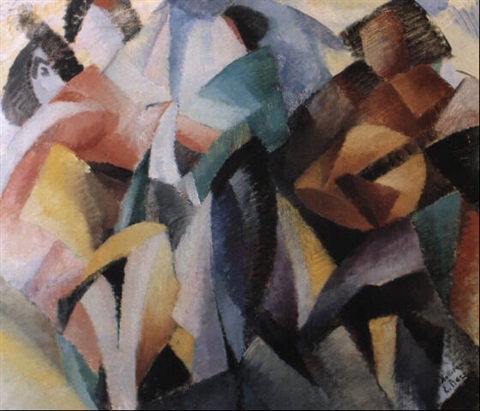
The German-born Dutch painter Else Berg (1877-1942), member of the Bergen School, was influenced by several avant-garde movements. During an extended stay in Mallorca, Berg applied herself to cubism, creating various cubist works, including a portrait of a Spanish Lady holding a fan and the Spanish Dance House, shown below. In this near abstract painting, a number of figures emerge. In a multitude of curved and oblique shapes, interlaced by pastel colours, a flamenco dancer materializes; her head, eyes, and eyebrows, are clearly defined. To the right, represented by earthy coloured diamond and circular shapes, is the musician playing his guitar. In the centre a third figure passes by. Unlike her husband, the artist Mommie Schwarz (1876-1942), who created an awesome calendar of expressionistic dancer Gertrud Leistikow performing in a variety of roles, dance images in Berg’s work are rare. Apart from a few sketches of Leistikow, I could only find this one painting. Of all the Spanish dance images, I have seen in the past months, Else Berg’s painting is the most unconventional and a unique work within her oeuvre.
In the first decade of the 20th century, Andalusian and flamenco dancers flocked the stages of the Parisian music-halls. The gypsy dance style dazzled the Parisian audiences. A French version of the café cantante, the café chantant, came into being, replicating the Spanish tablao. The most notable, a Parisian establishment named La Feria, opened its doors in 1912. Patrons, including various Dutch artists, could enjoy a meal, drink sherry and be entertained by Spanish dancers and musicians. The impressionist, Isaac Israels, visited Spain in 1893/4. Most of his Spanish dance images, however, were not painted at that time, but in 1913 when he frequented La Feria.
The three paintings, shown below, are but a selection of the images Israels made of La Feria. As the viewer, you get an impression of the architecture, the stage, the space and of the amiable ambience. The left painting is actually two scenes in one. In the background, on the small podium confined within an alcove, Israels sets the scene with quickly sketched figures. Even though the dancer is but a small figure, the twists and turns, so characteristic of flamenco dancing are emphatic. In the front, painted and drawn in greater detail, are some guests enjoying the performance and, so it seems, a table with two empty chairs inviting the viewer to join in.
The two other paintings show the dancer, castanets in hand, dancing vivaciously on the small podium of La Feria. Israels concentrates on the subtle intricacies of the dancer’s movements, as she twists, revolves, and rotates fervently, compelling her audience. In these two paintings and in most of his other La Feria images, Israels appears to have acquired a seat very close to the stage.
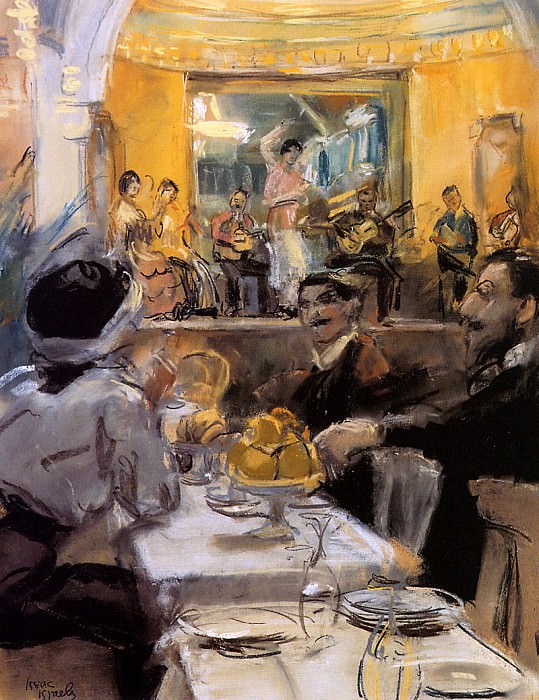
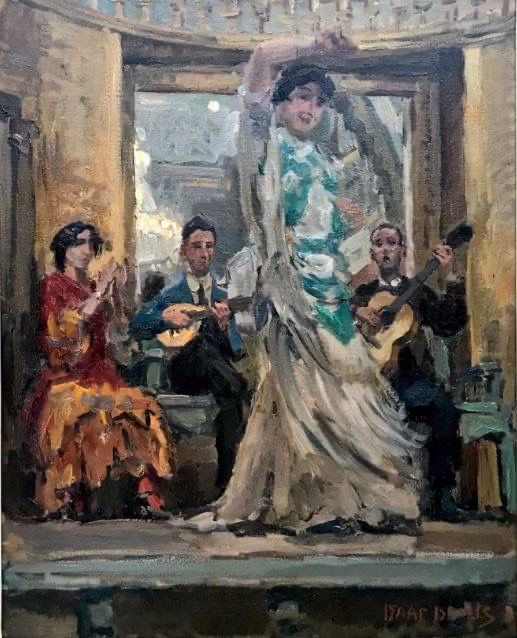
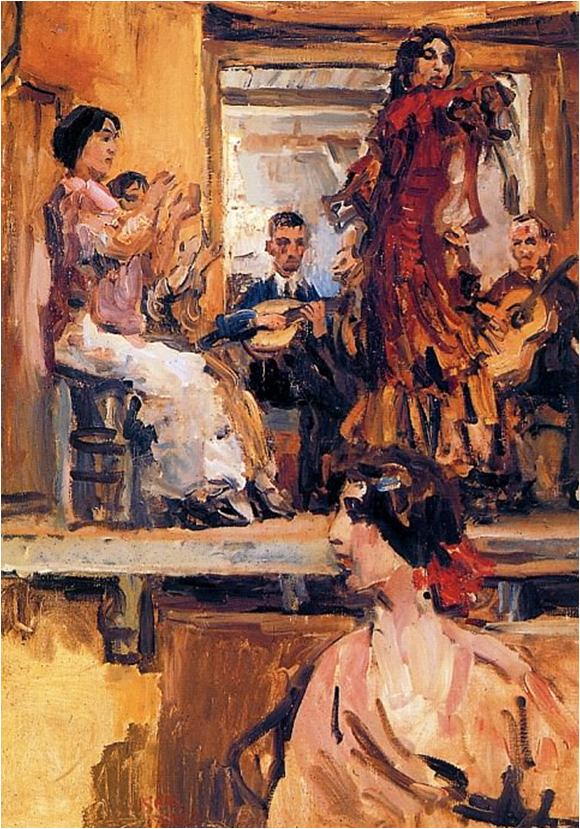
Isaac Israels – Café Chantant, La Feria – Paris, 1913 – Singer Museum, Netherlands
Isaac Israels – Café Chantant , La Feria – Paris, ca. 1913 – Gallerix
Kees Maks, who first travelled to Spain in 1903, was spellbound by the passionate musicians and fervent dancers performing in cafés and taverns. Their exciting rhythms, the fierce emotions, and dynamic performance, resulted in a considerable number of paintings. He painted many forms of Spanish dancing, both in Spain and in The Netherlands. Spanish dancers regularly toured The Netherlands, performing in the theatre and in the cinema. At the magnificent Tuschinski cinema in Amsterdam, Spanish dancers invariably provided the intermission programme. Maks sketched the dancers during the performance, to later invite them to his studio to continue working. He preferred to work in the evening, using artificial light; in his own studio, he reproduced a theatrical setting using spotlights and other lighting effects. The following two images of a gypsy dancer and her troupe are similar in composition and sphere. Most likely these are members of a travelling troupe that Maks saw performing in the theatre. These paintings are unmistakably posed and painted in his studio.
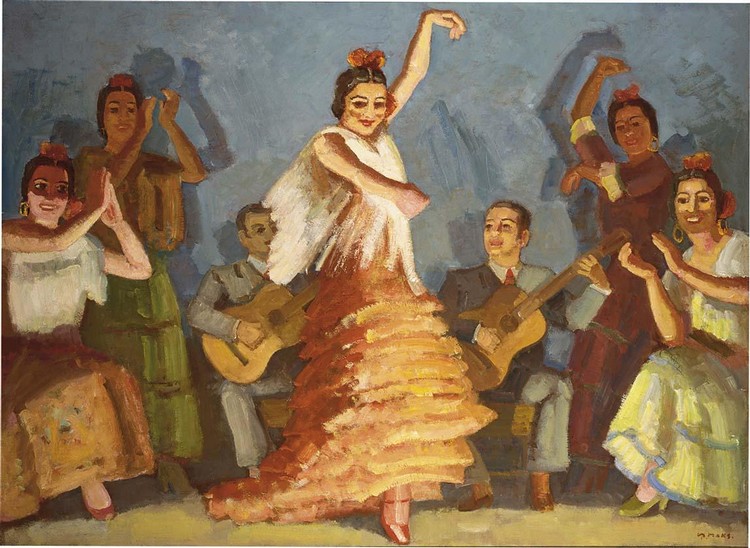
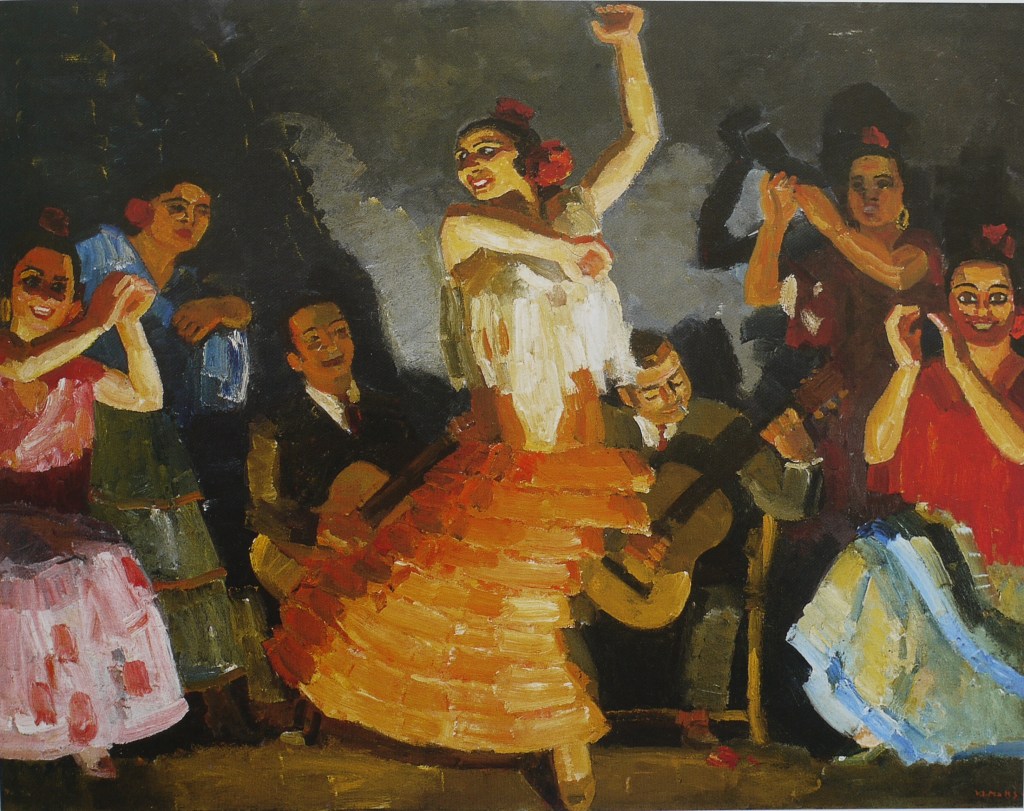
Kees Maks – Gitane dancers – oil on canvas, 124 x 162 cm – private collection
I wonder how many (Dutch) artists can play flamenco music on the guitar or sing flamenco texts passionately? Jan Sierhuis (1928-2018), post-war, contemporary artist, and a flamenco aficionado regarded the flamenco as total theatre; literature, dance and music unified in a unique theatrical framework. Sierhuis played the flamenco guitar proficiently, sang for his pleasure, and was acquainted with the various forms of flamenco. For practically three decades Sierhuis painted and sculpted flamenco dancers and musicians, frequently naming his works after specific forms of flamenco dance; amongst others Alegrías, Fandangos, Soleares, and Petenera.
Sierhuis regularly visited Spain. He owned a house, which included a workshop, in the Barcelona area. Not infrequently, he invited a flamenco dancer and guitarist to his workshop. Unlike Kees Maks, who asked his models to assume a specific pose, Sierhuis required the performer to dance passionately. As she strikes a pose, rotates, or stamps her rapid feet, he strives to capture the flow and dynamics of her every movement onto his canvas.
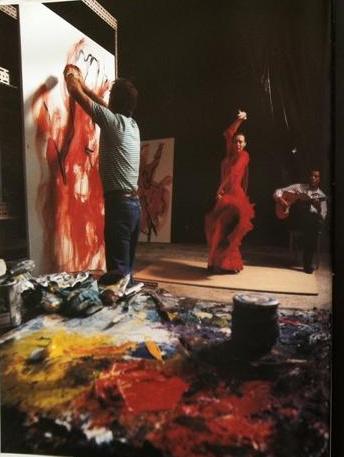
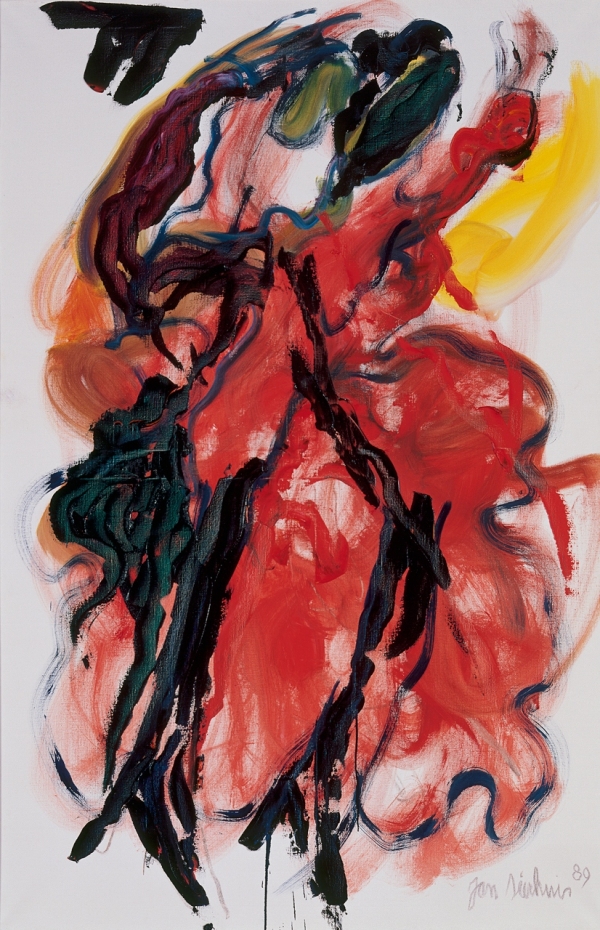
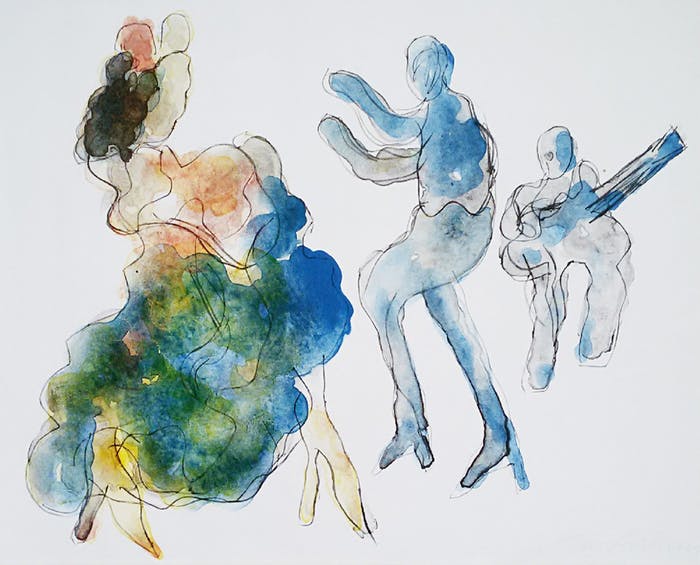
The flamenco, Jan Sierhuis points out, is a collaborative art form; a unity of dance, music, and literature. This post focused on the flamenco performed in the café, taverns and theatres. The following post will explore another facet; the electrifying Spanish Dancer. But for now, one more image by Jan Sierhuis; his interpretation of the female dancer, her partner and that most essential element, the guitarist.


 DANCE IMAGES IN THE ART OF THE NETHERLANDS