In previous posts I wrote about the remarkable Dutch artist Kees Maks, each time addressing the astonishing manner in which he expressed movement. His paintings, whether of dancers, horses, clowns, equestrians, or entertainers, are scintillating and full of life. In recent posts I discussed his unforgettable tango paintings, his cheeky can-can, and two delectable paintings inspired by the orient. In this post I will look at more of his exciting dance images.
Kees Maks (1876-1967) is fondly named the ‘artist of mundane life‘. Maks adored light theatrical entertainment, frequenting the circus, dance halls, revues, and the cabaret. He painted many images of dancers, finding his models at the performances he attended. At the magnificent Tuschinski cinema in Amsterdam, dancers invariably provided the intermission programme. Maks sketched the dancers during the performance, to later invite them to his studio to continue working. He preferred to work in the evening, using artificial light; in his own studio he reproduced a theatrical setting using spotlights and other lighting effects. Maks’ work often displays a stark light/dark contrast, complemented with the glow of artificial illumination and further enhanced by a striking use of vivid colours.

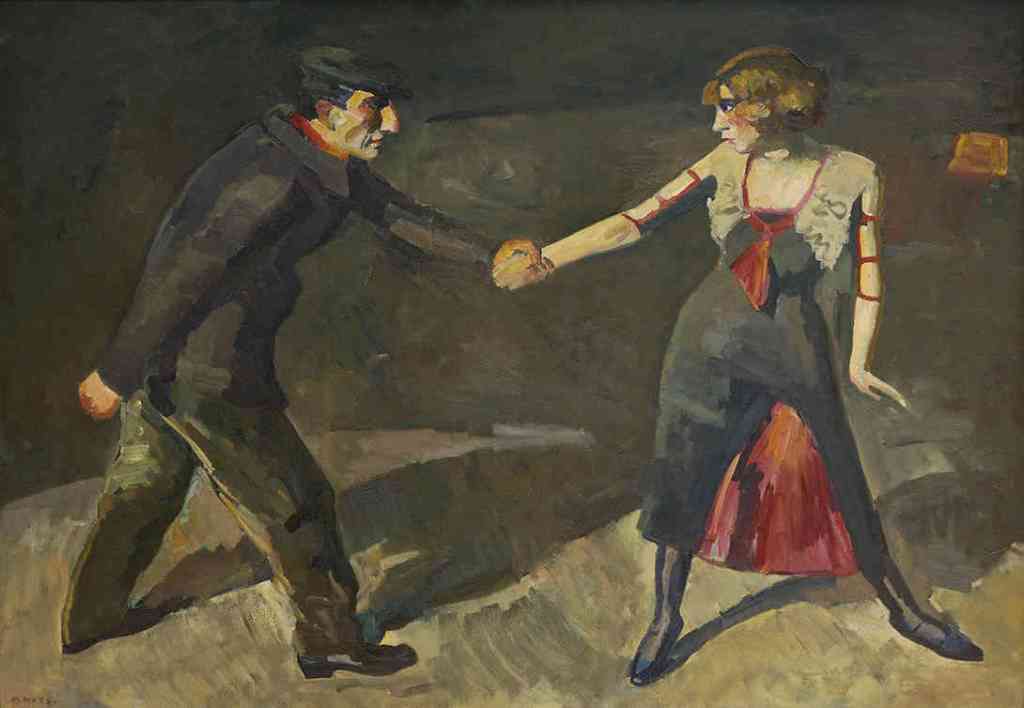
On the photograph, shown above, Maks is working in his studio with the very successful French dance couple René Blanc and Lucette Gilbert. They toured The Netherlands in 1914, performing the trendsetting dances of the time, the tango, the two-step, and the highly popular Valse Chaloupée. This dance, also called Apache Dance, was a rigorous spectacle imitating a physical struggle between a ruffian and street girl. Maks’ Valse Chaloupée, is, as similar works by his contemporaries Jan Sluijters and Kees van Dongen, a figurative image of dancers brazenly confronting each other. The couple pictured in the photograph is dressed similarly to the painted couple; it is clear that Maks invited the dancers to his studio. The sizeable canvas (167 x 238 cm) shows two larger than life dancers against a nondescript background. The background, painted roughly in irregular brush strokes, is dark. On the floor, which is just as roughly executed, fall large shadows of both dancers; Maks uses artificial lighting. Similar shadows fall over the dancer’s faces. The man’s face appears especially rugged.
Early in the second decade of the 20th century an old Italian dance, the furlana, was rekindled. Apparently Pope Pius X, who regarded the upcoming tango as improper, suggested a revival of the old courtship dance. The energetic furlana, danced to a duple-time, recalls the tarantella. In no time the furlana became the newest, though short-lived, dance craze. The Stedelijk Museum, Amsterdam, houses an impressive work titled The Furlana. Painted in 1913, this large-scale painting depicts two dancers both kneeling on one knee; they look intently at each other. Their arms, held at shoulder level, are placed across their backs as they join their hands in preparation for the following sequence.
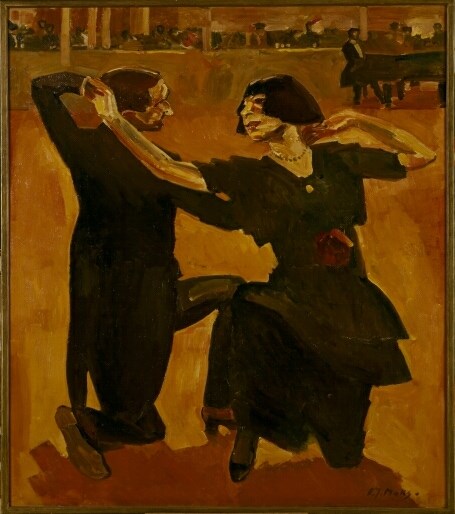
The dancers are positioned boldly over the entire canvas; they dominate the painting. Maks plays with, even distorts, the perspective. There is very little distinction between the floor and the background; the floor appears to slope upwards until met by a vague horizontal barrier. A closer look reveals that the barrier is, in fact, a balustrade behind which an audience is seated. And in what appears to be a distant spot, there is a handsomely attired pianist playing the grand piano. Where was Maks sitting when he devised this painting? The pianist and the indiscernible audience seem airborne. The baffling perspective is further heightened by the overall brownish hues. Even the black clothing of the dancers is tinged by a mahogany glow. In another painting, presenting the popular dance Maxixe Brésilienne, Maks uses matching brown hues and a very similar, if not the same, setting as The Furlana.
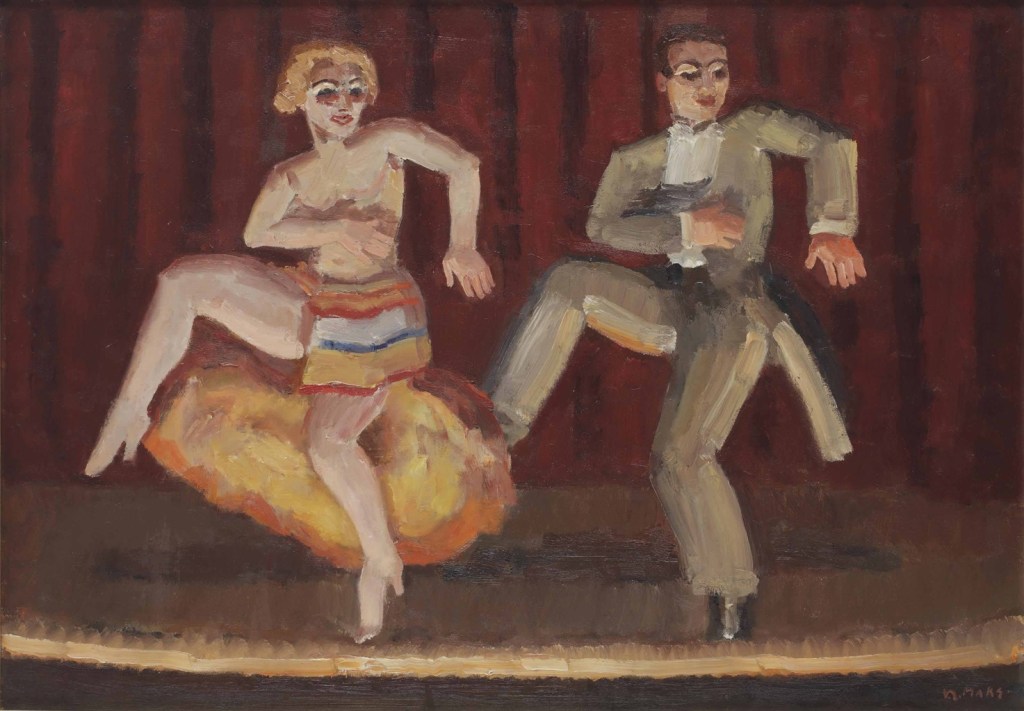
Maks embraced the world of amusement. Whether Maks painted the charleston, the ragtime, the cakewalk, or any other dance, his work bubbles with energy. It is evident that Maks, as he sketched the revue artists shown below, was sitting in the stalls; some paintings show the border of the stage and the illumination of the footlights. The dancers perform upon an apron stage; two paintings clearly show the main curtain closed. These delightful entertainers can be none other than dancers performing an intermission divertissement at the cinema. The dancers face the same direction, are synchronized, and perform identical movements with an indistinguishable amount of playfulness. Except for the charleston, each painting shows the dancers lifting one leg as they balance on a slightly bent knee. Both dancers either bend backwards or swivel their shoulders with a strong rotary twist. The woman’s skirt is long at the back and short at the front, allowing a generous view of her shapely uplifted leg. Looking at the angular arm movements, the accentuated hands, the facial features, and the beaming personalities, it is more than likely that Maks produced a series of works presenting the same dazzling duo.
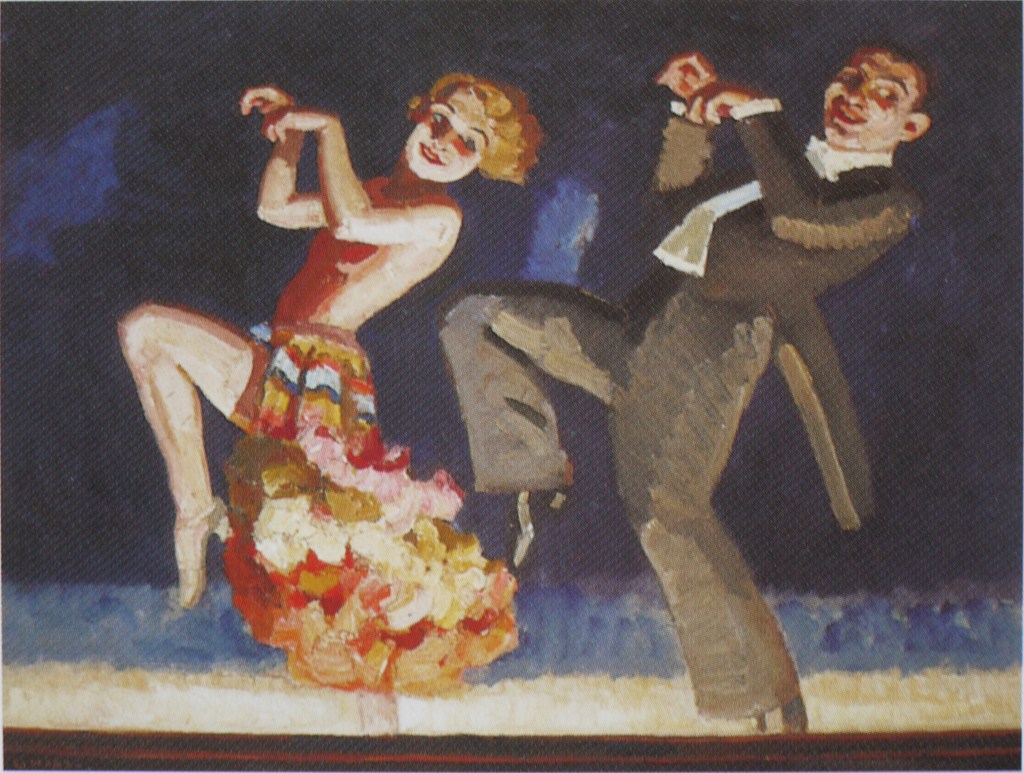
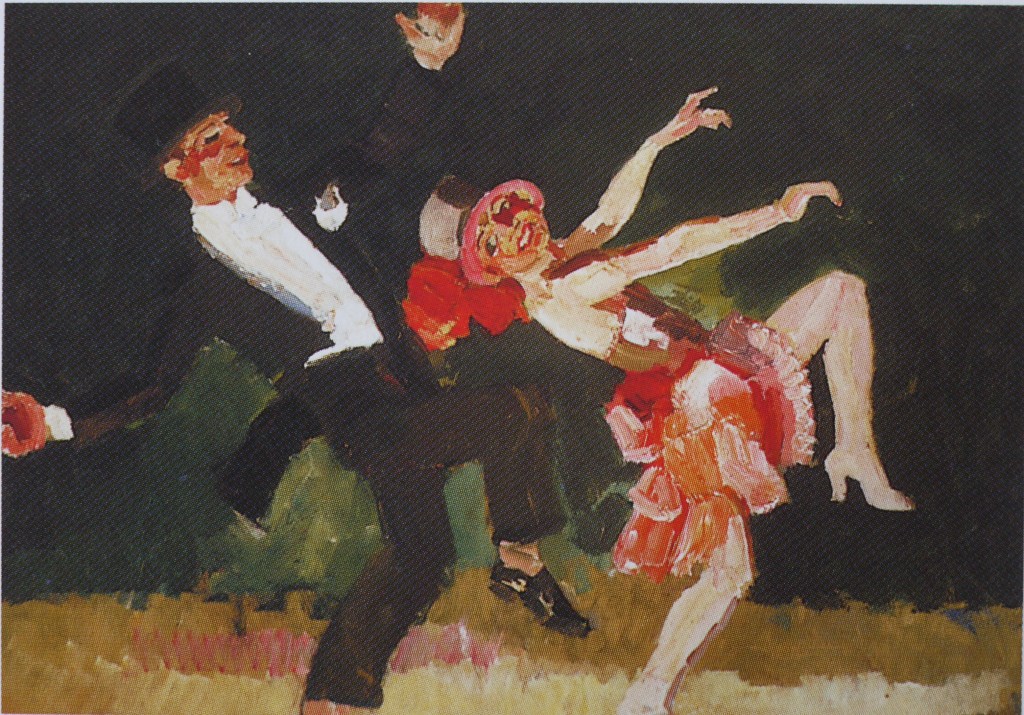
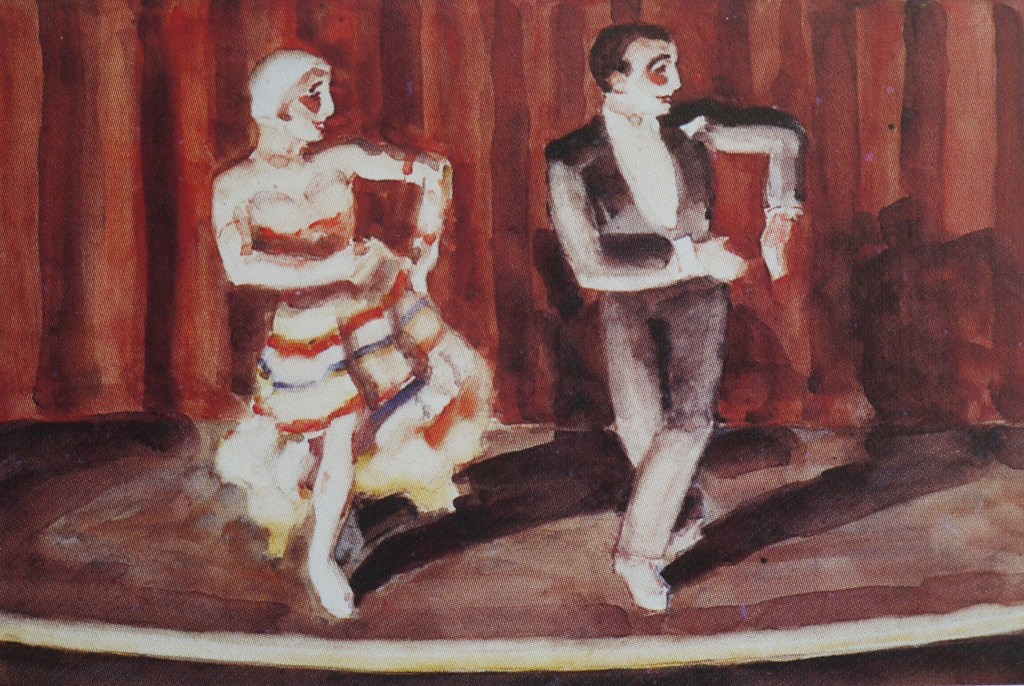
- Upper left: Les danseurs excentriques (cakewalk) c. 1928 – oil on canvas, 70 x 100.5 cm – Christie’s
- Upper right: Les danseurs excentriques (cakewalk) c. 1928 – oil on canvas, 92 x 121 cm – private collection
- Lower left: Ragtime c. 1928 – oil on canvas, 93 x 121 cm – private collection
- Lower right: Charleston – watercolour on paper, 42 x 62 cm – private collection
Maks, who first travelled to Spain in 1903, was not only fascinated by the Spanish lifestyle, but mesmerized by Spain’s brilliant light and the ravishing colours. He was spellbound by the passionate musicians and fervent dancers performing in cafés and taverns. Their exciting rhythms, the fierce emotions, and dynamic performance, resulted in a considerable number of paintings. He painted many forms of Spanish dancing, both in Spain and in The Netherlands; Spanish dancers regularly toured The Netherlands performing in the theatre and in the cinema.
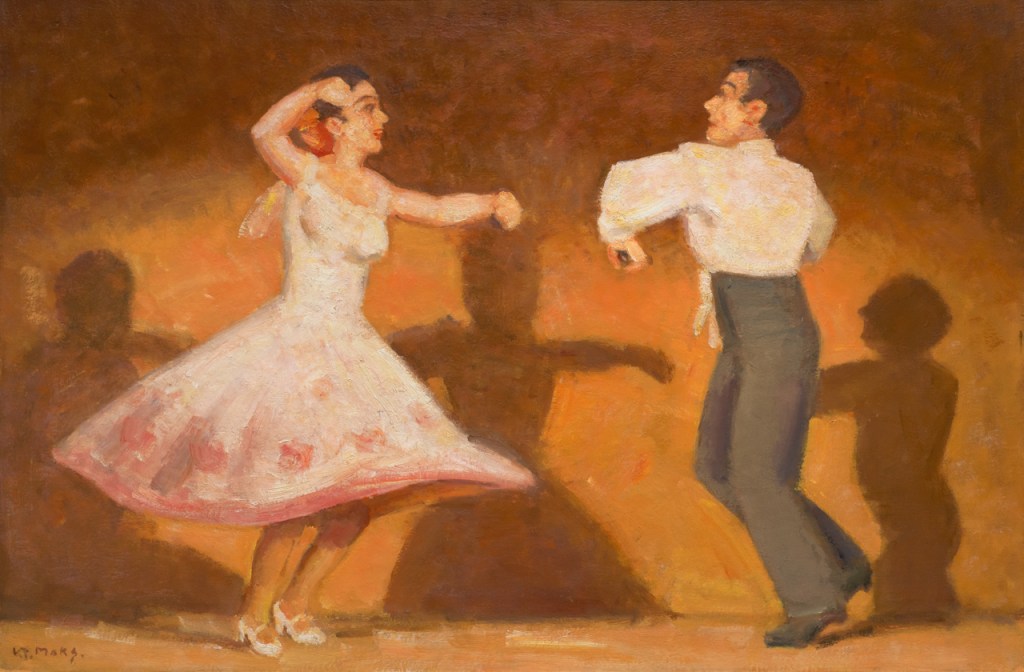
These whirling dancers give the impression of actually moving; you can practically sense their following movement. This lively couple performs a sevillanas, a popular Andalusian folk dance, closely related to the flamenco. Did Maks compose this painting in a Spanish café, at a performance or in his studio? Regardless, the dancers sparkle with energy and relish in their movements with undeniable fun and exhilaration. Behind them, against a luscious brown/orange background, their recognizable shadows add yet a second layer of dancing. The third shadow appears to be a musician. Bountiful use of projected light and an abundant flourish of vivid colours, in this case robust terracotta, are characteristic of Maks’ work.
And what about the evocative colours in Spanish Dancer Sotomayor? Blistering red and flaming orange dominate the canvas. Maks painted Sotomayor, who toured The Netherlands with her troupe, a number of times. This portrait is a studio piece; Maks was known to have rearranged his models endlessly until he was satisfied with the composition. Sotomayor and her company are posed in typical flamenco style; the arranged composition may have yielded some spontaneity, but Sotomayor’s bewitching expression fully compensates that. Standing in front of this monumental work, the viewer is welcomed by her alluring personality and enticed to participate in a feast of colour, rhythm and Andalusian entertainment. An even closer look reveals the artist’s thick, bold brush strokes.
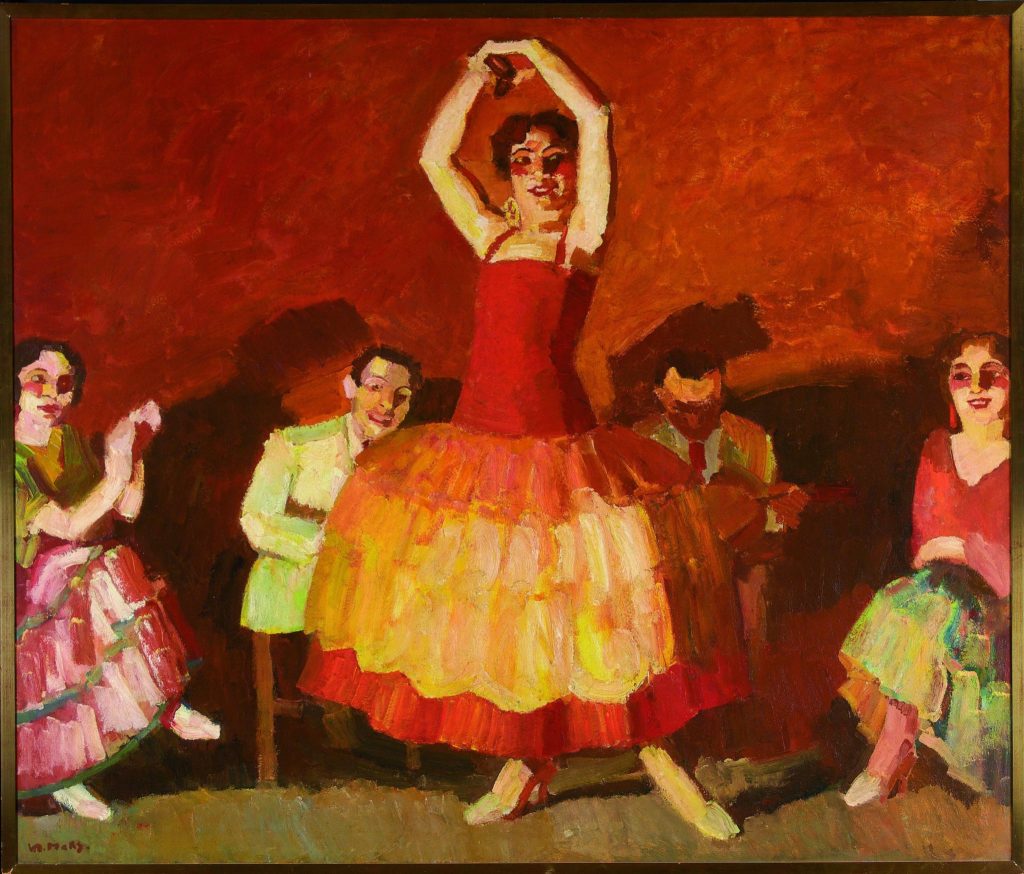
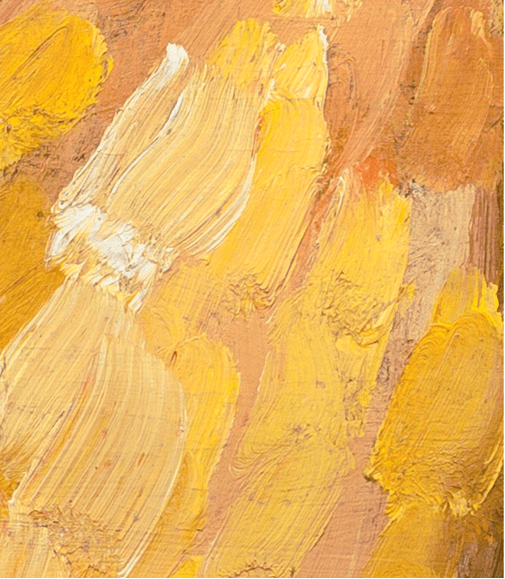
A detail from Spanish Dancer reveals Maks’ specific brush stroke. These thick, forceful layers of paint immediately command the viewer’s attention. The texture is irregular, rough, even bumpy, so much so that the bulky paint advances forward jutting off the canvas, virtually creating a three-dimensional work.
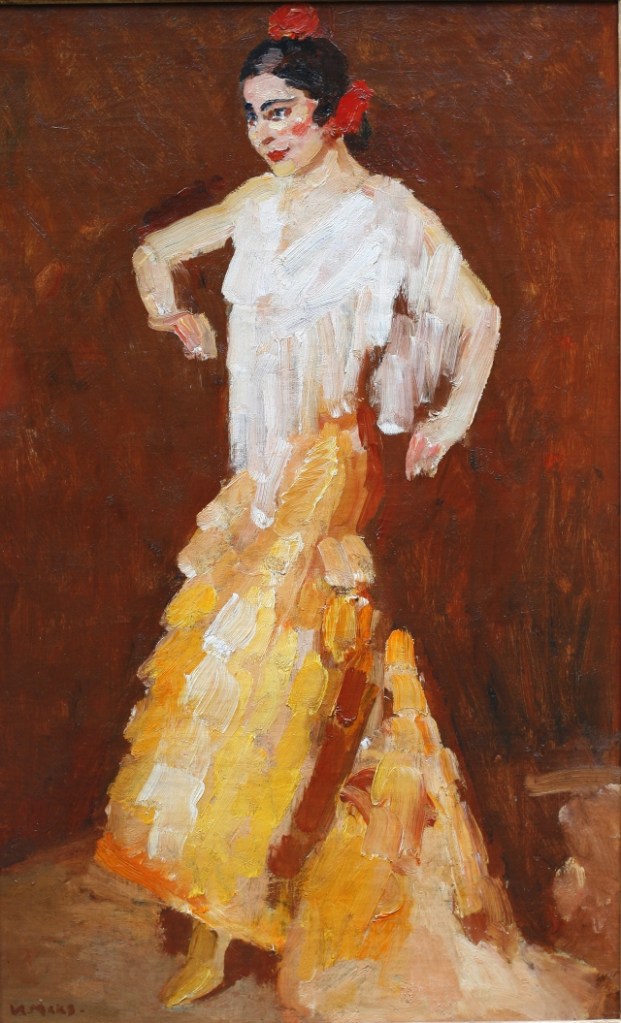
The canvas, Spanish Dancer, embodies Maks’ distinguishing brush style. The enlarged detail is a fragment of the dancer’s flamboyant skirt, consisting of a considerable number of short, crude brush strokes. A similar technique is practised throughout the entire portrait. Composition wise, Maks has zoomed in on the nameless dancer, ‘freezing’ her in an emblematic flamenco pose. And as we have come to expect from Maks, the artist plunges the dancer in a dramatic ray of light, illuminating her entire presence.
Kees Maks revelled in dance performances. His interest in dance was unbounded. Apart from the flamenco and other Spanish dances, Maks loved ballroom dances. His images of the tango, the ragtime, the charleston, and the cakewalk, display his enthusiasm and delight in movement. With equal passion he was captivated by shows and by the revue; the costumes, lights, make-up, and every other facet of theatrical life appealed to this innovative artist. Maks was a prolific artist. Many of his paintings are, to this very day, in private collections. I have barely touched on a fraction of his imposing (dance) oeuvre.


 DANCE IMAGES IN THE ART OF THE NETHERLANDS