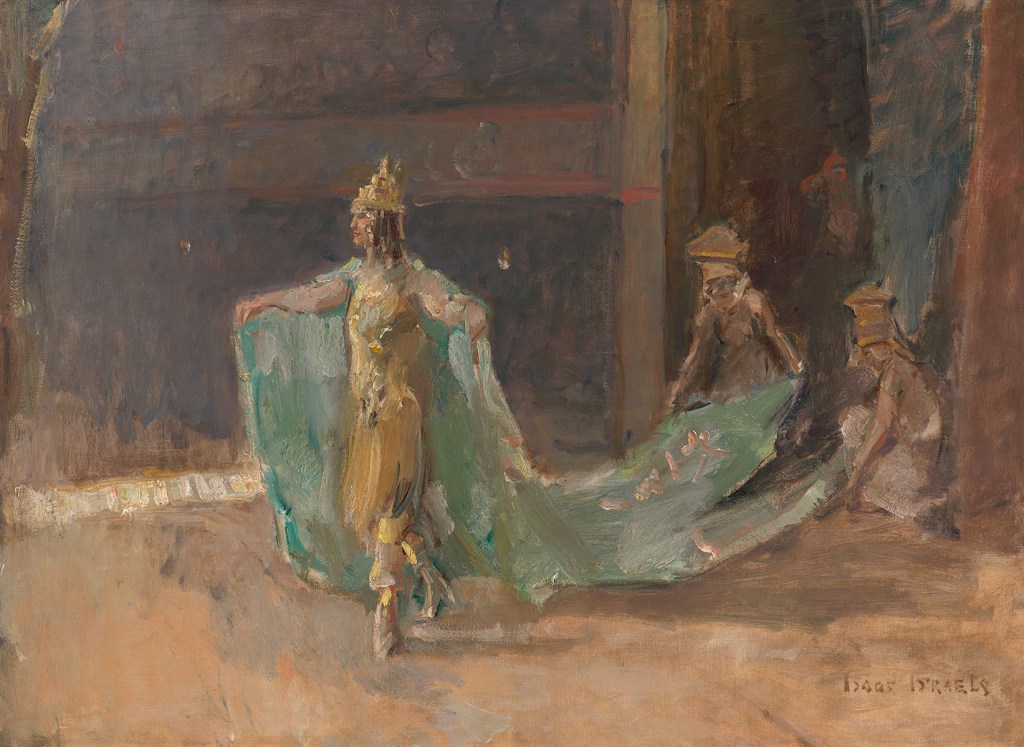
The Dutch impressionist Isaac Israels once wrote that the atmosphere of the studio has a numbing effect on me.* He continued to explain that he takes his subjects from nature, and they are executed directly from nature.* Israels is known to have roamed through the streets of many a city carrying a sketchbook, constantly sketching subjects of interest with charcoal or pen. He delights in bustling city life. Israels was fascinated by light, colour, movement, and motion, frequenting dance events, theatre and other forms of entertainment. This post will look at Israels’ impression of dance from the late 19th century until the 1930s, when Israels became a regular guest at the Scala Theatre in The Hague.
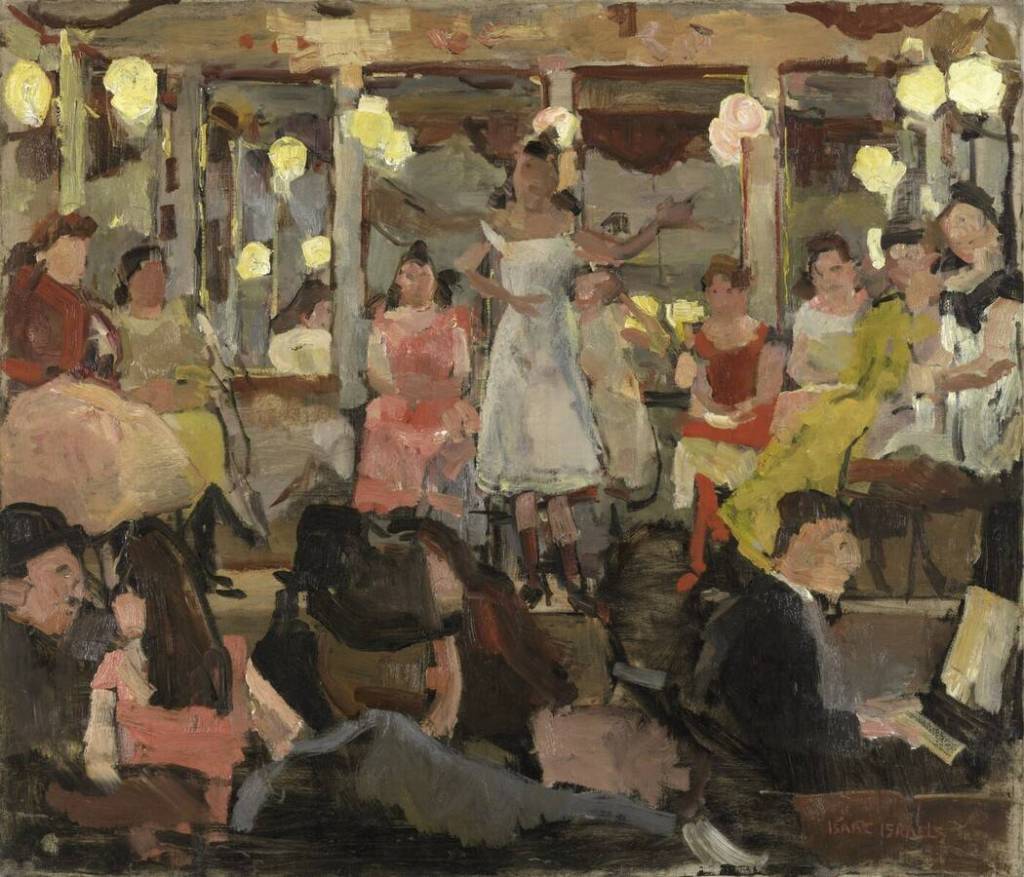
The Nes, a narrow street in Amsterdam running parallel to a main thoroughfare was, in Israels’ time, the home of the variety theatre; entertainment for the middle classes. In the various cafés chantants dancers, singers and other variety entertainers performed while the patrons smoked, drank, and enjoyed the buffet. In this colourful painting Israels draws attention to the performer; she is most certainly a singer and most probably a dancer. I wonder what the group of women sitting around her actually think of her presentation. She is performing with utmost confidence, but without exception, the surrounding women sit slumped, look lustreless, even though their brightly coloured dresses would normally give a cheerful effect. Some members of the audience, as you will have noticed, are also distracted.
This cafe-chantant has invested in electric lighting. By reflecting the light bulbs in the background mirror Israels has composed a striking spectacle. The top half of the painting, with the radiant lights and the equally radiant dresses, is aglow. Israels ‘executed directly from nature’; he regularly visited this type of establishment. It is more than likely that Israels was present during this performance and most probably, sitting directly behind the man with his back to us. From that vantage point Israels could sketch the stage, the audience and the pianist.
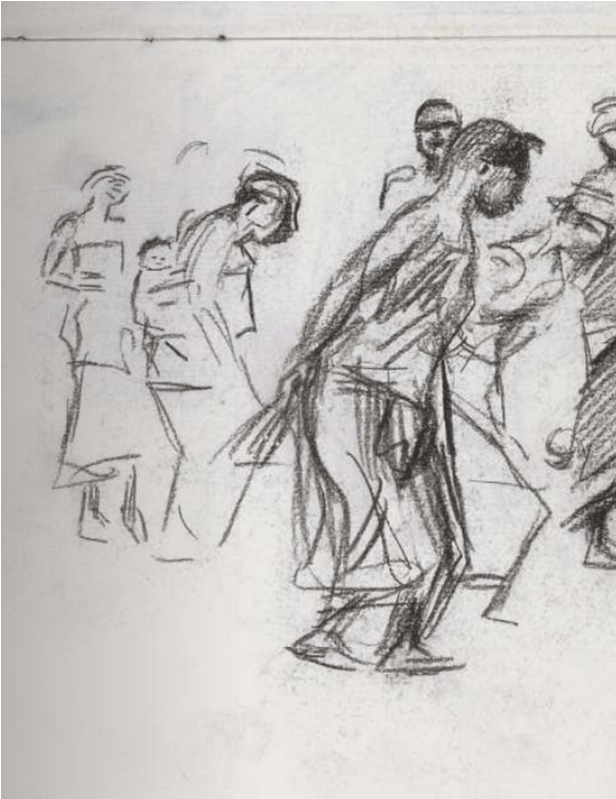
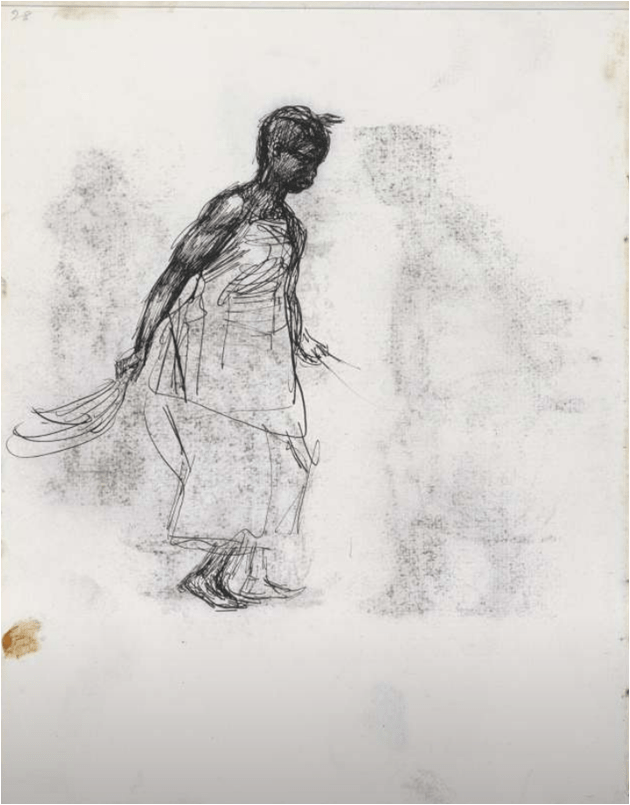
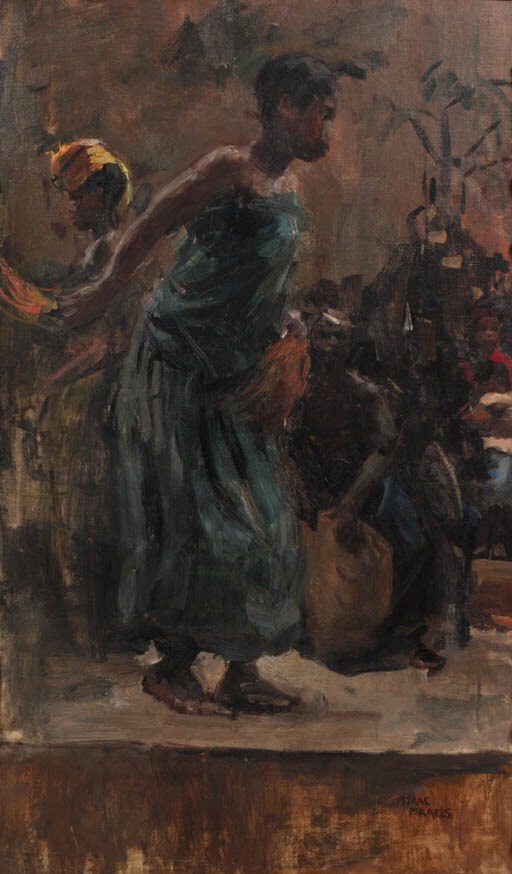
Ashanti dancer – oil painting c. 1900 – Christies
The Kingdom of Ashanti is now part of Ghana (click on image to enlarge)
Dancers from the Kingdom of Ashanti, the so-called Ashanti dancers, were invited to perform at the coronation of Queen Wilhelmina in 1898. Israels drew numerous sketches which he developed into four oil paintings. Israels was primarily interested in visualizing the movements of the dancers and in evoking the rhythms that drove them. In the three images above, you can practically feel the weight, the gravity, the earthiness of each individual step. Even without seeing the accompanying musicians, the downward curve of the dancers, the heavy feeling projected by the bent knees and their earthbound feet is sufficient indication to suggest the beat of tribal drums.
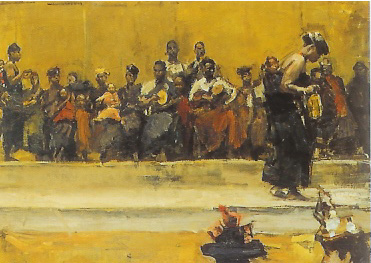
Israels was also fascinated by the dynamism of colour. In the oil painting, Ashanti Dancers, a yellowish-brown tone spans over the entire canvas suggesting a scorching landscape. The burnished stage forms the background for a tribal dance. A woman, her baby hanging snugly in a sling on her back, dances entirely alone. Other members of the troupe, mothers with children seated on their laps, musicians playing drums and people standing, are arranged on a low podium. All those figures, painted in various hues of yellows, browns, and reddish brown, blend effortlessly into the yellowish setting. However ethnic this painting may appear, Israels was basically interested in communicating rhythm, motion and colour. He consciously reminds his viewer that this is a painting of a performance; the bottom right-hand corner reveals two western ladies wearing fashionable hats. And at least one of the ladies has turned her head away from the stage.
In one of Israels’ many sketchbooks there is a series of watercolours showing exuberant dancers in colourful costumes. This series is housed in the Kunstmuseum, The Hague; the figures are described as ‘African dancers’. Researcher Esther Schreuder argues, and I tend to agree, that these are Caribbean dancers. The costumes and headwear, according to Schreuder, infer that they come from the island of Martinique.
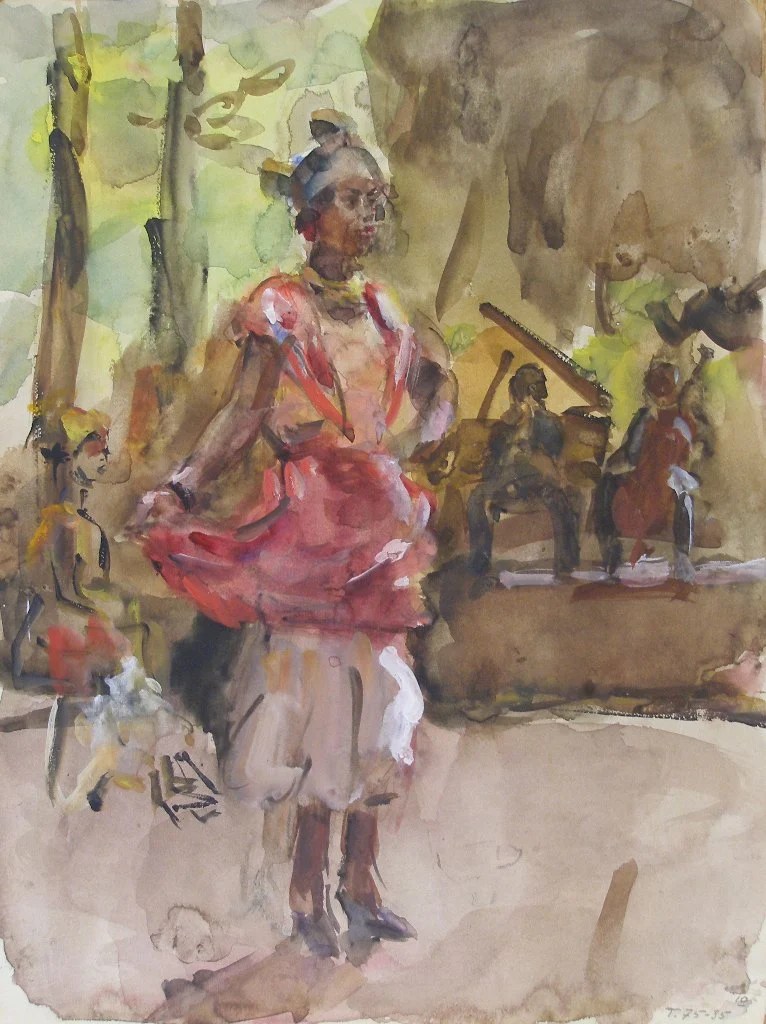
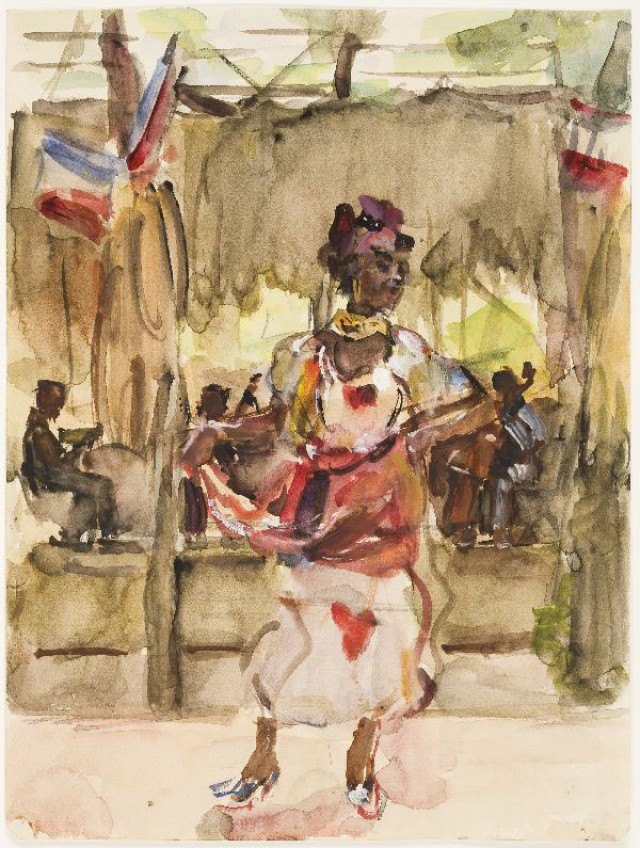
Israels, always mesmerized by the dynamics of movement, rhythm and shifting tempi, painted these Caribbean women in watercolours with swift loose strokes and blotches. The sketches are playful, rhythmical, spirited and were composed rapidly. But there is something curious about these tropical dancers. At first sight they appear to be authentic ethnic dancers, but a closer look reveals they are, in fact, professional entertainers. Caribbean dancers accentuate the hip and shoulder movements, add a touch of sensuality, but never, as these performers do, wear high heels when dancing. Where the dancing takes place is not clear, but if the blue and red strokes of the French flag are any clue, this is most probably a café-chantant that Israels visited during his long sojourn in Paris. That would explain why the dancers are accompanied, not as you would expect by a steel-band, but by a group of musicians playing western instruments. I can see, among other instruments, a grand-piano, a cello, a saxophone or a trumpet. As far as I know, this series of watercolours was Israels only venture into Caribbean dance; he did not develop these sketches into oil paintings.
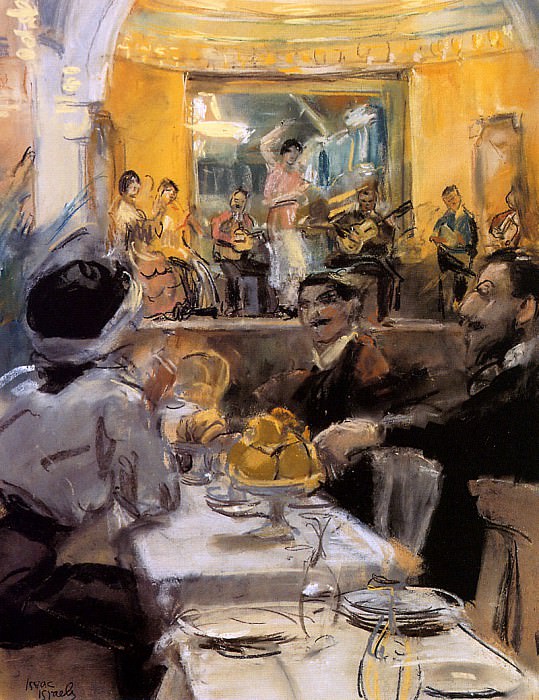

Café Chantant with Spanish dancing group La Feria in Paris – 61 x 46.5 cm – 1913 – RKD
Café Chantant with Spanish dancing group La Feria – Paris -1913 – Singer Museum, Netherlands
( La Feria opened its doors in 1912 – click on image to enlarge)
Paris 1912. If you wanted a taste of Spain in Paris, a locale known as La Feria was the place to be. As the patrons dined and drank sherry, flamenco dancers performed their intoxicating dance to the guitarist’s dynamic rhythm. Their performances inspired Israels to create an extended series of Spanish dance. The left painting, shown above, is actually two scenes in one. In the background, on the small podium confined within an alcove, Israels sets the scene with quickly sketched figures. Even though the dancer is but a small figure, the twists and turns, so characteristic of Flamenco dancing are emphatic. In the front, painted and drawn in greater detail, are some guests enjoying the performance and, so it seems, a table with two empty chairs inviting the viewer to join in.
The right painting, in the collection of the Singer Museum, shows the dancer, castanets in hand, dancing vivaciously on the small podium of La Feria. Israels concentrates on the subtle intricacies of the dancer’s movements, as she twists, revolves and rotates fervently beholding her audience. The dancer, encompassed in a long swinging skirt, is shaped in uneven strokes of paint. The surface of the painting is not at all smooth; often layers overlap each other. The men, oddly enough, are rendered with some degree of precision as opposed to the rough, often jagged representation of the women.
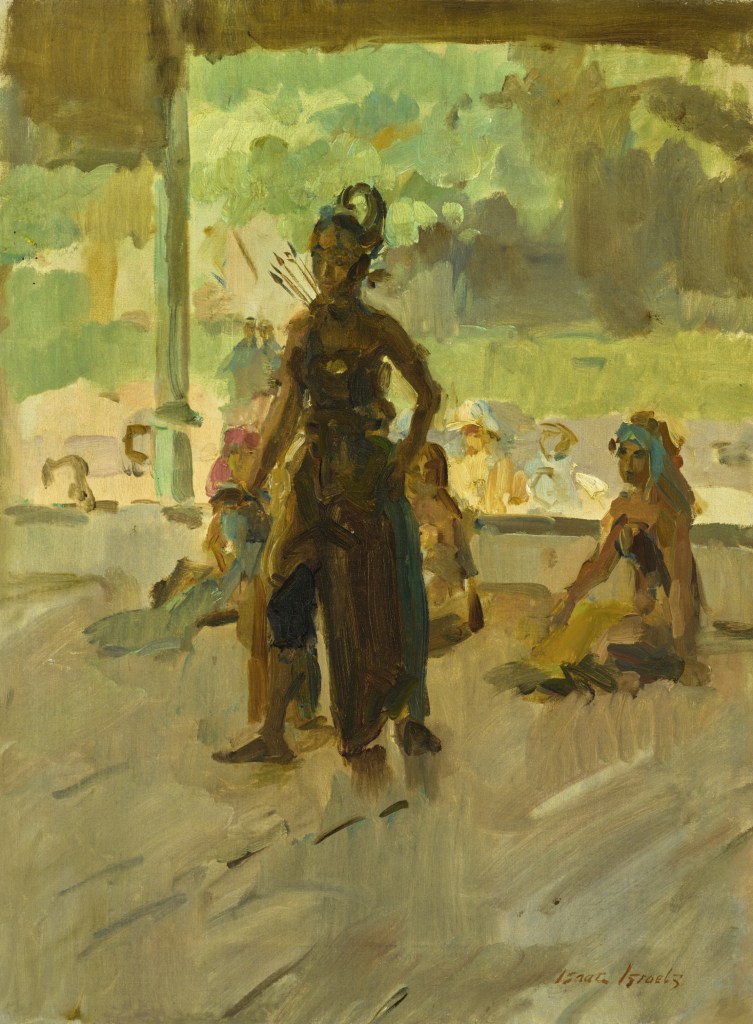
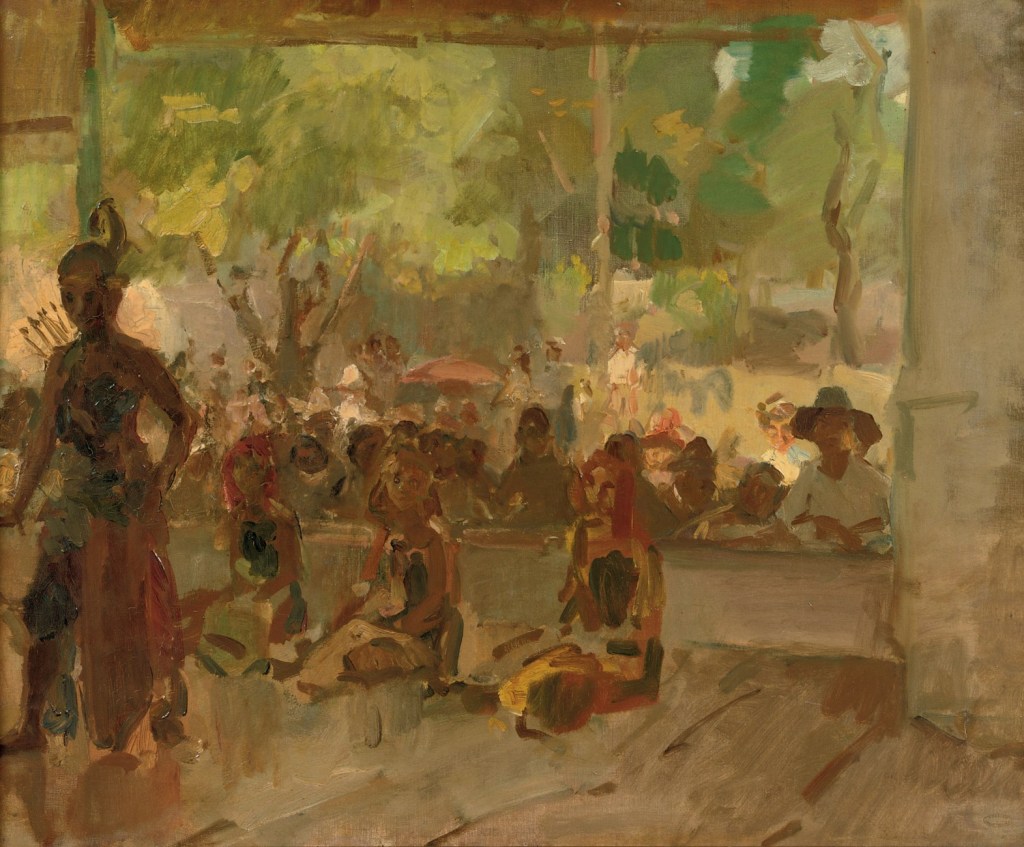
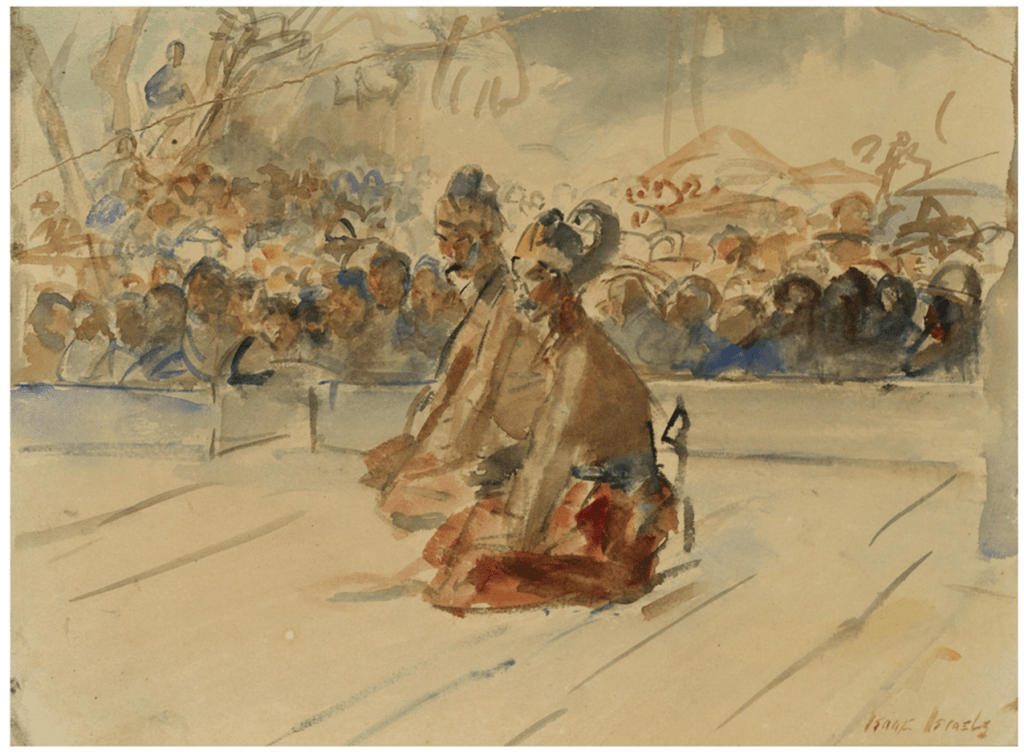
- Court at Surakarta – 1921-22 – Sotheby’s
- In the Pendopo – a Javanese dance performance 1921-22 – Christie’s
- An Indonesian dance performance
Israels’ interest in Indonesian dancing was aroused in 1898 when he attended an exhibition with visiting Javanese and Balinese performers. In 1921, he finally set sail for Batavia (modern day Jakarta), and stayed in The Dutch East Indies (modern day Indonesia) for more than a year, visiting the Kraton at Surakarta, Bali and Batavia. There, Israels sketched and painted the daily life of village and townsfolk as well as court scenes. Common to all images is Israels’ stunning use of colour and his characteristic manner of quickly casting the paint onto the canvas by means of a few swift brush strokes. But, whereas in all the previous dance images discussed, Israels is occupied with translating animated movement and rhythm onto paper, his Indonesian dancers, by contrast, are serene, composed and somewhat exalted. The whirling skirts, the turns, the rotation of the hips and shoulders and gripping focus of many previous images is replaced by a quiet stately pose. In the images shown above the dancers perform on an outdoor stage; the audience taking their place on the outside lawns. Israels creates a sphere, bathed in various shades of yellow and brown and further enriched with luscious greens, that unveils a mystifying world.
In his later years, Israels lived in The Hague. Being a theatre lover, Israels was often seen at the Scala Theatre. There he sketched scenes of performers in the wings, in the foyer, backstage and in the dressing rooms. He also sketched during the performance itself. He was fascinated by the enchantment of the theatre, but equally interested in the daily toil of the hard-working performers.
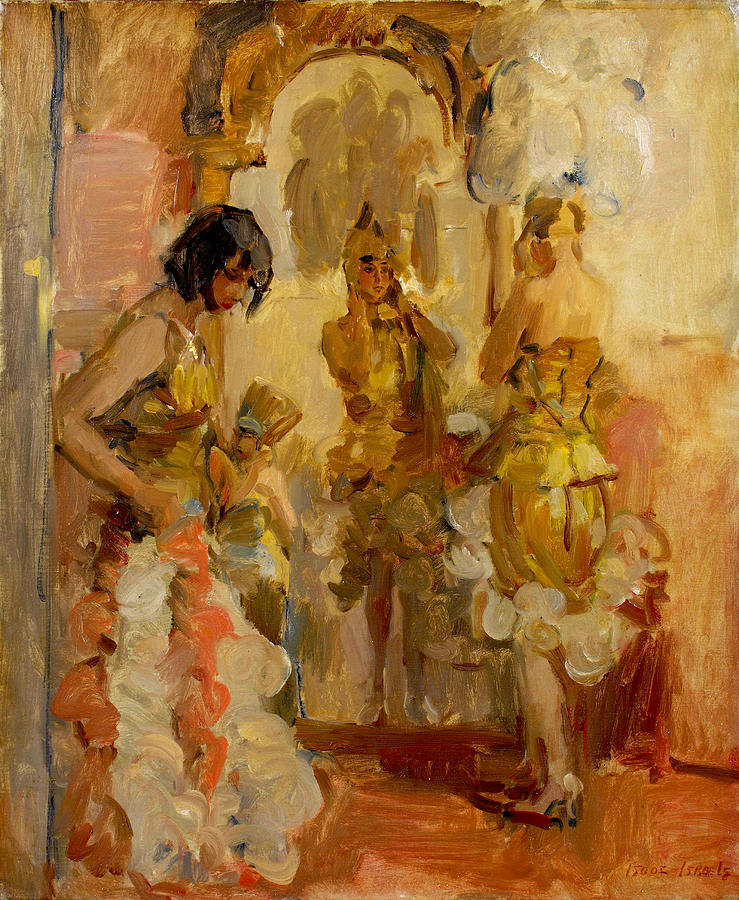

Before the performance at the Scala Theatre, The Hague between 1927-1934 – 79 x 65.5 cm – oil on canvas – Christie’s
Revue Girls at Scala Theatre, The Hague c. 1924 71 x 61 cm – oil on canvas – MutualArt (click on image to enlarge)
The two paintings shown above, despite their obvious glamour, disclose the stage-world behind the enchantment. Showgirls are seen rearranging their skirt, adjusting a flamboyant headdress or waiting in the wings. These, all preparations before the performance, are painted in Israels signature style; the quick, unerring brush strokes, a play of light together with his subtle use of colour.
And finally, the glamour of the performance itself. This beautifully dressed performer strides onto the stage ready to dazzle her public. She commands the stage. It is not inconceivable that Israels sketched this diva sitting, with pen and paper on his lap, among the audience.
Isaac Israels the man who so delights in the beauty of every passing scene** painted dance images throughout his entire career. This post and the three previous posts looked at the great diversity of dance images that the most celebrated Dutch impressionist painted. Israels interest spanned from whirling dancers in the café, young ballerinas, to folklore, show girls and theatre. One field still needs to be discovered; Israels painted numerous portraits of dancers. Israels’ portraits, including the portrait of Mata Hari, are the subject of the following post.
* Isaac Israels – Anna Wagner Meulenhoff Amsterdam 1969 p.7
** Isaac Israels – Anna Wagner Meulenhoff Amsterdam 1969 p.13


 DANCE IMAGES IN THE ART OF THE NETHERLANDS