The Dutch impressionist Isaac Israels lived in London from 1913 until 1914. The crowded streets of London, the busy traffic, pedestrians strolling along the Thames, Rotten Row, where the fashionable upper class was seen riding, and ballet girls, offered Israëls bountiful material and inspiration.
At the beginning of the twentieth century it was not unusual for well-to-do children to follow lessons in ‘fancy dancing‘, a combination of dance, deportment, and etiquette, as part of their education. Many youngsters also attended stage schools; these schools specialized in training their pupils for a stage career. Stage schools and ballet schools, especially after the London performances of Tamara Karsavina, Anna Pavlova, and the Diaghilev Ballets Russes, flourished. Which ballet school Isaac Israels actually visited in London was never documented, but judging from the technique that the young dancers display it was definitely a professional school. During his stay in London Israels resided in the Morley’s Hotel situated at Trafalgar Square. Most of his paintings in the 1913-14 period are situations and subjects of inner London, thus it is more than likely that the ballet school he visited was located in the same area. Well known schools at that time were Stedmans’s Dance Academy where Lydia Solokova, ballerina with the Ballets Russes, received her early training, Lila Field Academy, where Ninette de Valois founder of the Royal Ballet trained, and the Espinosa School of Dancing, home to many professional dancers. All my efforts to find vintage photographs of these studios have come to no avail; for now, the name of the studio will remain a mystery.
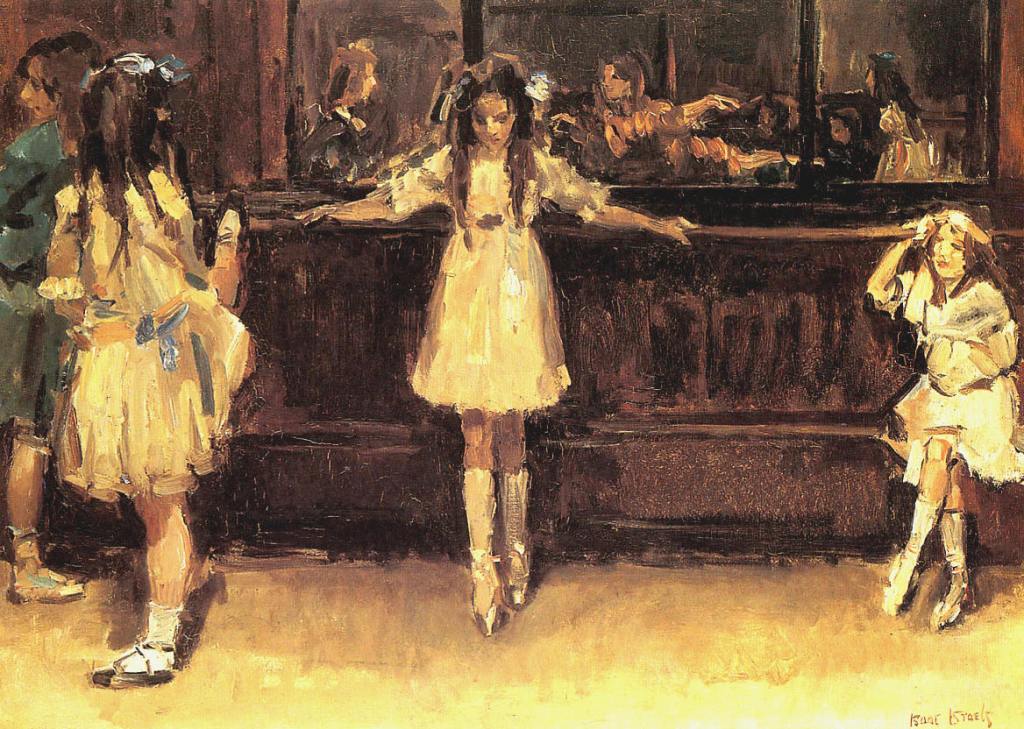
Israels painted a mere handful of ballet dancers. Unlike Edgar Degas, whom he greatly admired, Israels did not limit himself to professional ballerinas; he also portrayed young girls practising their ballet exercises in normal classroom situations. That Israels chose to paint young dancers is not surprising; children regularly appear in his work. It is little wonder that these frail, conscientious, ambitious girls attracted his attention.
Israels presents a ballet studio, where a few girls are practising their daily exercises. The knee-length practice skirts tied with coloured sashes, the long socks and the free-flowing hair bound with large ribbons, position the classroom in the early decades of the twentieth century. This is an accomplished ballet school; the centre girl, even though she is holding the barre quite firmly, is standing fairly correctly on her pointe shoes. She appears just a little uncertain and glances down at her feet to check her placement. The girl with her back to the audience has placed her leg on the barre; from a technical point of view quite an acceptable ballet position. Behind the girls there is either a second studio where people are waiting and practising, or perhaps this is a mirror reflecting the opposite side of the studio. The girl directly behind the centre girl is practising one of the most beautiful of all ballet steps, the arabesque, and to her left a lady appears to be playing the piano. There is no teacher to be seen, but, there is always the possibility that the teacher herself was accompanying the class on the piano; not an altogether uncommon practice, even today.
The painting resembles a snapshot. The girl standing on pointe is the focus of attention. With a little imagination this ‘snapshot’ might commemorate her first attempt at standing on the tips of her toes. As often seen in a photograph, some figures have been cropped and other people have been photographed unawares. Israels is known for his rendering of day to day situations; no doubt, Israels sketched this scene whilst watching class.
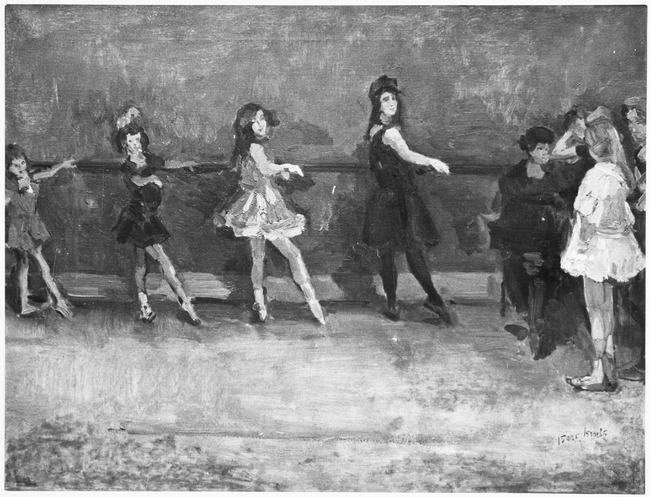
In this endearing painting, of which I could only find a black and white version, another aspect of the influence of photography emerges. This work, in all probability, illustrates the opposite wall of the studio where the young girl practices her pointe work. The pianist concentrates on her music; around the piano various girls are waiting. Some of these figures have been cropped. The greater part of the painting is reserved for four girls, ranging in length and age, practicing a ballet movement known as battement tendu. There is nothing unusual about the execution of this movement except that all the faces are looking directly towards the onlooker. It is possible that the teacher directed the pupils to use this specific head movement in conjunction with the extension of the foot, but to my mind it appears more like a photographer is asking the girls to say cheese.
Most dance schools, and most especially stage schools offered their pupils an opportunity to perform. Teachers feverishly prepared their pupils to attend auditions for theatrical productions, often the Christmas pantomime. If selected, the young dancers were expected to work, long hours, on a daily basis. Hilda Munnings (1896-1974), later to become the ballerina Lydia Solokova for Diaghilev’s Ballets Russes, recounts that as a pupil at Stedman’s Academy in 1910, she danced six matinées a week for which she was paid one pound.*
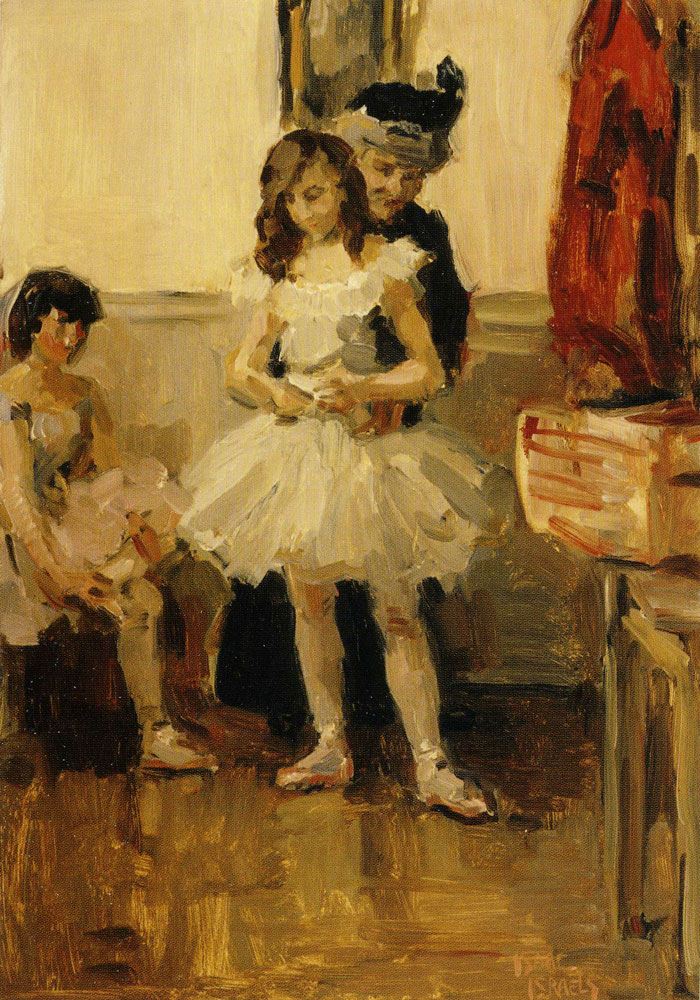
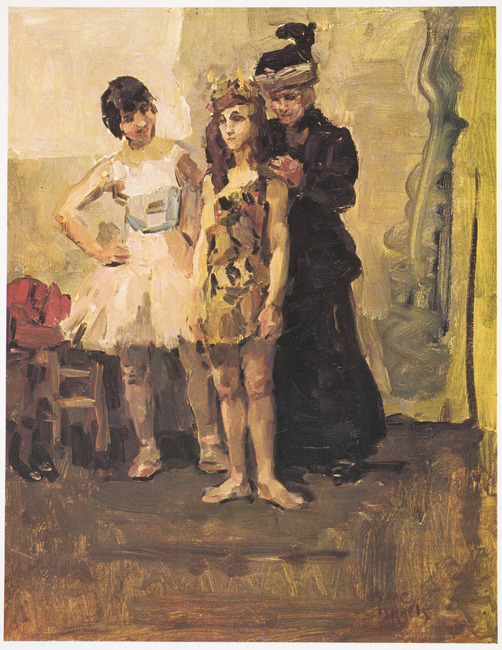
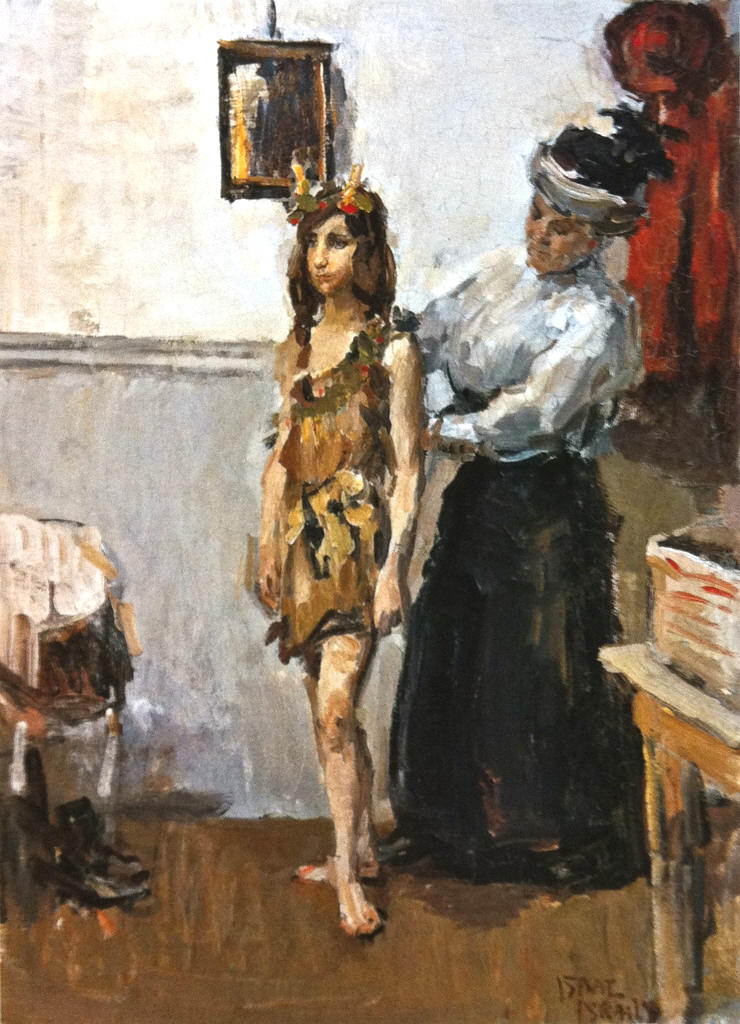
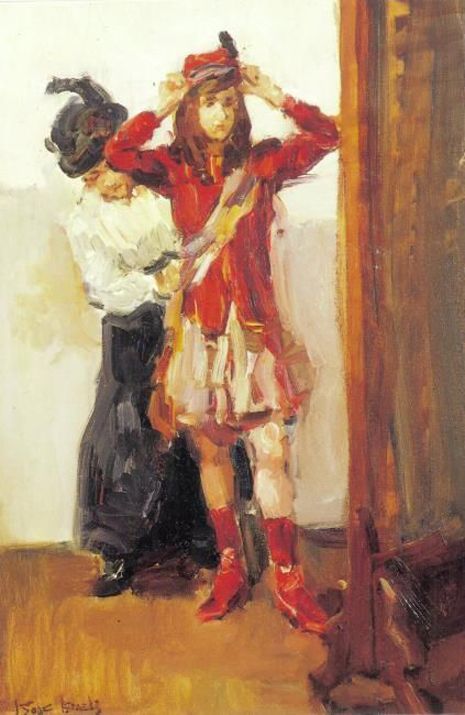
- Ballerina Dressing – 1913 – Kröller-Müller Museum
- The Fitting-room – 65 x 50 cm – RKD – private collection
- In the Dressing room – Museum De Fundatie, Zwolle
- Dressing room – a folk dance costume – (click on each individual image to expand)
The above four paintings are a selection from a series of young dancers in a theatre dressing room; a mother or a dresser is helping a girl with her costumes. The performer, the same in each image, resembles one of the girls in the ballet studio paintings. There is nothing especially glamorous about these images; just snapshots of a girl preparing for a performance. Israels paints the young ballerina waiting patiently as her costume is being adjusted; you can see the tension and concentration on the girl’s face. In the same snapshot another young budding dancer waits patiently; this figure has been cropped. The second painting reveals a change of costume; the ballerina, still very placid, is exchanging her tutu for a Greek tunic. Her companion ballerina looks more relaxed. In the last two paintings, the dresser, who must have been on her feet for hours, has removed her jacket. Diligently she continues to arrange, first the girl’s Greek and then the Scottish costume. Israels in this series gives a glimpse, just as Degas with his dancers at the Paris Opèra, of normal backstage practice; showing the dancers waiting, working hard, their expectations, and their daily routine.
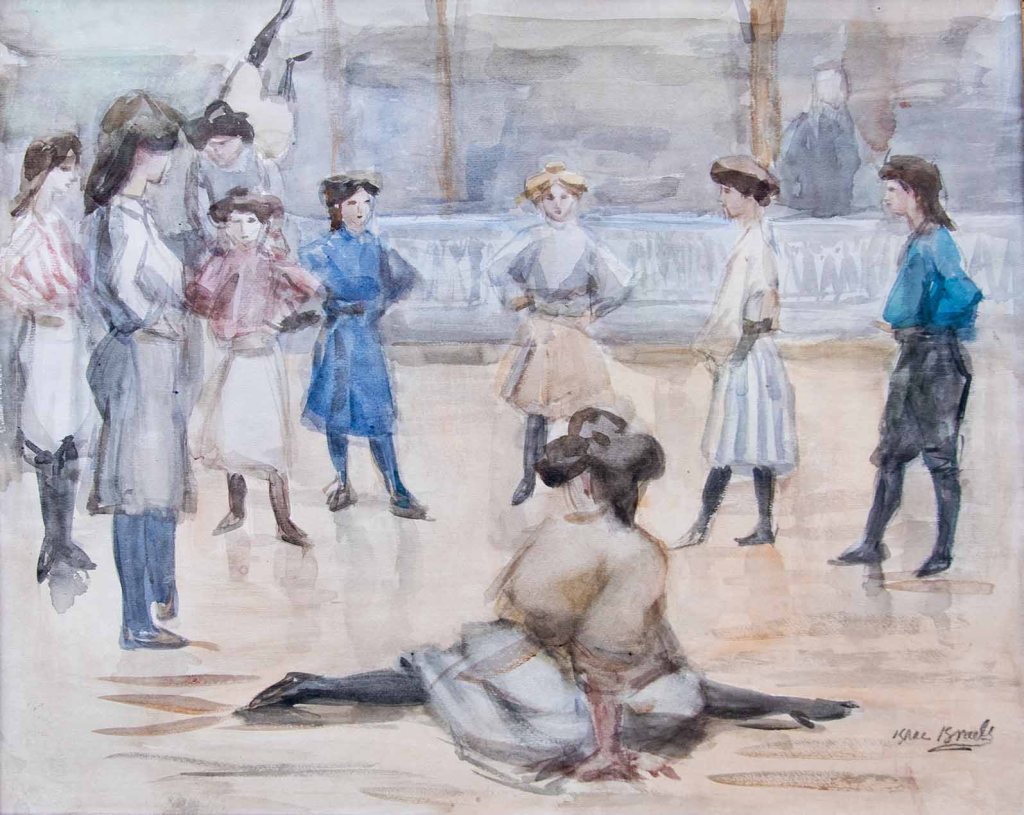
One by one the girls practice their splits; an accomplishment necessary for every would-be professional dancer. But there is more going on; to the left, one of the girls is practising a handstand on the shoulders of another girl. No mean feat, but the supporting girl, nor for that matter, the other girls seem to pay the acrobat any attention; in fact more girls stand astride with hands placed firmly on the hips. More than likely this is a classroom exercise to be practised with each individual pupil. A stage-school catered for all forms of theatrical dance and acrobatics would certainly have been on the curriculum.
Dancers in a Ballet School is far more luminous than the other paintings discussed in this post. Ballet School in London has an overall brown tone, with just a touch of blue and some green on the outer cropped edge. Light falling on the dresses gives them a yellowish glow, and the girl’s themselves fuse into the general brownish coloration. The dressing room paintings, though definitely using more variation in colour, cannot be classified as bright. Dancers in a Ballet School has a constant light over the entire image. The fleeting onlooker is led astray. The overall light gives the impression that this limbering class takes place outdoors. This impression may linger on were it not for the area behind the dancers. A brief comparison of both images reveals an unexpected twist. The panels are similar and the window/mirror is identical. Furthermore, in the watercolour there is a figure, either watching the class or being reflected in the mirror (your choice), not dissimilar to the figures in Ballet School in London; both images despite the great discrepancy in colour and technique were painted in the same studio.
Many artists paint ballerinas, dancers on stage, and dressing room scenes, but as far as I know Israels is the only Dutch artist to paint ballet pupils in a classroom setting. The twentieth century Dutch artist, Willem Dooijewaard (1892-1980), painted a large collection of ballerinas, including a few of young girls working in the studio. Dooijewaard’s charming ballerinas are decorative and graceful. Isaac Israels, however, presents young dancers practising their day to day routine; an intriguing insight in an early twentieth century ballet class.
* Dancing for Diaghilev. The memoirs of LYDIA SOKOLOVA : edited by Richard Buckle p.8


 DANCE IMAGES IN THE ART OF THE NETHERLANDS