When Isaac Israels (1865-1934), settles in Paris in 1904 he was already a fully-fledged artist. Son of Jozef Israëls, a major Dutch artist, Isaac, an impressionist, was inspired by the everyday life. He painted street scenes, park scenes, working girls, nursemaids, people relaxing in cafés and many dancers. His oeuvre includes, dancers in cafés, Spanish dancers, Javanese dancers, show dancers, Ashanti dancers, pupils of a ballet school in London and even a full-length portrait of Mata Hari.
Isaac Israels had already visited Paris numerous times, but it was not until 1904 that he decided to settle there for a longer period. Kees van Dongen and the Swiss born, French print designer Théophile-Alexandre Steinlen were among his friends. The daily hustle and bustle of Montmartre, the lively boulevards full of local people, the fairs, the circus, street musicians and the cafés, all enthralled him. Israels was a regular guest at Aristide Bruant’s cabaret (Le Mirliton), the Moulin Rouge and, just like Kees van Dongen and Toulouse Lautrec before him, the Moulin de la Galette.
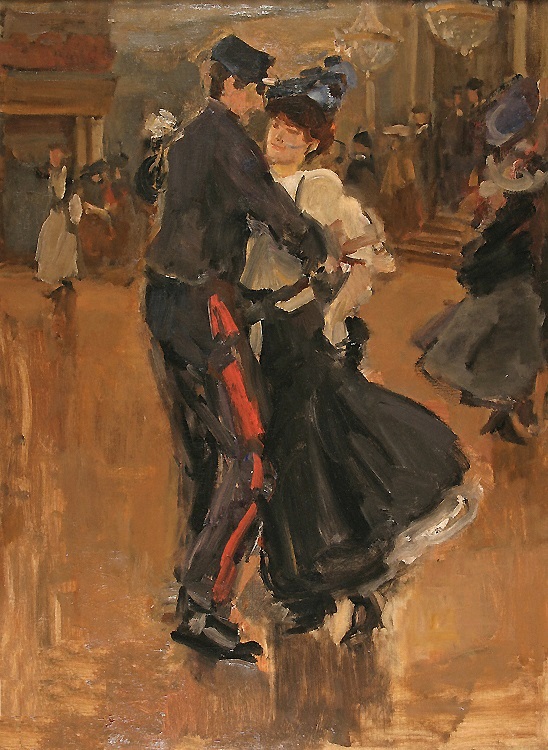
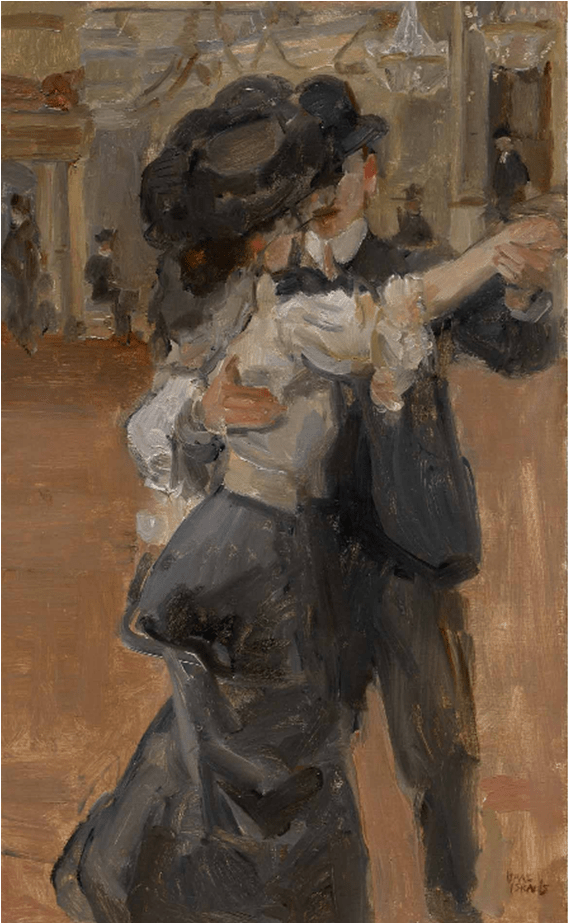
Isaac Israels – Dancing couple at the Moulin de la Galette – c. 1907 – 54 x 33 cm – Kunsthandel Ivo Bouwman (click on image to expand)
In most paintings of the Moulin de la Galette whether by Renoir, Toulouse-Lautrec, Picasso or Kees van Dongen, the dance hall is always crowded, crammed with dancing, drinking and chattering merrymakers. Isaac Israels paints a different picture. The above images, give a more personal scene, describing two people dancing affectionately. The large dance hall is practically empty. A few guests are walking down the stairs and others are seated on a bench. Israels has painted the dancers from the same angle, placing both scenes in a similar, if not the identical setting; in both paintings there are chandeliers, stairs (not visible in the right painting) and columns. The left image presents a young woman dancing with a military man; possibly there is another couple dancing behind them. The right image illustrates, I presume, a somewhat older couple, but this is not easy to see since both faces are concealed. The younger couple is situated in the absolute centre of the canvas, portrayed from head to foot. There are no musicians to be seen, but looking at the woman’s swinging skirt and her swift footwork, they are most probably dancing a lively fashionable dance. The military man holds his partner just tight enough to facilitate the lively dance movements. This is a fun-loving pair, enjoying themselves. The right couple appears to be the only couple on the dance floor. Even the other guests seem oblivious of their presence. The gentleman holds his partner tenderly; his arm placed well over her back. They are deeply involved with each other. Israels gives no indication as to how they are dancing having cropped their feet entirely. In both these paintings, Israels, pays particular attention to the background, the body language and the couple’s physical interaction. He sympathetically illustrates human emotions of everyday people in common situations.
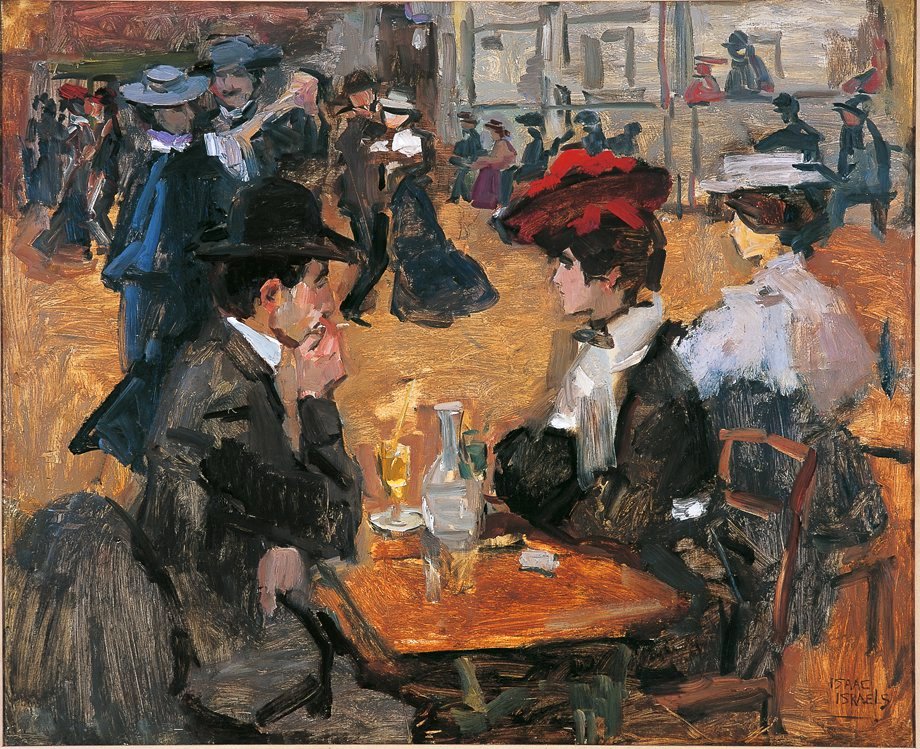
Le Moulin de la Galette, besides being a popular dance hall, was famous for its galettes, a delicious bread brown, often served with wine. All women, even those with somewhat looser morals, had a free entry. Around the dance floor there was ample space to sit, eat and drink. Israels painted a series of canvases showing a man and woman seated at a wooden table, with people dancing in the background. Nowhere is the Moulin de la Galette ever crowded, nor light-hearted or exuberant as in the works of Renoir or Kees van Dongen. The sphere is muted; Israels predominately uses black and various shades of browns supplemented with an occasional red hat, a white scarf or a sombre blue dress, and even those colours are subdued. The image, shown above, is painted from a high vantage point; Israels was probably originally sketching from the balustrade. He zooms in on a couple, seated at the edge of the dance floor. They are well-dressed, as all the guests present. The man smokes a cigarette. He has a glass of wine in front of him, his lady friend, judging from the green liquid, a glass of absinthe. You will recall that absinthe has a high alcoholic percentage and once thought to be a hallucinogen.
Who are these people? What are they talking about? Have they come to the Moulin de la Galette for a night out? Why is she drinking absinthe? Are they friends? There are more questions than answers, and we can only guess their relationship. In the above painting, the two appear to be distant; the woman is definitely eyeing the man. The woman to the right, in the white blouse, like the figures ‘glued’ against the walls, waiting for an opportunity to dance, seems forlorn. To my mind, there is little cheerfulness in the dance hall; just three couples on a nearly empty dance floor. In the background, placed conspicuously exactly in between the seated couple, another very similar couple is dancing.
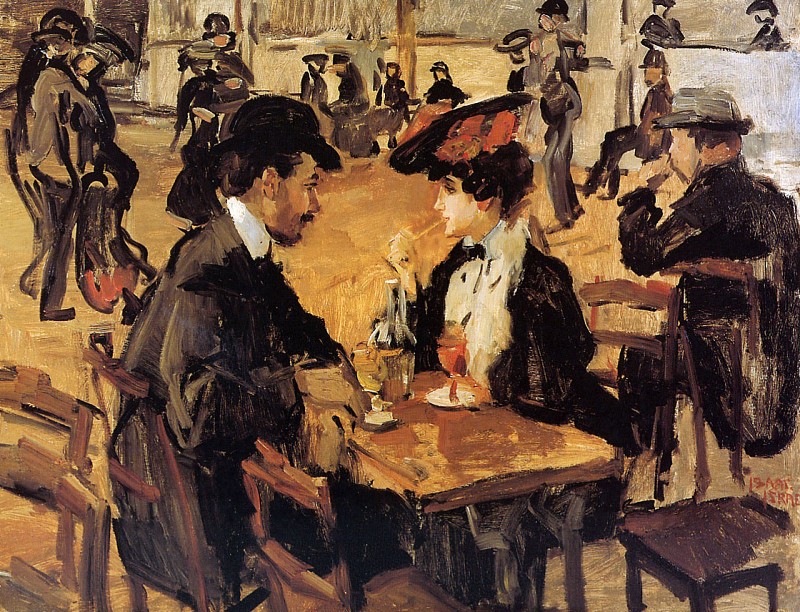
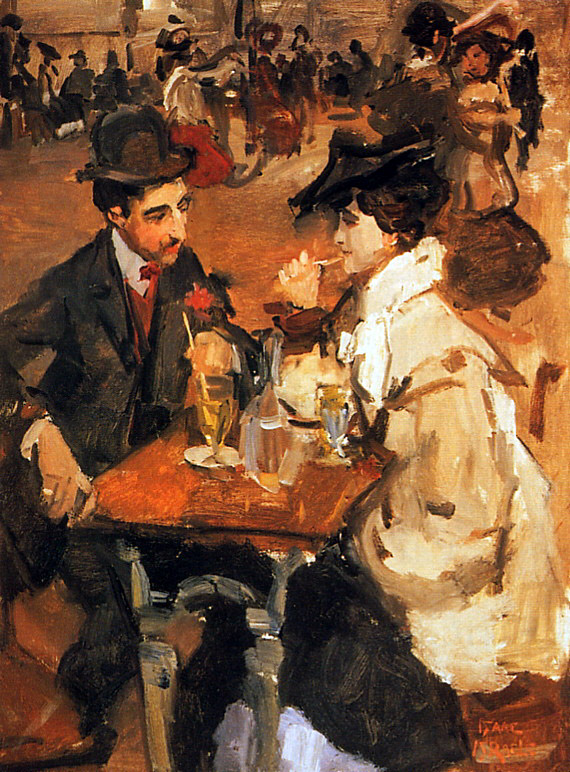
Isaac Israels Left: Café Dansant – Moulin de la Galette – 1905-6 – private collection & Right: Moulin de la Galette – c. 1905 – private collection (click on image to expand)
The above two paintings have a very similar composition. The front couple remains the focus of attention. The man and the woman, in the various paintings, look terribly alike. Are we looking at the same couple on subsequent days? These paintings show, once again, a near-empty dance floor, save for a few solitary dancers. A greater rapport has developed between the couple; the man advances slightly forward and the woman, though still sitting well-poised, is more inclined towards him. The painting on the right shows the couple in a more intimate conversation, both leaning slightly towards each other. In the background, as in the other paintings, a few isolated people are dancing.
The actual depiction of the dancers, in all the canvases, is sketchy. Rough black outlines, coarse shapes, and uneven brush strokes are common to all the dance figures. Their contours are unrefined; it is often the sway of the woman’s long skirt that suggests movement. With one or two exceptions, the faces are vaguely rendered. Rough as these dancers are portrayed, the figures can be seen embracing, twirling under a partner’s arm, dancing intimately and dancing side by side. All the dancers, small in relation to the front couple, are banned to the background. Dancing is by nature a joyous activity, but these dancers are primarily solitary figures, circulating in a none too jolly dance hall.
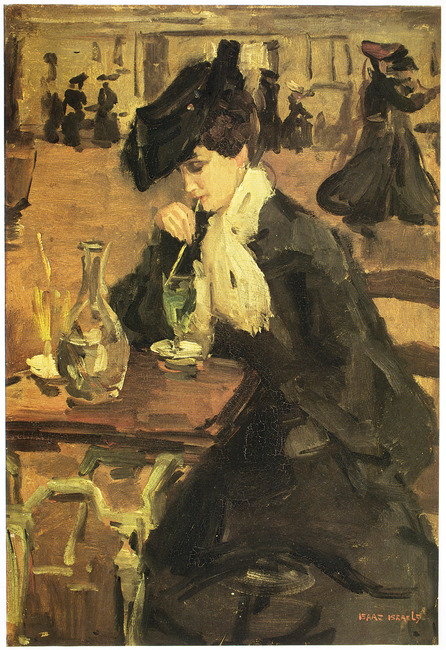
The woman is totally alone. She is drinking a glass of absinthe. Israels has not painted a vacant chair, so I presume she is not waiting for her male friend. Around her, the large hats lead me to believe, that only women are present. Except for her white scarf she is totally dressed in black, just as the dancing women directly behind her. Here, as in the entire series painted in Le Moulin de la Galette, Isaac Israels, reveals the more melancholic side of the dance hall. Israels juxtapositions the pleasure of dancing against the ambivalent relationship of a man and a woman.
As I wrote this post, a ballet by the superb Dutch choreographer, Hans van Manen, came to mind. His specific use of body language and the clear-cut focus he demands of his dancers make him a master at conveying human relationships. Van Manen is also a fascinating photographer and this photographic aptitude is, at times, unified into his ballets. In The Old Man and Me, a piece made for Netherlands Dance Theater III, van Manen unfolds the ending of a relationship through a set of five ‘snapshots‘.
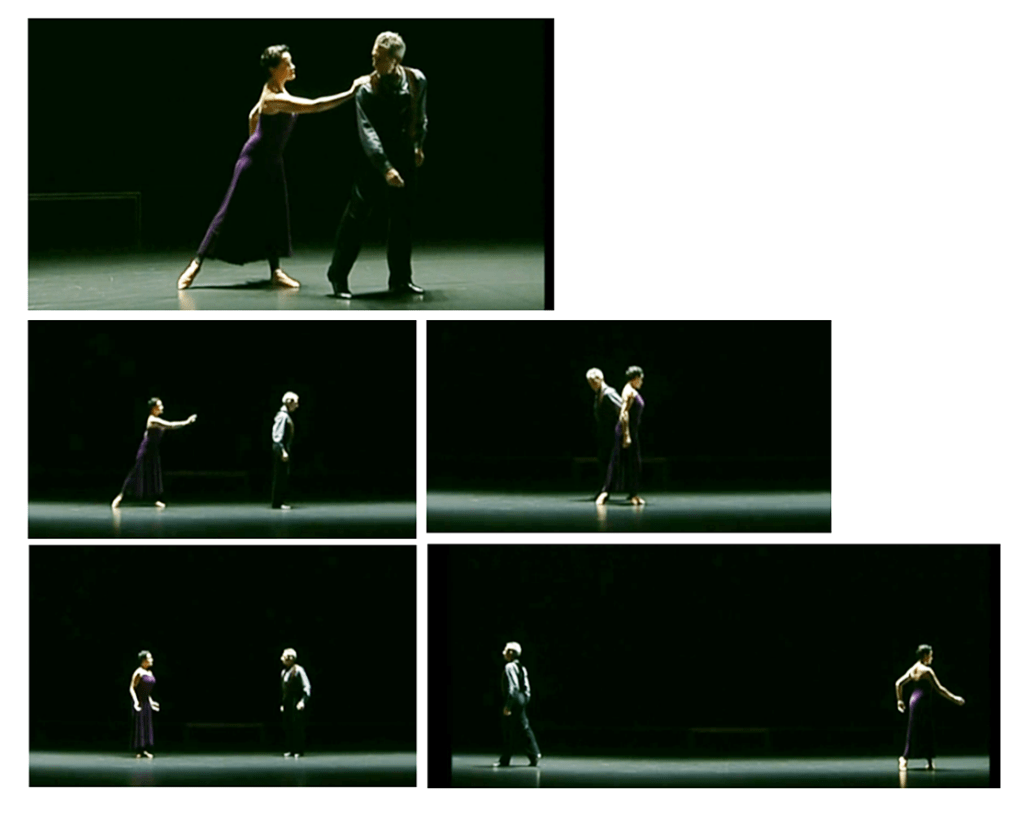
These photos show the very last moments of the ballet where the man and the woman end their relationship. Between each photo moment there is a short blackout. One last photo shows a totally empty stage, with only the green floor light still glowing.
Historically, there is no connection between Isaac Israëls and Hans van Manen. What I find fascinating is that both these artists fuse dance and art, using both art forms to express intense human emotions. Israels, in his Moulin de la Galette series, uses dance as a delicate metaphor hovering in the background of two ambiguous people. Hans van Manen embodies five ‘live‘ photographs that, say, all there is to say, about the relationship between this man and this woman.


 DANCE IMAGES IN THE ART OF THE NETHERLANDS

