Bal du moulin de la Galette, that immensely popular painting by Pierre-August Renoir, shows Parisians, dancing, drinking, and socializing, in the open air dance hall, Le Moulin de la Galette. Henri Toulouse-Lautrec’s painting Moulin de la Galette presents an interior scene of the same establishment showing the darker side of Montmartre, where women of ill repute frequented the cafés and roamed the streets. The Dutch artist, Vincent van Gogh, who lived near the Moulin de la Galette, painted various works of the old mill and its surroundings; he, however, never painted the fun-loving Parisians dancing in the celebrated, frankly infamous, venue. His fellow countrymen, Kees van Dongen (1877-1968), Isaac Israëls (1865-1934), and Jan Sluijters (1881-1957), who all lived in Paris for some time, found their inspiration in the boisterous nightlife of Montmartre and were frequent visitors at the Moulin de la Galette. The café’s proprietor, thankful for the free advertising, welcomed up and coming artists; he specifically kept a space free for them.
(click on image to enlarge)
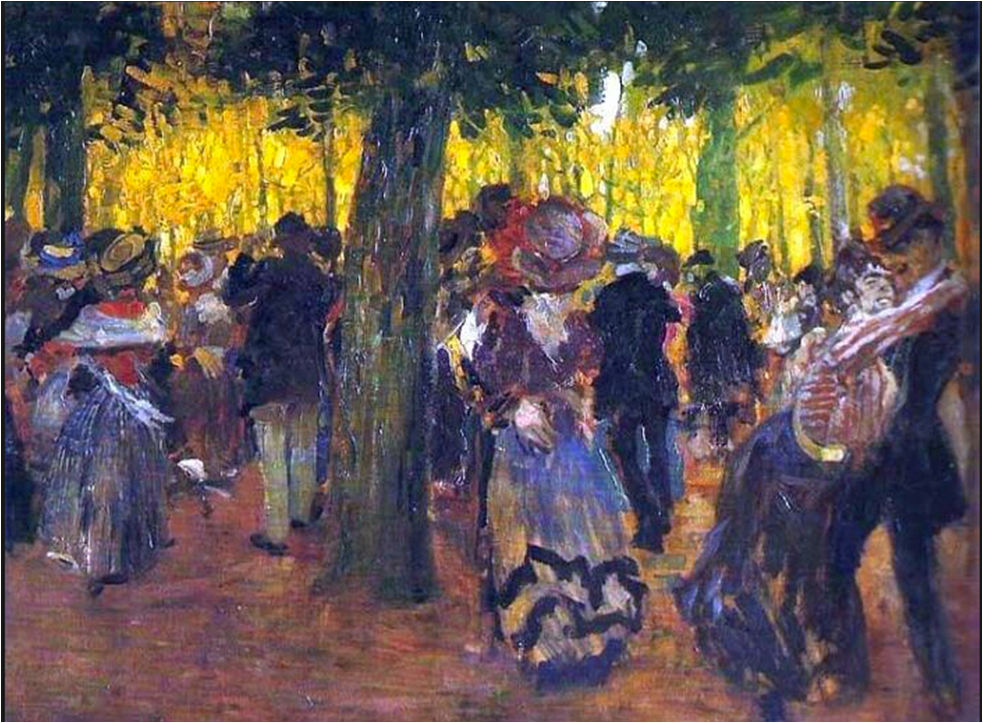
In the summer months the dance hall, Le Moulin de la Galette, opened the adjoining garden. Renoir’s famous painting presents a summer scene; friends chatting around a table, couples dancing, kissing, and hugging. The colours, the light, the guests, including the dancers are exuberant, so much so that you may forget that Montmartre was not a particularly respectable neighbourhood. Kees van Dongen, has painted the same garden as Renoir but where the French artist treats us to fairly natural colours, van Dongen, a Fauvist, uses an excess of pink, mauve and blue hues. For the most part, he retains the natural colour for the trees, in exchange for the artificial yellow glow extending over the entire breath of the canvas. The artist leads the viewer, bypassing a large tree trunk, into a garden full of merrymakers. They appear to stand in a scattered type of semi-circle amusing themselves. The two couples, just right from the tree, hold each other closely, moving inseparably to the rhythm of the music. All the guests have their backs turned to the viewer, except the distinctly affectionate couple on the right. She, possibly a seamstress, a laundress or woman of questionable repute, throws herself into the arms of an impassioned man; both are visibly ecstatic.

(click on image to enlarge)
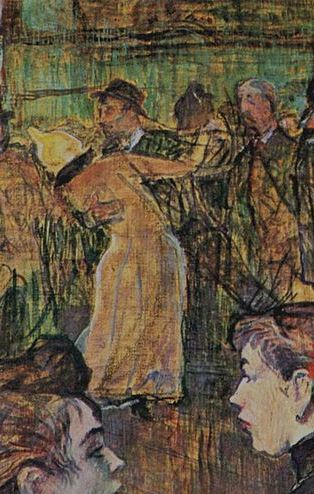
Kees van Dongen admired the work of Toulouse-Lautrec; the above two images of dancing couples, are interestingly similar. Apart from the sketchy approach, the rough brush work and the constrained use of colour, I am most amazed by the similarity in movement and in characterization. The man in Toulouse-Lautrec’s rendering and the woman in van Dongen’s painting both assume a long lunge to form a diagonal line. Toulouse-Lautrec’s gentleman sturdily grabs his partner as she leans decidedly sideways, just as Van Dongen’s chap supports the woman as she plunges towards him. Not only is the composition of the figures well-nigh interchangeable, but in both cases the gentleman is an unsavoury character. The expression on the face of Van Dongen’s figure is especially dubious. Toulouse-Lautrec and Van Dongen painted real-life situations and their paintings reflect the reality of life in the Montmartre.
(click on image to enlarge)
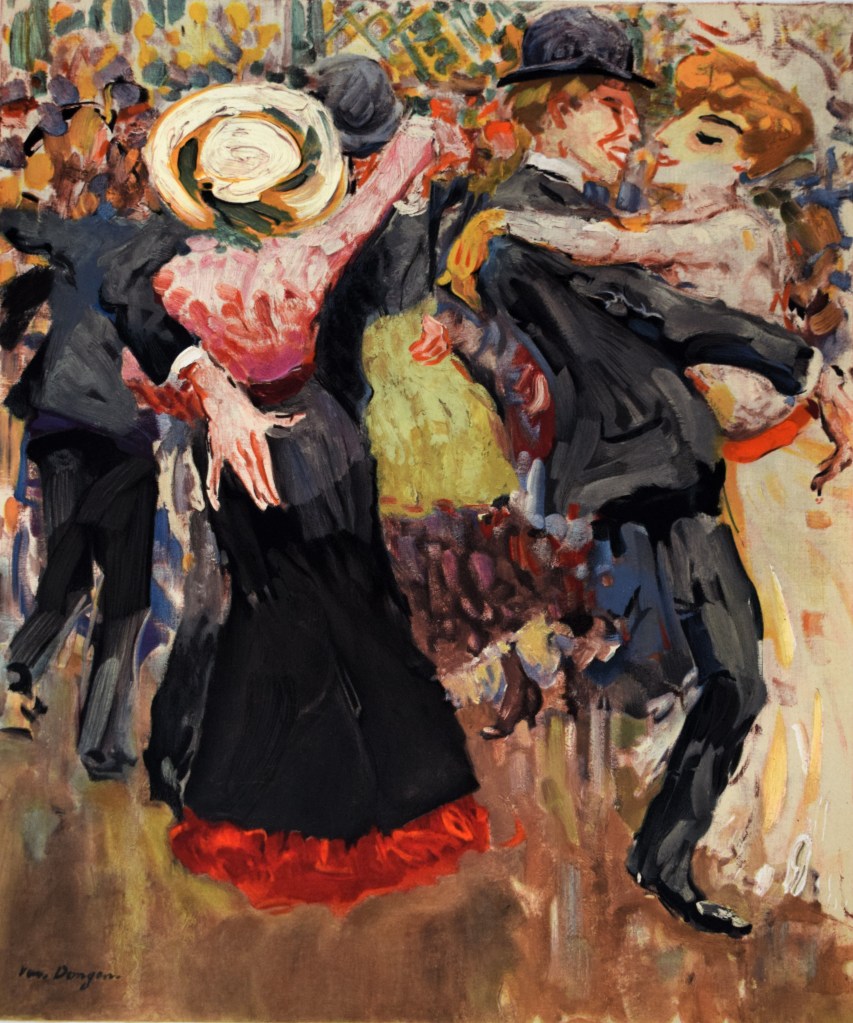
Montmartre offered Parisians entertainment, amusement, dance, and not to forget, flirtation. The cheerful, chirpy dance, the Matchiche, (also spelt Mattchiche) danced to a catchy melody with mischievous lyrics about a robust Spanish fellow, visiting the Moulin de la Galette, teaching a certain mademoiselle a new dance, became a craze. The song, La Mattchiche, popularized by Félix Mayol,* was a tremendous hit. Kees van Dongen, himself a passionate dancer, would most certainly have danced this vivacious, lighthearted dance. His painting captures the effervescent sphere of partygoers at the Moulin de la Galette, prancing to the lively rhythm of this vaudeville-like dance. The dance hall is filled to the brim; two couples dominate the painting. Behind them, mostly represented as dots and dashes, are many more revellers. The two prominent couples are obviously absorbed in each other’s presence. The left couple, whose faces are hidden from our sight, dances intimately; the man placing his large stretched hand unhesitatingly in the woman’s buttocks. In composition, they are remarkably similar to the couple standing nearest to the tree in Bal au Moulin de la Galette. Only the right couple shows their faces; they obviously enjoy each other’s company. The woman’s dark eyes and equally dark eyebrows are typical of van Dongen’s portrayal of the female face. And the man, smiling gleefully, pushes his entire body firmly against his partner. The risqué sphere of the Moulin de la Galette is set; music, dance, drink, romance and quite possibly, the rendezvous.

This originally large canvas, stretching over two meters, remained in Van Dongen’s possession until the 1950s, when the artist decided to divide the work into six segments. Each segment was sold separately. For the purpose of this post, I have placed the segments in their original setting.
Top row – Moulin de la Galette – private collection Monaco, The Chandelier – Nouveau Musée National de Monaco, The Cellist – The Courtauld Gallery, London
Lower Row – Moulin de la Galette – private collection, Moulin de la Galette – private collection , Moulin de la Galette – private collection
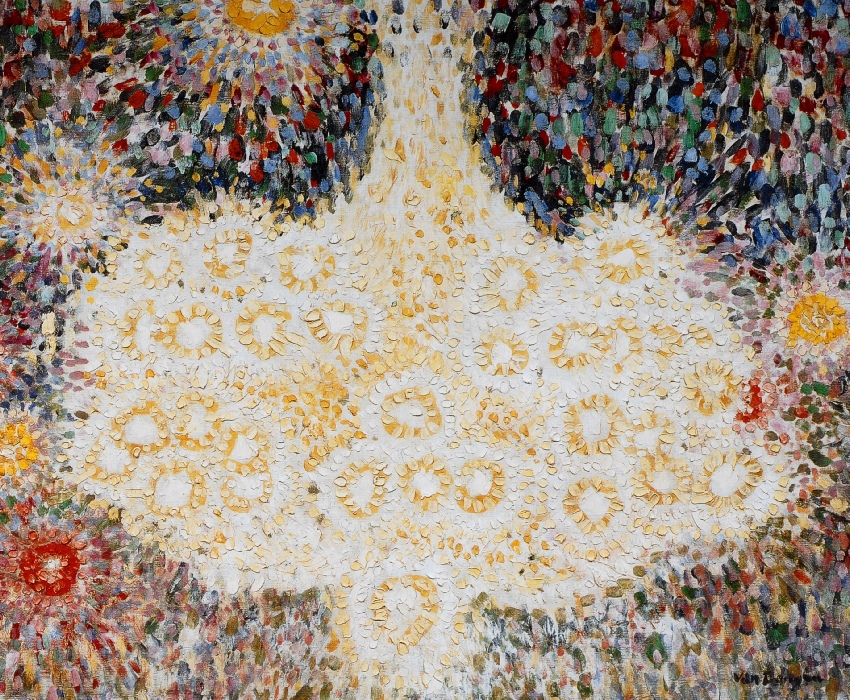
Where Renoir, three decades earlier, painted a pleasant outdoor scene of Parisians dancing and drinking cordially under the shade of some lovely old trees, van Dongen exposes the legendary dance hall under the sparkle of modernity. The electric lights embrace the entire dance hall. In the top section of this large painting, the overpowering chandelier is positioned in the absolute centre, escorted, on both sides, by dazzling coloured lights; they hover as stars over a large crowd of pleasure seeking public. The lowest layer of the painting is stacked with revellers, although, only a few figures are actually recognizable. Even then, we only see them from the waist up, or looking the right lower panel, just part of the face as the woman walks ‘out of the painting’. Despite the fact that none of the figures are actually dancing in the conventional sense of the word, Van Dongen has genuinely captured the sphere of this nocturnal festivity, highlighting the invigorating energy of the dancers on the dance floor.
Equally, stunning is Van Dongen’s specific brush stroke. Paul Signac and Maximilien Luce, friends of Van Dongen, experimented with an exaggerated form of Divisionism. The myriad of small points, typical of Georges Seurats’ work, made way for larger dots, strokes and stripes, giving a mosaic-like impression. Van Dongen combined this technique with impastoed daubs of paint; the resulting effect is no less than incandescent.
(click on image to enlarge)
As the years passed, Van Dongen became more interested in painting high society. He did, however, when well into his eighties, revisit Le Moulin de la Galette. In 1965, together with a group of French artists, he commemorated the life of the French writer and friend, André Warnod, in Les Peintres mes Amis, a book filled with a collection of lithographs.
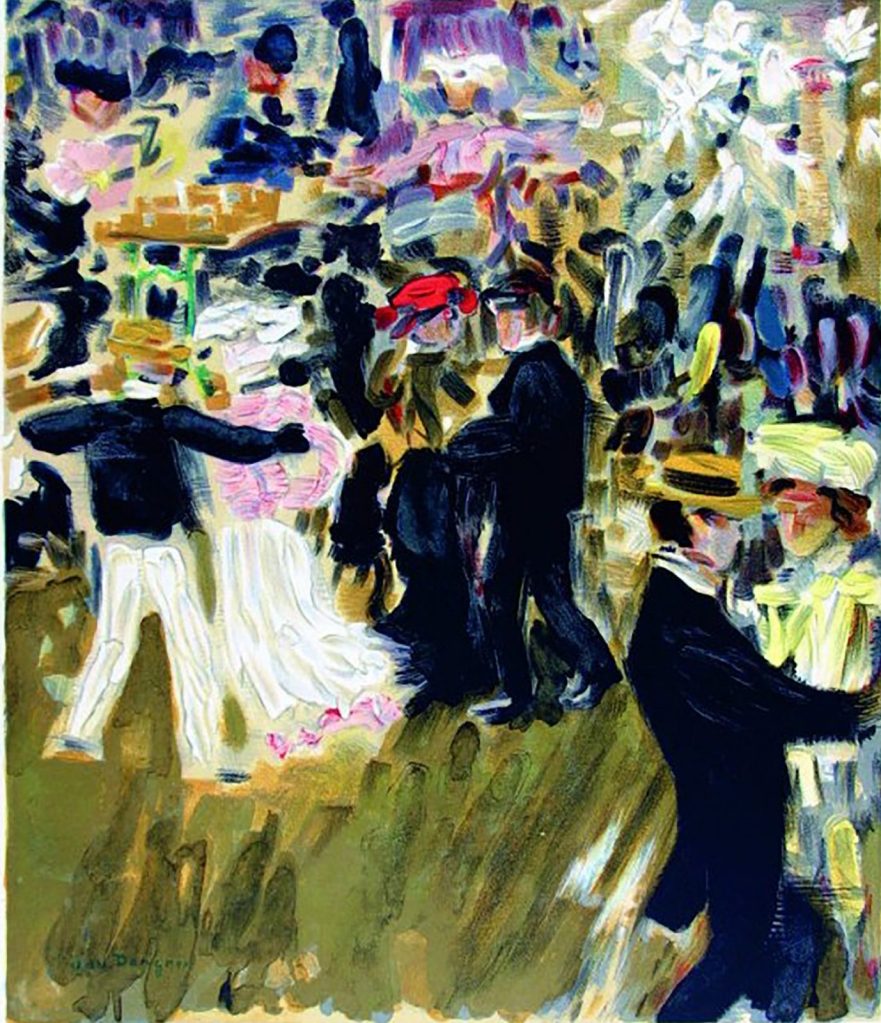
from Les Peintres mes Amis – tribute to André Warnod
(click on image to enlarge)
The characteristic van Dongen elements are present; vibrant colours, brilliant white light, strokes and dashes and a rugged brush stroke. The top right corner is occupied by a flashing light source, and vaguely recognizable shapes are intermingled between the scintillating patches and strokes. In front of this kaleidoscope, three couples can be seen dancing. We have no way of knowing which dance they are enjoying. There are no musicians to be seen, and the title offers no clues. It may be my imagination, but this lithograph appears to transverse time. The centre couple, in black with the man wearing a bowler, looks old fashioned. The lady with the red chapeau and her partner dance formally, retaining an appropriate distance. The more fashionable right couple dance rather intimately. More to the left, there is a dashing man in white trousers. He and his fleet-footed partner are dressed in 1930s attire. Just for interest’s sake, take a close look at the man’s legs; you can literally see the bone structure of his pelvis and legs. Is this vibrant, lively lithograph in reality the artist, once a particularly good dancer, reminiscing? You will remember that Van Dongen was an excellent dancer. According to his second wife Marie-Claire, all Paris was aware of his extraordinary dancing skills. Be what it may, Kees van Dongen, in this lithograph and in so many of his dance images, fascinates our imagination to this very day.
* This link will take you to a delightful You Tube film of Félix Mayol singing and ‘dancing’ , La Mattichiche – 1906


 DANCE IMAGES IN THE ART OF THE NETHERLANDS

