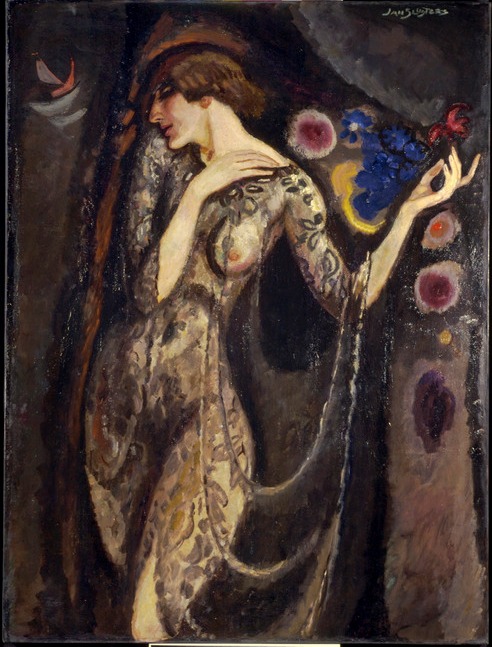
Not long after the Prix de Rome scholarship was revoked,* Jan Sluijters left Amsterdam to work in the countryside. He devoted himself to a variety of subjects, including landscapes, portraits, and nudes, and practically neglected dance. Years later, the German expressionist dancer Gertrud Leistikow revived his interest. Leistikow had toured regularly in the Netherlands since 1914, but it was not until around 1917 that Jan Sluijters actually saw her dancing. Leistikow was slender, agile, and elegant, using shawls, veils, and masks, to enhance her performance. One of the earliest paintings, acknowledged as Gertrud Leistikow, shows the dancer virtually nude, covered sparsely with a black lace diaphanous veil-like drape. Contrary to Sluijters previous dance works, take for example the explosive Spanish dancers and lively nightclub dancers, painted in what is often referred to as his Wild Years, this dancer is serene, not to say, refined. Sluijters has painted a sensual woman, gently poised in a delicate curve, with her left breast, though covered, unmistakably visible. The soft contours of her graceful body compliment her partially concealed face whilst her expressive elongated hands, especially the left hand, are highlighted. The light falls explicitly on her long neck and on her eloquent hands, appearing all the more luminous when set against a dark setting. A few blue flowers emerging from a yellow source and some coloured shapes placed gently near her hand, softens the otherwise ambiguous, somewhat sombre background. One could ask; are we looking at a portrait of Gertrud Leistikow, the dancer or Gertrud Leistikow, the elegant, lithe, arousing woman?
The same question does not apply to the following painting, often recognized as Gertrud Leistikow, although the RKD(Netherlands Institute for Art History) designates the painting as Dancer. Two aspects are certain; the painting, whether or not actually Leistikow, was inspired by the dancer and secondly this painting depicts a dancer genuinely dancing. The full-length figure, set in an enigmatic surrounding, with only a stem laden with a few green leaves rising out of a yellow vessel, perhaps a vase, and three white circular shapes, is not dissimilar, in composition, to the 1918 portrait. The shape of the dancer however is; she is graceful, and although the 1918 portrait shows a slender Leistikow, there is no denying that this figure is disproportionately long and overtly slender. Sluijters at the time, showed a marked interest in mannerism; his portraits, whether nude or practically nude, feature an improbable female physique.
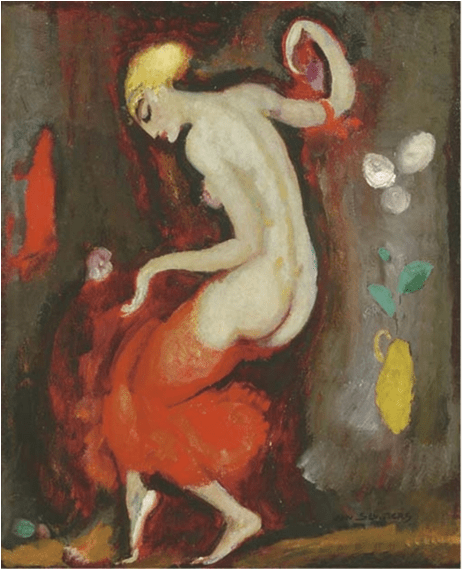
Sluijters has moulded the dancer into one continual soft curve flowing from her crown to her feet. Light illuminates her entire body, not only drawing attention to her refined, contemplative face, but emphasizing her backbone, her clearly defined buttocks, her suspended arms, and her uncommonly long fingers. Less conspicuous, though clearly visible, is the one breast protruding from behind her folded arm. Counterbalancing the nudity, Sluijters has placed a red covering, perhaps a veil, over her thighs. Whilst she moves, the red cloth widens out around her calves. The same red hue is repeated in the bow decorating her lifted arm. At times, Sluijters also outlines her nude body with a red border stripe, and also, reminiscent of Kees van Dongen’s work, with a line of green paint. Dancer, though different in subject matter to the paintings in his Wild Years, irrefutably demonstrates Sluijters impressive capacity to draw movement; the artist has portrayed a fleeting moment in the dancer’s performance.
Surely the same can be said of the paintings shown below; each painting illustrates a dancer moving effortlessly in space; her upper body making a decisive action. The paintings, all simply called Dancer, were created around 1920. Without doubt, each was inspired by the expressive dancer Gertrud Leistikow, who at the time was not only a greatly admired performer, but also an innovative trailblazer establishing various influential dance schools in the Netherlands.
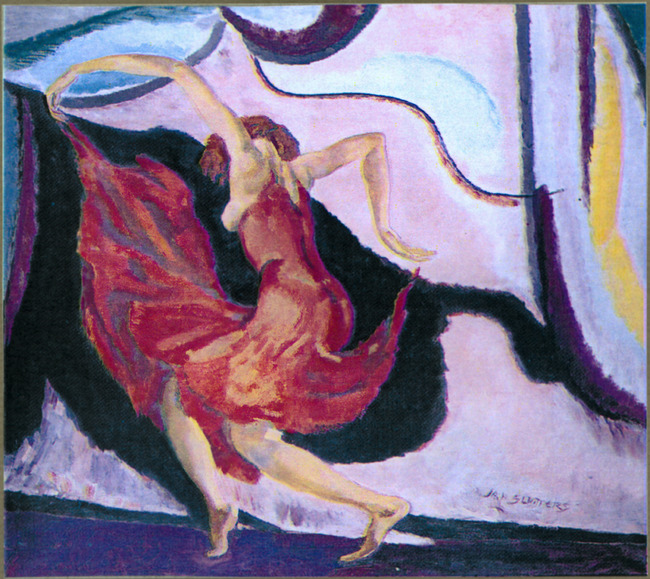
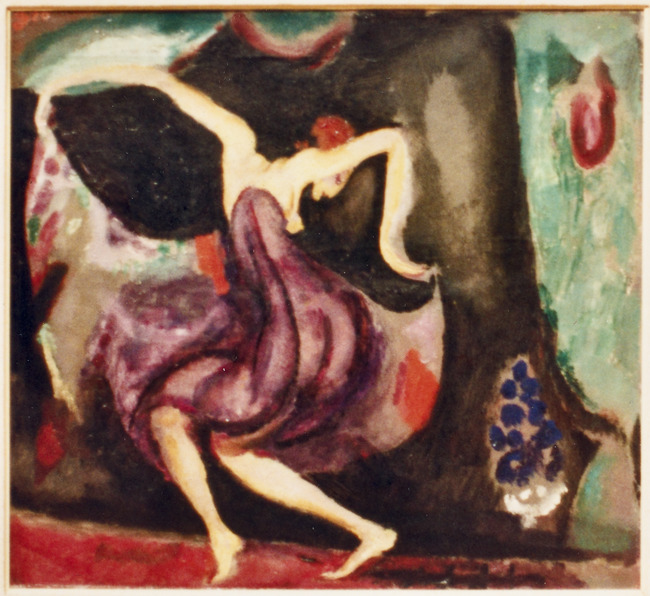
- Dancer – c.1920 – 116 x 131 cm – Christie’s Amsterdam – RKD (large image)
- Dancer – 1920 – 110 x 150cm – private collection – RKD (small image – top right)
- Dancer – 1920 – private collection -RKD (small image – below right)
- Click on any image to enlarge
Sluijters frequently created works in series. In the above three images the artist uses essentially an identical subject matter experimenting with colour, form, space and the plasticity of movement. There is a common motif; all three dancers wear a red dress revealing their upper body, all are long, lean dancers and all dance on stage in front of a multi coloured backdrop. The paintings recall Sluijters’ Fauvre period.
It is remarkable, from a dance point of view, that the position of the legs, in all three paintings and to a lesser extent in Dancer described earlier, are relatively similar. In general the front leg is forcefully bent bearing much of the dancer’s weight, whilst the supporting foot is placed high on the ball of the foot. The other leg is placed further behind the body, in preparation of the subsequent movement. The feet, you will have noticed, are exceptionally long, even disproportionate. All the dancers are poised in a gentle curve with their skirts flying upwards or swirling around them; the flow of the skirt complementing the dancer’s surge. There is nothing static about these dancers; their kinetic energy, their projection, and their innate sense of movement is entirely perceptible.
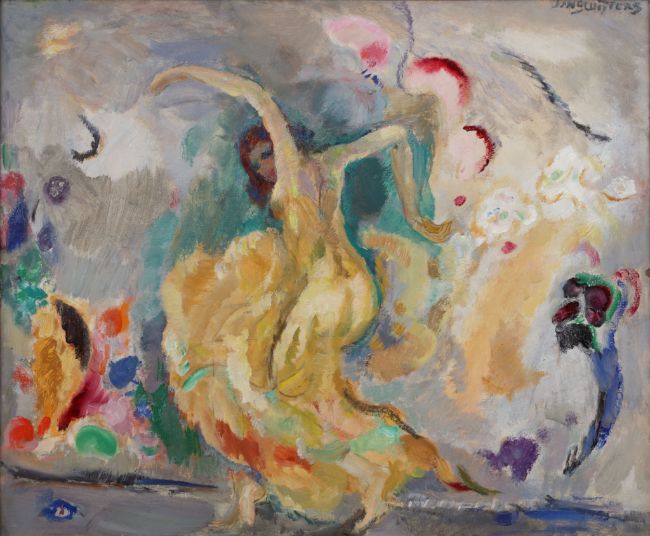
Even though at first sight, all the dance images have a realistic appearance, a closer look reveals that the top of the body, especially the arms and hands, are exceptionally long, often near boneless, and are painted in positions that, if at all possible, could only be performed by an acrobat. The front arm is often projected in a long arc, whilst the back arm is bent and twisted into a taut shape, ending with a rather distorted upturned hand. Regardless, the arms radiate an abundance of energy. Unquestionably, Sluijters fascination with mannerism swayed him to investigate how to use the properties of elongation to create sensitive curves, ceaseless fluidity, roundness and a continuity of line that leaves the impression of limitless motion.
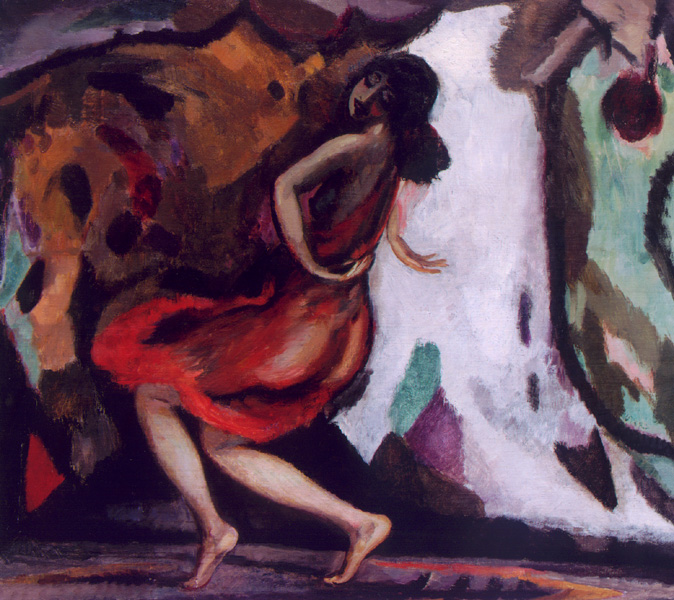
Jan Sluijters habitually altered, amended, or ‘improved’ his work. The painting now known as Black Woman Dancer, previously bearing different titles, including Green Dancer, was, according to Sluijters’ son, Rob, originally painted in Paris around 1907, and reworked at least three times; the last time in the 1940s. All this time the painting remained in Jan Sluijters private collection.
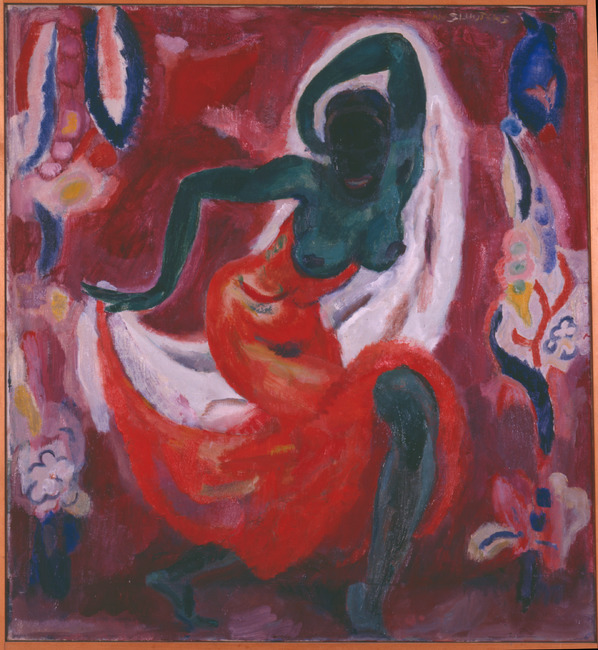
The model is unknown; quite possibly a dancer performing at the Folies Bergères. This painting, from a dramatic point of view, reminds me of Sluijters vivid Spanish Dancer who, like this vigorous dancer, pounces forward occupying the entire panel. This bare-breasted dancer looks directly towards the onlooker, demanding reciprocal contact. She manoeuvres between ranks of pink, blue, and red, fantasy flowers, all of which blend into a mauve background. Boldly contrasting the Fauvist setting stands a dark dancer, painted in a slightly greenish tint, wearing a most revealing vivid red dress. Sluijters definitely portrayed a stunning dancer, but from my perspective, he was just as interested in portraying a breathtaking, provocative woman.
What Sluijters ‘improved’ over the years is not documented, except that he apparently changed the dancer’s leg position in the 1940s. It would be illuminating to know what Sluijters actually changed. Today, we can see a dancer who bends deeply through her front leg, subsequently pushing her pelvis briskly backwards and has no qualms at exhibiting her breasts. The dancer’s arms, here, as in the other paintings, are subject to mannerism, executing unnatural overstretched feats. This is a unique work in Sluijters oeuvre; of all the dance images, discussed in this post, Black Woman Dancing, most poignantly embodies a tempestuous dancer, now in full-frontal view, asserting herself to any and every onlooker.
Jan Sluijters was touched by expressionism, inspired by fauvism and a leader in the Dutch luminism. He, together with Leo Gestel, Kees Maks and Kees van Dongen, introduced French modernism to the Netherlands. After the 1920s Sluijters rarely painted dance figures and then, only revivals of older works.* His original dance paintings, today, continue to intrigue, to amaze, and to inspire.
* See previous post – Electric Light: Let’s Dance
* Read my discussion on Sluijters’ Salomé in an earlier post.


 DANCE IMAGES IN THE ART OF THE NETHERLANDS