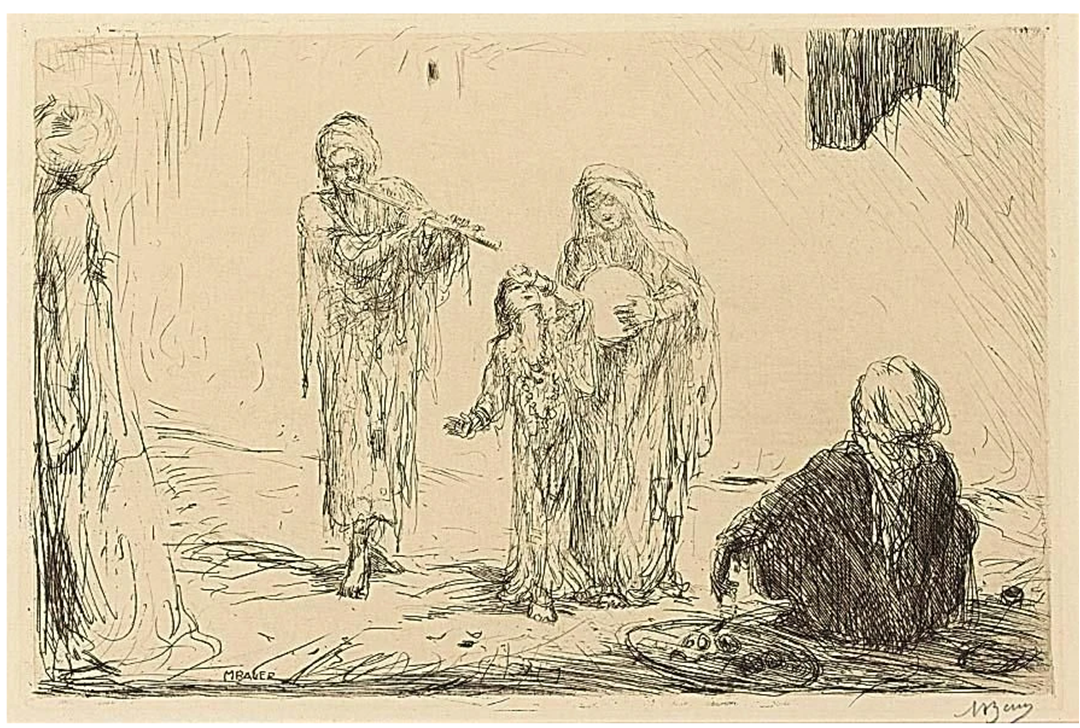
Marius Bauer (1867-1932) is, without doubt, the best known Dutch orientalist. As a young lad, he delighted in the stories of A Thousand and One Nights. Bauer loved to travel, and travel he did, to the most faraway places. Sponsored by E.J. van Wisselingh, an art dealer in Amsterdam, Bauer, just on twenty-one, travelled to Constantinople, and became fascinated by the exotic world unfolding before his eyes. Thereafter, he travelled to India, Egypt, the Nederlands Indies, Algeria, Tunisia, Morocco, to name but a selection of his destinations. During his numerous travels Bauer made notes and sketches, filling many sketchbooks with street scenes, busy market scenes, dervishes, bazaars, costumes and anything of interest that crossed his path. On his return to the Netherlands, he developed these sketches into paintings, etchings and watercolours. His work is not a realistic portrayal of the East, rather, he was a romantic, presenting his personal impression of the oriental world. Bauer drew people in action, merchants, musicians, riders on horseback, fisherman and dancers wherever he travelled. As discussed in my previous blog about the Whirling Dervishes, Bauer had an uncanny talent to translate movement onto a two-dimensional piece of paper. Whether looking at a Whirling Dervish or a high kicking French Cancan dancer or a serene Serimpi court dancer, Bauer captures the sphere and the specific characteristics of each dance, so convincingly that you can image the dancers actually moving.
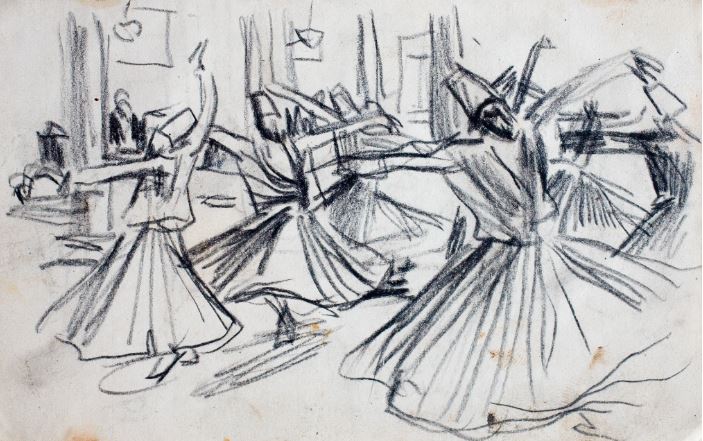

- Top – Dancing Dervishes – sketch – Teylers Museum, Haarlem
- Centre – A Nautch girl – Mutual art.
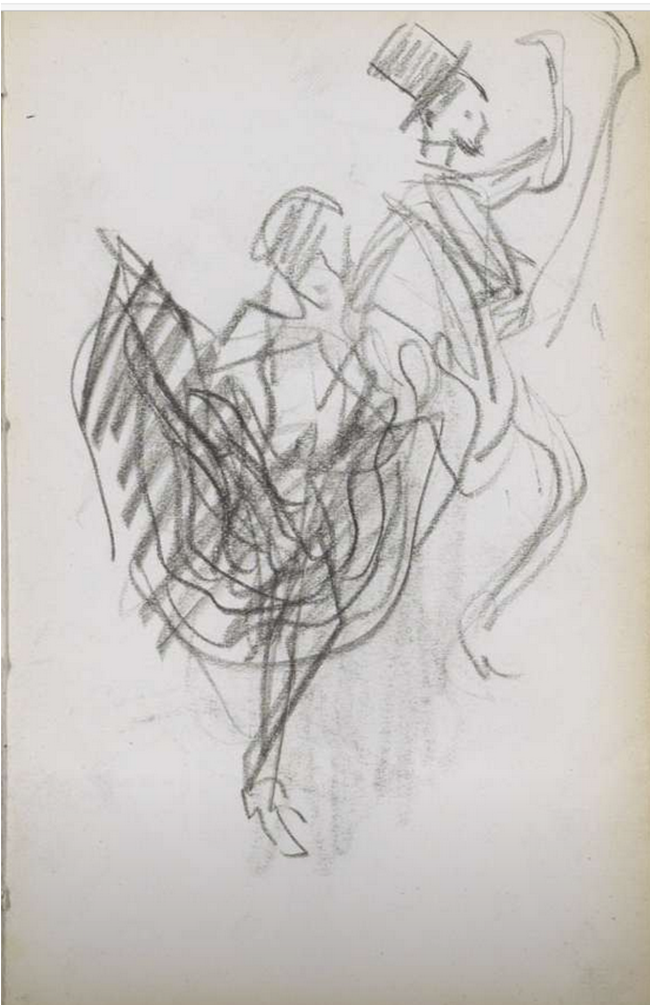
- Bottom – Dancer from Yogyakarta – 1925
- Large image – Couple dancing – Moulin Rouge – Paris 1891 – sketchbook Rijksmuseum, Amsterdam (click on images to enlarge)
Early in his career Marius Bauer visited Paris. Apart from drawing many of the city’s tourist sites, he also visited the Moulin Rouge. No doubt he enjoyed the dancing, filling ten pages of his thirty-five page sketchbook with images of cancan dancers. The cancan is an energetic dance, full of acrobatic capers; the splits, cartwheels, hopping in a circle whilst holding the leg high in the air and more enthralling, even slightly mischievous movements. Bauer concentrated on the high kicks; with just one or two exceptions, all his sketches show the dancers executing a very high leg kick.
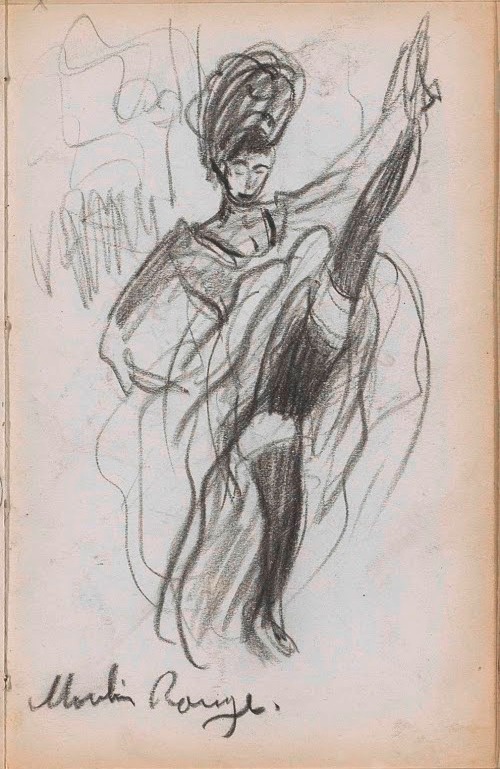
(click on image to enlarge)
This sketch of a cancan dancer was made at approximately the same time as Toulouse-Lautrec’s poster of Jane Avril, and Seurat’s cancan painting La Chachut. The young Bauer’s interpretation is brazen; this image, unlike the somewhat more reserved French images, displays the high kick from a frontal view, showing absolutely no discretion, except that the legs are partially covered with black stockings.
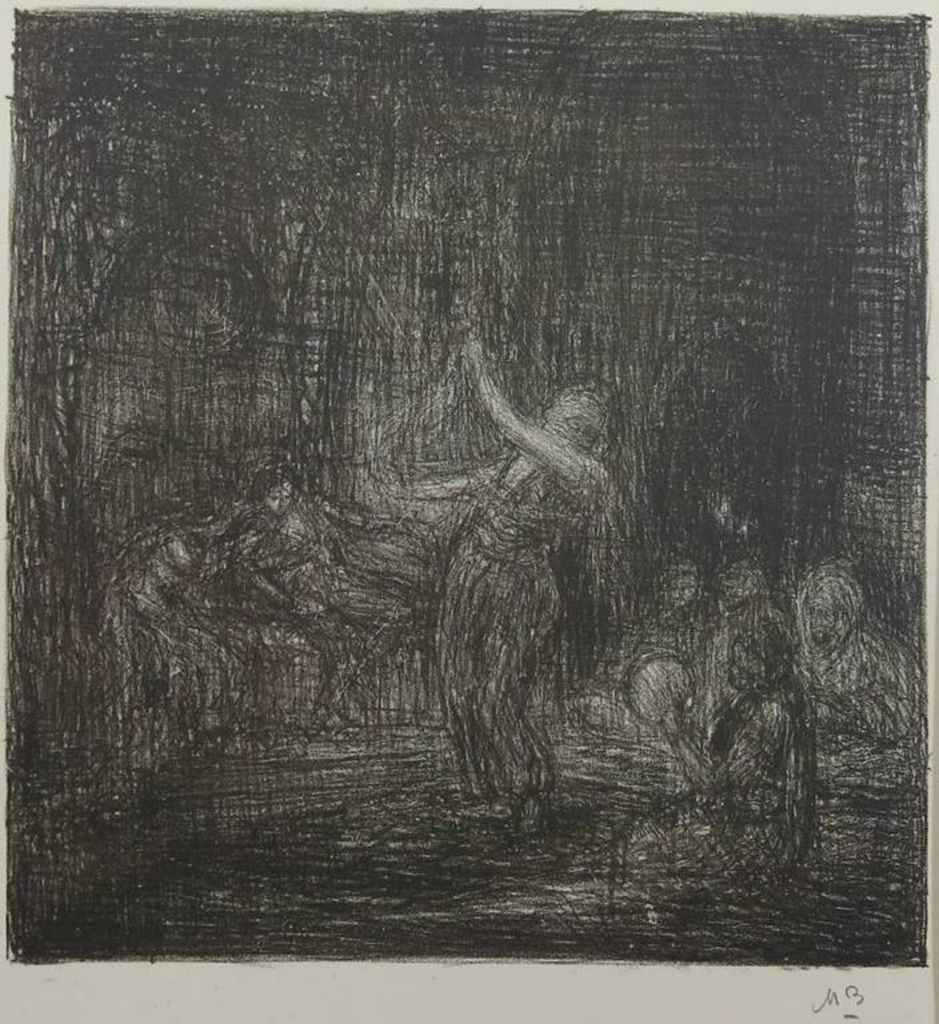
In 1891, Bauer also illustrated Gustave Flaubert’s ‘La Légende de Saint Julien l’Hospitalier’, designing ten lithographs. One of these, a monochrome lithograph, shows a dancer, entertaining Julien and his companions. Even though the image is relatively dark, men, clad in eastern attire, can be seen lounging on the floor. To the right there is a musician playing, presumably, a tambourine accompanying the belly-dancer whose provocative dance is much appreciated by the relaxing men. Bauer can convey movement. Just as the cancan dancer convincingly displays vitality and zest, this suave exotic dancer with her rolling hips, her inclined pelvis, her expressive arms and long loose hanging hair appear totally authentic.
When I look at the following sketches, made in Algeria in 1922, I can imagine Marius Bauer sitting comfortably on a bench enjoying the sunshine, sketchbook in hand, quickly sketching a group of dancers and musicians giving an impromptu performance in a village square. With little more than a few swiftly placed pencil strokes, Bauer catches the liveliness and vigour of the Algeria dancer as she rolls her hips and swivels her upper body invitingly. Probably as a reminder for later work, Bauer has jotted down the colours of the costumes and accessories.
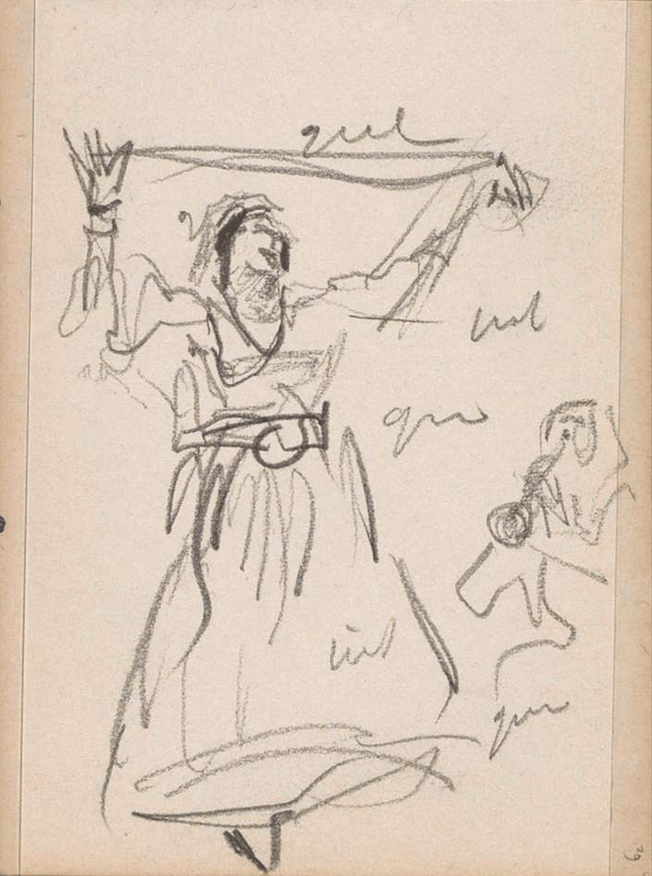
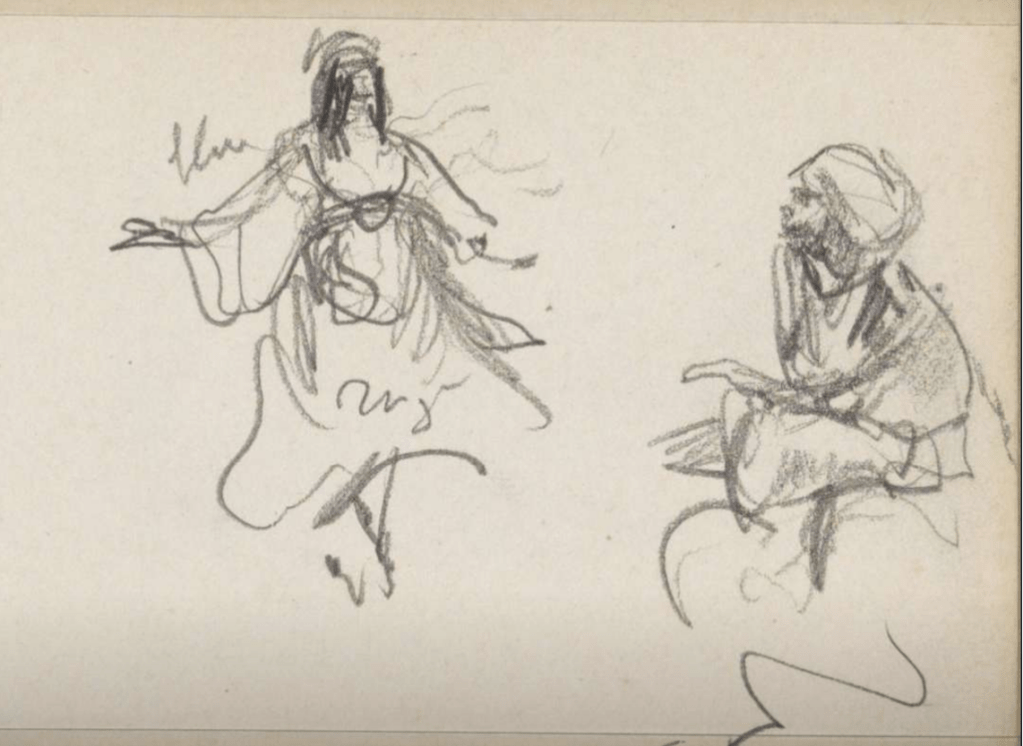
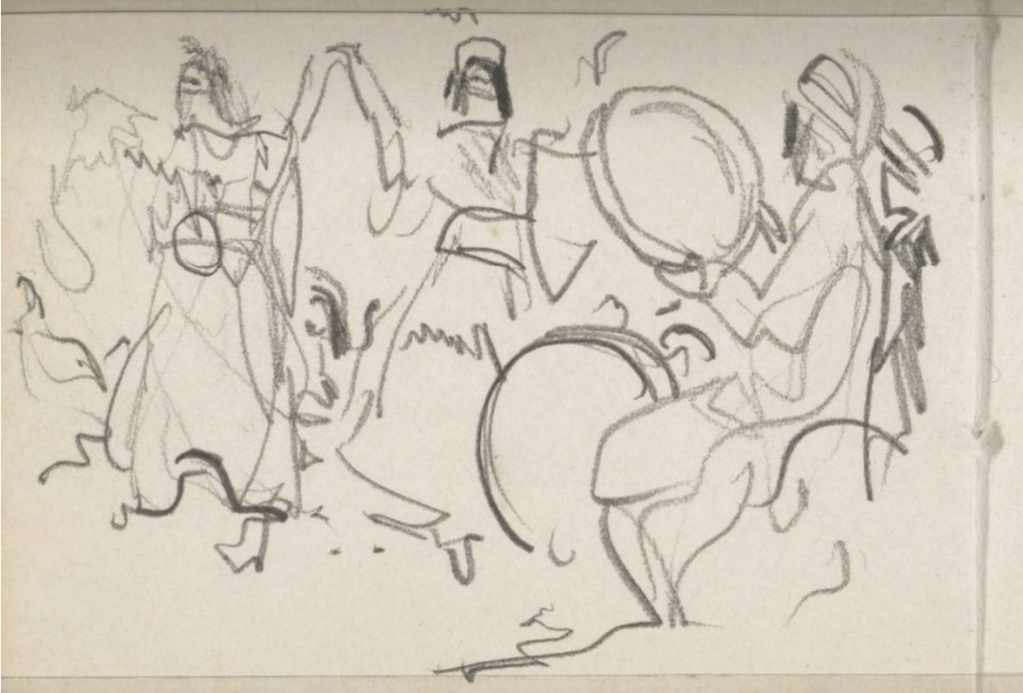
- Marius Bauer – Three sketches taken from a 1922 sketchbook
- Large image – Algerian dancing woman
- Top – Algerian dancer with onlooker
- Bottom – Dancers and musicians
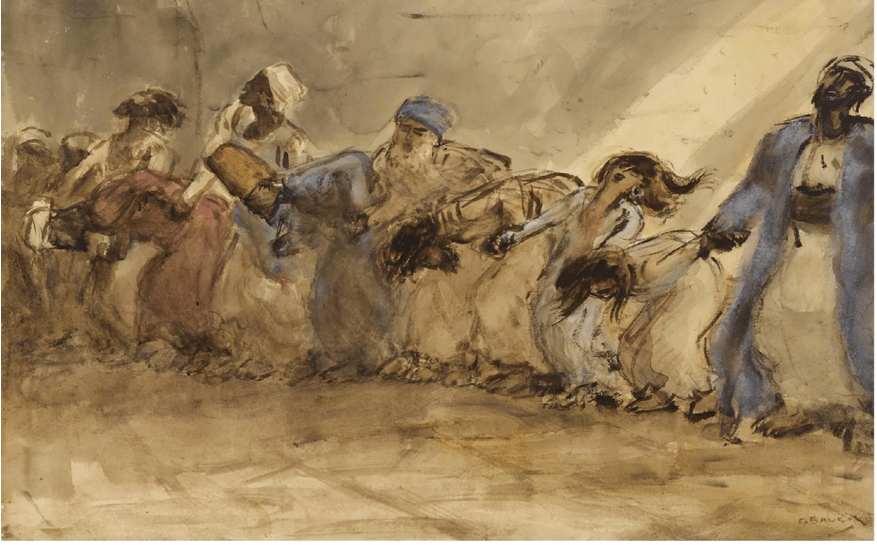
The opening page of the official Marius Bauer site features an extraordinary work; perhaps an exotic ritual or ecstatic religious dance. The viewer is thrown into an obscure setting. The location, of this primarily brownish-yellow tinted watercolour, is unclear. The foreground, most of the costumes and the background, blends together, with only a scattering of rough, dark lines outlining the dancing figures, dark paint for hair and faces and a touch of colour to differentiate the monochrome surface. Are we looking at a line of dancers propelling themselves forward and backwards as if in a state of frenzy? Or are we, the viewer, standing in the circle with passionate dancers revolving all around? Bauer has cropped the figures leaving us no clues as to the formation of the dance. Every second figure, be it a man or a woman, bends sharply forward from the waist. The person next to them responds with an instantaneous backward movement. The dancers hold each other firmly; so firmly that the front women’s arm is practically dislocated. Judging from women’s wildly tossed hair it is fair to say that the movements are swift and most probably repetitive. Every gesture, every nuance from the compulsive bending, to the bewildered hair and the dancer’s fervent upward focus, emphasize the intensity of this overpowering dance.
In 1925 Bauer was invited to visit Dutch East India, having received a commission to design a gift for the silver wedding anniversary of H.R.H. Queen Wilhelmina. As always Bauer filled sketchbooks brimmed with drawings and studies. Many of these books are now in the collection of the Rijksmuseum. The gift, a presentation of four etchings, included an image of a Javanese court dancer performing the celebrated art-form, wajang-wong.(See below)
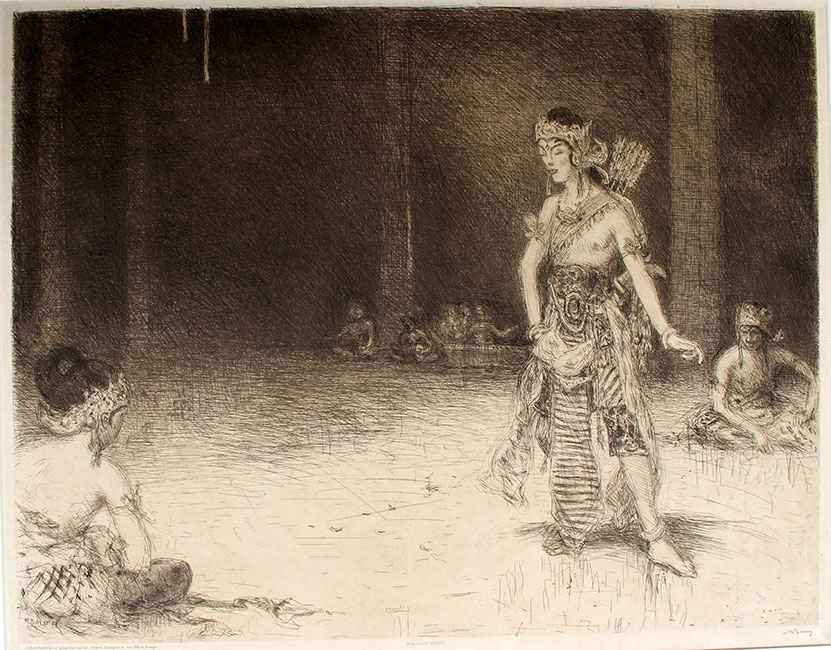
Where Bauer achieves a striking, spontaneity in the Oriental Dancers, he attains total serenity in Wajang-Wong. The dancer is refined, cultivated, showing the years of training needed to acquire a highly polished technique. There is very little spontaneity in this scene; every movement is stylized, each nuance is performed meticulously. Bauer, with an eye for the minutest detail, has frozen the classical dancer in archetypal Javanese pose. The dancer is calm, even introspective. The etching breathes tranquillity; the dignified dancer claims the entire stage, towering all the surrounding figures. Bauer heightens the majesty of the dancer, still further, by placing him in a setting filled with long shaded pillars, complimented by dark planes, suggesting immense spaciousness.
The exotic and the unfamiliar worlds of oriental were and remained Bauer’s greatest inspiration throughout his entire life. However, when we specifically look at dance images, there are some unexpected surprises in his earlier work. Barely twenty years old, he painted a scene of a café dansant, where the public enjoys a dancing lady, various ballroom scenes and a number of watercolours of well-to-do people attending the Haagse Stadschouwburg, a well-known theatre in The Hague. Ballet also triggered his interest. His early sketchbooks contain some rough sketches of ballerinas, and, in 1887 Bauer drew a monochrome image of a corps de ballet. In this longitudinal drawing, a large group of rather inelegant, indistinct dancers mimic a shadow play. Some of the ballet movements seem vaguely familiar, but all the dancers look stiff and graceless, not dissimilar to the cursory figures in the sketchbooks.
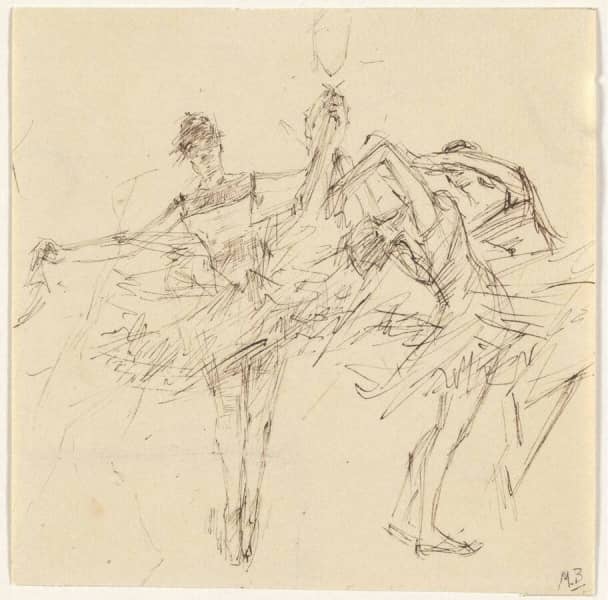
The Three Ballet Dancers, shown above, seem charming enough, although they are not as graceful as you would expect a professional dancer to be. They must be professional dancers because one dancer actually stands on pointe; no amateur dancer would have studied pointe-work in the 1880s. The dancer on pointe is technically proficient, but the other two dancers look more awkward, most especially the dancer standing on flat feet in an ungainly backbend. What puzzles me most is the ambiguous shape that Bauer has placed just above the dancer’s clasped hands. Perhaps this shape is no more than a quick scribble, although my imagination tends to see preparatory lines of a man’s head and shoulders. If so, has Bauer looked at paintings of the Foyer de la Danse, so vividly painted by Jean-Louis Forain, Edgar Degas, and other French masters, where gentlemen were permitted to stand in the wings and scrutinize their favourite dancer?
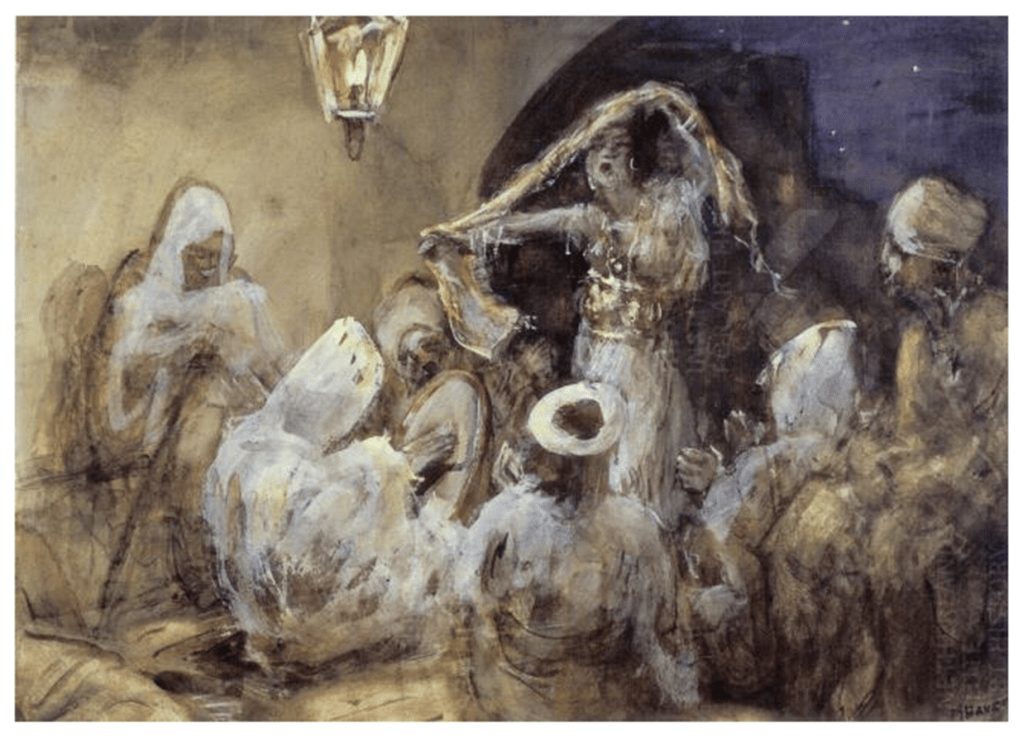
Oriental dancing, often called belly dancing, was originally a traditional dance. It was danced at weddings, at feasts and at other social activities, often improvised on the streets or in the village square. Later, belly dancing also became a performance dance, seen in cafés, taverns, and on stage for interested tourists. In Bauer’s Oriental dancer, it is difficult to ascertain where this dancer is actually dancing. She appears to be performing inside some type of building, possibly a tavern. Behind her, there is an opening which leads to a street or a plain. Just one lantern, either hanging on the wall or suspended from the ceiling, illuminates the space. The dancer is accompanied by at least one musician. Perhaps one or two of the other men, seated with their backs towards us, are also playing an instrument, but Bauer has hidden this from our sight. We can see a small group of admirers watching her dance, although, the person sitting against the wall looks pre-occupied. Perhaps, Bauer just happened to see this dance on one of his evening walks. Or, just as likely, he was one of the guests in a tavern where the dancers were performing. During his travels, Marius Bauer will no doubt have seen many oriental dancers. In the 19th century and in the early decades of the 20th century, many artists were inspired by these exotic dancing women. The alluring exoticism of the oriental dancer also swayed the heart of other Dutch painters including Jan Sluijters and Kees van Dongen. More about these artists and other artists who succumbed to the charms of the Oriental dancer in the next post.


 DANCE IMAGES IN THE ART OF THE NETHERLANDS