Vincent van Gogh (1853 – 1890) needs no introduction; he has become a household name. This Dutch post-impressionist painter created more than two thousand paintings and drawings. Exceedingly famous is his superb The Starry Night where the stars magically appear to sparkle. More down to earth is The Potato Eaters, a stark picture of peasant reality. His Sunflower paintings, just as the series Irises and so many of his magnificent works have achieved world fame. Some are so universally popular that they feature upon anything from an everyday cookie-jar to an expensive silk scarf. Vincent van Gogh is legendary.
Vincent van Gogh moved to Antwerp in 1885. The nightlife, the theatres and the dance halls, of this vibrant city, caught his fascination. There, van Gogh drew two works, which as far as I could find, are his only works that deal exclusively with dance and dancers.
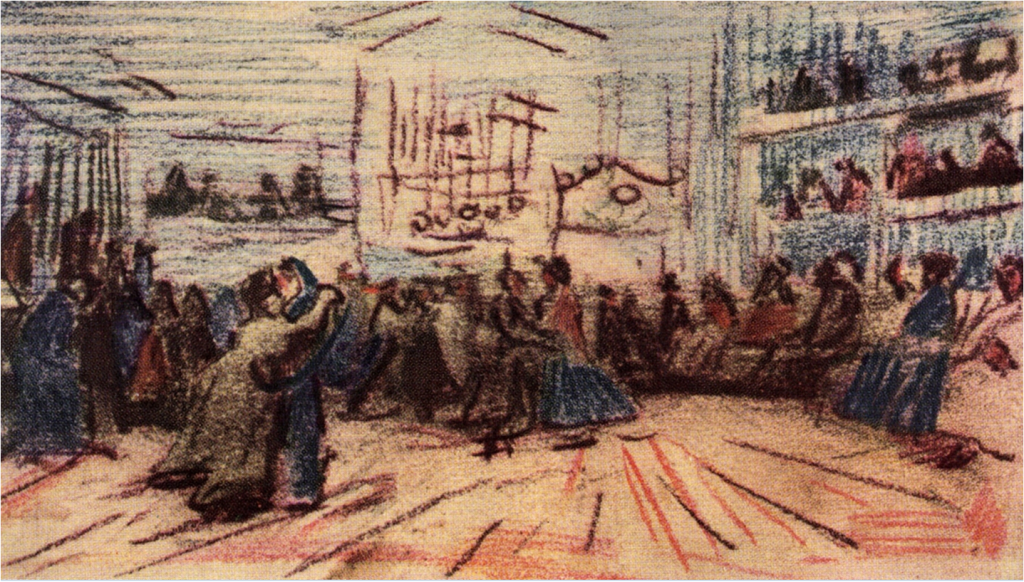
In this chalk drawing our attention is immediately drawn to the leading couple; more couples can be seen dancing towards the back wall. Except for the front couple, the people are difficult to distinguish. Line and shapes are intertwined, but the general intention of dancing can still be determined. To the right there is a group of musicians; a double bass is barely discerned. Spectators are seated along the dance floor. Others are watching the entertainment from the boxes. All this activity is set against a backdrop that vaguely resembles seagulls hovering above a rowing boat sailing next to a few ambiguous markings that bring to mind, the newest innovation, dangling electric lamps. The festivity takes place in a large open hall which van Gogh has given the impression of depth, with a few seemingly haphazardly drawn rusty tinged stripes.
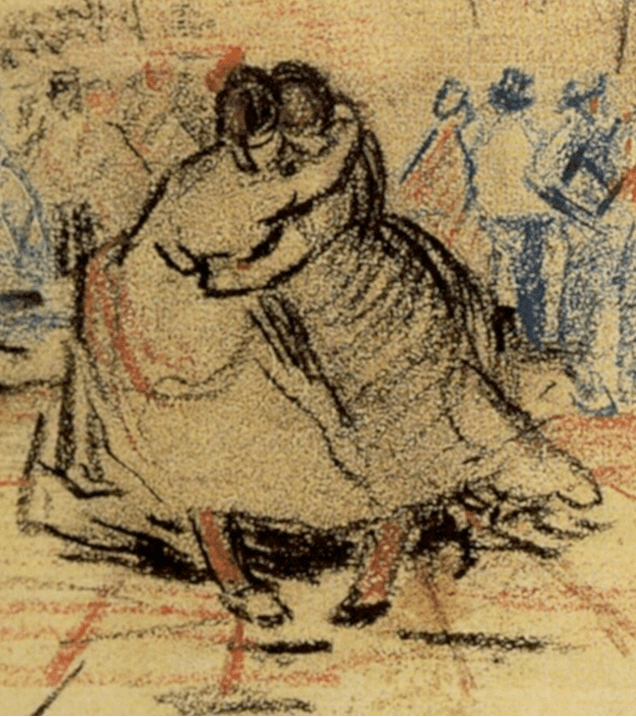
What I find most remarkable about this and the following sketch, is that the dancers look as if they are actually dancing; no mean feat to accomplish on a flat piece of paper. These dancers have not been positioned in some choreographic pose, rather they move spontaneously. They are not beautiful as the dancers we know from the art nouveau style with their sweeping movements, graceful figures and long flowing hair. Nor do they have the theatrical fascination of Degas’s ballerinas or music hall playfulness of Toulouse-Lautrec’s animated show girls. Van Gogh’s dancers are ordinary people enjoying themselves. The people are unrecognizable; their faces are turned away from the viewers. The top drawing, as far as I can make out, depicts a man and woman dancing while the lower drawing shows two ordinary women, holding each other closely. All the figures are anonymous. I can image Vincent van Gogh, as one of the onlookers, drawing these dancers fleetingly in his sketchbook. With just a few well-placed dark lines and curves, highlighted with occasional blues and a little sparse red colouring, he seizes the momentum displaying the exuberance of the dance hall.
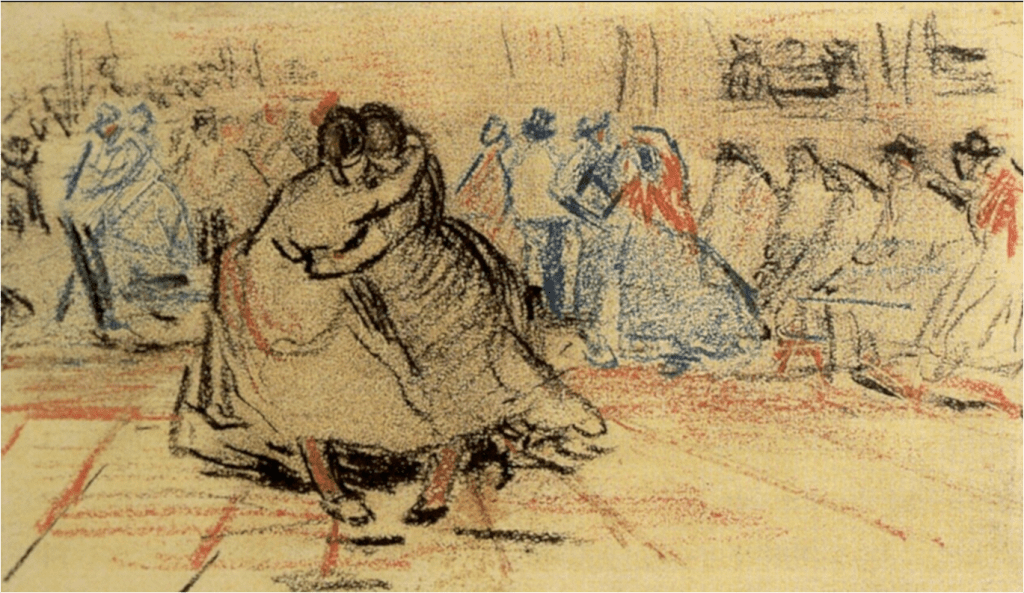
This second sketch is similar in composition to the first, but van Gogh has plunged these dancers right into the foreground. More people are outlined in a curved boarder further back. One couple, a man in blue and a woman, likewise in blue and wearing a red top, are dancing. The front women, two sturdy dancers, hold each other tightly. They are illustrated by a few sketchy black chalk lines. One of the women has her arm around the neck of her partner whilst her partner holds her by the waist. Their faces, placed cheek to cheek, look away from the viewer. Judging from their fluctuating skirts, the women are turning quite quickly. Are they dancing a waltz or some other revolving dance? Are we looking at two working girls dancing together, which was very acceptable at the time, or are they more than casual girlfriends?
Although there is no lack of dance images, be it paintings, drawings and caricatures, amongst 19th century Dutch artists, no one artist was as prominent as Edgar Degas, August Renoir or Henri de Toulouse-Lautrec. Vincent van Gogh, as mentioned, rarely focused on dance, but two of his contemporaries, George Hendrik Breitner (1857-1923) and more especially Isaac Israels (1865-1934) were inspired by the everyday dance, the mundane and that they found in the cafés, dance halls, and streets of Amsterdam.
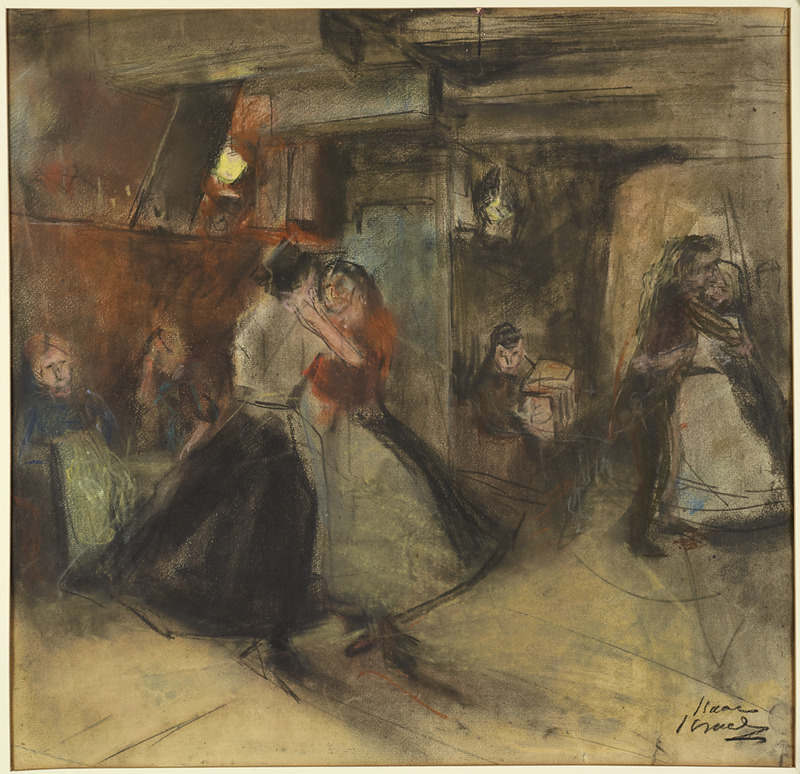
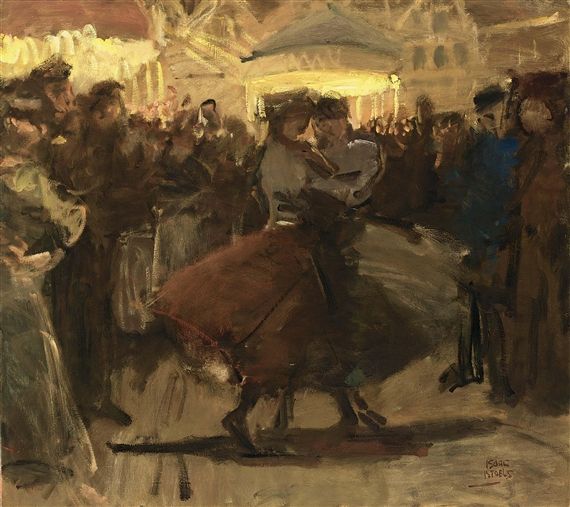
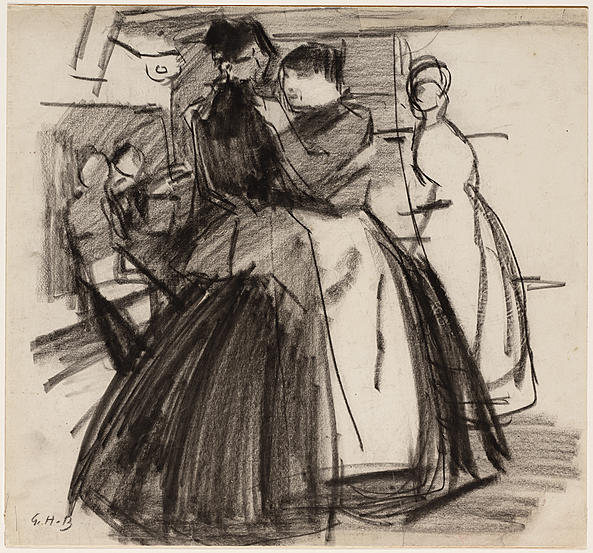
Midway the 1880s when van Gogh moved to Antwerp, the dance hall was very popular. There, the lower classes enjoyed their sparse free time drinking and dancing. The sphere was, no doubt, vivacious, inspiring van Gogh’s two sketches. Isaac Israels, as Breitner, was known to frequent bars, dance halls and cabarets in search of recreation, inspiration and innovation. There, with pen and paper in hand, Isaac Israels sketched the lower classes; maids, laundresses, seamstresses and other working folk enjoying themselves. Breitner, on the other hand, was one of the first artists to photograph his subjects, using the photos as reference material for his paintings. It could not have escaped your notice that van Gogh, Israels and to a slightly lesser extent Breitner, render dance, in a strikingly similar fashion. Take the three examples shown below; each show two working girls dancing, holding each other closely, with a few people in the background. To my mind, van Gogh has most successfully portrayed the actual sensation of movement. Israels can convince me that women are swirling, but Breitner’s women are more passive, more occupied with each other. However, even though the nuances may be different the similarity remains obvious. In fact, the question arises if the artists were inspired by each other’s work, or, if they just happened to be present at the similar establishments and see the same type of dancing.
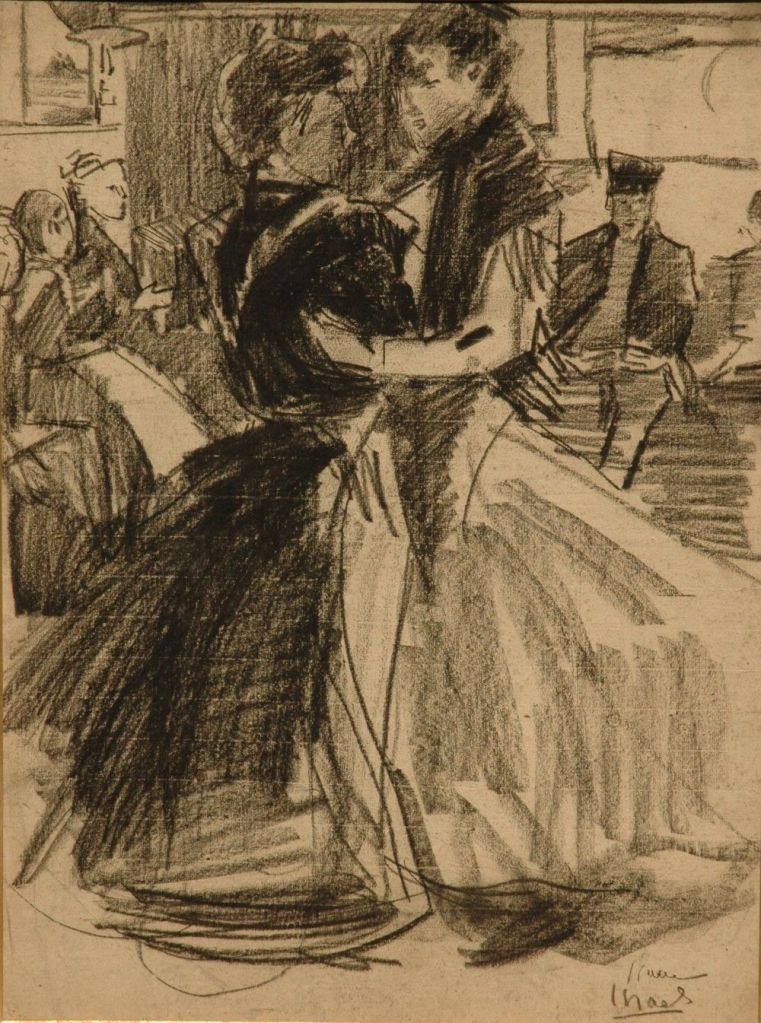
Centre: Isaac Israels – Dancing women at the Zeedijk – c. 1892-93 -Simonis & Buunk Gallerease
Right: Breitner – Dancing women at the dance house, Zeedijk -1892-93 -Stadsarchief Amsterdam
(click on image to enlarge)
An answer to this question can only be one of speculation. Vincent van Gogh and the four year younger Breitner were best friends, known to roam through working class neighbourhoods in The Hague. Isaac Israels was well known in the Van Gogh family, painting a portrait of Vincent Willem van Gogh (the son of Vincent’s brother Theo) in 1894. And Breitner and Israels, though rivalry marred their friendship, were associated with each other for many years, even visiting the same cafés, dance halls, cabarets and day-to-day locations. The three artists were acquainted with each other’s work, and at this time in their careers, were fascinated in illustrating the harsh reality of the populace. Their sketches, drawings and paintings, however individual, show that they stimulated each other in themes, in style and in the expression of movement.
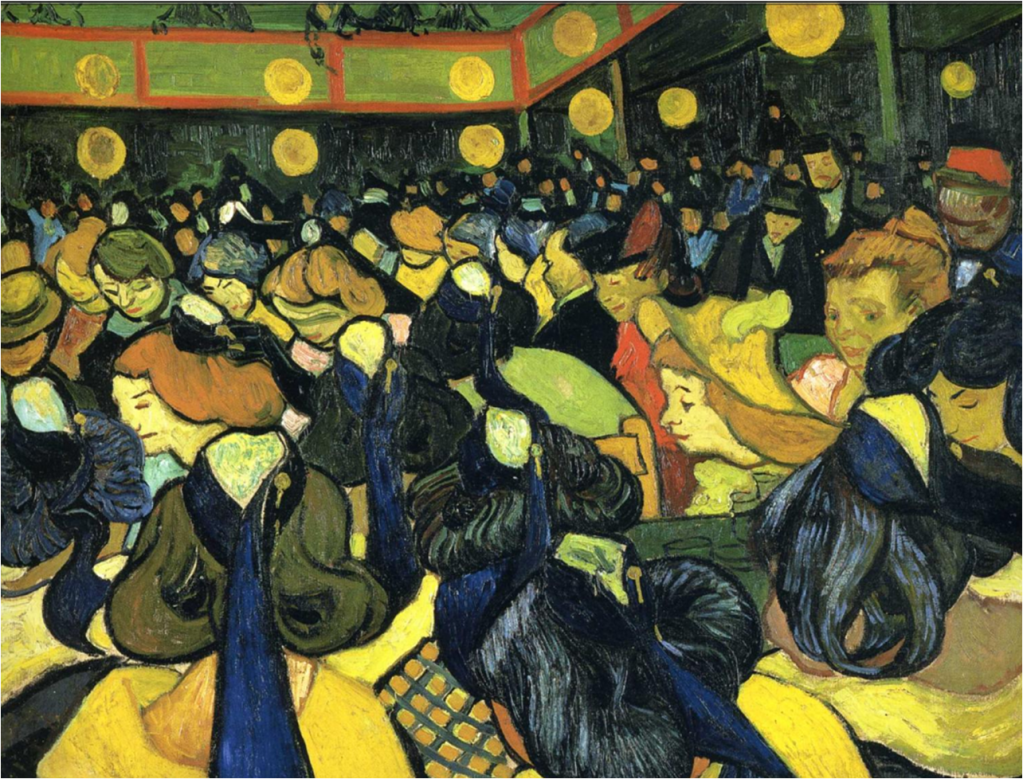
A post about Vincent van Gogh and the dance hall would not be complete without looking at The Dance Hall at Arles. Van Gogh was fascinated with Japanese art; the high elevated horizon, so typical of Japanese art, is eye catching as are the curves and contours of the girl’s hair that dominate the foreground. Another innovation, inspired by Paul Gauguin and the Pont-Aven School, is the characteristic dark outline that encloses areas of bright, flat colours. This technique, cloisonnism, was popular in the 1880s and 1890s, and was inspired by both cloisinné enamel and the fabrication of stained-glass windows.
Curiously, though this painting represents a dance hall, there is very little dancing to be seen. The image is crammed with indistinguishable figures, except for a certain Madame Roulin on the right, the only figure to look in the direction of the viewer. This busy establishment is full of men and mostly, younger girls navigating themselves through the crowd. All the figures overlap; we either see a small section of a figure’s back or a face, defined with a few stripes to indicate the facial features. As many other artists of his time, van Gogh applies cropping, leaving the borders with incomplete figures. The bright yellow that van Gogh uses for the front group of girls, strongly contrasts the dark outlines, the blues, blacks and murky greens. For the electric lighting, a new phenomenon in the 1880s, van Gogh once again uses the vibrant yellow.
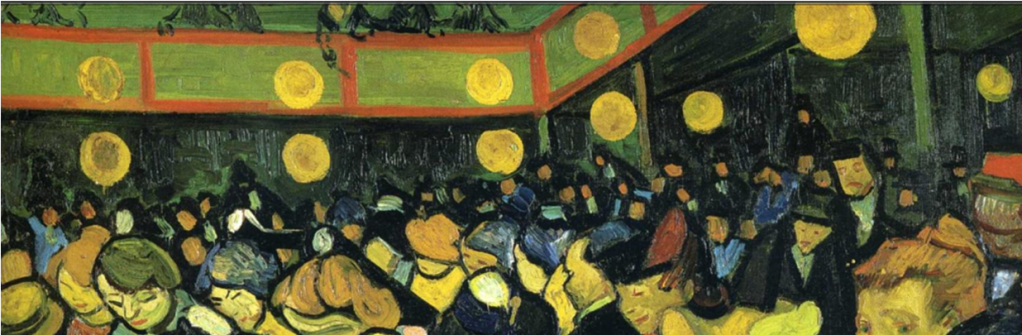
And yet, within this claustrophobic turmoil, a dancing couple can be identified. Between the two bright yellow lights, on the left, you can spot a man in a dark suit, dancing with a woman in a bare-shouldered dress. And on the right there is a large group of musicians, and one musician, judging from the brown blob of paint, is playing a double bass. This section of the painting, including the balustrade where onlookers stand, echoes the sketch Vincent van Gogh made in the dance hall in Antwerp in 1885. Three years later, after having lived in Paris, having been mesmerized by Japanese art, having worked with Paul Gauguin, Vincent van Gogh intentionally or not, refined a swiftly drawn sketch into an unquestionable masterpiece.


 DANCE IMAGES IN THE ART OF THE NETHERLANDS
