If the innumerable images of the illustrious dancing Salome, produced in the late 19th and early 20th centuries and the acrobatic images, sculptures and carvings created in the late middle-ages are momentarily set aside, then we are left with comparatively few images of Salome actually dancing. Italian Renaissance artists, Giotto, Fra Filippo Lippi, Fra Angelico, Gozzoli, Ghirlandaio, to name but a few, painted magnificent paintings and fresco’s, often as part of a narrative cycle about John the Baptist, showing Salome dancing before King Herod Antipas. After the Renaissance, artists, from all countries, were inclined to paint Salome as a beautiful young woman presenting, even caressing, the severed head of John the Baptist, that laid on a platter. Artists juxtaposed the boundless beauty of Salome with a gruesome, frequently bloody decapitation. The artists of the Low Countries followed suit but a few continued to paint Salome the dancer. From the 16th century onward, artists from Flanders and the Northern Netherlands, every so often, placed the young irresistible dancer in the spotlight; this post will look at artists working in the Netherlands.
Herod, as recounted in the biblical narrative of both Mark and Matthew, is enthralled by the tantalizing dance of an alluring young girl. In most art works, the dancer, the daughter of Herodius, better known as Salome is invariably shown dancing alone. She, and she alone, is the absolute centre of attention; she is the spill around which the tragedy evolves. Karel van Mander, a Flemish born artist, who, to escape religious persecution, moved to the Northern Netherlands, designed an unusual version of the biblical scene where Salome dances a chic Renaissance dance together with a debonair young partner. This exquisite engraving printed by Jan Saenredam, places the biblical scene in an oriental, quasi Renaissance court setting, with Herod and guests sitting around a long table. To the right, away from the grand feast, John the Baptist is about to be decapitated.
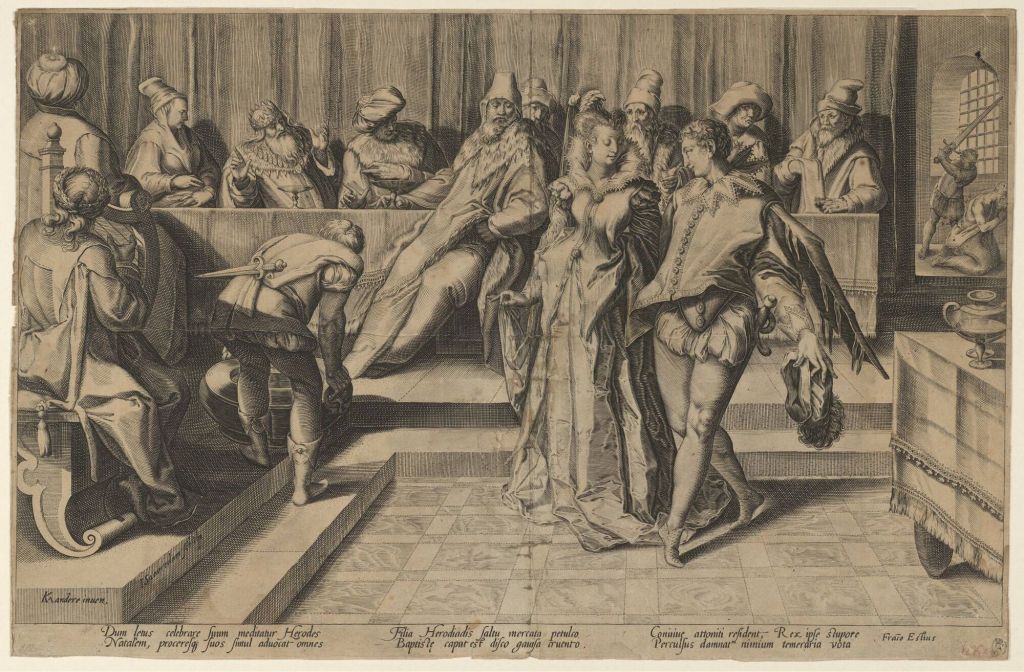
The entire engraving, but, especially the dance echoes Karel van Mander’s time spent studying in Rome. Salome and her partner are dancing a stylish court dance. Could it perhaps be a pavane or a galliard? Contemporary Italian dance manuals by Fabritio Caroso and Cesare Negri show various images of comparable dance poses, but without the astonishing artistic eye for detail that this van Mander/Saenredam engraving displays. This couple wear highly fashionable and impeccably detailed clothing complete with elaborate sleeves, buttons and decorated lace collars. Both are demurely covered from head to foot and although Salome has a very small waist and a well-formed bosom these aspects are only subtly accentuated. And, paradoxically, she appears rather reserved, not to say modest, as she casts her eyes downwards to avoid her partners inviting gaze.
Back to the dance. Van Mander’s Salome, beautiful as she is, has none of the familiar characteristics generally associated with the infamous Salome. Where Salome habitually dances a free-flowing, improvised, dance exhibiting her body with subtle and less subtle rotations and sensual gestures this Salome has, just as her partner, taken dancing lessons. Their refined style and deportment reveal that they are thoroughly acquainted with Renaissance etiquette. The slight backward inclination, the gentle forward thrust of the lower pelvis, the contrived placement of the hands and fingers combined with the man’s extended leg and controlled footwork eliminate any form of spontaneity. The couple seem preoccupied with themselves and except for the man lounging in front of the long table and the man peeping from behind his shoulder, few of Herod’s party, including the Herod himself, pay the couple much attention.
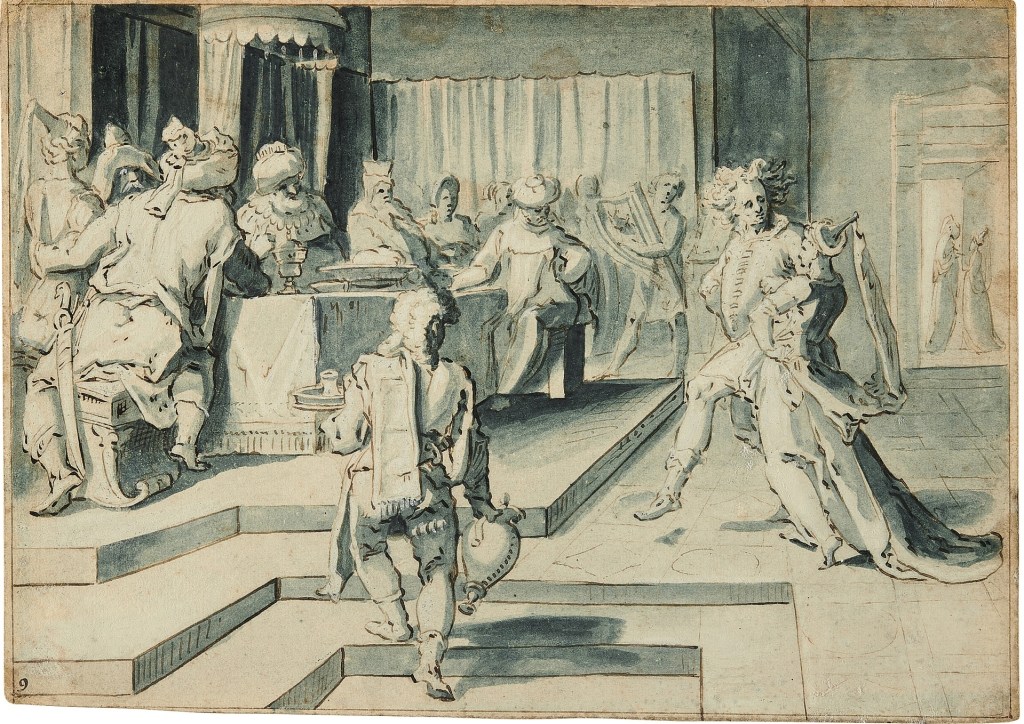
The pen drawing, shown above, is associated with Karel van Mander. Experts are still undecided if this is an original work or a copy of an original van Mander design. The drawing, part of a series about the life of John the Baptist, reveals a spontaneous Salome, escorted by a dashing cavalier, boldly advancing towards Herod and his guests. Her daring deportment, her loose flowing dress shamelessly exposing a bare leg, challenges all the table guests. All eyes are focused on the ravishing Salome. This Salome dances to seduce, dances to entice and, unlike the previous engraving, has no qualms about court etiquette.
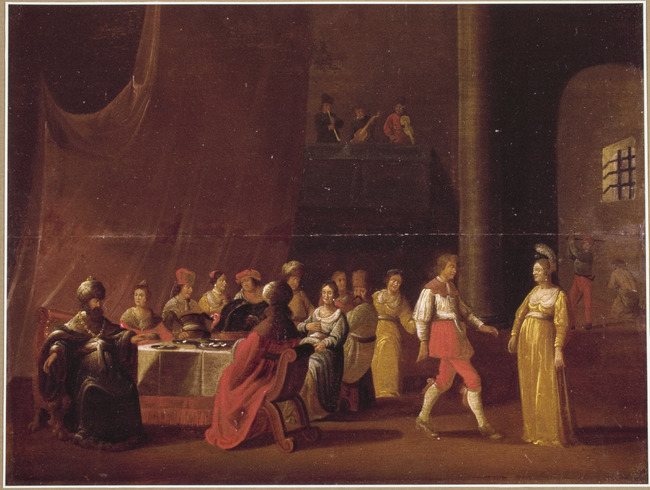
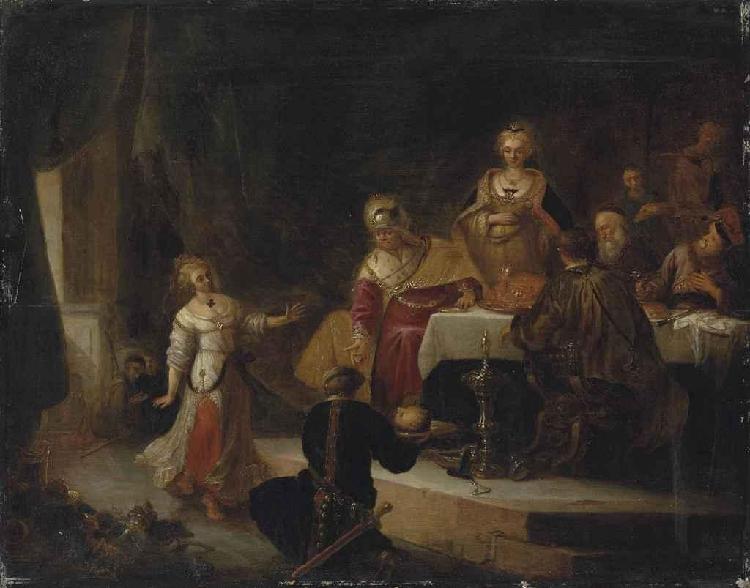
The two 17th century paintings show Salome dancing before and after the beheading of John the Baptist. On the left, in a work attributed to the Northern Netherlander Jan Spanjaert, Salome appears composed. Has she just danced or is she waiting while her partner dances? To my mind she is neither seductive nor desirable. Perhaps the large feather on her head or her low décolleté is intended to impress Herod. She must have pleased him; just behind her in somewhat vaguer lighting John the Baptist is about to be beheaded. The painting on the right, a work by Jacob Willemsz. de Wet or an artist within his circle that shows Salome dancing merrily, as the executioner presents the head of John the Baptist to King Herod.
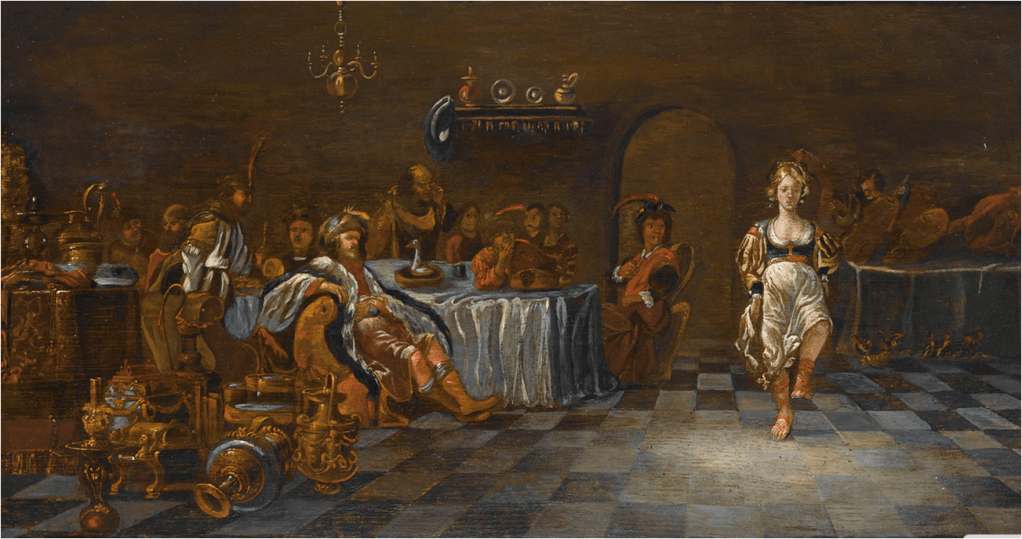
Salome, as we have come to know her, is an enchanting, desirable creature, able to turn Herod’s head. The seemingly disinterested Salome in Vroman’s painting has neither the sensuality nor beauty, one would think, to entice Herod, yet, he and a number of his party seem enthralled by this orthodox dancer. Has she, perhaps, just performed an arousing dance? Is she in a trance or merely catching her breath? Whatever the case may be, the artist has captured her in a mundane, straightforward frontal pose, one leg lifted, evading any suggestive pelvis, shoulder or torso movements that would make her appear more provocative.
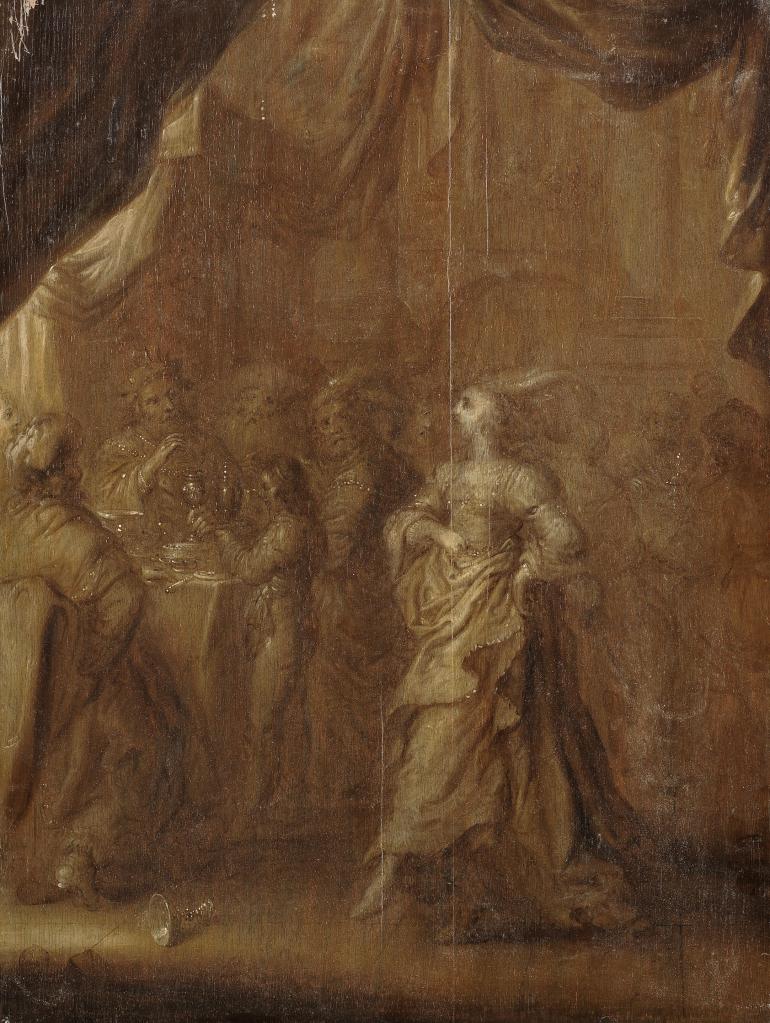
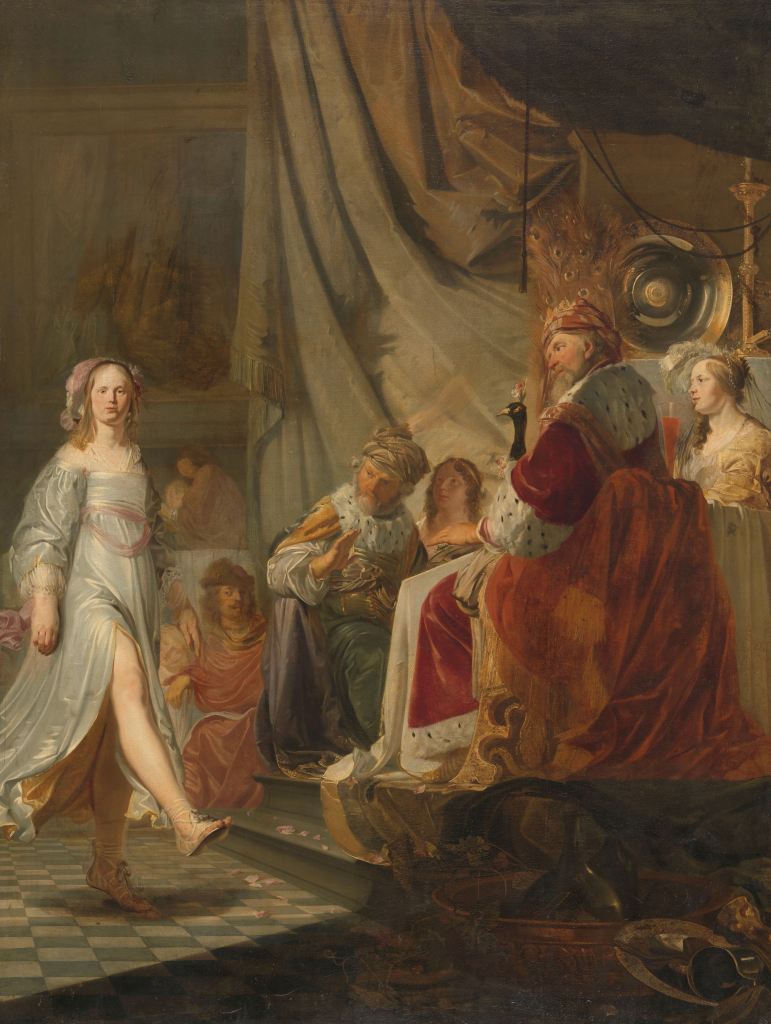
Salome, the provocative, is the subject of the above two paintings. On the left, a grisaille by the multi-talented artist Adriaen Pietersz. van de Venne (1589-1662), famous for his paintings and book illustrations and the well-known ‘Fishing for Souls’, a sharp political commentary, housed in the Rijksmuseum, Amsterdam. Amongst his works are fools, peasants, beggars, animals, and the well-to-do, all dancing and this remarkable interpretation of Salome. This tall, elegant woman moves gracefully, yet decisively, claiming the unrelenting attention of Herod and the other men. The artist, even though working in monochrome hues, differentiates the light-fall so that it touches her face and the front of her body defining her temperament and accentuating the subtle, suggestive rotation of her shoulders.
To the right, a work by Hans Horions (1624-1672), resident of Utrecht. Herod donned in an ermine cape, sitting next to what I understand to be a peacock pie, scrutinizes the well-formed Salome as she dances. What a starling young girl this Salome is. She looks directly at her audience as if our presence is meddlesome. Her dance never wavers. She may not appear seductive at first sight, but her brazen disposition and the high opening of her robe, which exposes more leg than modesty permits, clearly pinpoint her treacherousness intentions. And have you noticed that vague delineation of a head in the vicinity of her left hand? Could this be the face of John the Baptist?
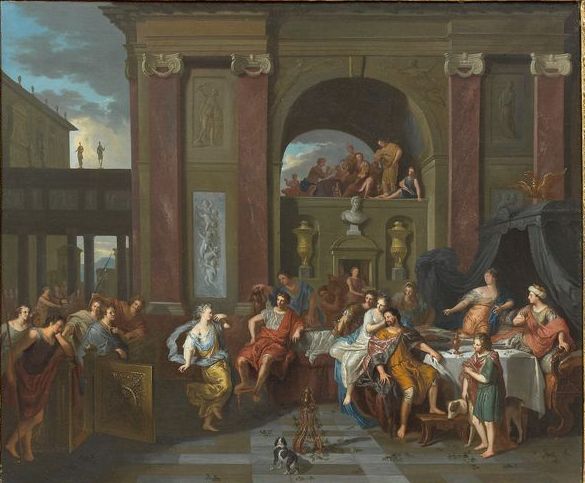
In the late 17th, early 18th century, the period of classicism, artists, throughout Europe, were impassioned by the Ancient World. Gerard Hoet (1648-1733), a Dutch Golden Age painter, known for his religious and historical works, places his Salome in Ancient Rome. This setting is, in fact, justifiable; the court of Herod Antipas, though in Galilee, had strong connections with Ancient Rome. Herod’s feast, reduced to a mere third of the painting, takes place in a courtyard enclosed by an over-towering arch decorated with capitals, pilasters, statues and vases. In this opulent setting, Salome, were it not for the light falling vividly on her face and upper body, would simply merge in with the rest of the party group. But the persuasive Salome knows how to attract attention. All eyes focus on her as she hops or capers, with one hip frivolously inclined and a bodice so draped as to reveal her bare shoulder. Her flirtatious undulations are accented by her skirt and scarf, that swing sensually around her slender body.
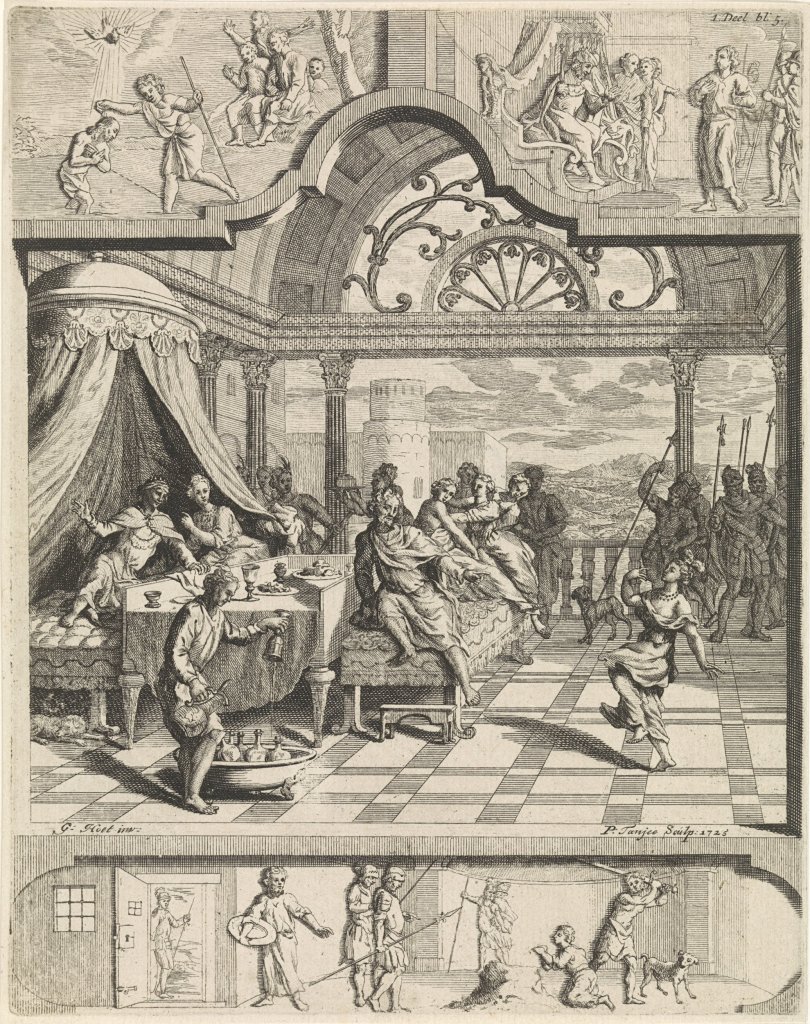
Pieter Tanjé (1706-1761, a shipmate turned engraver from the Northern Netherlands, created a print, perhaps based on a lost painting by Gerard Hoet or perhaps based on the painting just discussed. In this print Salome is compelling. She draws the attention of men and women alike. The man, reclining on the bench, stretches his hand out in awe and even the little dog, standing just behind Salome, is curious. Herod lounging under the canopy seems very pleased, whilst Herodius seems apprehensive. Where, in the painting, Salome bares only one shoulder, this Salome’s has a plunging neckline adorned with eye-catching jewellery. The tale of John the Baptist is centred around this seductive being; the upper left border shows Christ being baptized, on the right John is shown criticizing Herod’s adulterous marriage to Heriodius, and on the lower border directly under Salome’s noxious dance John the Baptist is about to be beheaded.
The dancing daughter of Herodius incited the death of John the Baptist. Her role in this horrendous affair is open to various interpretations. Religious exegesis, art and literature have assigned her various roles. Her character has changed and evolved over centuries. Depravity, scandal, immorality were periodically aspects of her personality, but never as extreme as during the fin-du-siècle. Oscar Wilde gave the world a Salome, so sensual, so treacherous, so wickedly fascinating that he together with 20th century artists, dancers, choreographers, composers and film directors created the world’s most electrifying femme-fatale. Enough inspiration for the next post.

 DANCE IMAGES IN THE ART OF THE NETHERLANDS


