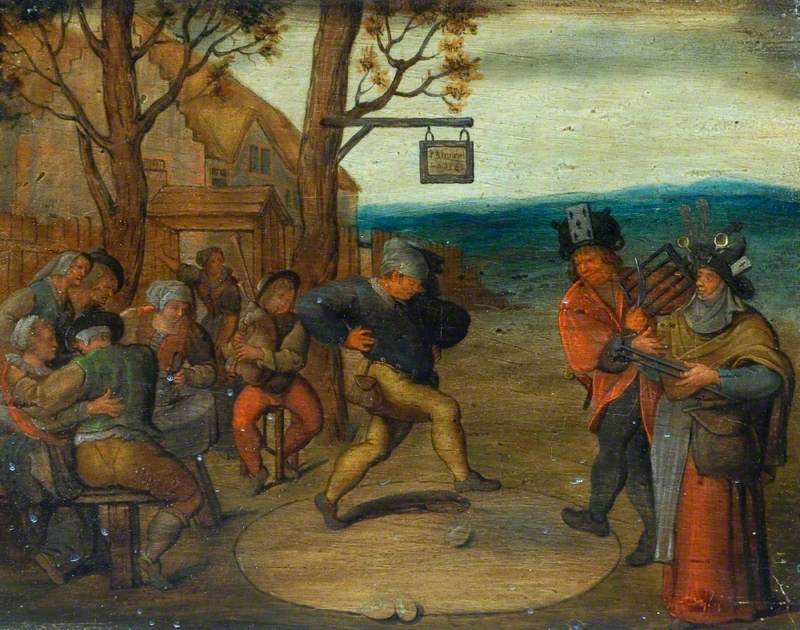
At approximately the same time as Pieter Aertsen painted The Egg Dance, the prolific Flemish artist Maerten de Vos (also written as Maarten or Marten) designed his own version of the egg dance. The drawing Egg dance outside a tavern is located in the Harvard Art Museum. This artwork, drawn in brown ink on cream paper, is the prototype for a number of engravings and paintings. Where van Aertsen’s composition takes place in a gaudy tavern with peasants drinking, making music, being amorous and dancing, de Vos’s drawing is an outdoor affair. The eye-catching egg dancer is encircled by jolly peasants, flirting and drinking, and two bizarre carnivalesque personages.
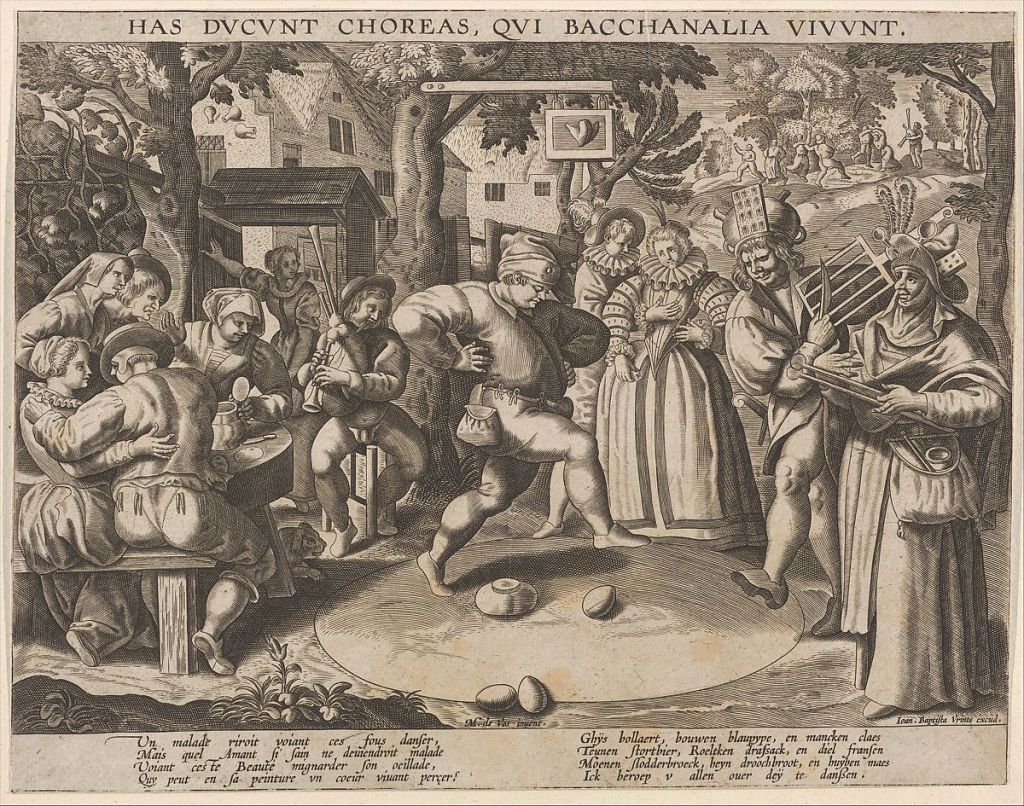
A number of virtually identical engravings of the Egg Dance, also known as Peasant Bacchanali: Egg Dance, published by well known Flemish publishers Johannes Baptista Vints and Joan Galle are housed in various museums, including The Metropolitan Museum of Art (New York), the Rijksmuseum (Amsterdam) and the Ashmolean Museum (Oxford). The engravings, contrary to de Vos’s original work, all have a Latin inscription at the top, and, at the bottom, two more sets of inscription. The left inscription, in French, begins with a text that discloses that a sick man laughs when seeing fools dance, and on the right, in Dutch, a row of nine contrived fanciful names and ends with an invitation that all present partake in the dance.
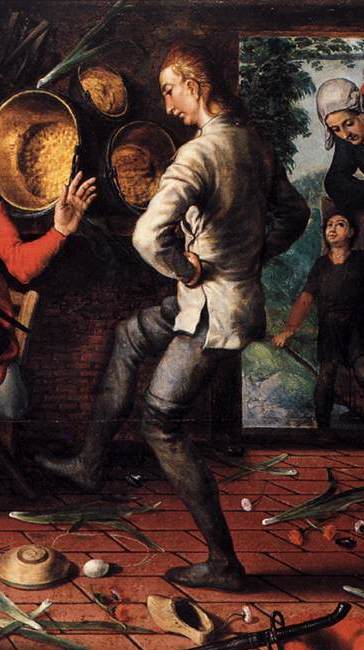
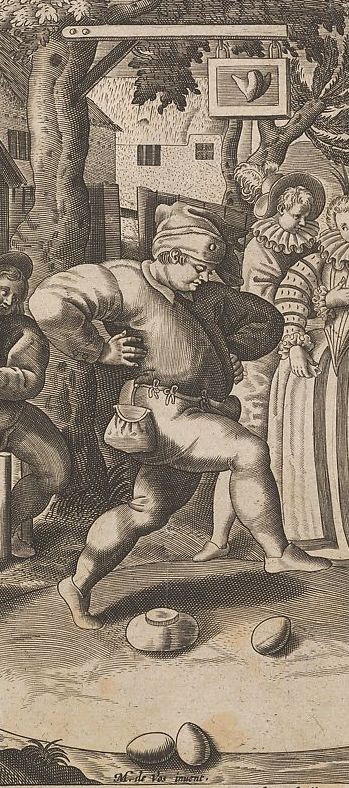
The egg-dancer, a rather bulky peasant, dances within a large circle shape propelling his energetic body forward as if playing a game of football. His extensive torso is strongly rotated and his robust arms are placed firmly on the hips in such a way that he gives the impression of forward propulsion. His powerful thrust barely skims above the abnormally big egg. Where Aertsen’s tall dancer demonstrates concentration and composure, this dancer, though focused, moves impulsively. Maerten de Vos has bestowed the dancer with enthusiasm and determination, but has this dynamic rustic sufficient skill to manoeuvre the egg safely under the bowl? The possibility, perhaps probability is the better word, that the egg will break has been anticipated; two more eggs lay waiting on the circle’s circumference. The images below illustrate the different approaches of the two artists, who both worked in Antwerp at approximately the same time.
Turning back to the engraving. There are two interrelated narratives; the dance and tavern scene in the foreground and a group of dancers, on the hill, in the background. In the foreground the egg dancer, encouraged by a curious audience, demonstrates his dexterity. At the left a group of people surround a table, and apart from the amorous couple, all focus their attention on the outsized egg and the dancer. A chunky youngster plays the bagpipes and behind him, a young woman stands under the portal looking, most attentively, at an out-of-place, aristocratic couple. Completing the semi-circle are two carnival figures, self-made musicians, who create a tremendous racket with their kitchen instruments. The man, crowned with a cooking pot, scrapes a knife across a gridiron and the women next to him, who has dressed-up her hat with wooden spoons, plays the fire tongs.
Were it not for, the aristocratic couple, we could be misled into believing that we were looking at a group of peasants enjoying a pleasant afternoon. Yet, all is not what it seems to be. Why is there an elegantly dressed noble couple in this coarse company? They are totally out of place. They show no interest in the dance; the man blatantly places his hand on the women’s breast. Maerten de Vos, is forthright here and elsewhere, in his display of the erotic. The small illustration on the tavern’s hanging sideboard, prominent for all to see, is an illustration of the centre section a man’s trouser. On the original drawing now at the Harvard Art Museum, the sideboard also has an inscription reading ‘in de broek’, which is Dutch for ‘in the pants’ (my translation). Enough clues to ascertain that this engraving represents more than a fun-filled afternoon; de Vos plunges the viewer into an inn where drunkenness and wantonness are the order of the day. The brazen aristocratic couple, the affectionate peasant couple, the provocative sideboard, the bagpipes all imply the lecherous and unchaste. This image, no less than Pieter Aersten’s painting The Egg Dance, reproaches excessive drinking and untoward pleasures of the flesh. The dance scene at the top of the image, though seemingly casual, duplicates the message emphasizing the irresponsibility and nonchalance of three couples and bagpiper.
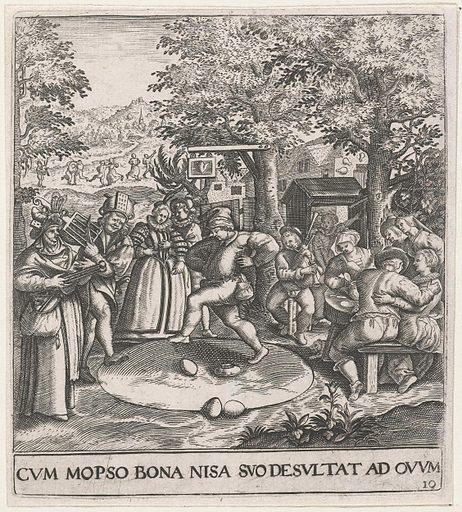
The Flemish publisher and engraver Johann Theodor de Bry (1561-1623), adopted Maerten de Vos’s design for an album amicorum, an album of friends, in 1596. Except for the obvious; the engraving is printed in reverse, the proportions changed from rectangular to a square like shape, higher trees and a more extensive background, there is a church spiral visible in the background. Perhaps this church is just part of the village scenery, but just a likely it serves to remind the tavern’s decadent guests of the righteous path.
In earlier times it was not uncommon that artists, inspired by popular works, painted their own version. There are, for example, many versions of Pieter Breugel’s Peasant Dance, painted not only by his son Pieter Breughel the Younger, but also painters in his workshop, painters in the circle of and painters working in the manner of. Keeping this in mind, it is not surprising to find two paintings of the egg dance designated as after Maerten de Vos.
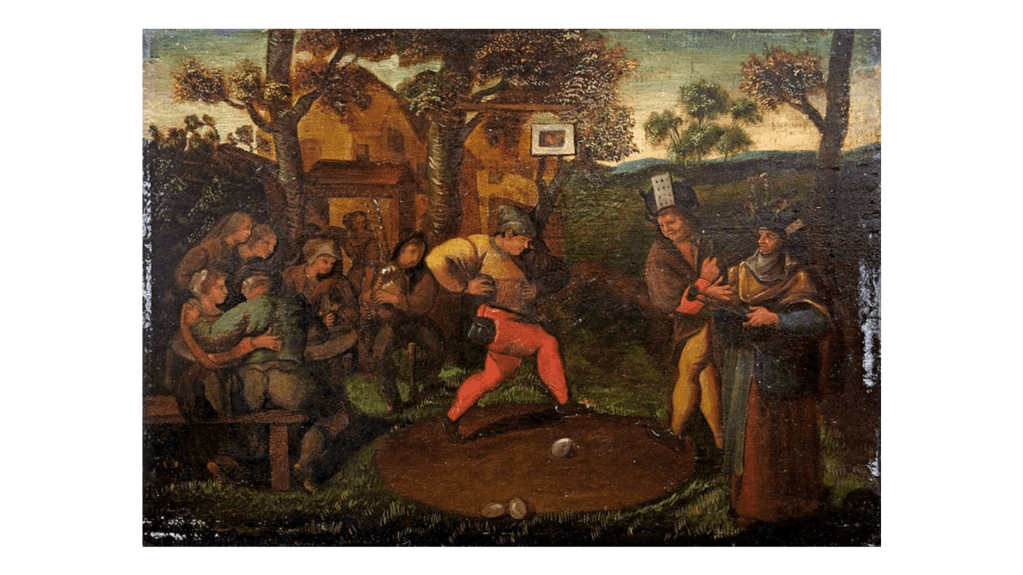
The above painting recently presented at auction, is marked as a 17th century work. The narrative, when compared to the original message-laden work by Maerten de Vos, is straightforward. This is a scene of people enjoying themselves; prim and proper in every way. The original dancers, high on the hill, have been replaced by a spacious landscape. The man, with his back towards us, still has his original well pronounced backside, but the bagpiper has gained in refinement; his attire no longer defines his masculinity. And the amorous ‘out of place’ courtly pair has apparently returned to court, leaving, the space vacant for a charming view of the countryside. Last but not least the hanging tavern sideboard no longer carries a double message, but displays a vague indecipherable image. An ideal painting, it would seem, for gentle society.
Finally, there is a painting in The Bowes Museum, which, the museum information tells us, was previously attributed to an imitator of Pieter Bruegel the Elder; it is dated 1563 and the signboard shows a false signature of Pieter Breugel. In all probability this work was created in the 19th century; the artist remains anonymous. As in the previous work ‘after Maerten de Vos’, all the tantalizing, naughty tidbits that defined the artist’s original work have vanished. The passionate aristocratic couple, the ambiguous hanging sign board and the dancing couples in the background have all made way for an ornamental painting.
Art embodies society; it can function as a mirror, a reprimand and as a deterrent. Over time the significance of the narrative and the function can change. The Egg Dancer, as designed by Maerten de Vos, expressed the conditions and ideas of his age. The original message, the condemnation of earthly delights, has altered over time, but the egg dancer, that energetic figure with undeniable determination has never lost his original dynamic power.

 DANCE IMAGES IN THE ART OF THE NETHERLANDS