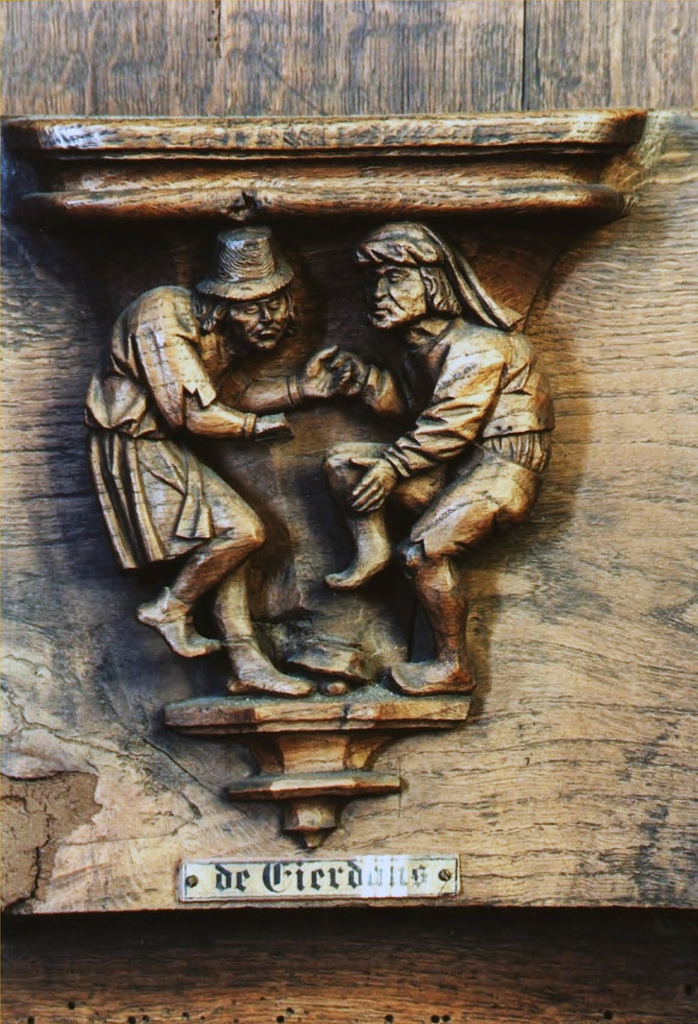
The origin of the Egg Dance goes back a long way. As early as 1498 an egg dance, more an egg dance competition, took place at the marriage festivities of Margaret of Austria and Philibert of Savoy. Apparently, after various couples had attempted the dance, breaking eggs in the process, the Duke of Savoy himself undertook the task which, he performed, to the pleasure of all the guests present, with great success. Over the years the egg dance proved a popular form of amusement, within both peasant and aristocratic circles. Furthermore, professional entertainers danced more complex stage versions. William Wagner, an Elizabethan playwright, refers to the egg dance in one of his plays and in 1790, whilst performing in Philadelphia, the famous American dancer, John Durang announced that he would dance ‘a hornpipe on 13 eggs, blindfolded, without breaking one’. Long before Durang performed his remarkable feat, the egg dance was a favorite pastime among the peasants as the following two images, both dating from the beginning of the 16th century, illustrate.
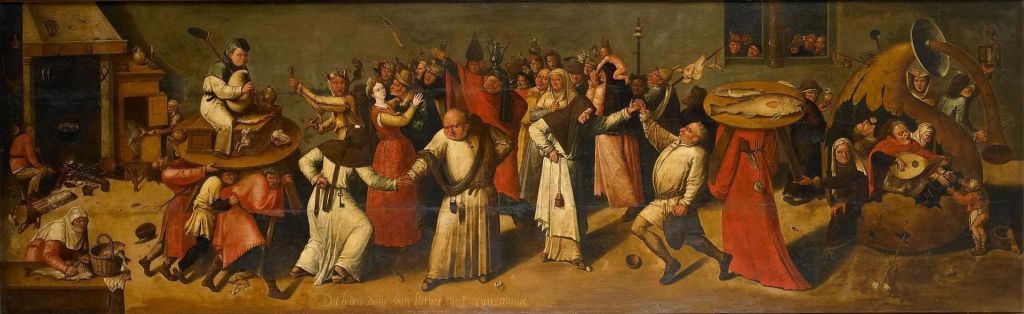
The Battle between Carnival and Lent, of which there are three copies, including a truncated version in grisaille, is an artwork painted in the manner of Hieronymus Bosch. The original painting has been lost, but it may be the painting referred to as ‘a dance in the manner of Flanders’ purchased by Philip II of Spain from Felipe de Guevara’s collection. This opens the possibility that Hieronymus Bosch (1450-1516) painted an egg dance late in the 15th or early in the 16th century. If so, it would be one of the earliest, if not, the earliest painted image of an egg dance. One of the works, after Hieronymus Bosch, is shown below, another is housed in the Museum Mayer van den Bergen (Antwerp) and the third, the grisaille version, in Het Noord Brabants Museum, the hometown of Hieronymus Bosch, ‘s-Hertogenbosch. In the grisaille version there is no egg dance, but this absence is compensated by an adorable dancing dog.
The three paintings in the manner of Hieronymus Bosch place the narrative in a period prior to Easter; the left side of the panel illustrating the excesses around Carnival and the right side the moderation during Lent. Two dancing couples dominate the foreground.
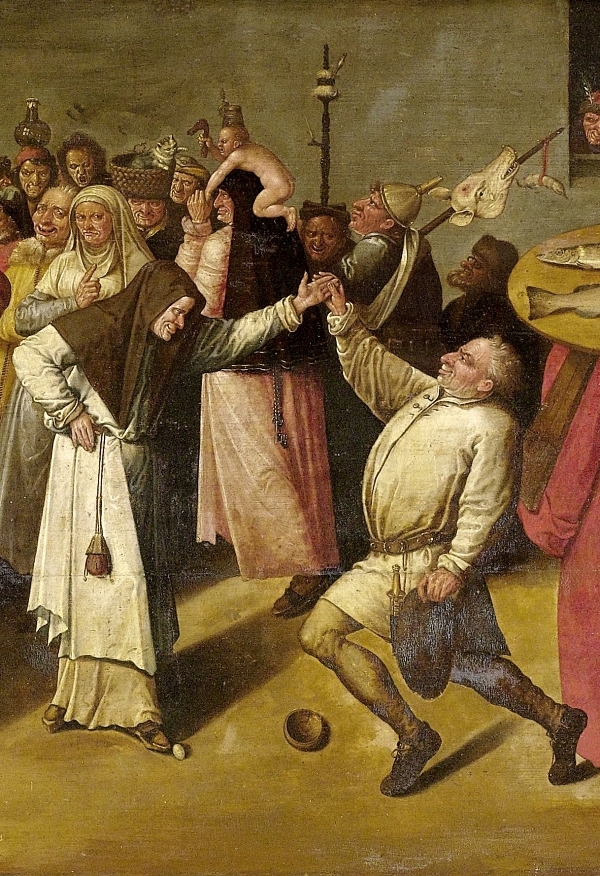
On the floor, just in front of the monk’s left foot, lies a bowl with the opening facing upwards. An egg lies at the tip of the nun’s sandal. Are we looking at an egg dancing contest? This, less than gracious couple hold hands, but cautiously stand at arms distance, forcing the monk to bend deeply; an unpractical pose that can only be held momentarily. Without doubt, this is a highly spirited dance, perhaps even a dance-like tug of war. Momentarily the nun appears to have the overhand. The contest is not yet decided; she still needs to get the egg into the bowl.
We do not know how the egg dance was actually danced; there appear to be various different forms. What we do know is that the dancer, whether amateur or professional, required great dexterity. Most art images from the Low Countries, show a dancer, standing within a chalked circle with his hands on his hips, hopping or shuffling on one leg, maneuvering an egg, or eggs, from under an earthen bowl, often to replace them back again under that same bowl. Dancers competed with each other where the most skillful dancer, having broken none of the eggs, won the prize; usually a basket full of eggs.
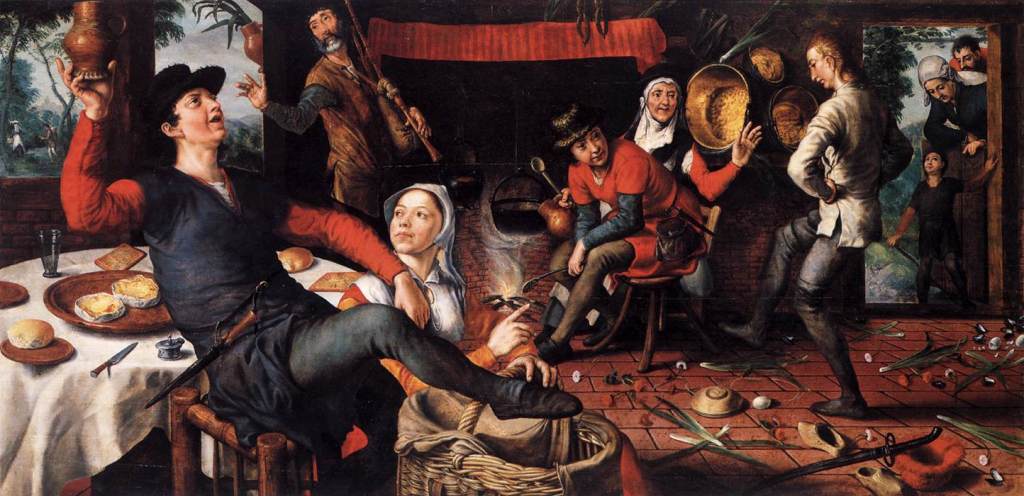
Pieter Aertsen, born in Amsterdam, placed the peasant, the ordinary man, at the centre of attention. His peasants are large figures, painted in close-up and found in the foreground of his paintings. The physical presence of the peasant, however, may dominate the painting, but, an Aertsen artwork always alludes to, a not to be misunderstood, moral implication. This painting, The Egg Dance (1552), is full of double meanings. At first-sight, it renders a comical scene of rustics dancing and drinking in a tavern, but the bagpipes, the hanging sausages above the fire place, a jug filled with leeks, leeks on the floor, the open jars, the mussels and the playing cards on the table, are all subtle and less subtle symbols making this seemingly fun-loving peasant setting, a scene of debauchery. Apart from the eye-catching foreground Peter Aertsen often further emphasizes his message with background vistas, frequently alluding to biblical readings. Pieter Aertsen and artists working in his studio, painted a second version of the Egg Dance; a detail is shown below.
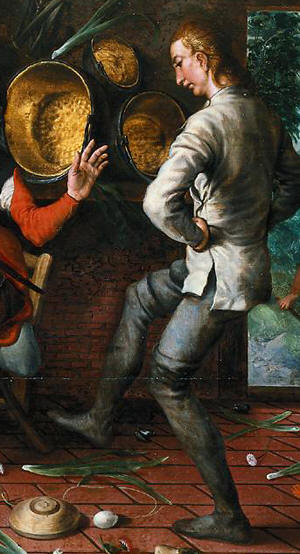
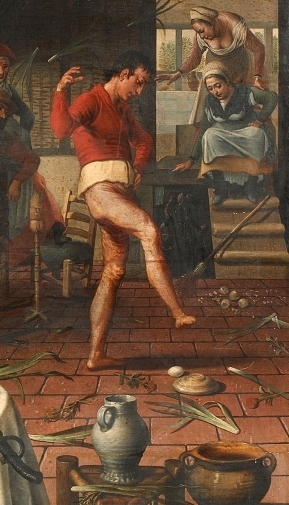
Now to take a closer look at the dance. The dancer performs his fastidious dance on the right-hand side of the panel juxtaposed with symbols and images of erotic context. Both dancers are accompanied by a peasant playing the bagpipes; an instrument symbolizing the male genitalia. Scene wise the similarities are crystal clear; a tiled floor is covered with leeks, mussels and flowers amidst which an egg lies next to a bowl, placed upside down. Just in front of each dancer, there is a small circle drawn in chalk. In the Amsterdam version, the dancer has placed his sword on the ground next to his cap and clogs, dancing in soft footwear with both hands placed firmly on his hips. His companion dancer wears stockings or dances barefoot, has one hand on his hip and holds the other just above shoulder height in an effort to retain his balance. During the entire dance the dancer must hop, spring, shuffle or wiggle on one leg, carefully moving the egg with the other leg. The length of the dance varies. It can be a long or short dance, depending on how quickly the dancer places the egg under the bowl or how soon the egg is broken. Concentration is essential; both dancers are totally focused, gazing downwards. It takes little imagination to appreciate how difficult this egg trick actually is; something to try at Easter perhaps? More seriously Aertsen’s Egg Dance may seem comical, but the dancer, the musician, all the other occupants and attributes of the tavern are a facade, behind which lies a moral message.
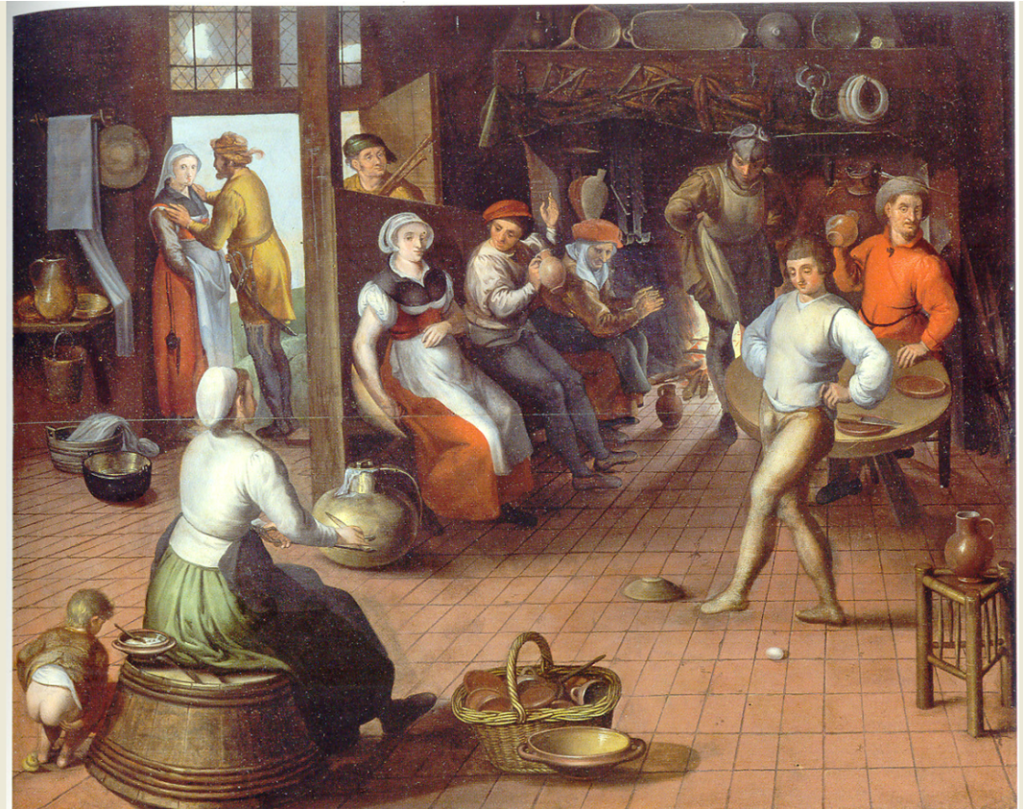
There is no mistaking that this painting, by the Flemish artist Gillis Mostaert, was inspired by Pieter Aertsen. Mostaert worked in Antwerp and would have known the work of Pieter Aertsen, who also worked in Antwerp for some time. All the familiar ingredients are present; an amorous couple, a bagpiper, various jars and other pottery and on the floor a bowl turned upside down complete with a chubby figure in the midst of the egg dance. Mostaert also adds a few of his own touches. He places the viewer at a somewhat higher vantage point than Aertsen does and also adds some amusing, down-to-earth accents. On the left a small child is relieving himself and just behind the dancer a farmer warms his backside near the fireplace.
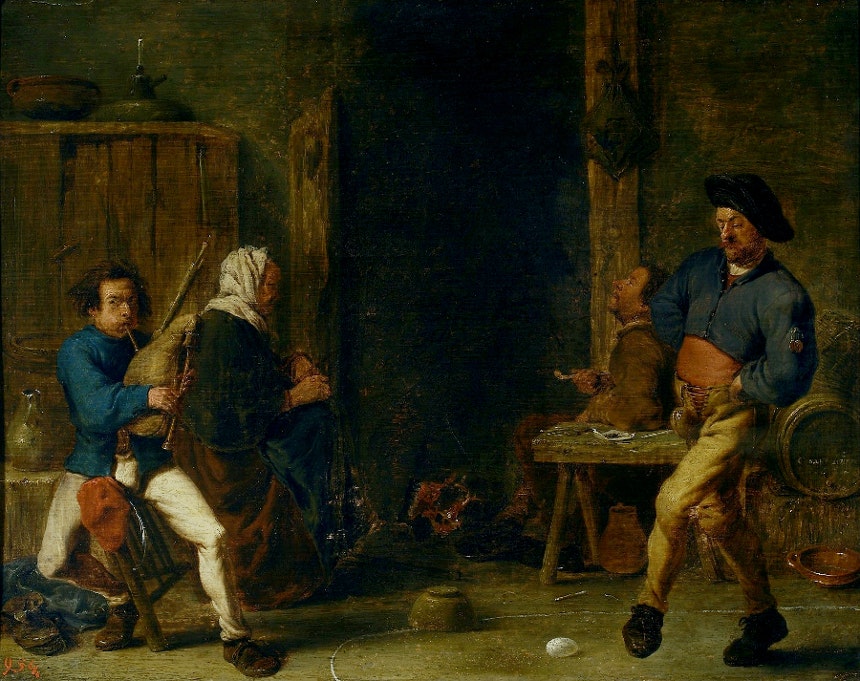
The tradition continues; in 1637 the Dutch painter Cornelis Saftleven used the same elements as his predecessors. In this sober interior scene, nobody appears to be interested in what the dancer is doing. The old woman is occupied and the man, seated at the table, is looking upwards. As hushed as the rear figures are the more activity Saftleven gives the musician and dancer. The bagpiper looks directly, somewhat ill-humoured, at the viewer. He is actually playing his instrument; just look at his puffed up cheeks. And Saftleven’s dancer, hands on the hips and shoulders slightly twisted, moves easily, even nonchalantly. He, contrary to his predecessors, has kept his boots on. This dance is a little less challenging; the chalked circle is much larger giving him more space to display his skills.
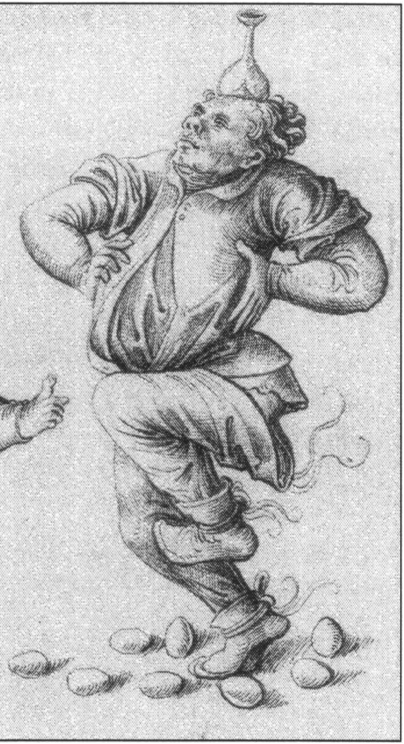
At approximately the same time that Pieter Aertsen painted his Egg Dance, the etching/engraving Dirty Sauce was published by Hieronymus Cock. This comical, satirical, rather distasteful work, which is all about grubbiness, is thought to be based on the work of the Flemish artist Jan Verbeeck. Each figure is grotesque, each a mockery of peasant life. In the foreground there is a woman whipping eggs in her apron while her child suckles on her nipple, an old fool blows his nose over the pan of fried eggs, a cat licks the butter, and a boy shares his porridge with a pig. The characters at the back, including the gloomy figures in the doorway, fare no better. Amongst these bizarre figures is an equally bizarre musician, cheeks fully puffed, playing the bawdy bagpipes and an outlandish character dancing the egg dance.
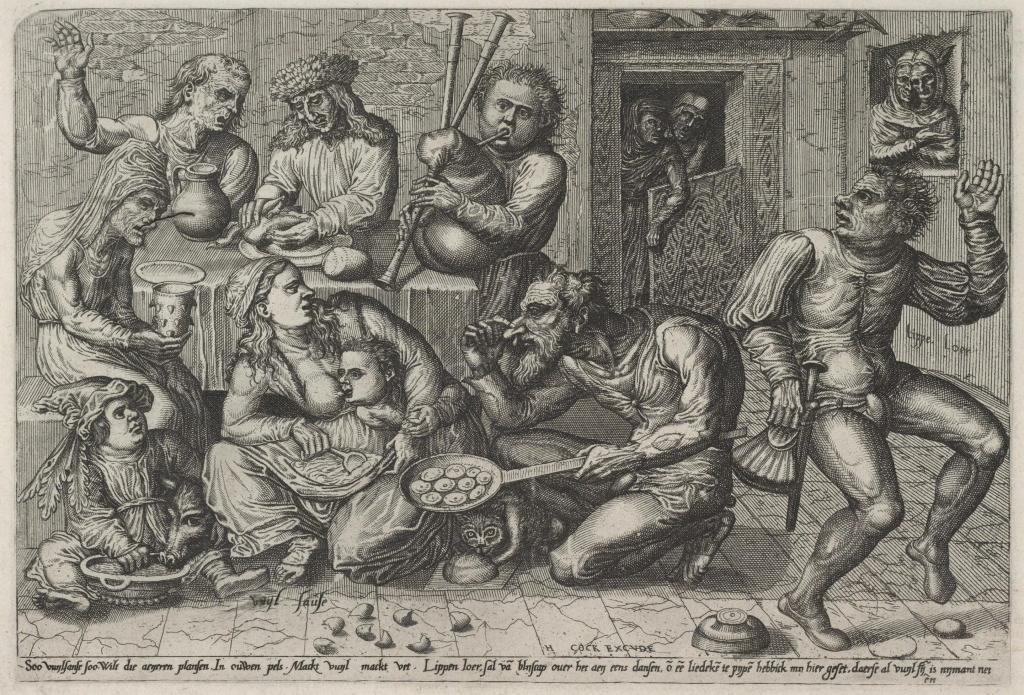
Lippen Loer, once a well-known folk character, dances under the only decoration in the derelict room, a relief of a two-faced jester. This foolish, clumsy, character with his pelvis tucked under and his coarse muscular legs is, like the other figures in the unappetizing image, a caricature of the peasant way of life. He is not focused on his dancing. His attention has been diverted. He may be looking at the musician, but I rather think that he is distracted by the dreadful creature, hollering at the back. But whatever the case, his left leg hovers awfully near to the last unbroken egg. What will happen when he puts his foot down? This artist not only mocks, teases and moralizes but leaves us burdened with a five hundred year old cliffhanger.


 DANCE IMAGES IN THE ART OF THE NETHERLANDS
