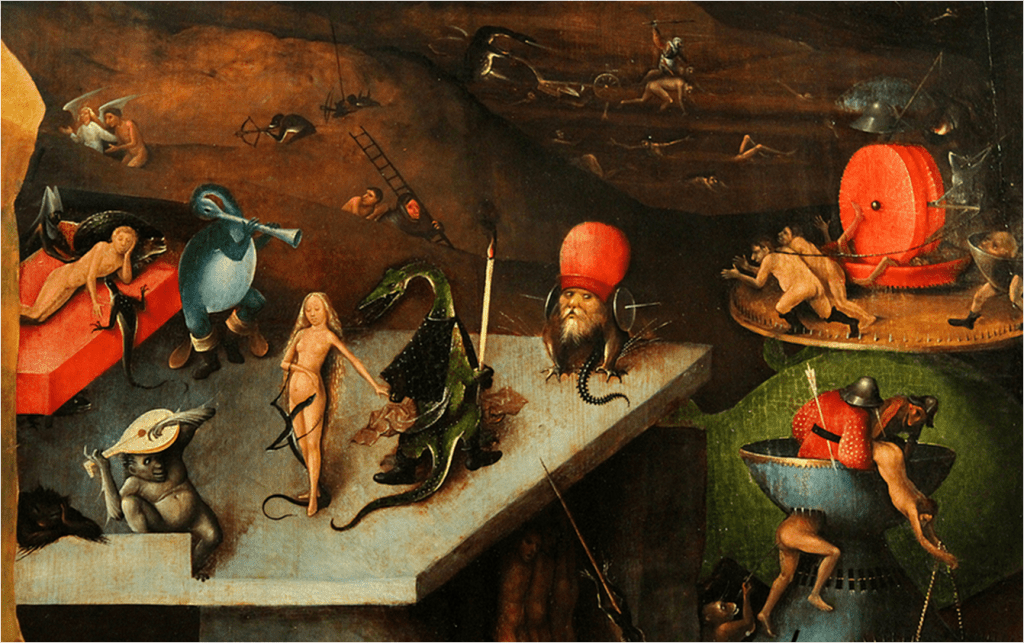
Just imagine the scene. A naked woman, with a snakelike creature crawling rudely over her legs, parades elegantly down a runway while a dragon turns his atrocious head towards her. Behind her there is a head wearing a large red hat and in the front of her, a chunky ape-like creature is playing the lute. To her left there is a most magnificent blue-green musical creature wearing elaborate boots. This curious fellow, a two legged bulbous shape with a long revolving neck that evolves into a fagot, plays a tune as he dances a jolly jig. The delicate lady and sprightly fellow are just two of the many figures of one of Bosch’s most terrifying paintings The Last Judgment. In the central panel, a representation of limbo, the damned are tortured by ghastly creatures and undergo great physical suffering. These tortures are so gruesome that the painting was surely horrifying to our medieval ancestors.
The central panel of The Last Judgment depicts the Seven Deadly Sins. Demonic creatures torture those humans who are guilty of committing corruption, avarice and gluttony or as shown above, the sin of pride. As often seen in illuminated manuscripts and artworks of the time dance and music was associated with lust, vanity and sinfulness. Time and again Bosch paints sinners ensnared, suspended and tortured on or by a musical instrument. The Hell panel of the triptych The Garden of Earthly Delights shows a sinner painfully entwined within the strings of an enormous harp and on the buttocks of another sinner, music notes have been engraved.
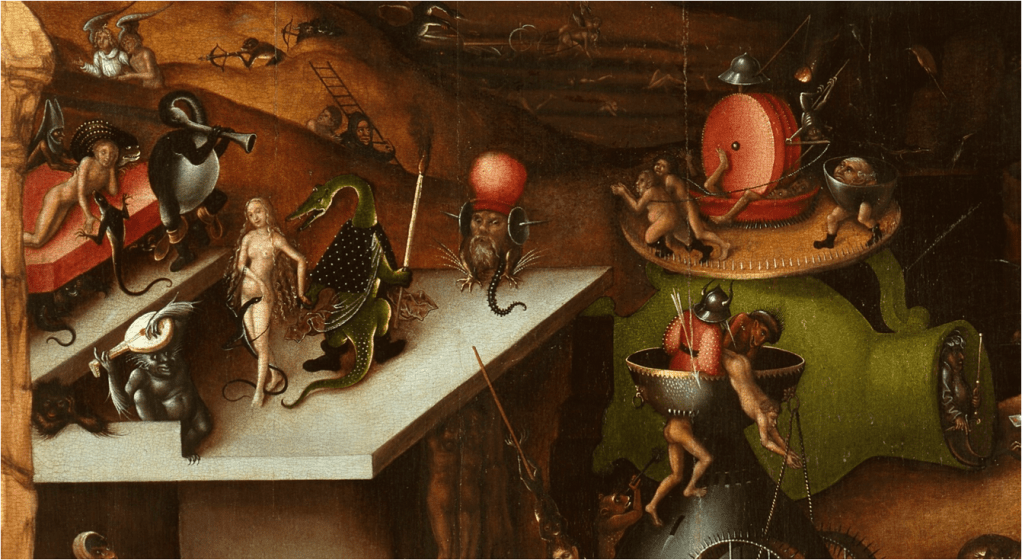
The nude women, oblivious all the horrendous brutality around her, promenades down the runway. We can question if she really dances, but there is no doubt that two musicians, the fagot and lute player, are accompanying her. She is the personification of pride; her confident composure, her shapely body, her long flowing hair and her self-assured downward glance all profess her vanity. Lucas Cranach the elder, a German artist, made a near copy of this Bosch painting. Interesting is that Cranach gives the seductive lady a sweet smile: she looks directly outward to us, intentionally seeking our eye contact. The man lying on the red plateau, contrary to the slumbering man in the Bosch version, gazes lustfully at this well-proportioned beauty with long curly hair.
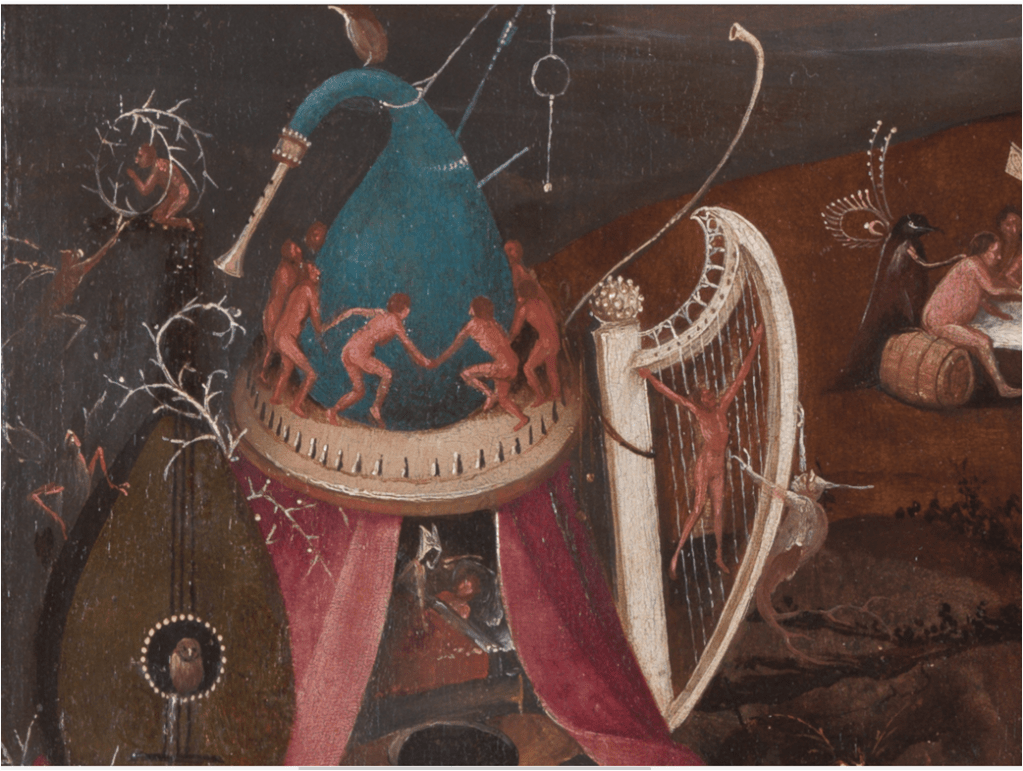
Another version of The Last Judgment housed at the Groeningemuseum, Bruges has, even though it is signed by Hieronymus Bosch, a disputed authorship. The triptych may be the work by Bosch himself or a product of his workshop. Scenes of torture, carnage, pain and suffering, similar to those shown in the Vienna painting, dominate the panel. In the central panel, just above a lantern-come-brothel a group of seven nude figures dance around a large musical instrument that has no instrumentalist. The dancers, reminiscent of figures encircling a classical amphora, revolve around the upper ridge of a plateau next to a nude figure ensnared within a harp, who is, mercilessly suspended as a ghastly creature approaches. This circle dance is a hideous form of a carole; the dancer’s movements are coarse and rudimentary. Some of the dancers clench against the bagpipes. The two front dancers, primitive in style, hop or leap towards each other. Bosch has placed dance and music, partners in lust, lewdness and impropriety, directly above a brothel and next to scenes of extreme banality and barbarity.
Below burning cities, amid the carnage, and the most monstrous scenes of horror, Bosch paints sinners chaperoned by devilish creatures encircling the belly of a gigantic bagpipe, which in contrast to the bagpipe above, is now played by a creature with a human face and claws of a repulsive bird of prey. The chaperones, a large-beaked bird, a nun and a grotesque court lady lead the three unclothed sinners in a circular promenade. This demonic dance performed on a plateau designed as a head-piece for the Tree-Man, takes place next to a large knife which gashes through a pair ears. In the rear end of the Tree-Man there is a tavern. There, a woman, who resembles the devilish court lady, is tapping bier. A flag, carrying the emblem of a bagpipe, stands on the rooftop. In this painting The Garden of Earthly Delights, Bosch, once again, utilizes dance and music to express the unhallowed and irreligious. The message is explicit; dance and music is a sure path to hell.
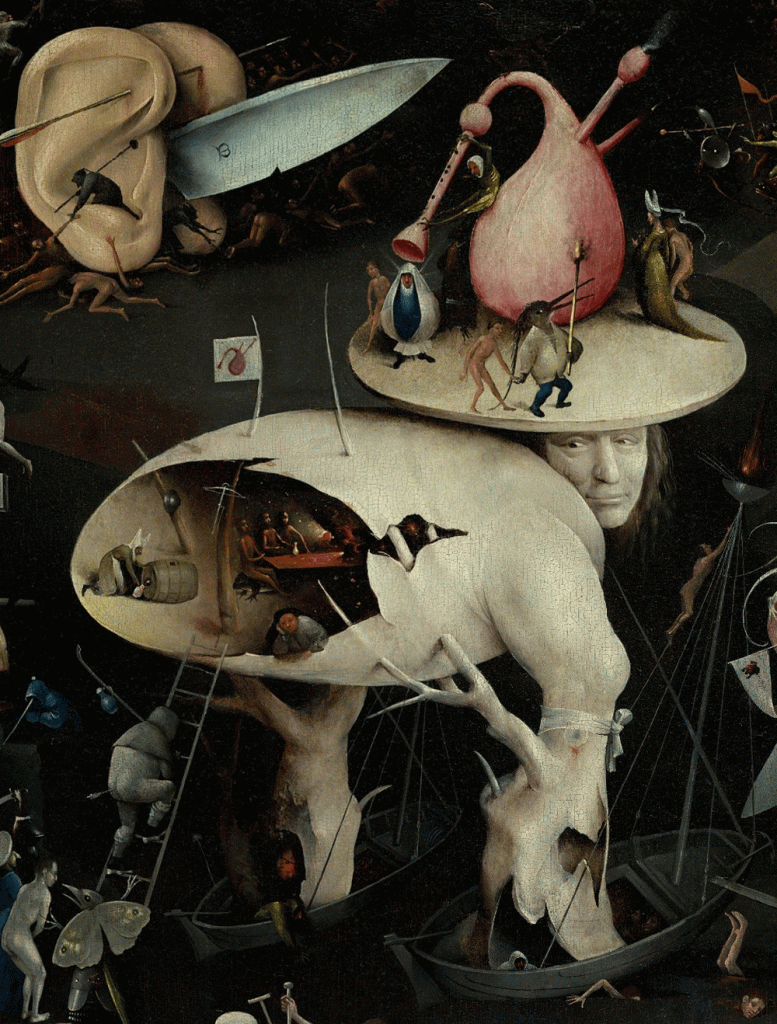
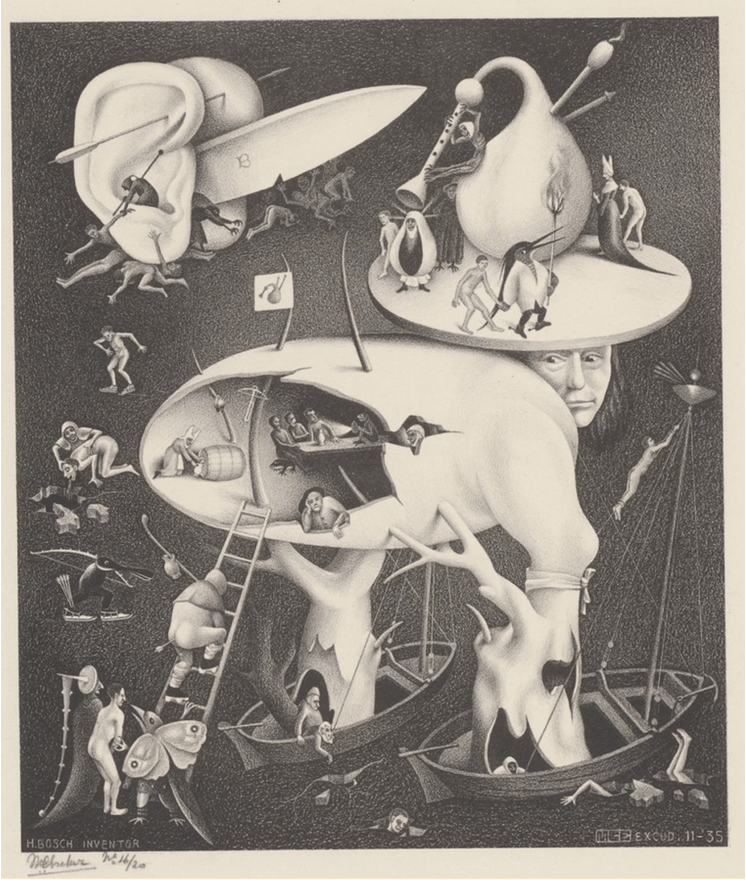
Right : M.C.Escher – The Garden of Earthly Delights (Hell panel) -Escher in Het Paleis (The Hague) – 1935
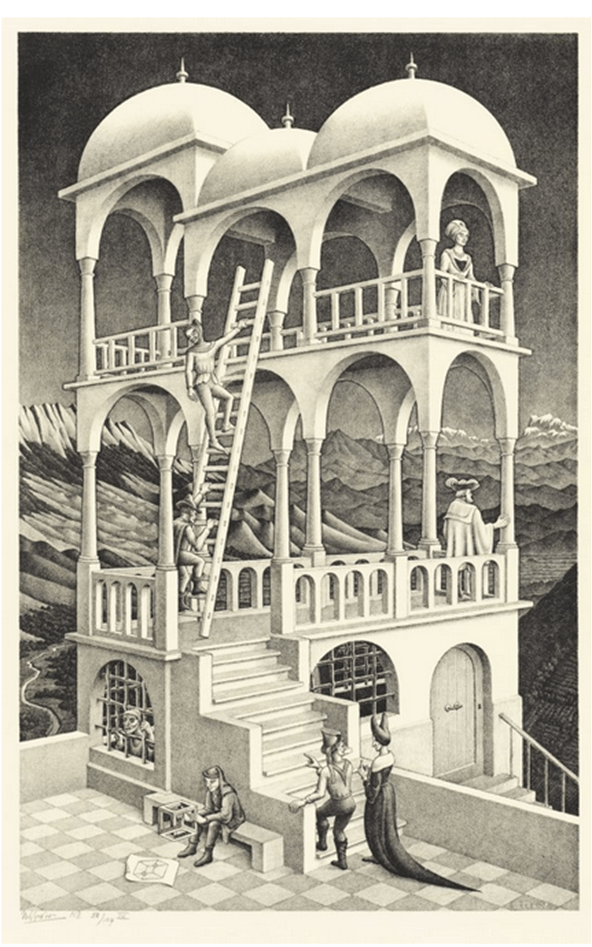
The Dutch graphic artist M.C. Escher, known for his mathematically and geometrically inspired work, made a copy of the Bosch panel in 1935. In Belvédère, a lithograph made in 1958, Escher revisited Bosch transforming the sinister court lady from the Hell panel to a non-dancing fairy tale figure.
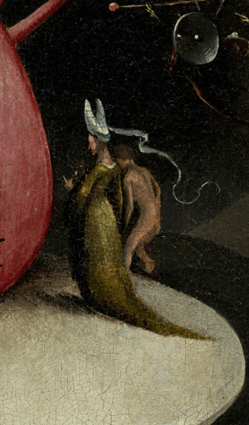
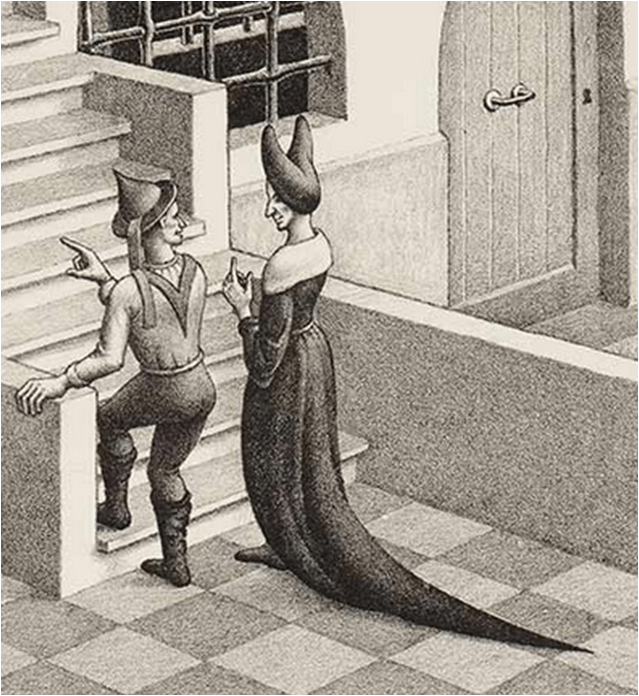
Centre : M.C. Escher -Belvédère (detail) – Escher in Het Paleis – 1958
Right: M.C. Escher -Belvédère (lithograph) – Escher in Het Paleis – 1958 (click to enlarge)
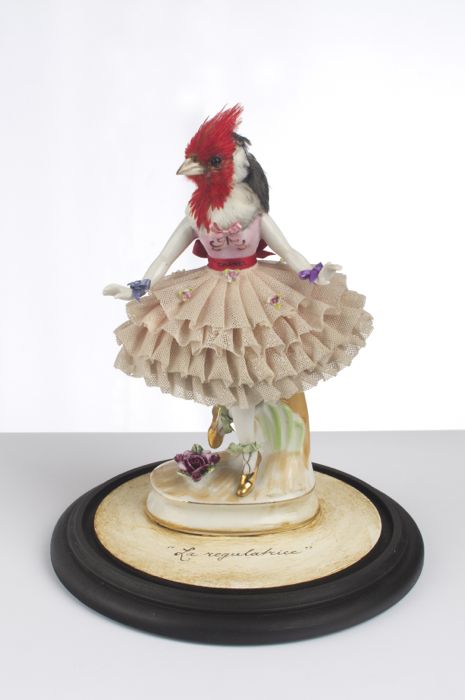
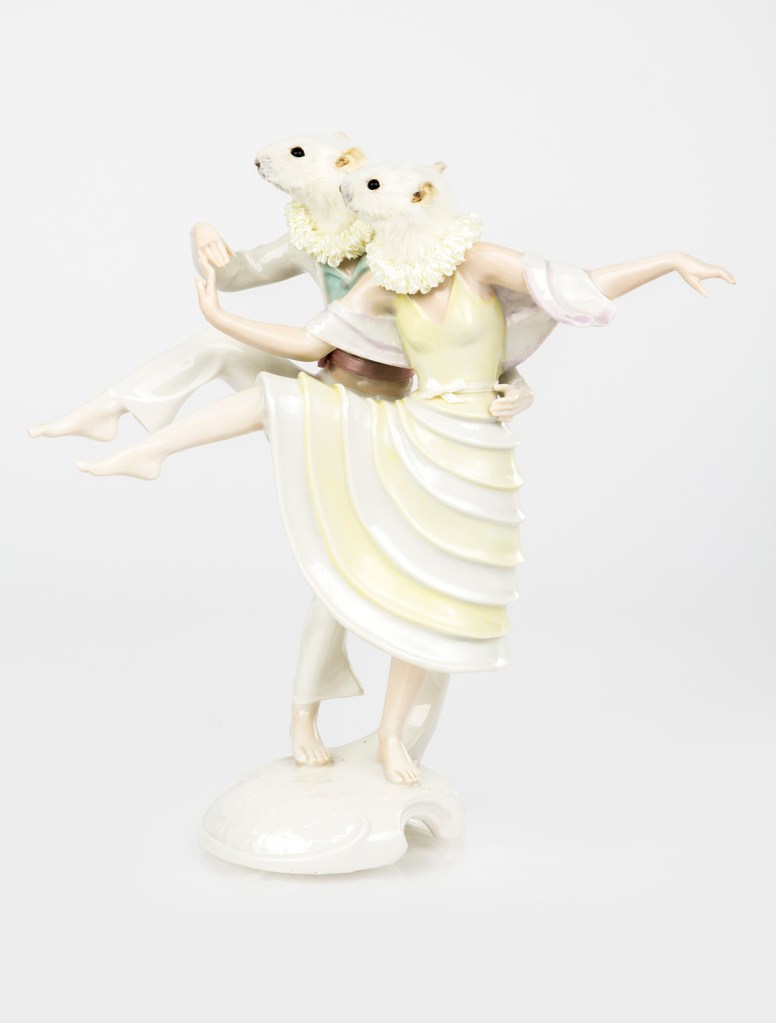
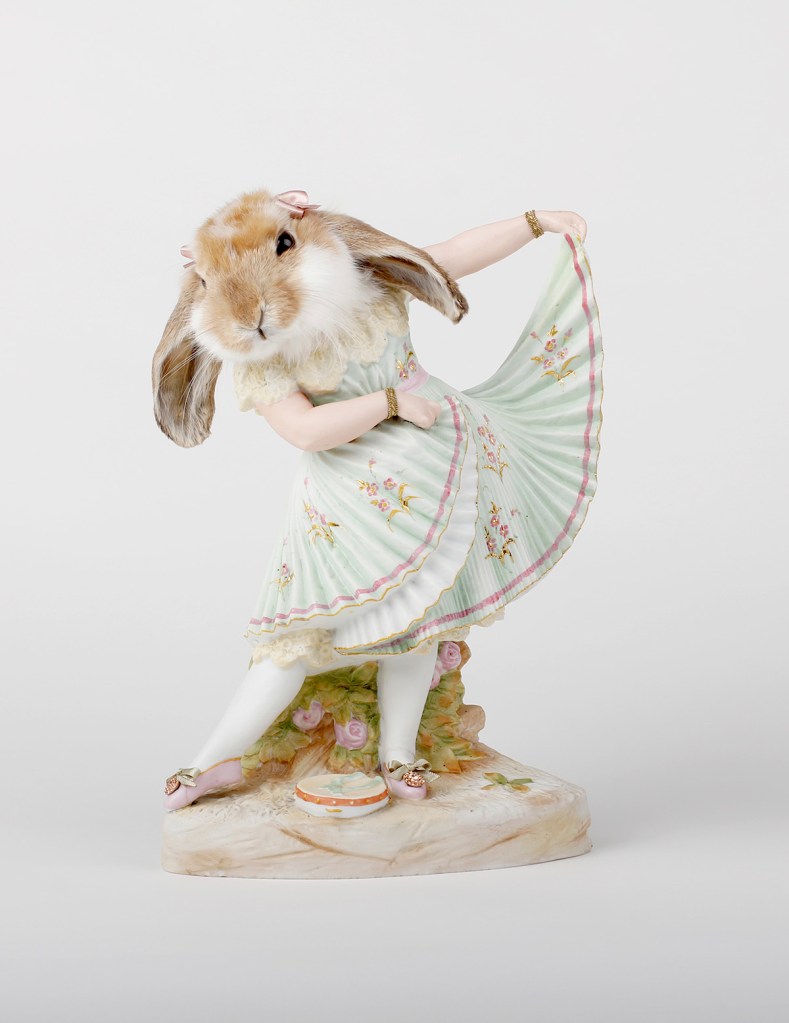
Dutch choreographer Nanine Linning composed the full-length dance spectacle Hieronymus B, inspired on The Garden of Earthly Delights for her company, Theater Heidelberg, in 2015. She worked closely with the Dutch artist duo, Les Deux Garçons, who designed the sculptures, sets and costumes for the production. These contemporary artists, Michel Vanderheijden van Tinteren (1965) and Roel Moonen (1966) work with a great variety of materials, creating assemblages, collages and sculptures combining porcelain and taxidermy.
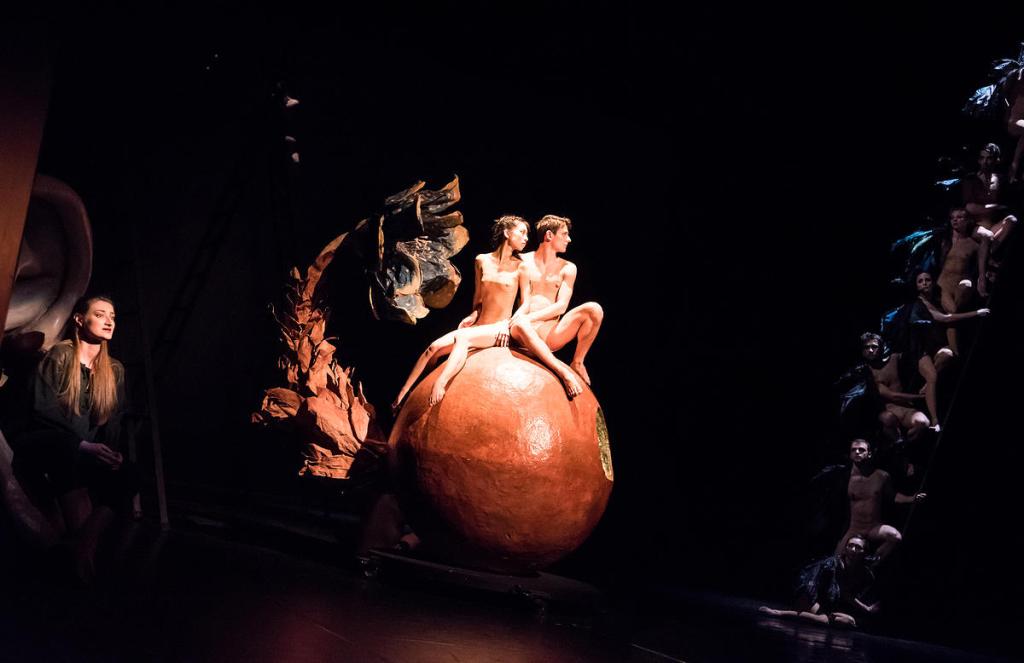
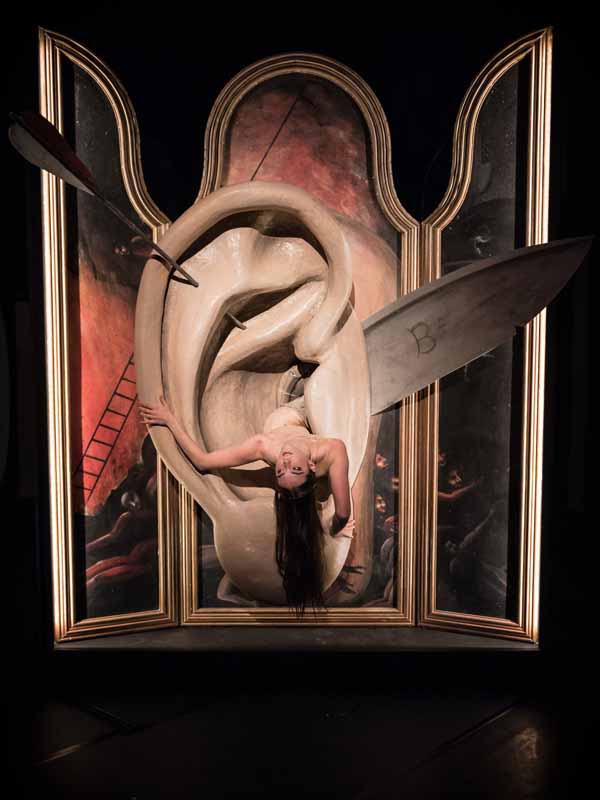
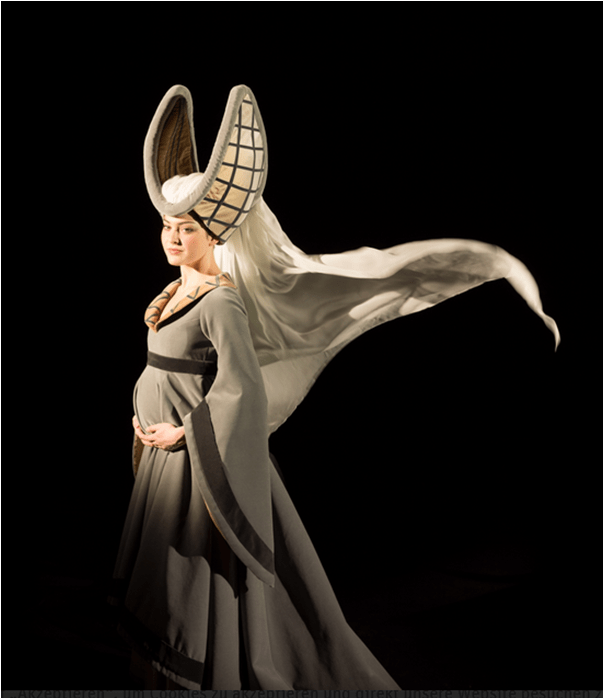
photography Kalle Kuikkaniemi ( photo 1 & 2), Erik Spruijt ( photo 3)
(click to enlarge)
One of the strangest, and simultaneously the most delicate of Bosch’s dance images is a hybrid figure of two nude dancers whose heads are covered by a large cherry upon which a big friendly looking owl has landed. The dancers are located on the lower central panel of The Garden of Earthly Delights adjacent to the Hell panel where sinners are being tortured on a gigantic harp, a hurdy-gurdy and other musical instruments.
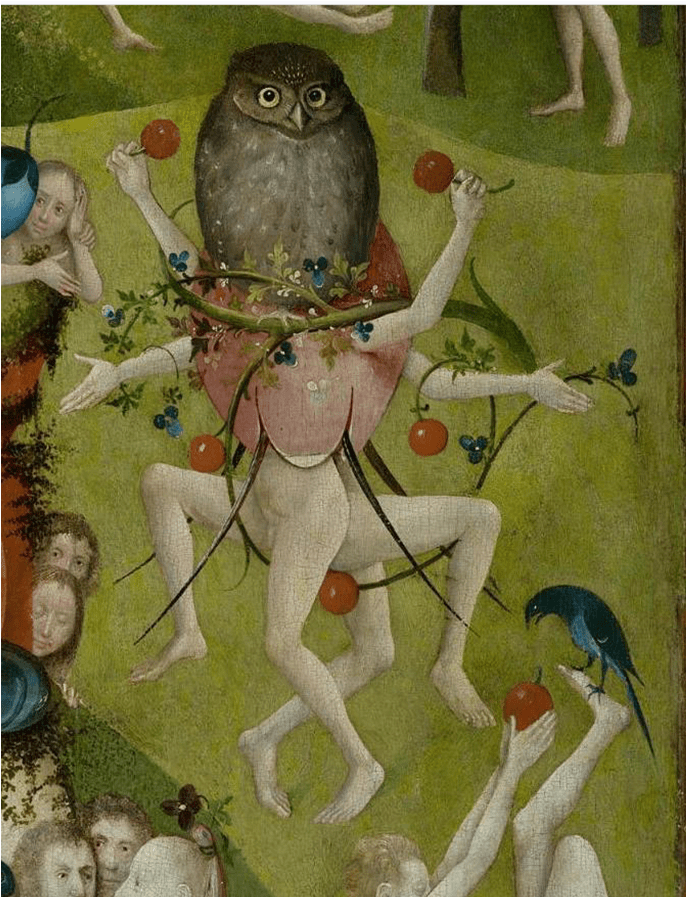
Be not deceived. However charming, these dancers seem to be, there is more than meets the eye. The central panel might appear to be a paradise, but all the people, including these two apparently carefree dancers are susceptible to self-indulgence, condemned to depravity. Lurking within this colourful panel, full of birds, butterflies, fish, flowers and fruit are ominous signs; the mermaid symbolizing seduction, the fruit suggesting lust and of course the owl as omen of adversity.
These dancers have lost their innocence. Bosch paints an entangled couple; one of them is male, entwined by branches with vines crisscrossing their naked bodies. The vines and ripe cherries even extend over the private parts. Both dancers hold ripe cherries in their hands. The large wise, yet foreboding owl totally encloses their heads. What is the moralist Bosch telling us? Dance and music invite indulgence. This unwittingly leads to lust, one of the Deadly Sins. The consequences of their immorality are made visible in the excruciating images of the Hell panel.
As you know, grotesquely macabre hybrids feature prominently in many of Bosch’s paintings. They are intended to shock, warn and threaten the (medieval) onlooker. Les Deux Garçons, artists concerned with the preservation of nature and global warming, are fascinated by the bizarre, scavenging flea-markets, antiques shops and taxidermists for usable materials. All the materials, be it porcelain, old toys or dead animals are stripped of their original identity. Porcelain statues and old toy animals are decapitated to be re-headed with a pristine taxidermy head, which is further adorned with additional decorations. The object now has a curious, unexpected and contradictory identity. These hybrids can be comical, endearing, but remain uncanny leaving the viewer, just as Bosch does, feeling uneasy.

 DANCE IMAGES IN THE ART OF THE NETHERLANDS