In my previous post, I discussed a number of miniatures of the medieval dance the carole, that appear in various versions of Le Roman de la Rose. In this post, I will look at the carole again; this time in Prose Lancelot. The term miniature can be confusing, therefore a few remarks before we start. As used in illuminated manuscripts, the term does not refer to size; a miniature can have various sizes, ranging van small to full page illustrations. A miniature is an independent illustration set within a frame as opposed to decorative initials, bas-de-page decorations, borders and other embellishments. The word miniature is derived from the Latin word miniare which means to colour with minium. Minium, also known as red lead is a bright orange red pigment which was commonly used to decorate early manuscripts.
In Le Roman de la Rose, the carole is danced by the lover and a group of allegorical figures in the Garden of Love. In Prose Lancelot the carole takes place in an enchanted forest. In this mysterious woodland, ladies, having been placed under a spell, dance a never-ending carole, waiting to be released by ‘the best knight in the world’. This carole, a circular dance, has neither a beginning nor an end; the dancers travel to nowhere, seemingly suspended beyond the natural flow of time. When Lancelot and his men arrive in the enchanted forest, they see the ladies dancing a carole near an ivory throne bearing a large gold crown. Lancelot, having never committed an offense against love and being the best knight alive, enters into the dancing. He is found to be the rightful bearer of the crown. The spell is broken. And furthermore, being the best knight alive, Lancelot is also able to defeat the magical chessboard with its annoying habit of moving pieces on its own accord.
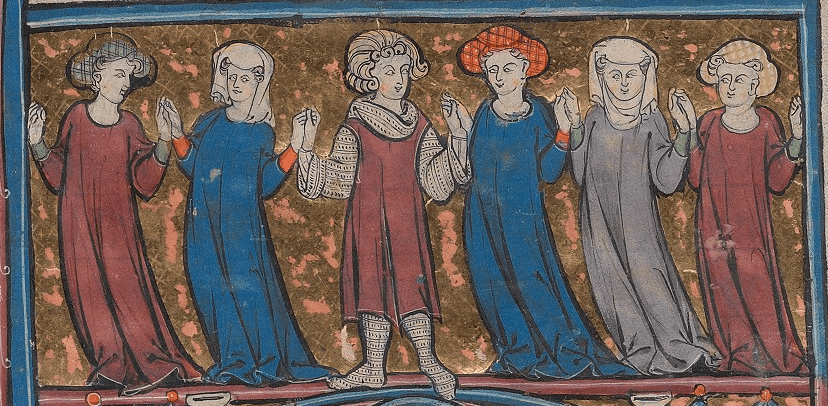
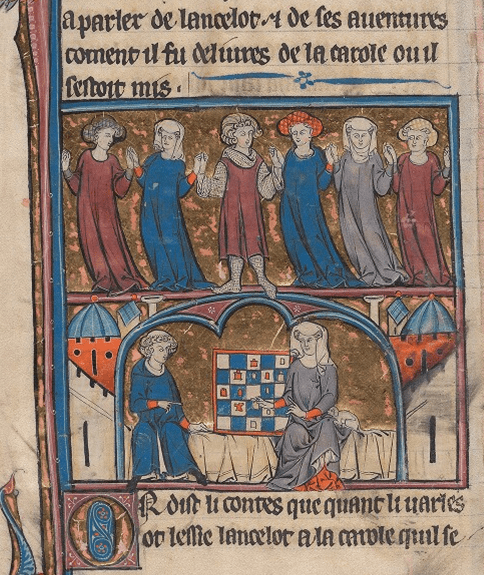
To find both these scenes, the magic carole and the magic chessboard, together in one miniature, is unique. The double-register miniature below from The Arthurian Romances depicts both scenes. This manuscript was composed in Flanders, possibly the Therouanne area, in the late 13th century. The top register shows Lancelot dancing, hand in hand, with five ladies. In Prose Lancelot the carole is represented as a circular dance. In this miniature the reader is only granted a frontal view, thus excluding the possibility of a circular formation. Even though we only see five dancers, we have no way of knowing how many ladies are actually dancing. The ladies at either end of the line have raised their arms just as the other dancers. It is possible to envision, that on either side of this line more ladies are joining in. Judging from the sway of the body, this carole advances gently to the right by means of a sideways or crossing over step. The ladies, poised and gracious, have their arms folded close to the body with the palms of their hands touching those of their nearest partner. The word carole, you have noticed, appears above and below the text. Noteworthy to mention is that even though we are observing a dance, here, and as we shall see in most other Lancelot miniatures, there is no musician present in either the miniature itself or in the area surrounding the miniature. In the lower register Lancelot, changed into a blue tunic, is playing chess. I delight in the way the artist has drawn the chess board.
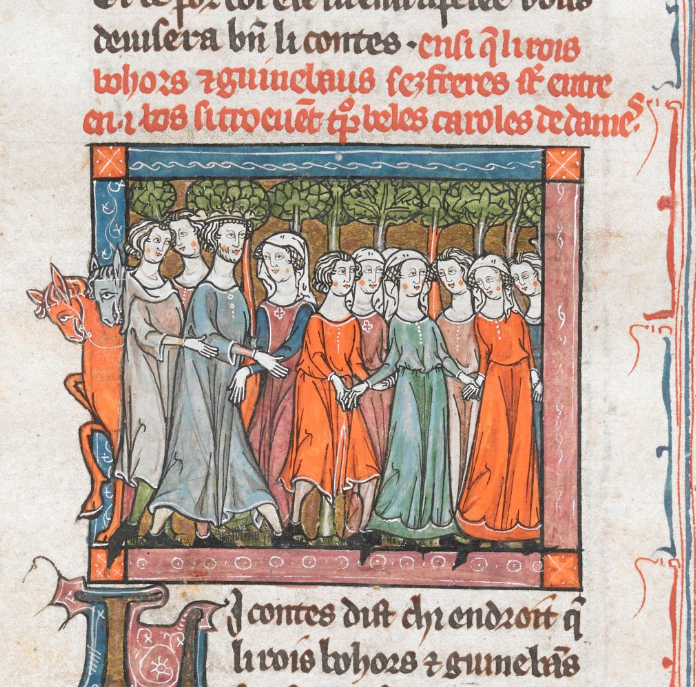
The next miniatures, created in St-Omer or Tournai around 1316, marks two different moments in Prose Lancelot. The first miniature, with the jolly horses, shows King Bohort and his brother Guinebaus dancing with ladies in the wood. This very small miniature is placed just above the centre of three-column folio. The ladies, their hands joined and facing front, are dancing in a somewhat ungainly circle that resembles a double row. This artist has placed a second row of figures behind the front ladies overlapping sufficiently to give the impression of a more circular formation. To create more depth he has added of a row of trees. I wonder why the back lady on the right side has been cropped. She and the orange clad lady hold hands so we can assume that this is the curve of the circle. Perhaps cropping, in this case, was a pure necessity caused by unexpected lack of space.
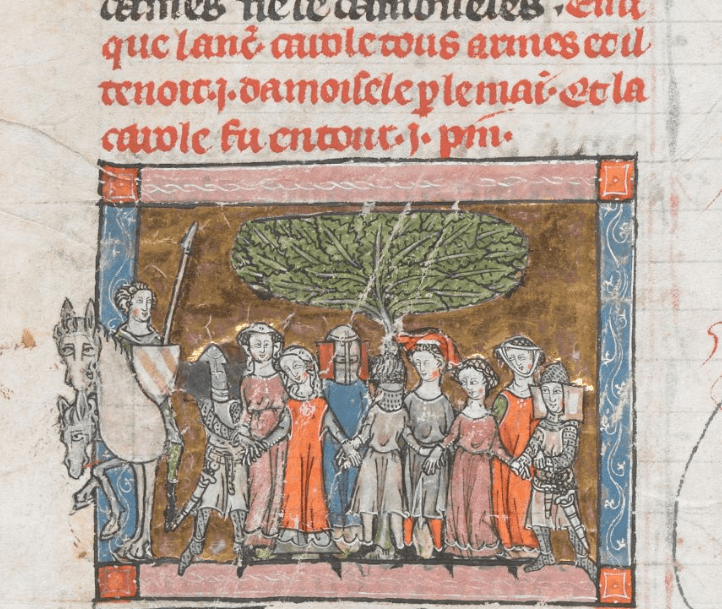
In this miniature and the next, the figures place their feet over the border of the frame. A clever artistic tool, used throughout the entire manuscript, that enables the artist to suggest even greater depth and simultaneously connects the reader with the figures that, together with the horses, appear to move forward. In spite of the fact that the both miniature illustrates dancing and that the word carole is noted above both, there are no musicians to be seen either in the image or anywhere in the close vicinity of the image. Musicians, by way of explanation, are not mentioned in that particular section of the Lancelot text. It is therefore plausible that the artist limited himself to only illustrate the written text and felt no need to add musicians.
The composition of the following image resembles the miniature just discussed, but this miniature represents Lancelot himself, wearing a helm, dancing with maidens and knights in front of a solitary pine tree. The construction of the circle, the use of overlapping, the placement of feet into the space just outside the border and the colourful frame with simple linear patterns, are all similar. Not surprising since both manuscripts originate from the same region and may once have been part of the same work. The artists probably worked in the same atelier and it is more than likely that they influenced each other.
A castle, a throne, tents, pine trees and dancing ladies are all present in this broad miniature which stretches out over two columns and includes a pertinent supporting scene. The miniature attributed to Master au menton fuyant* illustrates the narrative; on the left Lancelot and the dancers, followed by Lancelot, still wearing his helm, taking his place on the throne. The group of, not very friendly, men and women standing in a circular shape look as if they are talking or even arguing with each other. And yet this group is actually dancing together with the Lancelot. The word carole appears several times under the miniature. From what little that we can see, it would appear that the hands are joined just below shoulder height. The legs, except for Lancelot, and one other chap are covered so it is difficult to ascertain which steps are being made. Possibly the group is simply performing variations of a walking step.
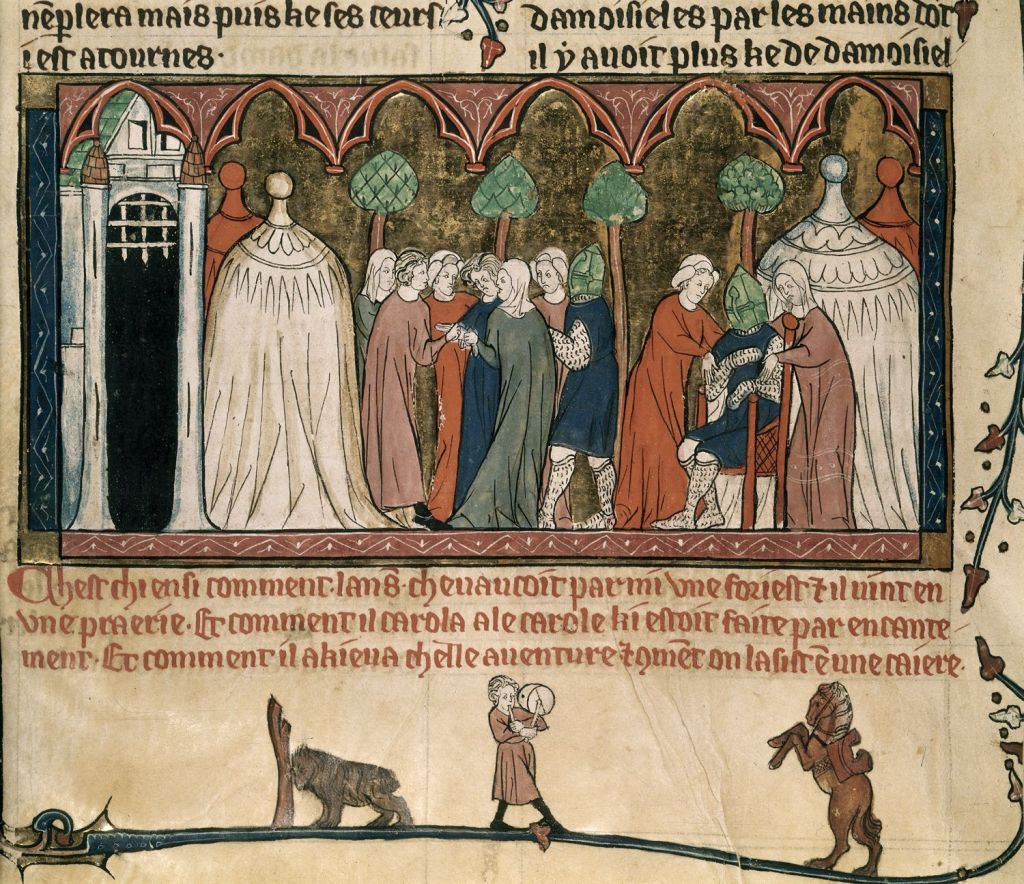
As with the other miniatures, there are no musicians present in the image itself. But the bas-de-page presents a most pertinent supporting scene of a musician playing a pipe and tabor to entice his horse to dance. Needless to say the bas-de-page and miniature are directed linked to each other; the dancers have their music.
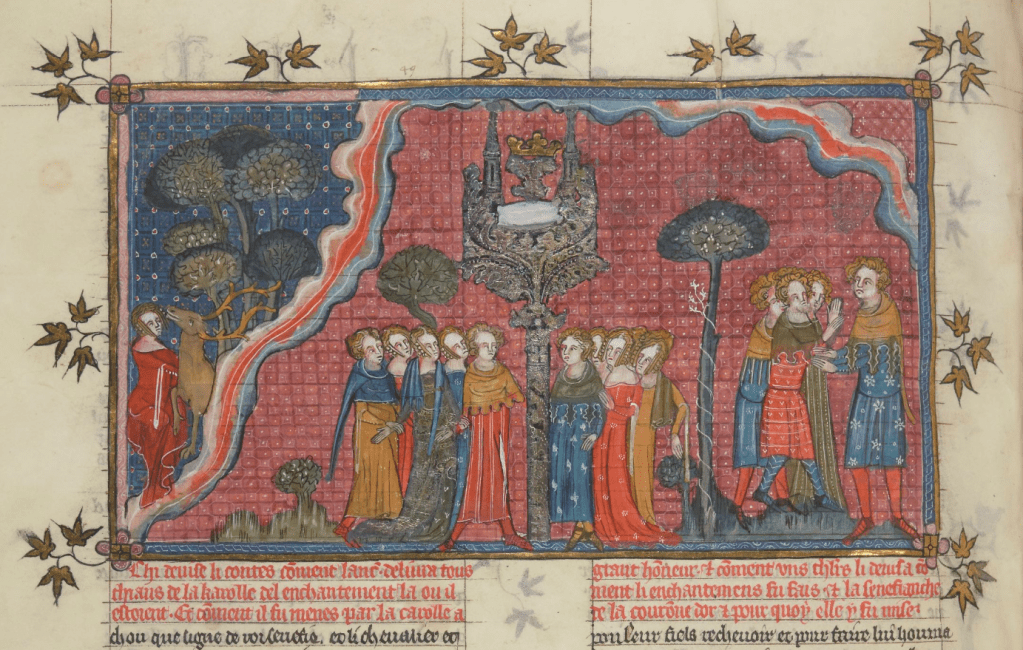
The artist who painted the elaborate scene below is exceptionally imaginative. Not only do we see Lancelot and the dancing ladies, pine trees, but also a most unusual throne with a crown resting on a cushion placed on a high column between two architectural pinnacles. The artist’s fantasy extends even further to adding an extra scene showing a fair lady and a stag, an episode not present in the narrative.
The miniatures above may give the impression that the dance images of 14th century artists of the Low Countries lacked spirited dance activity. This would certainly be a misconception; my previous posts have given many examples of truly animated dance images. But, given that the above images are placid, we must remember that there is uncertainty as to how a carole was actually danced and which music, (song, instrumental of both), accompanied it. Most of our information has been passed down through criticisms, prohibitions and religious condemnation of the dance. Experts query whether the carole was a line dance, a circular dance or even a combination of both. There is no written information about the steps; the carole was danced by men and women, young and old from all social classes, therefore suggesting that the steps and movements were free from complexities. It would not be inconceivable, even taking artistic license into consideration, that the carole, as danced by ladies such, as those in Prose Lancelot, was as calm and relaxed as the artist’s interpretations in these miniatures.
* Master au menton fuyant – attributed by Alison Stones

 DANCE IMAGES IN THE ART OF THE NETHERLANDS