The Romance of Alexander (Bodley 264) is a part historical, part fictional narrative about the life and adventures of Alexander the Great. This priceless manuscript is kept in the Bodleian Library, Oxford. We neither know who commissioned this manuscript nor the name of the original owner. The first seventy years of its existence are a mystery. By a stroke of good luck we can identify the illuminator. The original colophon informs us that the manuscript was illustrated by the Flemish illuminator Jehan de Grise and his workshop, adding that the illumination was completed on the 18th April 1344.
Bodley 264 is exquisitely illustrated with miniatures and marginalia; everyday scenes such as playing games, hunting, wine making, watching a puppet-show and women cooking are just as predominant as the many aristocratic and court scenes. Amid the marginalia are countless musicians and a large number of dancers. The dance scenes show a marked diversity extending from morris dance, court dance, acrobatic dance, dancing animals to mumming. No other 14th century manuscript made in the Low Countries, or in any other country for that matter, contains such an amazing range of dance images. In this blog, I will cover line and morris dance and re-visit the images of dancing animals. In my next post, I will look at at mumming and at court dance.

Folio 51v is an astonishing piece of art; a full page miniature divided into four compartments functioning as frontispiece for the battle of Alexander and Porus. At the bottom of the page five dancers, perform a lively but, totally haphazard, line dance. It is not clear in which direction they intend to move and that piece of cord which each dancer holds in his hand doesn’t make matters easier. Each of these pixie-like figures is unique. Each has an individual expression. This line dance resembles a friendly tug of war. The figure on the far left is being ushered forward by the red hooded dancer. The centre figure is not too happy, his hand is uncomfortably tangled in the cord and the last two figures, even though they are moving in opposite directions, are chatting to each other. On the right hand side are two more figures with hoods. Perhaps these are two dancers, taking the opportunity to share a beverage, during a well-earned break. Noteworthy is that an archer aims his crossbow upwards at Porus’ soldiers who are depicted in the miniature directly above him; an uncommon example where the figures in the bas-de-page actually interact with the characters in the miniatures.
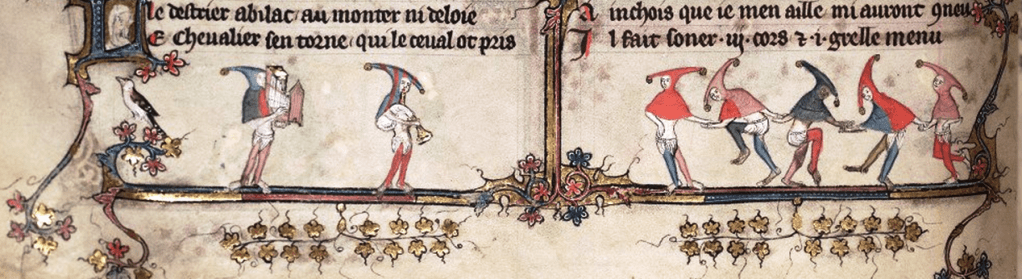
The image on folio 84v is well-known. These morris dancers are dressed in a one-piece cape extending into an elaborate hood with bells on each end. Under a bare midriff they wear an undergarment called braies and on their legs different coloured hose. Like many figures in Bodley 264 the dancers have tiny waists, are slender and fairly tall. The musicians, one playing a portative organ and the other the bagpipes, are similarly attired. Like the rustic dancers in folio 51v these dancers perform a line dance; the tanned centre dancer moving in the opposite direction to all the others. These dancers and the rustic figures execute basically the same steps, but, where the rustics are heavy and earthbound these performers are light footed, sounding their bells merrily with every step and caper.
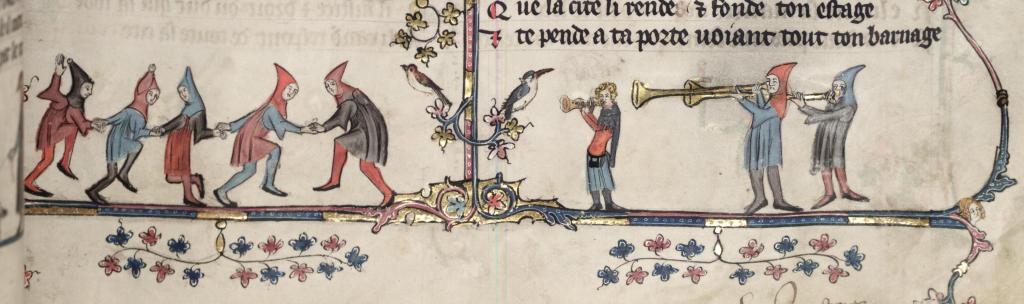
With three musicians playing for them this group of impish dancers, two of whom have bells on the top of their hoods, is having a great time. The artist is very precise drawing the arms and hands in a technically correct position, thus enabling the dancers to face each other, to turn and face another partner, rotate inwards and outwards and with a simple half-turn to all face the same line of direction as if participating in ‘follow the leader’. These are playful dancers each with a delightfully cheerful expression.

What a joyful sight these morris dancers are. Once again, the dancers perform a line-dance holding each other’s hand. The last man carries a large hand bell. We see the dancers in the act of dancing, actually springing up and down on one leg or hopping from one to the other. And judging by the likely rhythm of the tambourine and the ringing of the bell, this can be none other than a lively, spirited dance. Especially striking are the dancer’s hoods with their long tubular extensions (liripipe), which in the case of the bellman remains horizontally suspended in the air. Just as striking are the men themselves; some bearing full beards and others with an abundant hairdo appearing from under their extravagant hood. And with his neck thrust forward, his jagged jaw and pointed nose that bellman is an awesome character.
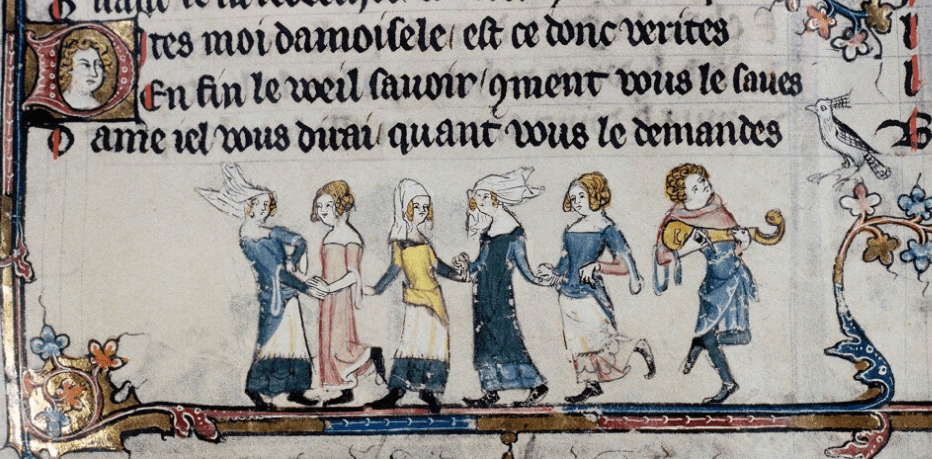
These five ladies are accompanied by a light-footed musician playing a gittern. The young man is hopping on one leg. Safe to say he must be playing a bright piece of music; you simply cannot hop slowly. In contrast, the ladies are walking rhythmically, possibly in combination with intricate footwork. How does the artist give this suggestion? The two ladies not wearing a headdress look as if they are about to land from a hop or jump. Their right foot barely touches the ground. Two other ladies stand firmly on the ground whilst the lady on the left is about to take a step. Choreographically this line dance is very interesting; dancers performing different steps and probably using contrasting rhythms. This image does not represent a random dance, but a dance performance; perhaps at court, perhaps in a village square. The women’s movements clearly demonstrate the tricky choreographic possibilities. Only practiced dancers can perform this type of choreography. And I cannot help but find their attire baffling. Are they wearing daily dress or costumes? There is an elegant court lady, young village maidens and a lady wearing a head scarf. Those two white ‘flying’ bonnets remind me of folk costumes still seen today in Brittany and elsewhere. These are the only two such bonnets in the entire Bodley 264. To my mind the women are wearing costumes. They even wear the same footwear. This can be none other than a performance.
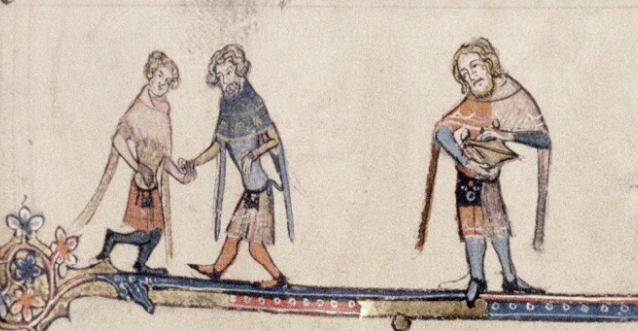
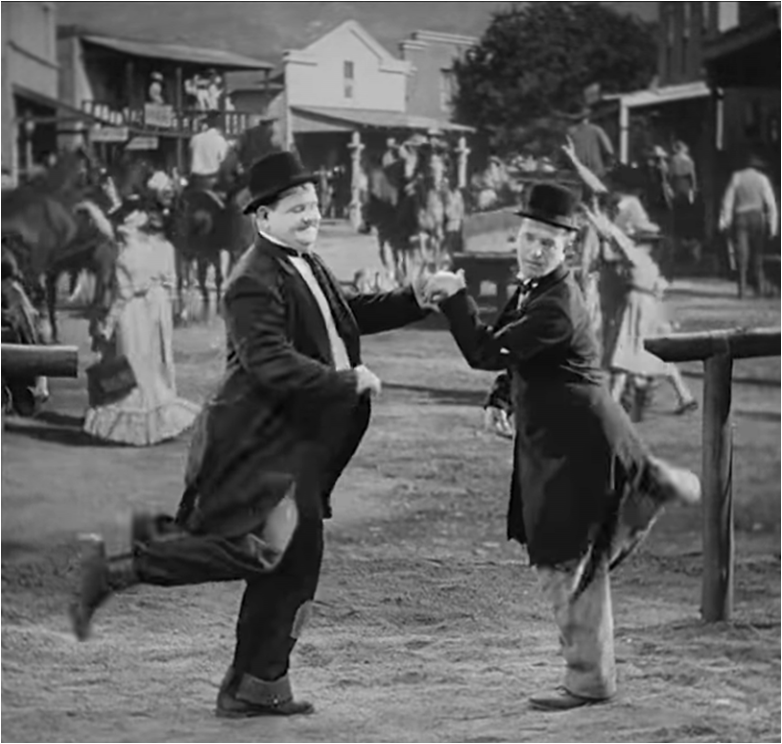
The above image – folio 86r – is an exception; just two dancers and a musician. Jehan de Grise has skillfully captured these two amiable men enjoying a carefree dance. I am reminded of a hilarious dance performed by Stan Laurel and Oliver Hardy in the film Way Out West (1937)
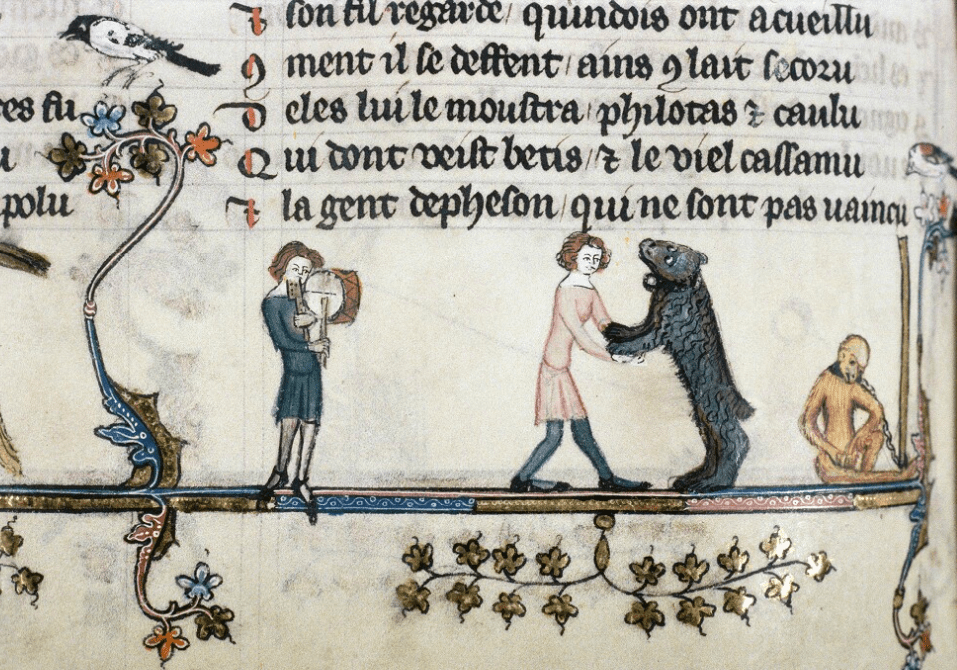
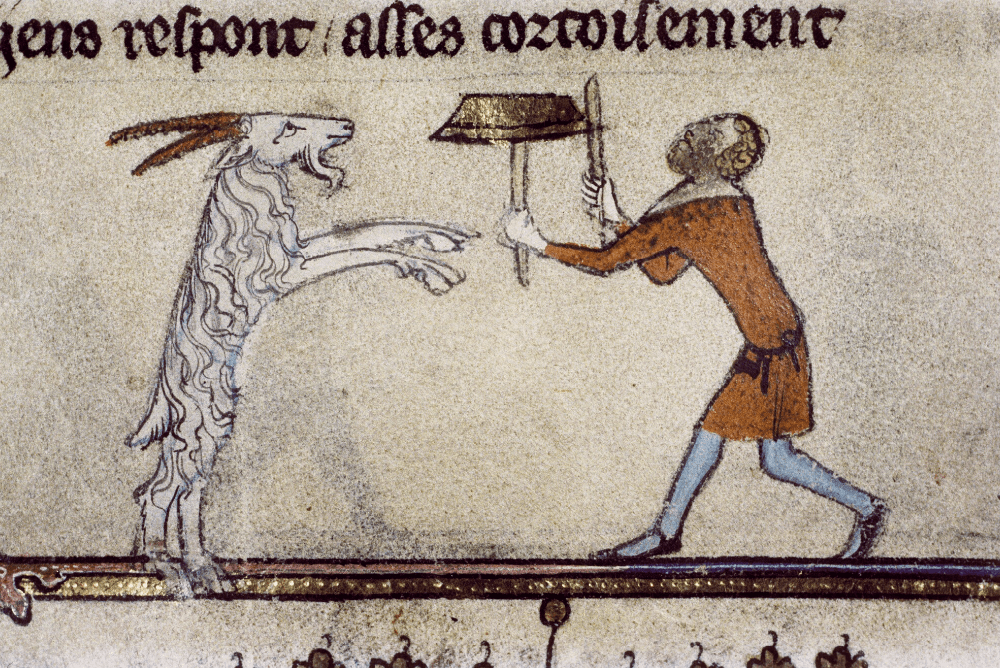
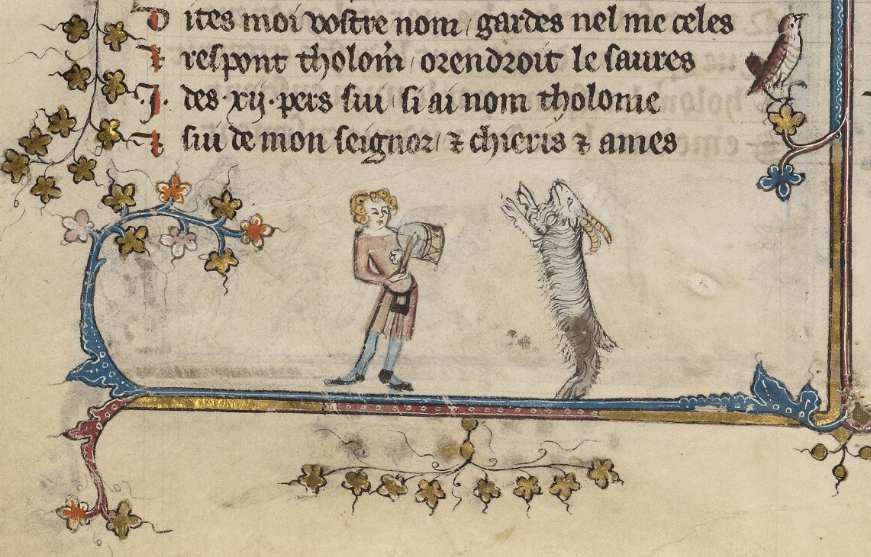
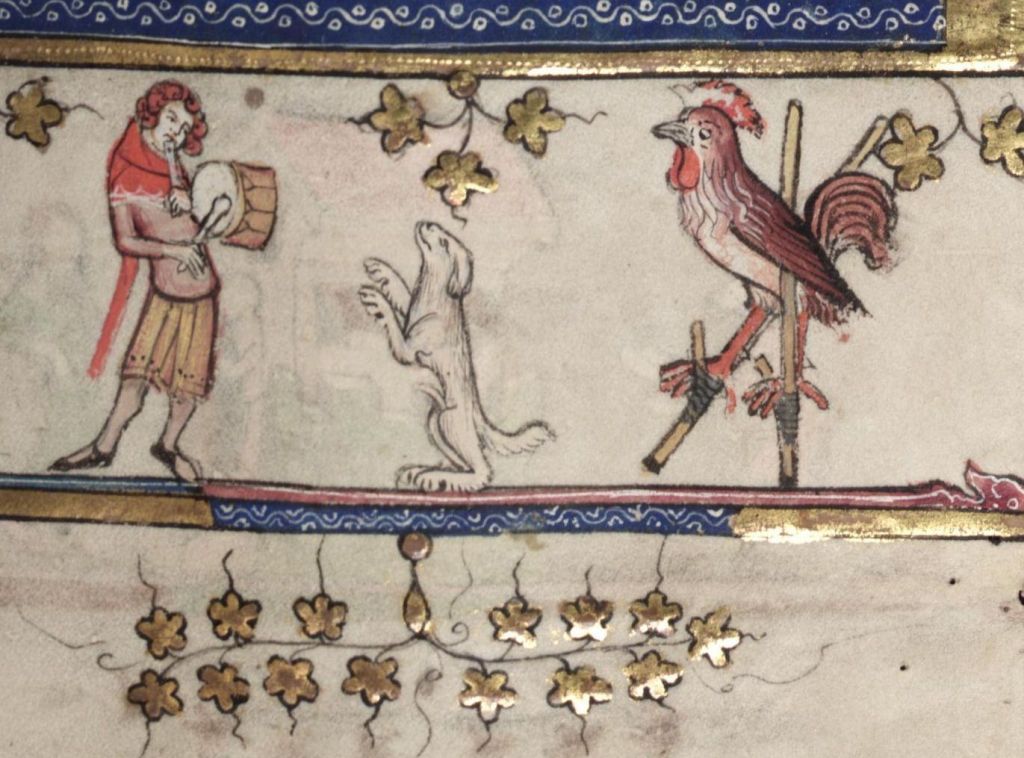
I wrote about images of dancing animals in a post called Dancing animals: bas de page. Bodley 264 has a dancing bear (f.117v), two dancing goats (f.130r & f. 91v), a dancing dog and a chicken on stilts (f.91r). Enjoy the slideshow.
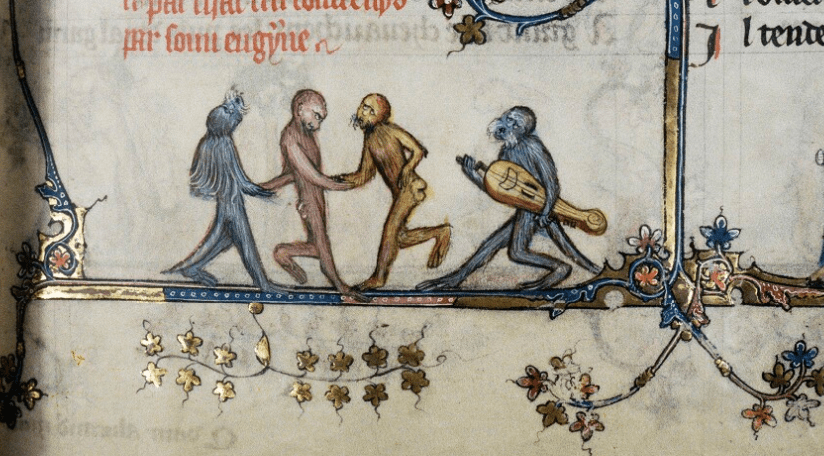
Monkeys appear throughout Bodley 264 taking part in a multitude of activities. In the post Dancing hybrids and monkey antics, I explained that monkeys participated fully in the marginal mockery. Monkeys were seen as devilish and were regarded as ugly. The monkey, it was said, imitated human action and the monkey image was designed to mock human behaviour. They highlighted the frivolity and folly of human actions. And that is exactly what happens in the follow image. There are three monkeys performing a line dance, holding hands, and dancing in a similar formation to all the other line dances discussed in this blog. The ‘blue monkey’ is holding a hurdy-gurdy and he and his other whiskered companion are possibly singing. The expression on the monkeys’ faces is just as vivid as the countenance of the ‘real’ people. Are the two ‘charming gentlemen’ flirting with the sweet, bashful monkey? And what is the role of the blue long-haired ape? One thing is certain; this scene is mocking human behaviour.

 DANCE IMAGES IN THE ART OF THE NETHERLANDS