Biblical references to dance fall into two categories. On the one hand there is dance of joy, worship, and exaltation and on the other, dance which is depraved, sinful and must be denounced. In Exodus, the second book of the Old Testament, both forms of dance occur. Miriam’s ecstatic dance is an example to all worshipers and needless to say the dance around the Golden Calf falls into the second category.
The first biblical reference to dance occurs in Exodus 15:20 where Miriam, with timbrel in hand, leads the Israelite women in dance and song, singing praise to the Lord, after successfully escaping from the Pharaoh and his army. Miriam’s dance of liberation has inspired artists from the Byzantium era to the present day. An early image of this glorious victory illustrates a folio in the Vienna Bohun Psalter. The Bohun family, a 14th century British noble family residing at Pleshey Castle Essex, had a permanent manuscript workshop on their estate lead by the illuminator John de Tye. His main assistant was an anonymous Flemish artist and it is possible that this Flemish illustrator worked on the Vienna Bohun Psalter.
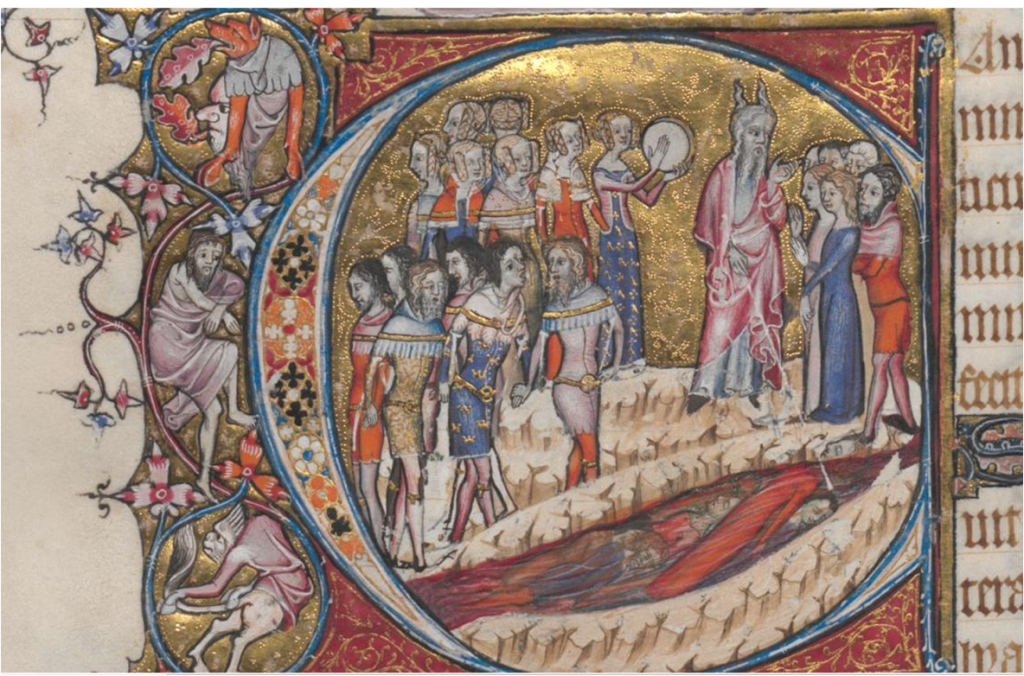
Miriam, Moses, and the Israelite’s are set against a gold background decidedly reminiscent of Byzantium art. From the scriptures we know that Miriam and the women sang and danced to celebrate God’s glorious triumph. But how to envisage a triumphal dance? Perhaps exhilarating movements, enthusiastic jumps, turns, and energetic music? Yet this Miriam and her following merely walk serenely displaying courtly dignity. The general feeling is not one of liberation but of restraint. Curiously Miriam and the women are all well dressed in fashionable apparel suitable for any 14th century court function. And have you noticed that, even after the challenging ordeal of crossing the Red Sea, their hair is still beautifully styled in immaculate plaits and curls.
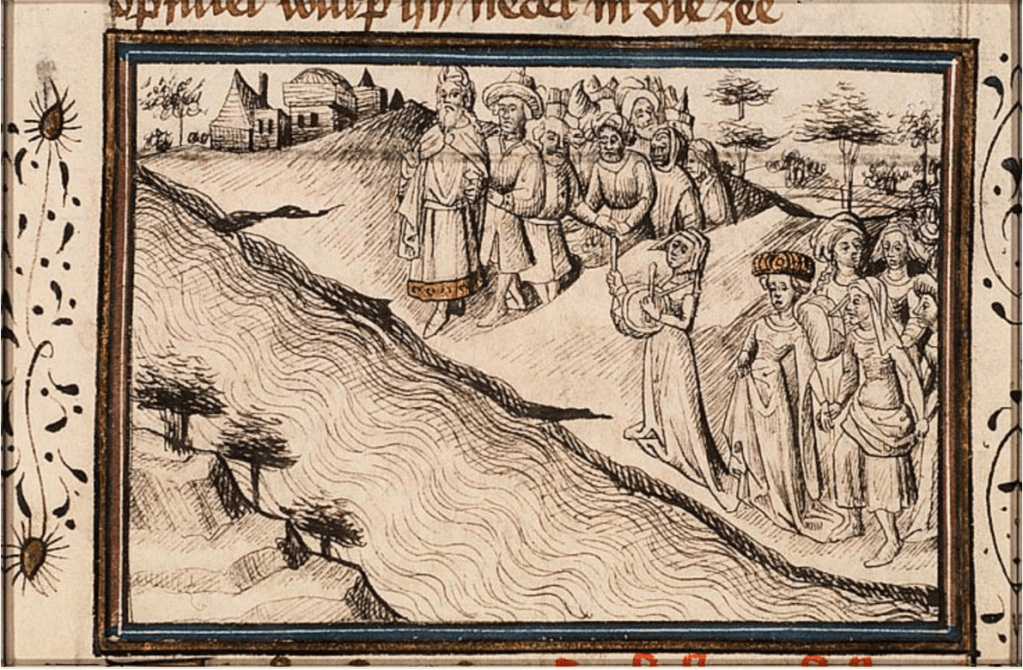
Another interesting but relatively static image is to be found in the Dutch History Bible produced in Utrecht around 1430. Neither the movement nor the expression of the women reveals the overwhelming sensation of a triumph. Miriam is playing a musical instrument so it is safe to assume that the women are dancing. Miriam’s playing lacks gusto; in fact she looks rather dismal. The other women appear to be tired and are none too joyful. And their attire is a little puzzling. Noble ladies dressed in long medieval gowns wearing dignified hats stand hand in hand with shoe less peasants in a setting which bears little resemblance to the Sinai.
Movement abounds in the two versions of the Dance of Miriam shown below. The left painting, attributed to Jan van den Hoecke, painter, designer and principal assistant to Rubens, shows the three women dancing and making music with immense fervor. You can almost feel the euphoria. In the background, between the swirling women and Moses, the drowning Egyptian army can just be seen. On the right is another Flemish painting from the early 17th century. It is attributed to Hans Jordaens III, a Baroque artist known for his many works inspired by the Old Testament. Miriam holding her timbrel high in the air is followed by a lively procession of rejoicing women. A second woman also plays the timbrel and she, together with the other women, appears to joyously tread down the earthen path inspirited by Moses who raises his arms in jubilation.
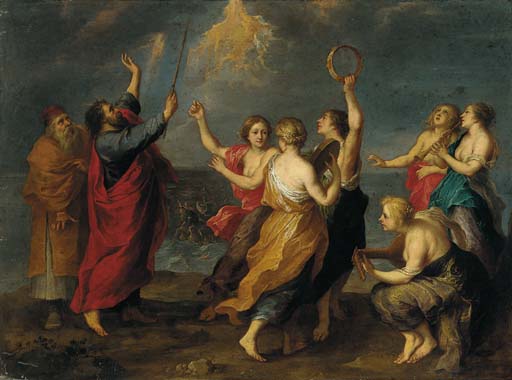
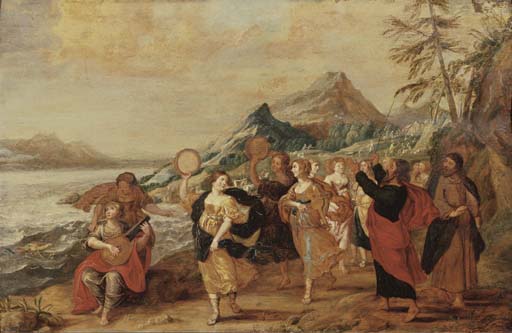
R – attributed to Hans Jordaens III ( Antwerp c. 1595-1643) – The Dance of Miriam
Where Miriam’s dance is one of joy, of liberation, and an inspiration to all worshipers, the dance around the Golden Calf is the exact opposite. This is a dance of condemnation. The scripture is well known; Moses returns from the mountain to see the Israelites dancing around a statue of a golden calf. Moses is incensed by the idolatry and all that he sees. The infamous scene has been a continual source of inspiration not only to the artists of the Low Countries but to artists throughout Europe. Lucas van Leyden, Karel van Mander, Jan Steen, Frans Francken, Pieter Pourbus, Jacob van Oostzanen, and many other artists, engravers and printers have devised their own interpretation.
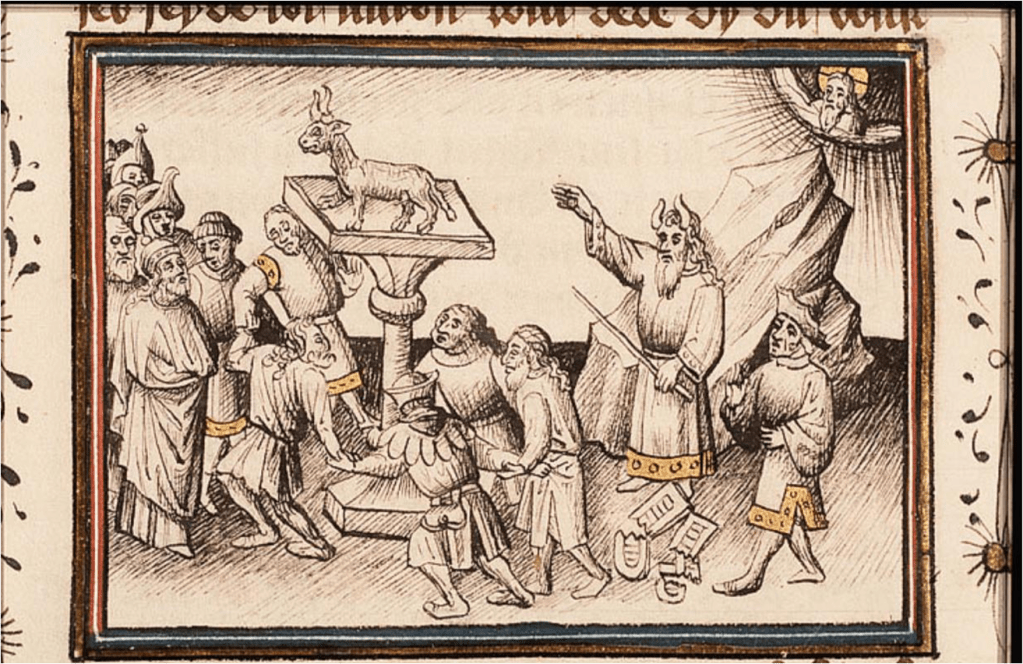
Back to the 15th century. In the Dutch History Bible, the same bible as mentioned above, there is a column miniature showing The Adoration of the Golden Calf. All the elements,the dance, Moses, the broken tablets, the calf, Aaron, the mountain and God peering into the scene, are present is this straightforward drawing. The dance itself is quite tame; just a few men, with their hands partially joined, encircling the calf. They look perplexed seemingly unaware of the impact of their idolatrous actions. The artist appears to struggle to achieve an impression of movement. The direction of the moving feet and the positioning of the bodies is inconsistent. One man moves forward, another sideways and a third is indecisive. Another possible reading is that the men abruptly stopped dancing when Moses smashed the tablets of stone. That might explain the bewildered expression on the left man’s face.
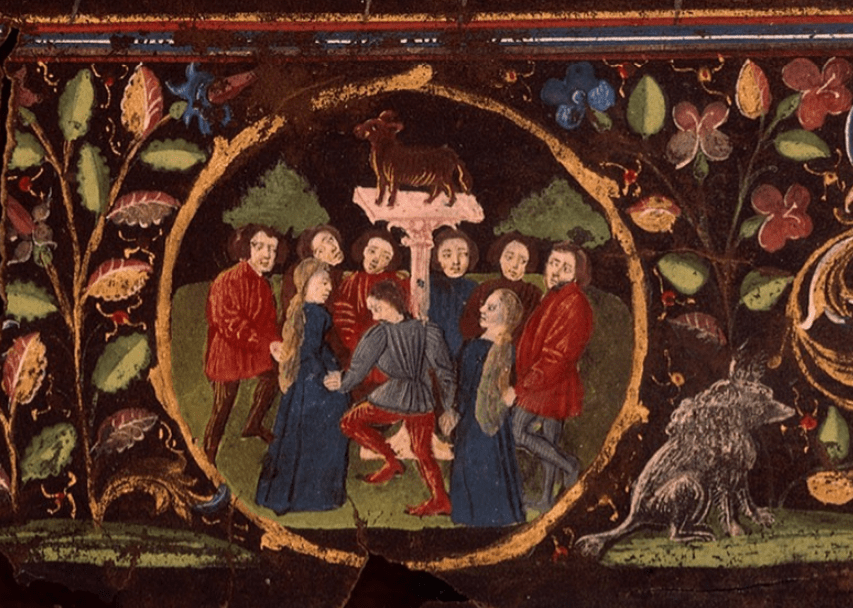
The Bibliothèque nationale de France holds a single leaf, once belonging to a 15th century breviary, made in the Flemish city of Bruges. Two small round miniatures decorate the page; one of Moses on the mountain and the other of the dance round the Golden Calf which is shown below. Seven men en two women, all attired in contemporary dress, circle round the Golden Calf. Even though the representation is relatively stilted the group does appear to move, even to dance. In an attempt to suggest some degree of movement the artist, Maître du Frossart de Philippe de Commynes, has painted the front man with his body facing towards the line of direction. His left leg is lifted as if he is about to skip or hop. The man on the right has also raised his leg and the man on the left looks as if he is midway in performing a step sideways. The group has joined hands and this together with the leg action of the three men, gives the impression that they are moving in a clockwise fashion around the pagan idol.
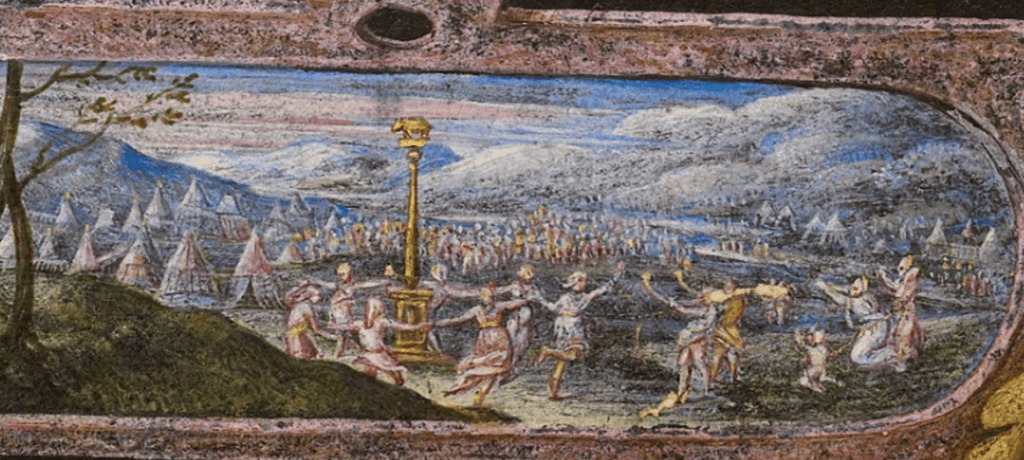
A most extraordinary manuscript, Mira calligraphiae monumenta, was commissioned by the Holy Emperor Ferdinand 1 and later decorated by Joris Hoefnagel. Interspersed between the folios of floral still-life, animals and calligraphy, are a spattering of unforeseen pages. On one of these there is a stunning miniature exhibiting unbridled idolatry and frenzy around the Golden Calf. Compared to Hoefnagel’s usual exquisitely detailed work, as seen in his natural history and floral drawings, this miniature is a rough and sketched; practically an expressionist work. It leaves no doubt about the idolatrous, lewd and pagan display that Moses saw as he descended the mountain.
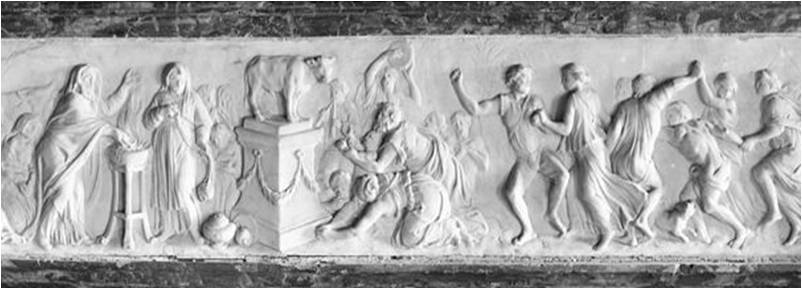
The Royal Palace in Amsterdam was originally the Amsterdam Town Hall. The entire building, both interior and exterior, is decorated with sculptures and paintings alluding to the ideas and ideals of the enlightened burghers of the city. Each room, each chamber has allegorical significance. So too the Magistrates’ Chamber decorated with a very large painting by Ferdinand Bol depicting Moses, holding the tablets of the Ten Commandments, as he descends the mountain. Immediately under this painting there is a fireplace trimmed with a frieze of the Israelites worshiping a false idol. The frieze, created by Flemish sculptor Artus Quellinus, and the painting of Moses form an allegorical unity.
Astonishing how this artist from the Southern Netherlands turned stone into movement. The figures move; every gesture depicts movement. The dancing couple to the right are rowdy. The man’s movements, with both his legs crudely bent, are boorish. The woman’s dancing is gentler. Her drapery swings with her every movement. To the right of them is a group springing and capering under arches formed by lifted arms. There is even a little dog that joins in the boisterous movement. It is hard to envisage a stronger contrast between the hush on the left side of the frieze and the rollicking on the right side. And just behind the group kneeling in adoration there is a musician playing the pan flute, behind whom a woman dances vigorously with a tambourine. Perhaps, not so long ago, she is one of the women who having crossed the Red Sea danced in jubilation following Miriam.


 DANCE IMAGES IN THE ART OF THE NETHERLANDS