The margins of early illuminated manuscripts are occupied by a great variety of musicians and to lesser extent dancers. Dancers and musicians are recurring motifs common to manuscripts from various centres including Paris, England and the Low Countries. In this post I will be looking at manuscripts produced in the Low Countries showing dancers together with musicians decorating the ends of foliage, vines, tendrils and line extensions.
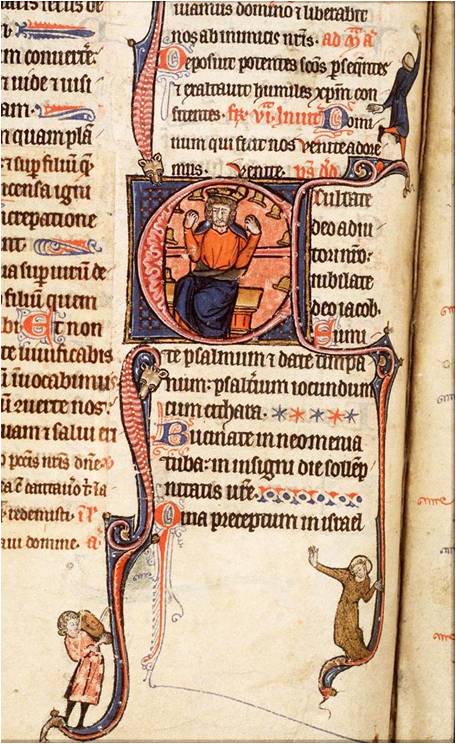
The above illustration shows a leaf from a 13th century breviary, made for the personal use of a Dominican friar. This leaf features two dancers, a musician and a historiated initial showing King David playing bells. It is very unusual to be able to credit a 13th century manuscript to a specific artist, but this breviary, housed at the National Library of the Netherlands, can be attributed to the Master of the Bute Psalter. Little is known about this artist except that he worked in prosperous cities in the border region of France and Flanders.
The Master of Bute Psalter is noted for his basic outlined figures. The first illustration, accompanying the text to Psalm 80 (Vulgate edition), shows the two dancers and musician resting on decorated bars, all extending from a historiated initial. In general, marginalia do not necessarily refer to the text or to the miniature but in this particular example the artist alludes to the text of the Psalm which invites the Israelite’s to ‘ sing aloud’ and make ‘a joyful noise’ on their timbrels and harps.
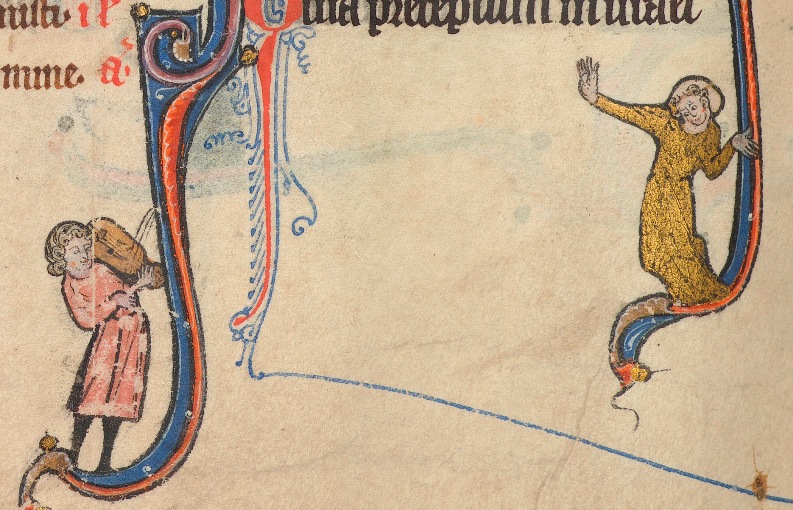
Taking a closer look at the musician and dancer at the bottom of the page (bas-de- page) the liveliness and interplay of these two figures becomes obvious. The dancer, balancing on the curve of the extension, approaches the musician with a very friendly demeanour. Her hips are thrust forward, her dress floats backwards, her arms flung open welcoming both music and musician. The Master of the Bute Psalter may have been known for his plain linear style but unquestionably draws friendly expressive faces. Her smile is directed at the musician who in turn reciprocates with an equally friendly response.
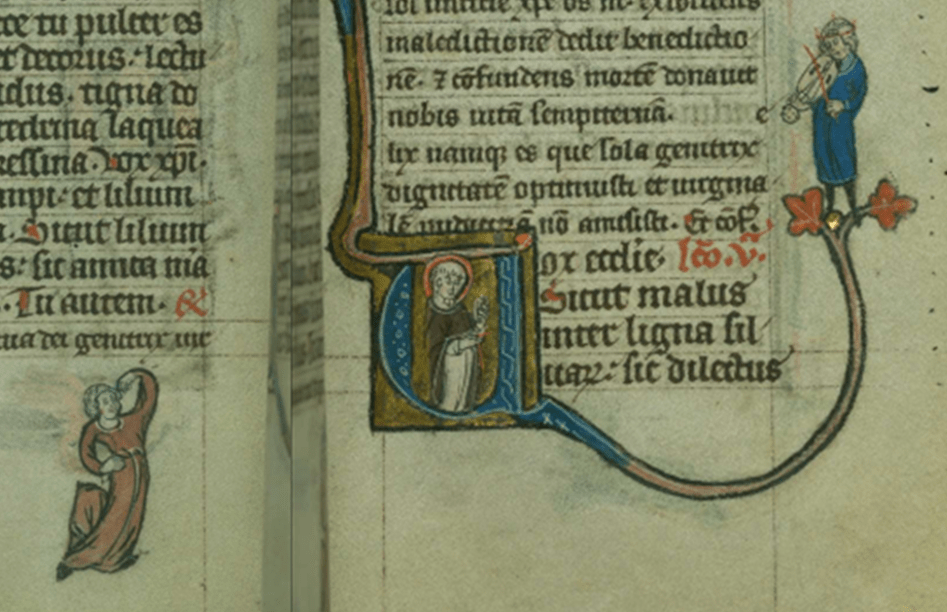
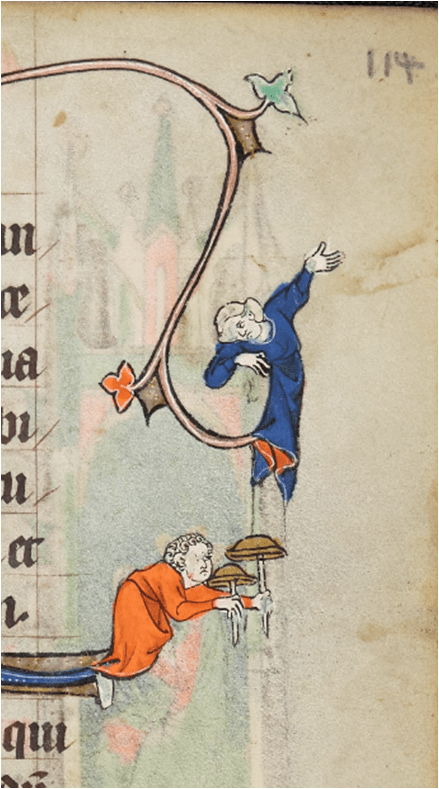
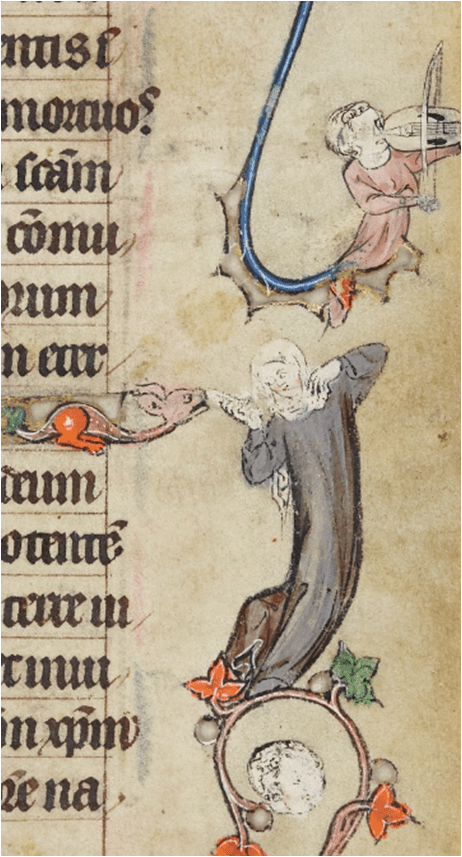
The Walters Art Museum houses an early 14th century Book of Hours that contains a rather special dance scene integrating the secular with the devout. This manuscript, Ms. W. 37, was in all probability made for a Beguine in the Liege area and is only 6.9 cm. wide and 9.1 cm high. On each page of this tiny manuscript the artist has not only drawn initials and miniatures but also innumerable drolleries. The dance scene, keeping in mind that this is a devotional manuscript, is rather unconventional. On the left folio the dancer tilts her hips gently forward, her right hand placed securely at her waist and looks over the centre fold at the musician standing on a line extension which stems directly from an initial inhabited by a monk. The musician, playing what looks like a vielle, acknowledges her attention in this undisguised courting scene. And in between the two worldly admirers the reclusive monk is left in a slightly embarrassing situation.
The two images below come from an elaborately decorated manuscript, B-11-22, held at Trinity College in Cambridge. The left image shows two half figures; the dancer blooming at the end of the tendril and the musician as a decorative end to a line extension. Half-figures, be it dancers, musicians, dragons, animals or grotesques were a very popular embellishing device. The image on the right shows the dancer suspended in an exaggerated curve which spirals back towards an amusing hybrid figure. One level above her is a musician, another half-figure, perched on an extension playing a stringed instrument to his heart’s content.
R – Trinity College B-11-22 f.150 r – Book of Hours Flanders c. 1300 – detail
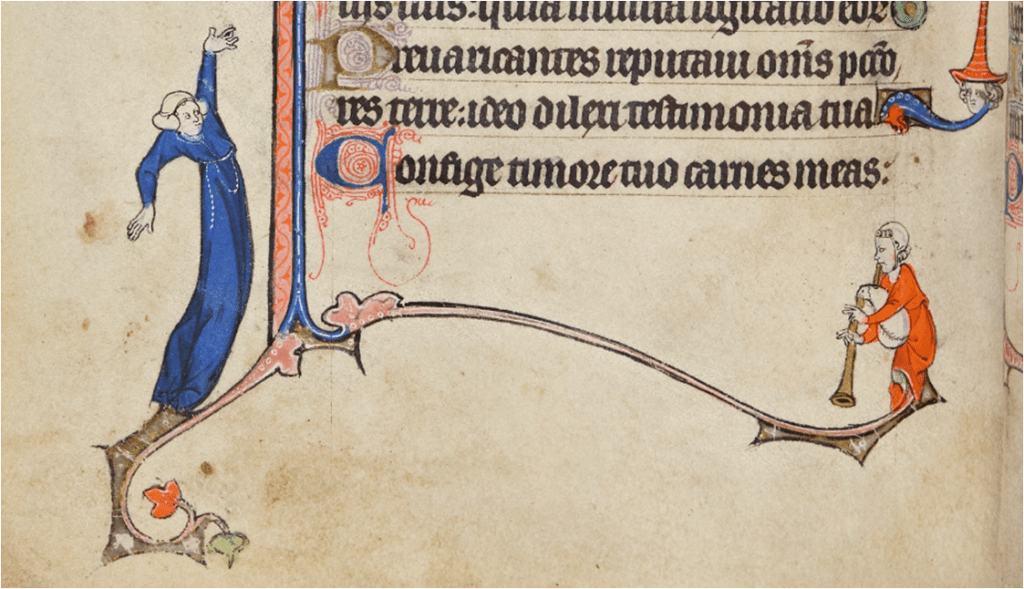
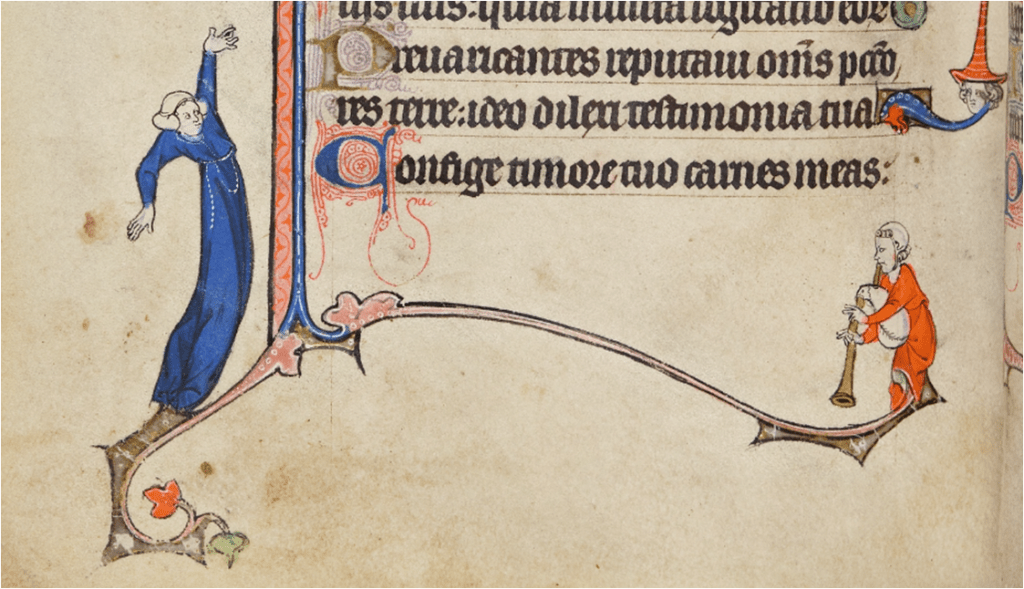
The illustration below shows yet another dancer poised in an excessive curve. Her high shoulders, tense hands and awkward expression betray how unpractical this pose is. Perhaps the artist wished to show the dancer moving in a particular direction. Whatever his intention the dancer appears stiff and graceless. The pose seems even more unstable because the dancer is disproportionately tall. The artist effectively juxtaposes her against the short musician on the opposite side of the vine who appears to have no trouble playing his trumpet whilst keeping his balance.
To conclude; two contrasting images of dancers standing on an extension. On the left is a detailed architectural setting enclosing a miniature of the Annunciation. A dancer and musician, situated in the border, perform at this memorable event. The dancer is elegant. She moves naturally demonstrating great ease. Her musician appears to be just as care-free as he boldly blows his trumpet. There is an interesting aspect here that needs mentioning. The dancer, though placed outside of the miniature, is practically on the same height as the Virgin Mary and the angel Gabriel. This specific positioning raises questions when one takes into account that dance was considered illicit in intellectual circles. Is the positioning a question of artistic lay-out, practical distribution of space or was the artist perhaps making a moralistic point?
Moralism has nothing to do with the next image. The elegant dancer in the Heures d’Isabelle de Luxembourg emerges from within of a vine, her back facing the reader. She inclines her hips sensually in a gentle curve, reaching upwards as if welcoming a sunny new day. She dances harmoniously almost serene. All appears to be ideal until you cast your eyes on the musician. What is he playing? Is he playing a beautiful tune for her to dance to? What does his music actually sound like? I can imagine many different sounds but certainly not the musical sound you would expect from a vielle. These figures act out a parody; mocking musical instruments. You have noticed; the musician is playing his instrument with a rake!
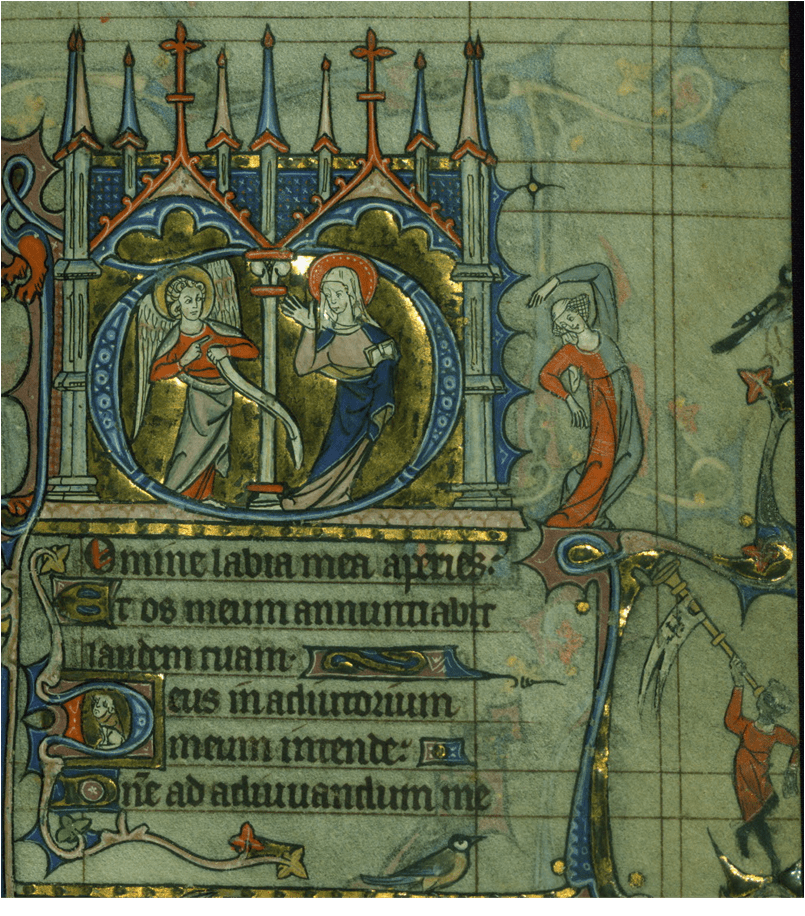
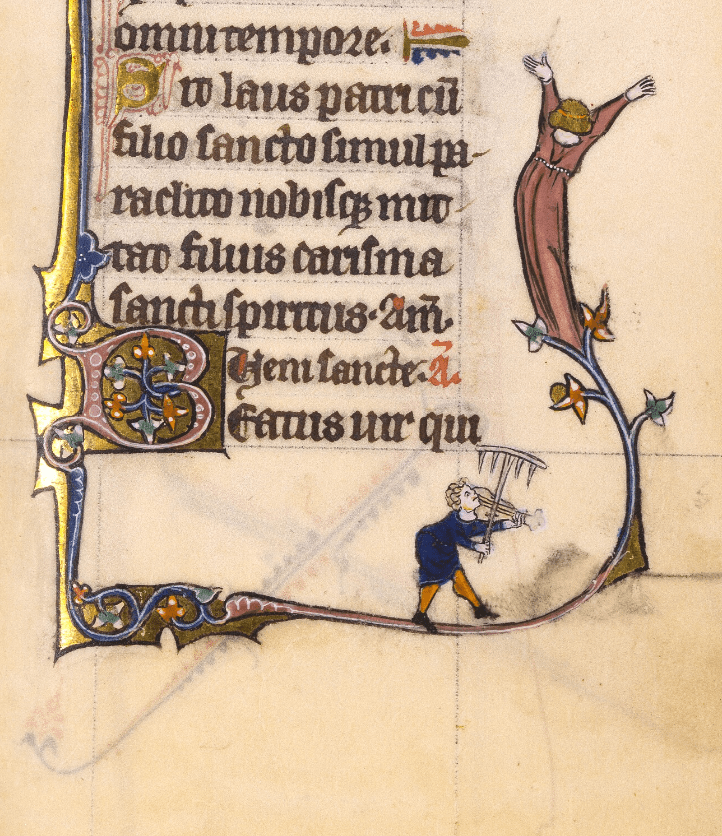
R – Bib. Chateau Chantilly Ms 0062 f. 118 – Heures d’Isabelle de Luxembourg – French Flanders, early 14th c. – detail
Walters Art Museum Ms.W. 37 is a gem. Follow this link.

 DANCE IMAGES IN THE ART OF THE NETHERLANDS