As a young aspiring dancer I loved to ponder over the magnificent paintings created by Edgar Degas. How his ballerinas inspired me. The atmosphere of the Paris Opera, the beautiful tutus, and the hard working dancers never failed to trigger my imagination. As the years past, I retained my love of dance, of Degas, of art, and developed an interest in knowing more about the cross fertilisation between art and dance.
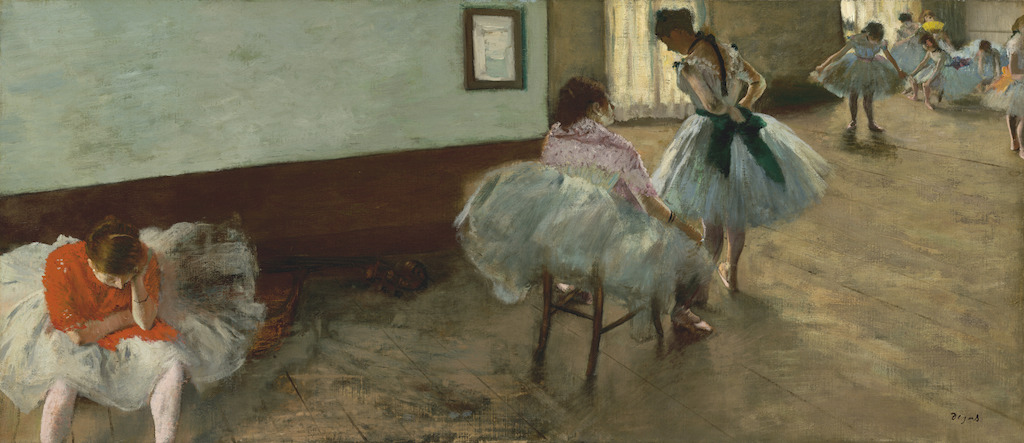
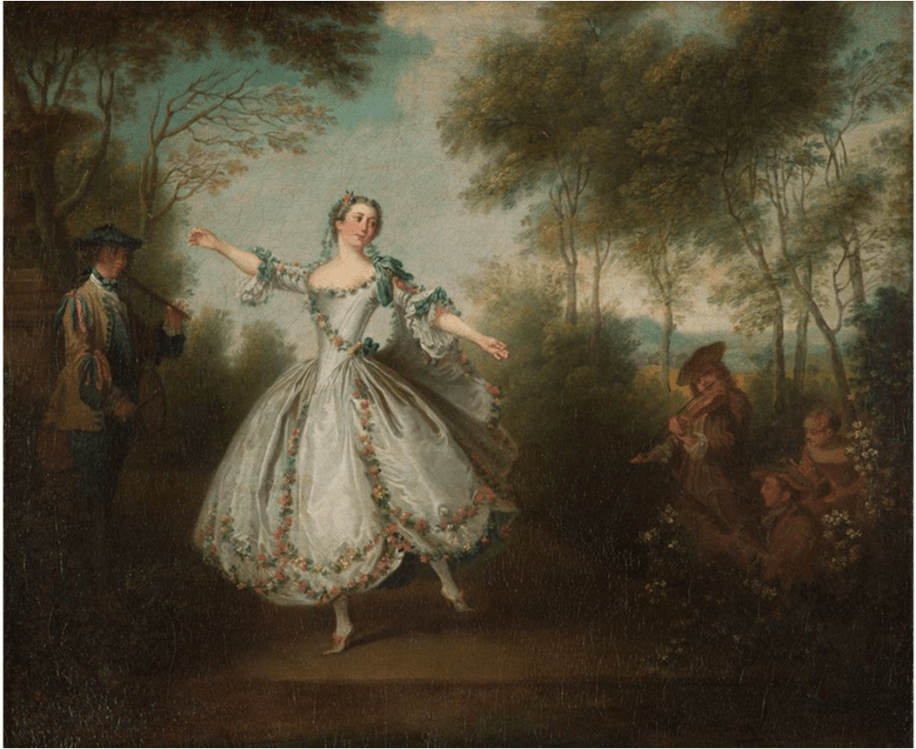
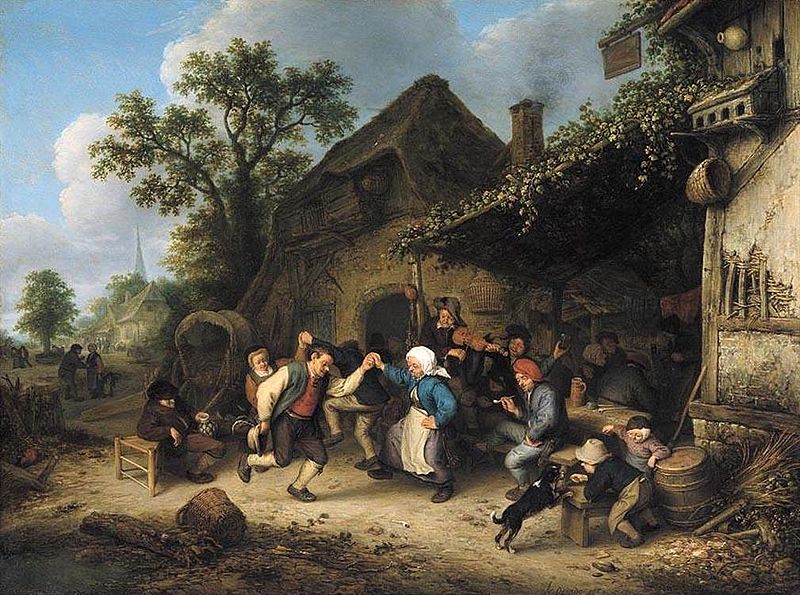
Dance is an international language. Throughout the ages artists from all countries and cultures have been inspired by dance and dancers. In the early 15th century Fra Angelico painted dancing angels in his Last Judgement and not much later Botticelli’s achieved heavenly sublimity in his Mystic Nativity with angels floating in a celestial circle. About the same time Bruegel the Elder’s fun-loving peasants heralded the common people onto the painter’s palette. Two centuries later Nicolas Lancret painted the 18th century ballerina Marie Camargo. Many a cookie jar has been decorated with that image of Camargo. The same applies to the popular dance paintings by the French artists August Renoir and Henri Toulouse-Lautrec. That another great innovator Henri Matisse astonished the art world with La Danse, a large painting where five figures join in a primitive dance. Even closer to our own time are Fernando Botero’s rounded figures of dancing couples that never fail to raise a smile. And then there is Keith Haring who more than other artist placed the New York dance scene in the public eye. With a few basic lines he thrusts us into the world of hip hop and break dancing.
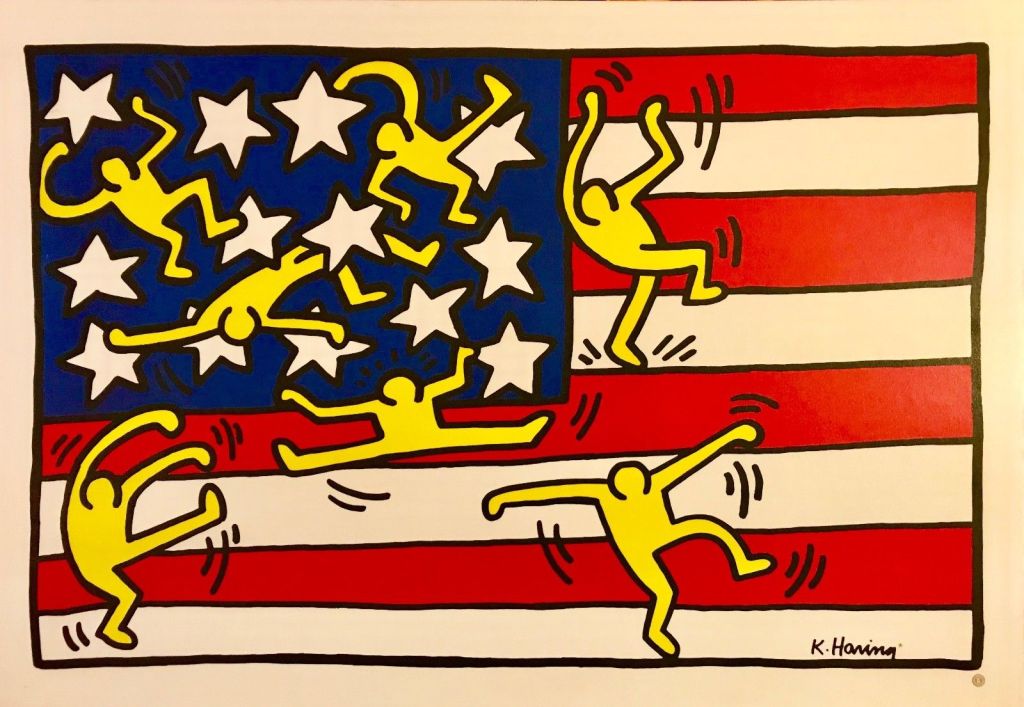
R – Keith Haring – New York City Ballet 40th anniversary/ American Music Festival (1988) ; image created for use as poster, program cover, stage projection & T-shirt
The above mentioned artists are but a few of the very many who have either been inspired by dance, have made designs for dance performances or have collaborated with choreographers. Much has been written about the collaboration between art and dance. These essays and books, however, barely touch on the paintings, sculptures, drawings and photographs created by the artists of The Netherlands. I intend to explore this field. Looking at art in The Netherlands from the 14th century to the present day, I became aware of the great diversity of dance imagery employed by the artists of The Low Countries. In this blog I wish to share this astonishing journey with you.
Before I start I need to clarify a few terms. I use the words dance and dancers in the broadest possible sense. Dance and dancers can refer to dancing in the streets, courtiers performing in a great hall, boisterous peasants enjoying themselves to the sound of a fiddle, villagers celebrating a religious holiday, Salomé dancing at Herod’s feast, dance in a music hall, theatrical dance, the more abstract figures like those from the artists of the Stijl and any other form of rhythmical movement.
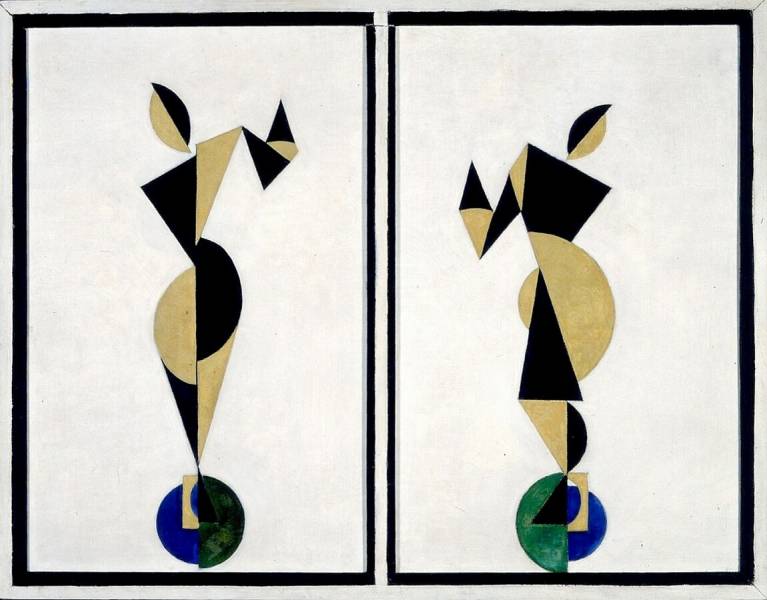
L – Theo van Doesburg – Dancers (1916) – Kröller Müller Museum , The Netherlands
I also need to clarify the name ‘The Netherlands’. Historically the area once known as ‘The Netherlands’ covered a much larger expanse than the country we know today as The Netherlands. In the Middle-Ages and most of the 16th and 17th centuries The Netherlands comprised of a group of countries, primarily present day Netherlands, Belgium & parts of Northern France. Their borders shifted constantly as conquerors won yet another battle or aristocracy arranged another profitable marriage. The Dukes of Burgundy presided over the entire area in the late middle-ages and early renaissance. Later this area came under the jurisdiction of Spain which resulted in the Northern Netherlands and the Southern Netherlands. The Belgian Revolution of 1830 lead to the separation of the southern provinces from the northern provinces. The southern provinces became the constitutional monarchy, Belgium, with Leopold 1 as the first monarch.
I use the term ‘The Netherlands’ therefore to indicate The Low Countries (‘nether’ or as the Dutch write ‘neder’ literally means low). I will be discussing artists who worked in The Low Countries. This explains why I will be writing about artists who once lived and worked outside of present day Netherlands. Bruegel the Elder, for example, worked in Flanders which during his lifetime was part of The Southern Netherlands. From 1830 forward I will concentrate solely on the country known to us today as The Netherlands.
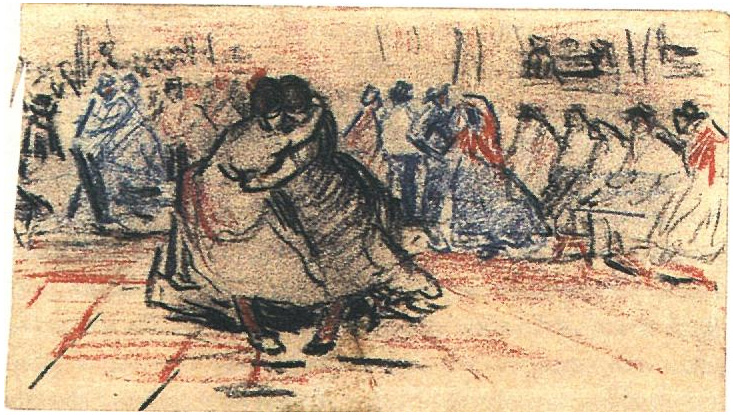
Enough introductions. It is time to start. Dance images first appeared in the both religious and secular illustrated manuscripts during the Middle-Ages and Renaissance. This will be our starting point. From there it is only a small step Hieronymus Bosch (1450 – 1515) and his strange, nightmarish hybrids which dwell on his unnerving panels. Time and again he uses dance figures to emphasis his prophetic message. Rembrandt painted theatrical scenes but, to my knowledge, he never painted dance scenes. His contemporary, Jan Steen made up for that with panels of celebrating village people dancing in taverns or in a village square. Fast forward to the 19th century to the work of Vincent van Gogh. Amsterdam has a museum totally devoted to his work. His Potato Eaters, Sun Flowers and self portraits need no introduction but his dance paintings do. Besides his Ballroom at Arles (1888) Van Gogh sketched several drawings like the one shown below. In Couple Dancing (1885) you can practically sense the motion of the two women as they swirl around the dance floor.
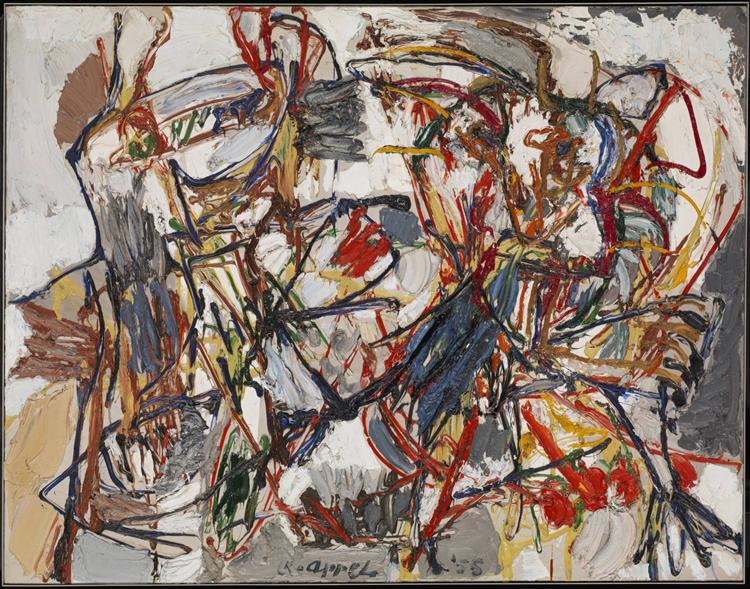
The 20th century ushered in a surge of stunning works. Early in the century Kees van Dongen and Jan Sluijters fascinated by the effects of electric light and exuberant Parisian night clubs painted expressionistic panels of dancers, musicians, acrobats and theatrical life. Theo van Doesburg and Piet Mondrian, who was also a passionate dancer, distilled dancers into abstract shapes or precisely organized coloured lines. Cobra artist Karel Appel painted a few, if not readily recognizable, dance paintings. He also designed theatrical productions. And this is just the tip of the iceberg.
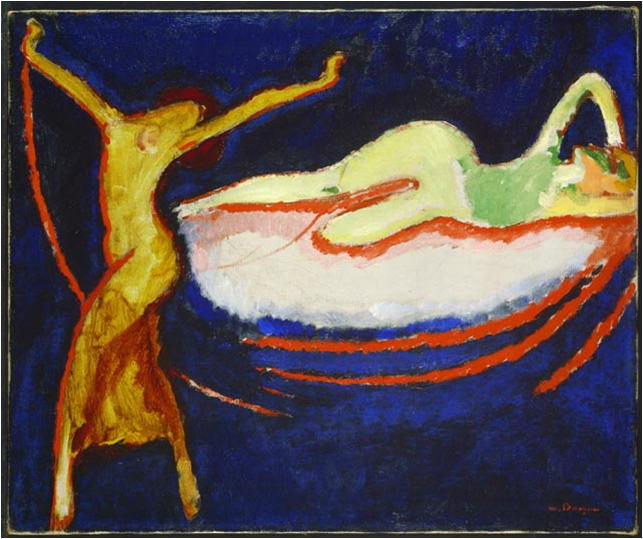
Depicting the Russian ballerinas Anna Pavlova and Ida Rubinstein dancing ‘Cléopâtre’
R – Karel Appel – Amorous Dance (1955) – Tate Modern, London

 DANCE IMAGES IN THE ART OF THE NETHERLANDS